
L.
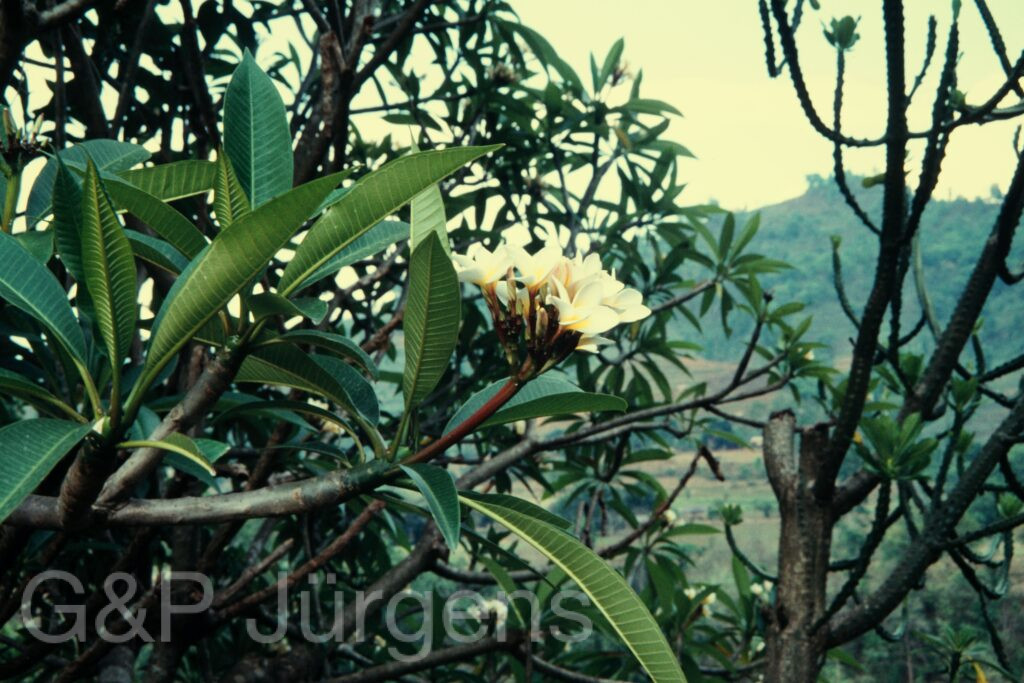
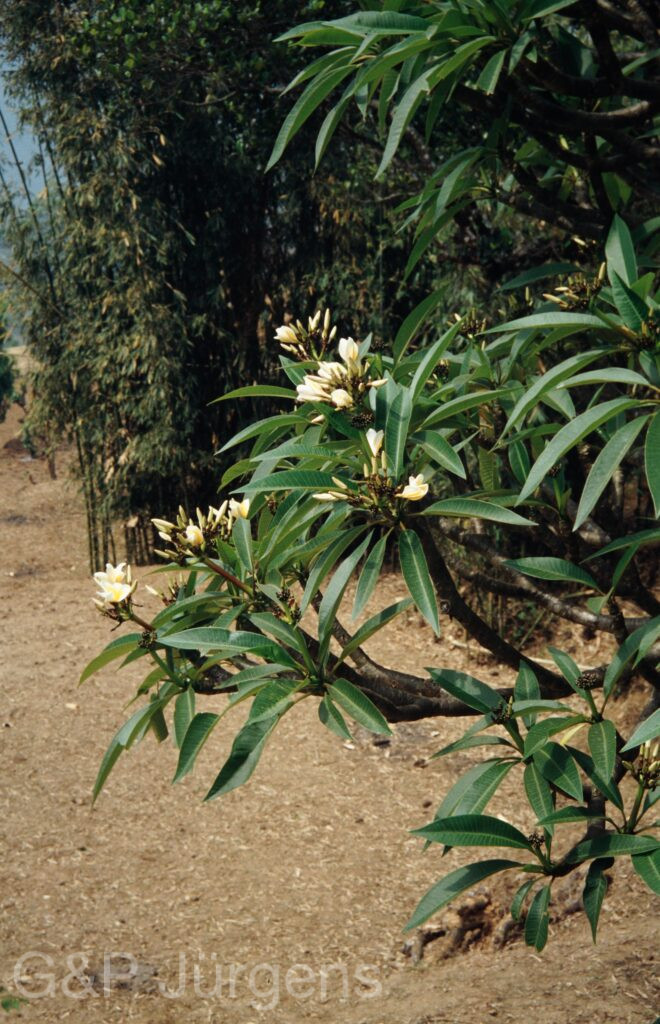
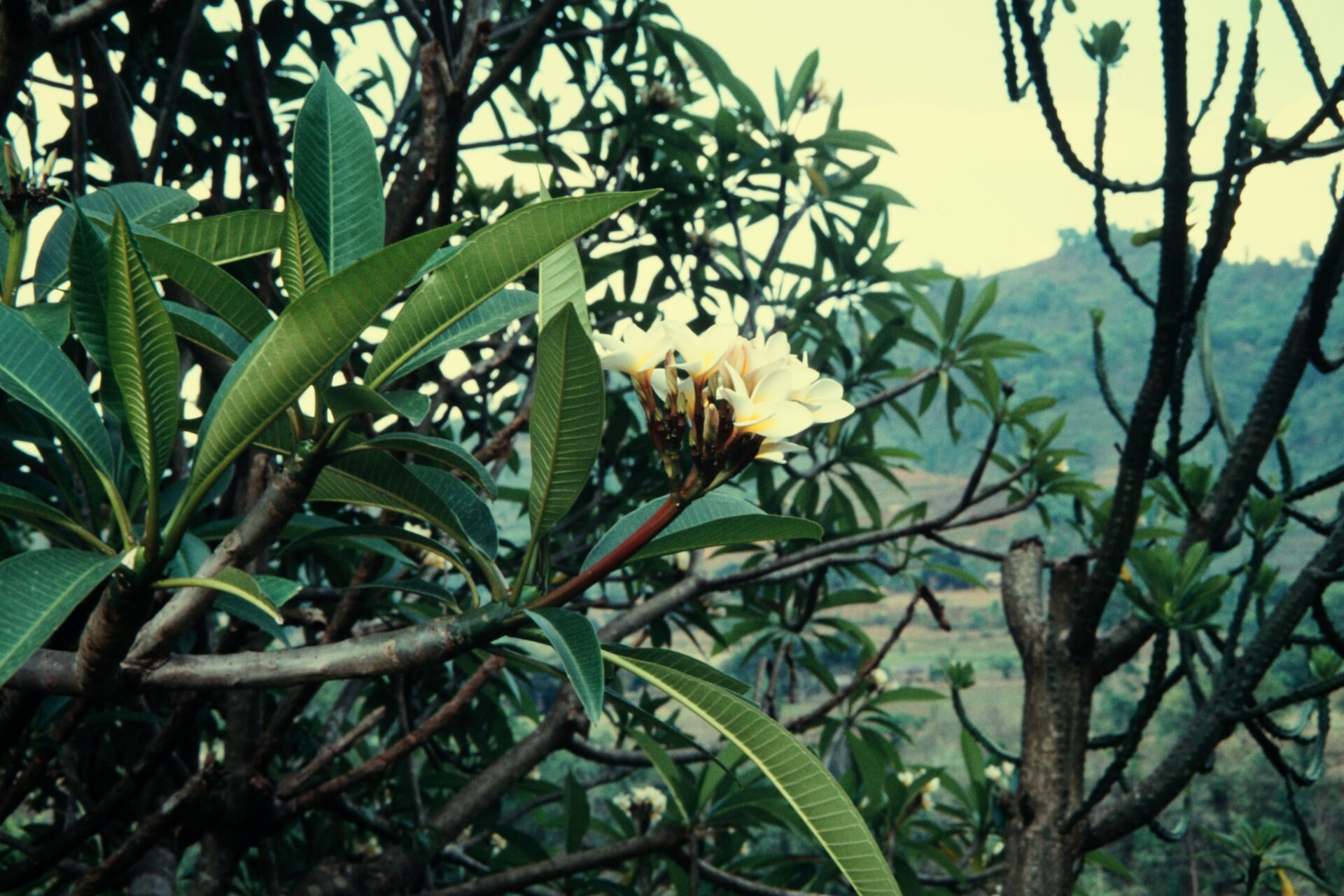
1000m April
Description
Plumeria rubra, the red frangipani, is a small tree native to Mexico and Central America but now pantropical through cultivation, a spread vividly reflected in its GBIF record of over 11,600 occurrences spanning Mexico, Guatemala, Costa Rica, Panama, Brazil, Colombia, Ecuador, Peru, the United States, India, South Africa, Indonesia, China, French Polynesia and many more. In the Himalayan foothills it is an introduced ornamental and temple tree rather than a wild element; the images from the Sabha-Khola valley (550 m, May) and the Simbhuwa Kola in eastern Nepal (1000 m, April) document it in the warm, frost-free lowland and lower hill zone where it is widely planted around dwellings, gardens and shrines. It tolerates seasonal drought, thriving in open, sunny, well-drained sites and flowering through the warm pre-monsoon and monsoon months.
It is a deciduous tree to about 5-8 m with a spreading crown of stout, blunt, sparingly branched stems exuding copious milky latex when cut. The large, alternate leaves are clustered toward the branch tips, oblong to elliptic-lanceolate, leathery, with prominent pinnate lateral veins joined by a marginal collecting vein. The strongly fragrant flowers are borne in terminal cymes; each has a salverform corolla with five overlapping, asymmetric lobes, typically white to yellow with a yellow eye in many forms but ranging to pink and deep red in the species and its cultivars. The fruit is a pair of divergent, cylindrical follicles releasing numerous winged seeds.
Plumeria belongs to the Apocynaceae subfamily Rauvolfioideae and comprises several New World species, of which P. rubra is the most variable and most widely grown, hybridising freely in cultivation. Its latex contains the iridoid glycoside plumieride and related compounds, and the plant carries deep cultural significance across South and Southeast Asia for use in offerings and garlands. Though of conservation concern nowhere because of its vast cultivated range, in the Himalaya it persists entirely as a human-introduced ornamental and has not naturalised into native forest.
Author: L. · Sources: POWO (Kew), GBIF, Flora of China Vol. 16, Flora of Nepal, Woodson's revision of Plumeria (Apocynaceae of the New World)