Tag:

Subtropical (<1500 m)

(L.) Medik.

Bhutan2012 1060
Bhutan Anthso 950m, October

Description

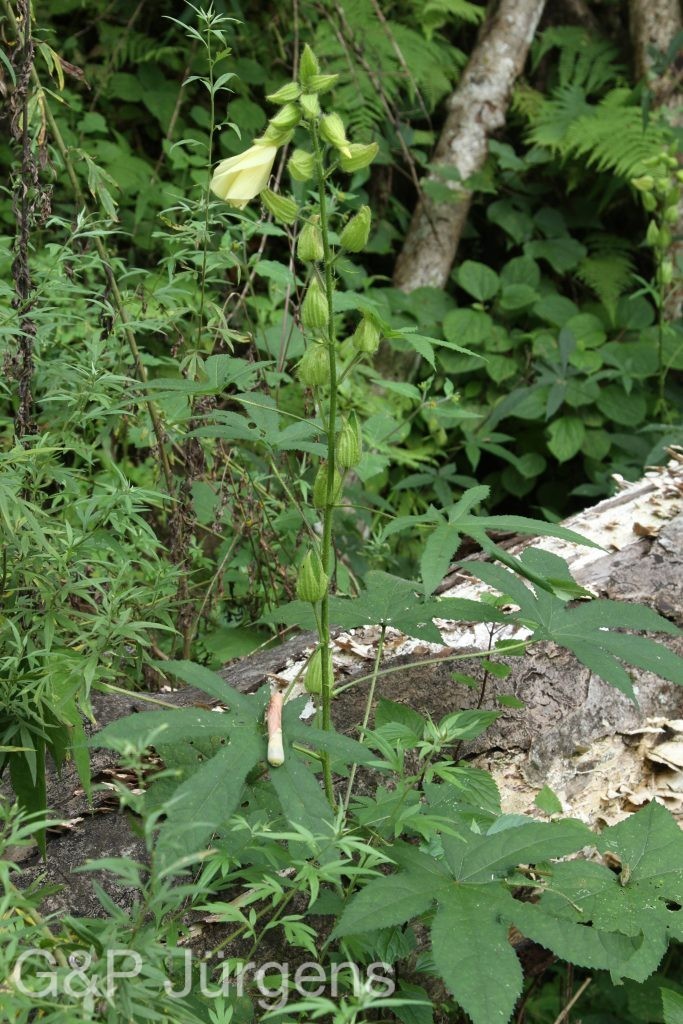
Abelmoschus manihot is a tall, robust herb of warm-temperate and subtropical Asia, now pantropically distributed through long cultivation. GBIF records span China, India, Nepal, Japan, Korea and much of Southeast Asia, together with Australia, Pacific islands and the Americas, reflecting both its native Asian range and widespread introduction. In the Himalaya it occupies forest margins, scrub, roadsides, terrace banks and disturbed ground in the foothills and lower montane zone, generally below about 1600 m. The photographed plant grows at Anthso in Bhutan at around 950 m, flowering in October. With more than 3200 occurrences it is among the better-documented Asian mallows.

It is an erect, hispid annual or short-lived perennial reaching 1 to 2 m, the stems bristly with stiff hairs. The leaves are large, long-petiolate, palmately 3- to 7-lobed or sometimes nearly entire, the lobes coarsely toothed, and bear conspicuous narrow segments in the epicalyx. The flowers are large and showy, solitary in the upper leaf axils; the epicalyx comprises several narrow bractlets and the spathaceous calyx splits down one side and falls with the corolla. The five broadly obovate petals are pale to deep yellow with a dark purple-maroon centre. The numerous stamens are united into a staminal column typical of Malvaceae. The fruit is an oblong, hispid loculicidal capsule containing many reniform seeds.

Long cultivated, the species is valued as a leafy vegetable, for its mucilaginous tissues used in papermaking and as a sizing agent, and in traditional medicine; ornamental and food forms exist. Its wide tolerance of disturbance and human dispersal make it abundant, and it is of least conservation concern across its range.

Author: (L.) Medik. · Sources: POWO (Kew), GBIF, Flora of China, Flora of Bhutan, Borssum Waalkes Malesian Malvaceae revision
Abroma augustum

by GP Jürgens

(L.) L.f.

Nepal 95 31 P53 ergebnis
Nepal Morandi-Khola 670m Octobre

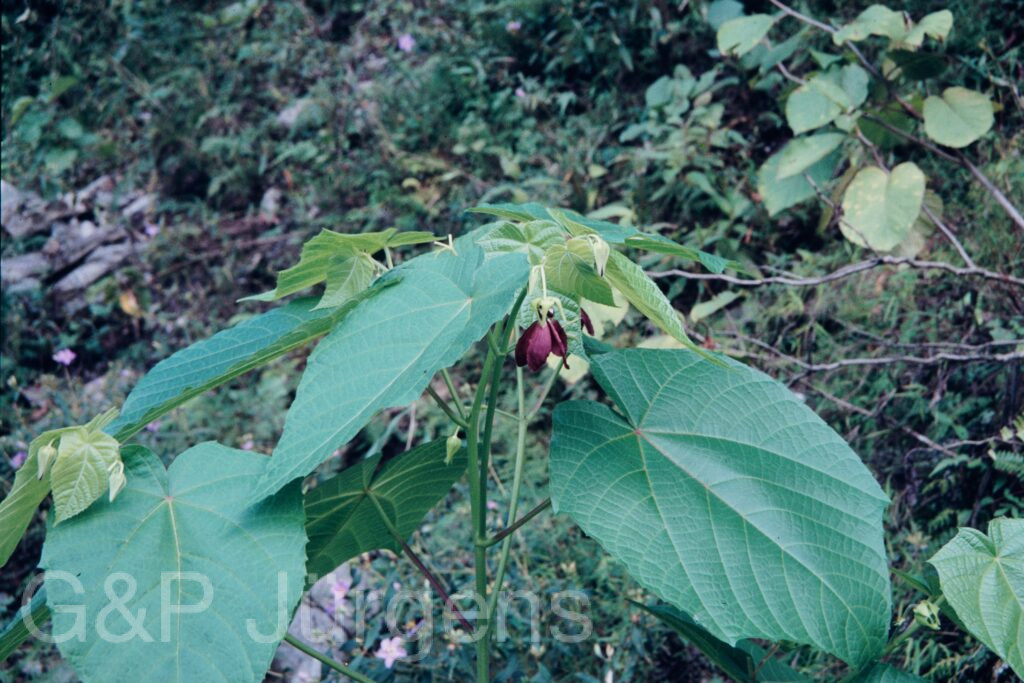
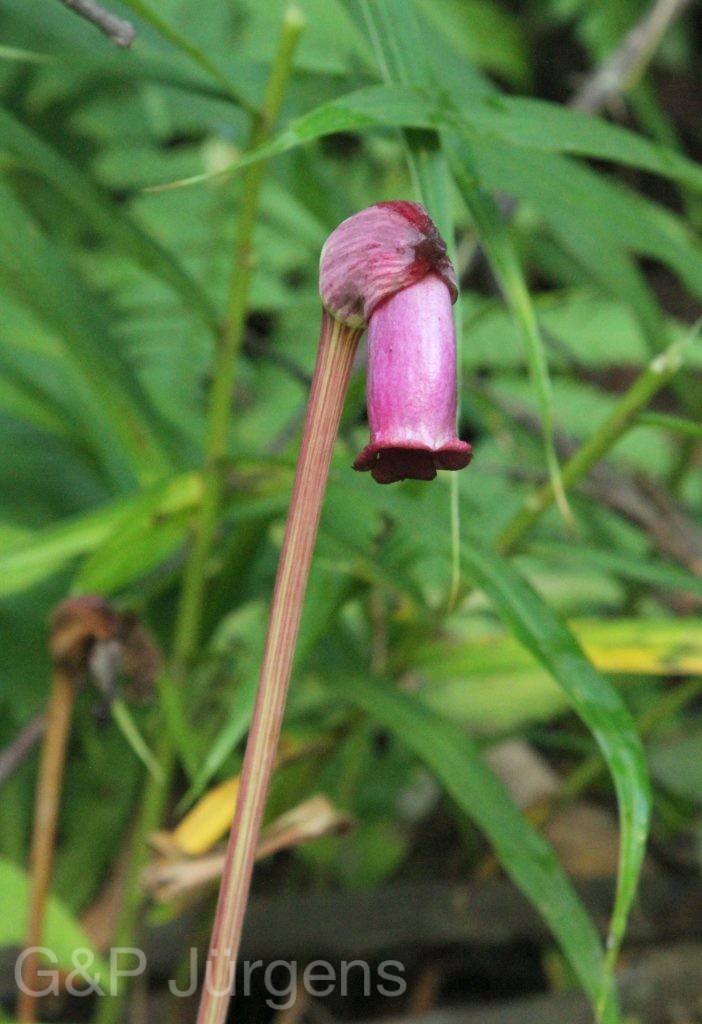
Description

Abroma augustum (L.) L.f. is a soft-wooded shrub or small tree of tropical and subtropical Asia, ranging from India, Nepal and Myanmar through southern China, Indochina and Malesia to New Guinea and Australia, and widely introduced elsewhere; GBIF documents around 2,078 occurrences across this broad Indo-Pacific span. It favours moist lowland forest margins, riverbanks, secondary thickets and disturbed ground at low elevations. The photographed specimen comes from the Morandi-Khola in lowland Nepal at about 670 m, flowering in October, consistent with its preference for warm, humid foothill habitats.

It is a fast-growing shrub or small tree 2-4 m tall, the young stems, petioles and inflorescence clothed in stellate and stinging-irritant hairs. The leaves are alternate, large, often somewhat dimorphic, the lower broadly ovate-cordate and shallowly 3-5 lobed, the upper smaller and oblong, all with palmate venation. The flowers are showy, pendent and about 3-5 cm across, with five reflexed dark maroon to purplish petals, each bearing a concave nectariferous basal scale, and a staminal tube enclosing five fertile stamens alternating with broad staminodes. The fruit is a distinctive 5-winged, truncate, membranous capsule with longitudinal angles, opening to release numerous small seeds embedded in irritant hairs.

Now placed in Malvaceae (subfam. Byttnerioideae, formerly the segregate Sterculiaceae), Abroma is closely allied to Theobroma and Guazuma. The stem bark yields a strong bast fibre ("devil's cotton") used for cordage, and the bark features in South Asian ethnomedicine as an emmenagogue. Widespread, weedy and often cultivated, the species is of no conservation concern, its success owing to rapid growth, copious wind- and water-dispersed seed, and tolerance of disturbance.

Author: (L.) L.f. · Sources: POWO (Kew), GBIF, Flora of China, Flora of Nepal, Flora Malesiana, Wilkie et al. phylogeny of Byttnerioideae (Malvaceae), Masters treatment of Sterculiaceae in Flora of British India

L.

Bhutan2012 456
Bhutan Wangdi 2500m, September
Nepal 95 63 P106 ergebnis
Nepal below Barphak 1400m October

Description

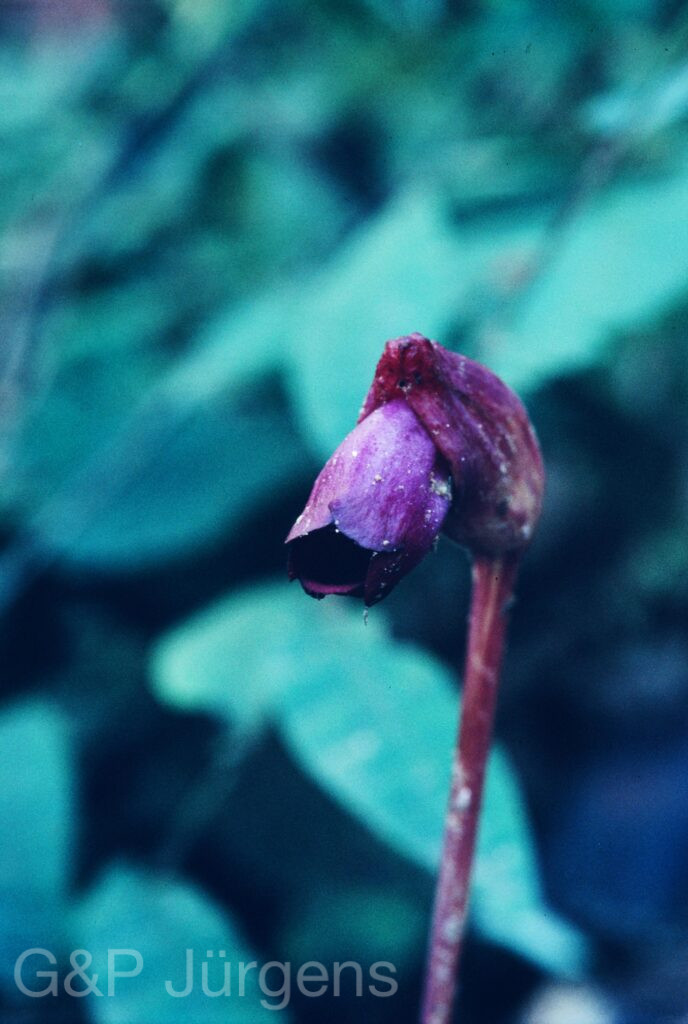
Aeginetia indica is a widespread holoparasitic herb of tropical and subtropical Asia, recorded from Japan, China, Taiwan, Korea and across South and Southeast Asia including India, Nepal, Bhutan, Sri Lanka, Myanmar, Thailand, the Malesian region and beyond; with about 3514 GBIF records it is by far the most frequently collected species in this group. It is a root parasite of grasses and other monocots, occurring in moist forest, grassland, scrub, plantations and field margins from the lowlands up into the lower hills, generally below about 2500 m. The plants illustrated, from Wangdi in Bhutan at around 2500 m in September and below Barphak in Nepal at about 1400 m in October, span this elevational range.

Lacking chlorophyll, the plant is reduced to fleshy, scale-like leaves on a very short underground stem attached to the host roots. The conspicuous part is the flower, borne singly atop a long, stout, purplish or yellowish scape; it is a large, tubular, somewhat curved corolla coloured deep purple to magenta with a paler throat, the five lobes short and the mouth oblique, subtended by a boat-shaped spathe-like calyx. There are four stamens and a superior ovary that ripens into a many-seeded capsule shedding the dust-like seeds characteristic of parasitic plants.

Now placed in the broadened Orobanchaceae following the merger of the old Scrophulariaceae-derived parasites, Aeginetia is an Asian genus of obligate root parasites, and A. indica is notable as a parasite of sugarcane and other grasses, where it can be a minor agricultural pest. Its enormous seed output and broad host and geographic range make it ecologically successful and of no conservation concern. The species is also used in traditional medicine across parts of its range.

Author: L. · Sources: POWO (Kew), GBIF, Flora of China, Flora of Bhutan, Annotated Checklist of the Flowering Plants of Nepal, Nickrent Parasitic Plant Genera of the World

Aegle marmelos

by GP Jürgens

(L.) Corrêa

Nepal 97 557 P1087
Nepal Sabha-Khola 550m May

Description

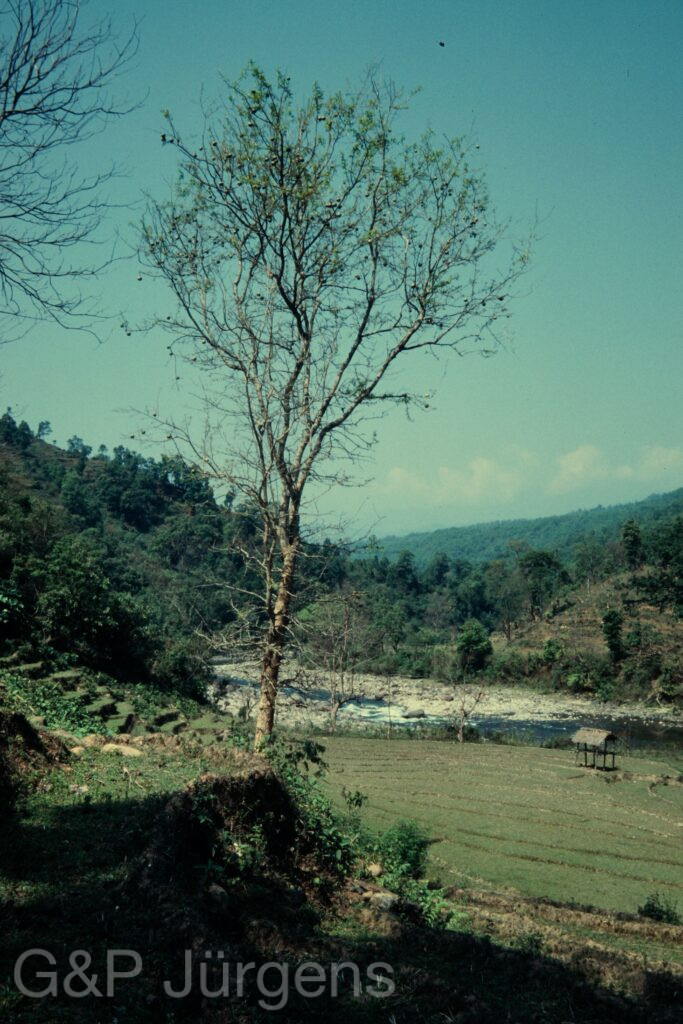
Aegle marmelos (L.) Corrêa, the bael or wood-apple, is a deciduous tree of the Rutaceae native to the Indian subcontinent and Southeast Asia and now widely cultivated and naturalised across the tropics. Its very numerous records center on India, Nepal, Sri Lanka, Bangladesh, Bhutan, Thailand, Indochina, southern China and Malesia, with introductions into the Americas, Australia and elsewhere. The species grows in dry deciduous forest, scrub and on cultivated and temple ground, tolerating poor, alkaline and seasonally arid soils. It is essentially a lowland and foothill plant, and the tree photographed along the Sabha-Khola in Nepal at 550 m in May represents the warm sub-Himalayan tract where it flowers with the pre-monsoon heat.

The tree reaches up to about 10–15 m, with a spreading crown and armed branches bearing stout, straight, axillary spines. The leaves are alternate and trifoliolate (rarely with five leaflets), the leaflets ovate-lanceolate, crenulate and dotted with translucent aromatic oil glands. The flowers are greenish-white, fragrant, bisexual, borne in short axillary panicles, with four to five petals and numerous stamens. The fruit is a large, globose, woody-rinded amphisarca, grey-green ripening to yellowish, the hard shell enclosing a sweet, aromatic, mucilaginous orange pulp with numerous wool-coated seeds.

Monotypic or nearly so within Aegle, the species is of exceptional cultural and economic importance: it is sacred in Hindu tradition, associated with Shiva, and is a long-established medicinal plant, the unripe fruit valued in the treatment of dysentery and digestive disorders. The pulp is consumed fresh and in beverages. Owing to its hardiness and usefulness it is extensively planted, and it is nowhere considered threatened, though its near-ubiquitous cultivation obscures the limits of its truly native range.

Author: (L.) Corrêa · Sources: POWO (Kew), GBIF, Flora of China Vol. 11, Flora of Pakistan, Stone: Rutaceae (Flora Malesiana)

(Wall. ex Cambess.) Hook.

Nepal 97 610 G1181
Nepal Godawari 1350m May
Garh 07 82 ergebnis
India Garhwal Trijugi Narayan 2300m, June

Description

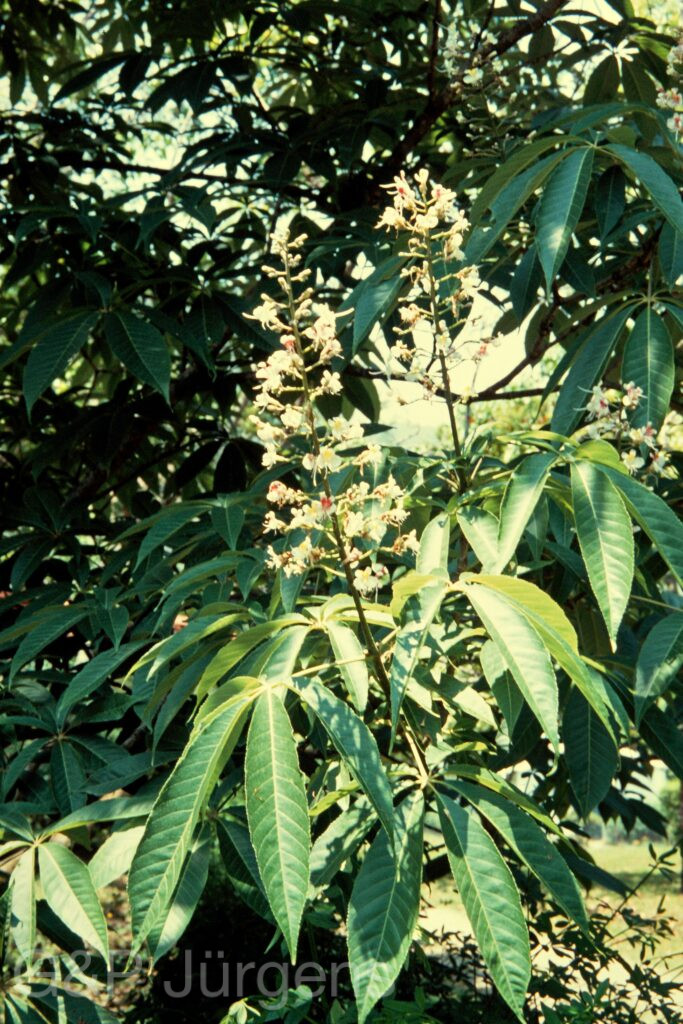
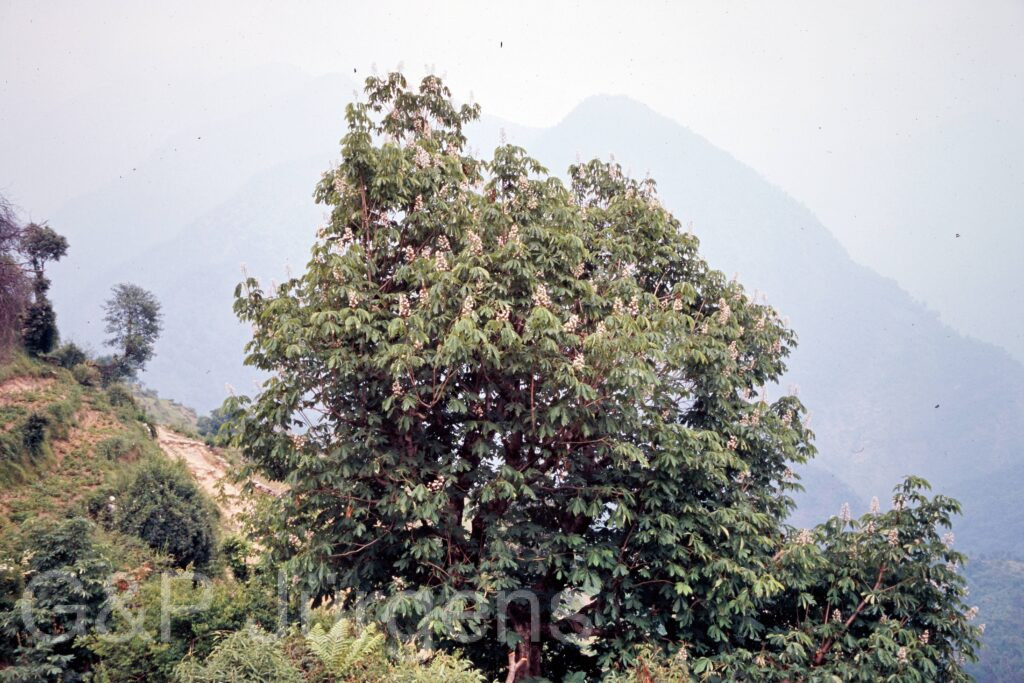
Aesculus indica ((Wall. ex Cambess.) Hook.), the Indian horse-chestnut, is a large deciduous tree endemic to the western and central Himalaya, occurring from Afghanistan and Pakistan through northern India and Nepal to Bhutan. The roughly 1,140 GBIF records, supplemented by numerous cultivated occurrences in Britain, Europe and North America, reflect both its native montane range and its popularity as an ornamental and avenue tree. It is a characteristic component of moist temperate forest, growing along streamsides, in shady ravines and on cool north-facing slopes, generally between 1,200 and 3,000 m, as illustrated by the Nepal record from Godawari at 1,350 m in May and the Garhwal collection from Trijugi Narayan at 2,300 m in June.

The tree reaches 20–30 m, with a broad rounded crown and smooth greenish-grey bark. The leaves are opposite and palmately compound, with five to nine lanceolate, finely serrate, long-acuminate leaflets that are sessile to shortly stalked and taper to the base. The flowers are borne in large, erect, terminal thyrses (panicles) up to 30 cm long; each flower is white to pinkish with a yellow or red blotch at the base of the petals, the stamens long-exserted. The fruit is a large, rough, pyriform, spineless capsule containing one to three glossy dark-brown seeds ("conkers").

The seeds are rich in bitter saponins and, after laborious leaching to remove toxicity, have traditionally been ground into a flour ("tattwakhar" or "bankhor") used as famine food and livestock fodder in the Himalaya. Distinguished from the European A. hippocastanum by its smooth, unarmed fruit and narrower leaflets, A. indica is widely planted for shade and timber. Though locally heavily exploited, the species remains relatively common within its range.

Author: (Wall. ex Cambess.) Hook. · Sources: POWO (Kew), Flora of Pakistan, GBIF, Flora of China Vol. 12, Hardin: A Revision of the American Hippocastanaceae and the genus Aesculus

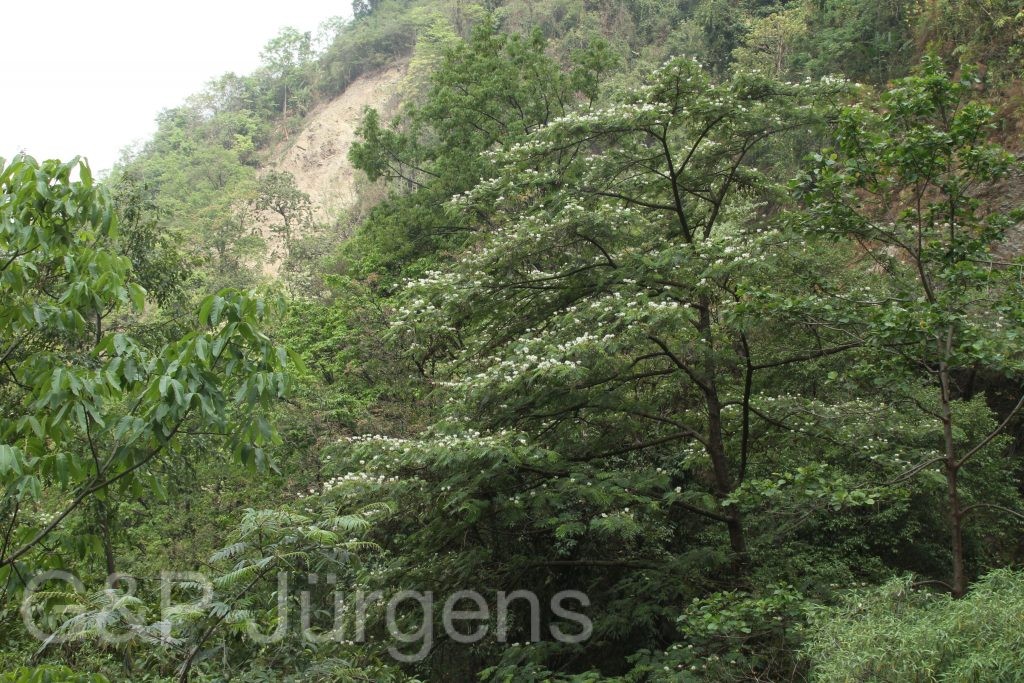
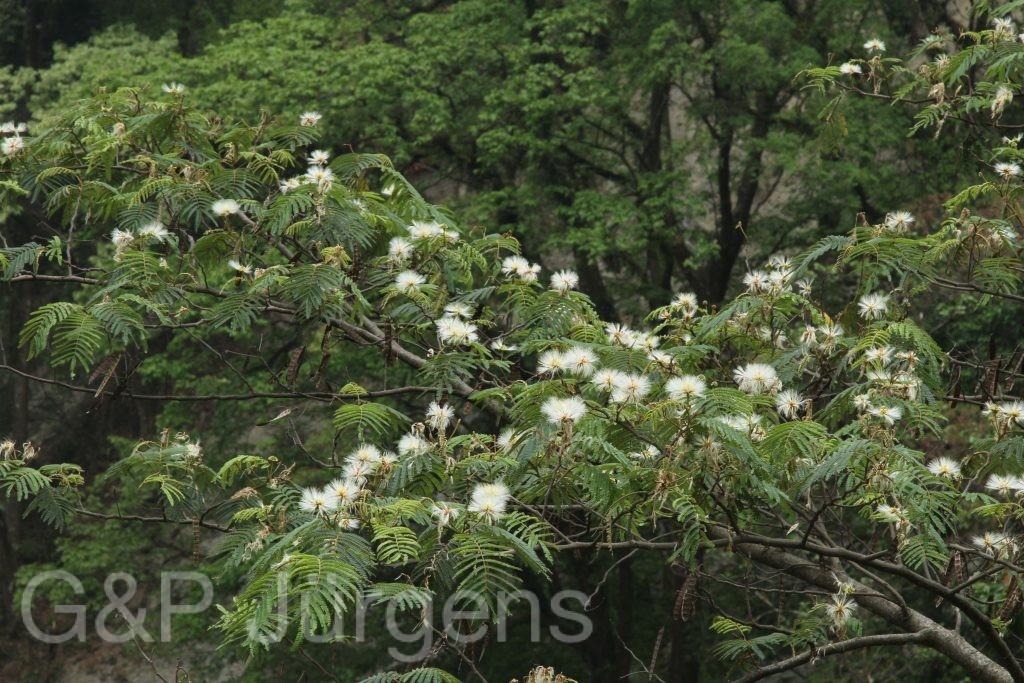
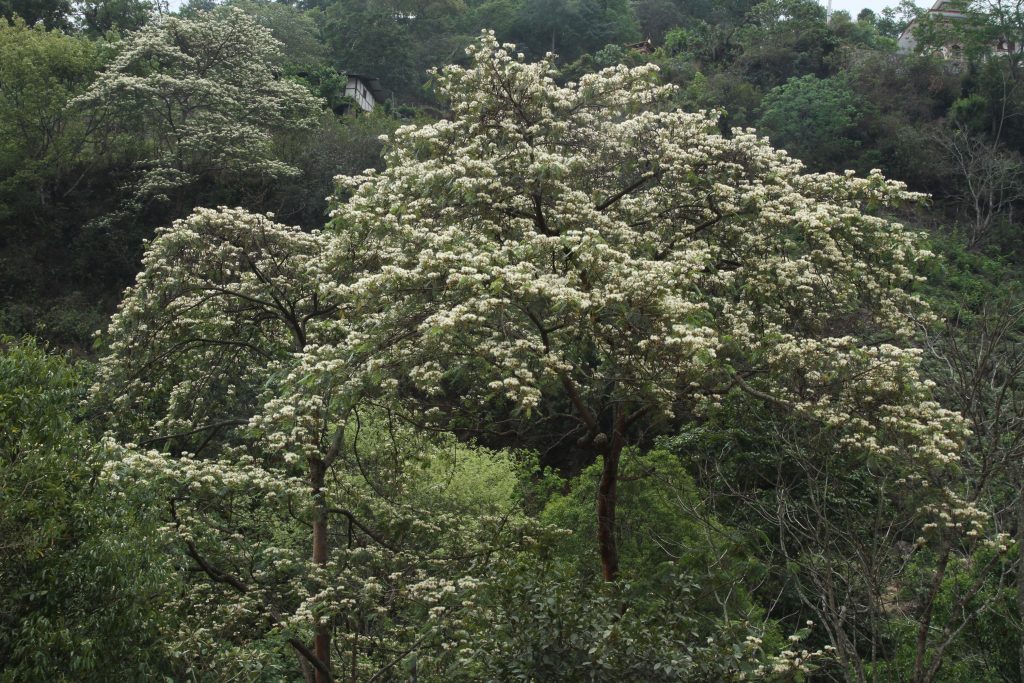
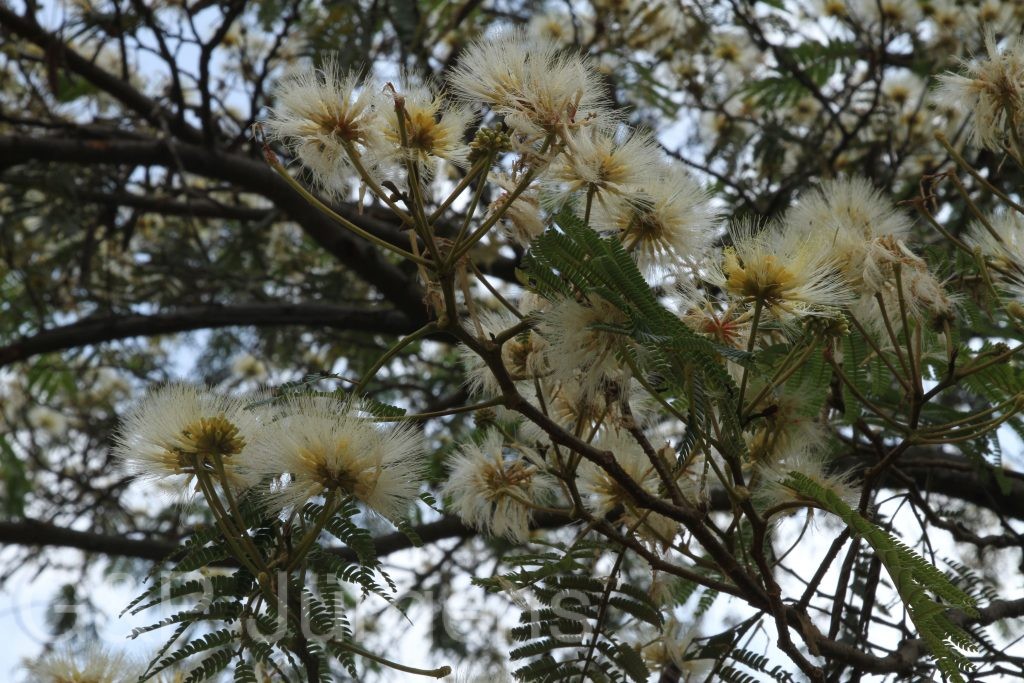
Albizia sherriffii

by GP Jürgens

Baker f.

Bhutan2014 3
Bhutan Sandrup 750m, May
Bhutan2014 5
Bhutan Sandrup 750m, May
Bhutan2014 224
Bhutan Karu-Chu 1800m, May
Bhutan2014 229
Bhutan Karu-Chu 1800m, May

Description

Albizia sherriffii is a tree of the eastern Himalayan foothills and adjoining ranges, recorded from Bhutan, north-east India, Myanmar and southern China, with GBIF holding about 65 occurrences that indicate a fairly restricted distribution. It occurs in warm subtropical to lower-temperate broad-leaved forest and along forest margins and river valleys, broadly between 700 and 1800 m, where the monsoon climate is warm and humid. The two illustrated Bhutanese gatherings, from Sandrup at 750 m and Karu-Chu at 1800 m, both in May, bracket its elevational range and show its flowering at the onset of the rains.

It is a medium-sized to large deciduous tree with spreading branches and bipinnate leaves bearing several pairs of pinnae, each with numerous small, oblong leaflets, the foliage often subtended by a gland on the petiole as is characteristic of the genus. The flowers are grouped in capitate or umbellate heads and, as in Albizia generally, owe their showy appearance to the long, numerous, exserted stamens united below into a tube, the small corolla being inconspicuous. The fruit is a flat, oblong, dehiscent legume (pod) containing several compressed seeds.

Named for the plant collector George Sherriff, A. sherriffii belongs to the mimosoid legumes (Fabaceae subfamily Caesalpinioideae, mimosoid clade), within which Albizia is distinguished from Acacia and allied genera by its stamen and pod characters. As a relatively narrowly distributed Himalayan tree, it is potentially sensitive to lowland forest clearance, though it has not been formally assessed in detail.

Author: Baker f. · Sources: POWO (Kew), GBIF, Flora of Bhutan, Legumes of the World (Lewis et al.), Flora of China

D.Don

Nepal 97 45 G67
Nepal Mewa-Khola 1100m, April
Nepal 97 46 P68
Nepal Mewa-Khola 1100m, April

Description

Alstonia neriifolia is a shrub or small tree of the warm, humid lower hills of the eastern Himalaya and Indo-Burmese region, recorded from India, Nepal, Bhutan, China and southwards into mainland and insular Southeast Asia including Vietnam, Indonesia and Singapore. It occupies subtropical broad-leaved forest, forest margins, stream banks and shaded ravines at low to moderate elevations. The specimen photographed at Mewa-Khola in eastern Nepal at 1100 m in April reflects its preference for the warm, moist foothill belt, where it flowers as the pre-monsoon temperatures rise.

Like other members of its genus it exudes a white latex when cut. The leaves are arranged in whorls of three or more, narrowly lanceolate to oblong and acuminate, recalling those of Nerium (oleander) and giving the species its epithet; the lamina is glabrous and leathery with numerous closely parallel lateral veins running to a marginal collecting vein. The flowers are borne in terminal cymose clusters, with a small five-lobed calyx and a salverform white to cream corolla whose lobes overlap to the left in bud. The fruit is a pair of slender, elongate follicles that split to release numerous flattened seeds bearing tufts of hairs at both ends for wind dispersal.

Alstonia is a pantropical genus of the Apocynaceae, subfamily Rauvolfioideae, well known for the indole alkaloids in its bark, several species of which are valued in traditional medicine and as timber. Alstonia neriifolia, described by D.Don, is distinguished from the better-known A. scholaris by its narrower, oleander-like leaves and smaller stature. Its comma-shaped, comose seeds and reliance on insect pollination of the fragrant flowers underpin its ecology in disturbed and successional foothill forest.

Author: D.Don · Sources: POWO (Kew), GBIF, Flora of China, Annotated Checklist of the Flowering Plants of Nepal, Flora of Bhutan, Middleton's revision of Asian Alstonia (Apocynaceae)

Roxb.

Nepal 97 57 P87
Nepal Mewa-Khola 1160m, April

Description

Amomum subulatum, the large or black cardamom, is native to the moist sub-Himalayan tracts of eastern Nepal, north-eastern India, Bhutan and adjacent China, the roughly 108 GBIF records reflecting both wild and extensively cultivated populations; records from the United States, Germany and Korea derive from cultivation and herbarium material. It grows in the shaded understorey of moist broad-leaved forest, along streams, ravines and damp shaded slopes, typically between about 600 and 2000 m, and is widely grown under forest shade as a cash crop. The photographed plant from the Mewa-Khola valley of Nepal at 1160 m in April is characteristic of its warm, humid lower-montane habitat.

It is a tall, tufted, rhizomatous perennial forming dense clumps of leafy pseudostems one to two metres high arising from a stout, creeping rhizome. The leaves are large, lanceolate, glabrous and distichous, with a long-acuminate (subulate) apex giving the species its name, and clasping sheaths. The inflorescence is a dense, head-like spike borne on a short scape at the base of the clump, the flowers with a yellowish, red-streaked labellum subtended by bracts. The fruit is a globose to ovoid, reddish-brown, ribbed and warty capsule containing numerous aromatic, blackish seeds.

Amomum belongs to the ginger family Zingiberaceae (here misspelled in the source) and is a major economic plant of the eastern Himalaya, the dried capsules forming the black cardamom of commerce, valued as a spice and in traditional medicine. Cultivation under natural forest canopy makes it an important agroforestry species. It is not of conservation concern, though wild genetic resources and the shade-forest systems that sustain its cultivation merit protection.

Author: Roxb. · Sources: POWO (Kew), GBIF, Flora of China, Flora of Bhutan, Annotated Checklist of the Flowering Plants of Nepal, Zingiberaceae of the Himalaya (taxonomic monograph)

Anisomeles indica

by GP Jürgens

(L.) Kuntze

Bhutan2012 1023
Bhutan Trithangebe 920m, October

Description

Anisomeles indica is a wide-ranging Asian mint extending from the Himalaya and the Indian subcontinent across China, Taiwan, Japan, mainland and insular Southeast Asia to the Pacific, with introduced or adventive records reaching the Caribbean; GBIF documents over 3000 occurrences across this large area. It is a plant of warm to subtropical lowlands and lower hills, characteristic of disturbed ground, roadsides, forest margins, fallow fields and waste places generally below about 1500 m. The photographed material from Trithangebe in southern Bhutan at 920 m, flowering in October, reflects its affinity for the lower, warmer reaches of the Himalayan foothills, where it behaves as a vigorous, sun-loving ruderal flowering into the autumn.

It is a coarse, aromatic annual or short-lived perennial herb, often a metre or more tall, with erect, quadrangular, densely pubescent stems. The leaves are opposite, ovate, crenate-serrate, acute, and softly hairy on both surfaces. The inflorescence consists of dense axillary cymes aggregated into elongate, leafy terminal panicles. Each flower has a tubular, ten-veined, five-toothed calyx and a two-lipped corolla coloured pale pinkish to pale purple, the short upper lip erect and the larger lower lip three-lobed; the four didynamous stamens are exserted and ascend beneath the upper lip. The fruit comprises four smooth, ovoid nutlets enclosed by the persistent calyx.

The species was described in Nepeta by Linnaeus and transferred to Anisomeles by Kuntze, the small Old World tropical genus being placed in subfamily Lamioideae. It is rich in essential oils and diterpenoids and is widely used in traditional medicine across its range for fevers, digestive and inflammatory complaints, which has prompted considerable phytochemical study. Far from threatened, its weedy, colonising habit and broad ecological tolerance make it a successful and locally abundant component of human-modified landscapes throughout tropical and subtropical Asia.

Author: (L.) Kuntze · Sources: POWO (Kew), GBIF, Flora of China, Flora of Bhutan, Flora of British India, Harley et al. Labiatae account in 'The Families and Genera of Vascular Plants'

Apios carnea

by GP Jürgens

(Wall.) Benth.

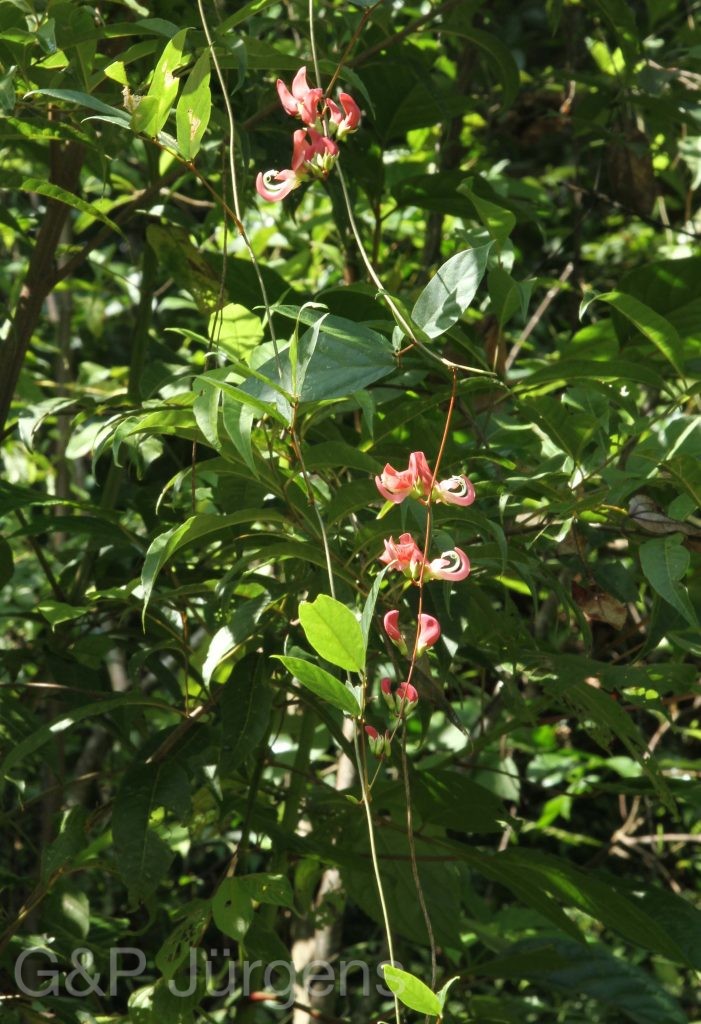
Bhutan2012 990
Bhutan Trithangebe, 1100m October
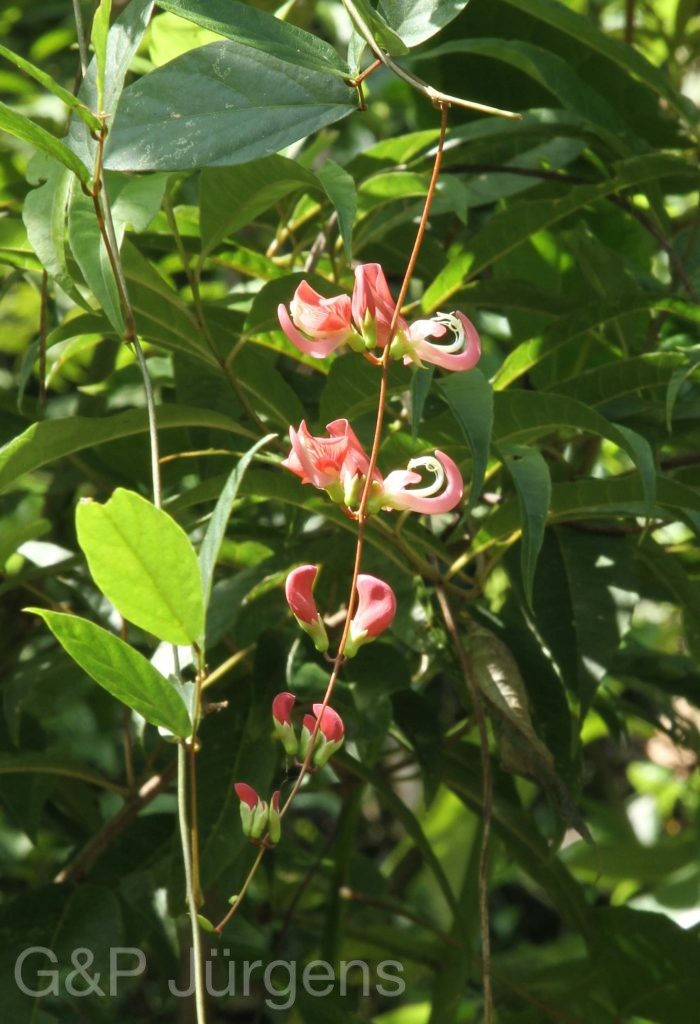
Bhutan2012 991
Bhutan Trithangebe, 1100m October
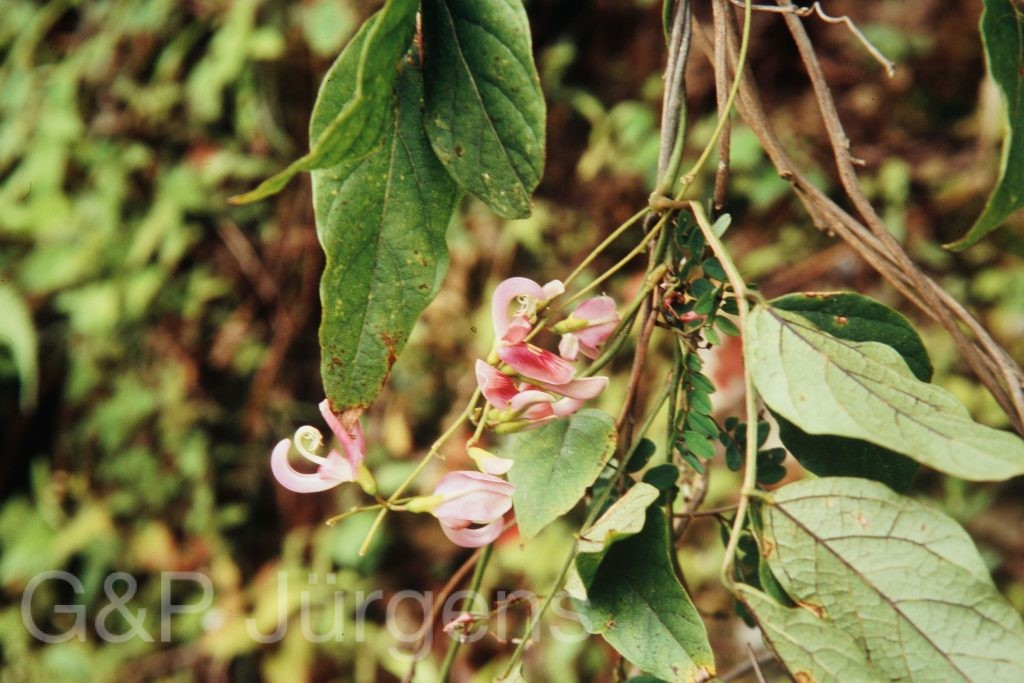
Bh09 242 P405
Bhutan Wangdi, 2000m June

Description

Apios carnea is widely distributed through the Himalaya and into south-east and east Asia, recorded from Nepal, north-east India, Bhutan, Myanmar, China, Thailand, Laos, Vietnam, Malaysia, Korea and Japan among its 887 georeferenced occurrences. It is a climbing herb of forest margins, thickets, streamsides and clearings in warm-temperate to subtropical settings, scrambling over shrubs and into the lower canopy. The Bhutan records at Trithangebe (1100 m, October) and Wangdi (2000 m, June) illustrate a broad altitudinal tolerance from about 1000 to 2400 m, flowering through the warm wet season.

It is a perennial twining vine arising from a tuberous, fleshy rootstock, with slender, herbaceous, somewhat woody-based stems. The leaves are pinnately compound (imparipinnate) with usually five to seven ovate-lanceolate, acuminate leaflets. The flowers are borne in dense axillary racemes and are typical papilionate legumes, flesh-pink to dull reddish or salmon, with a broad standard, incurved keel and the characteristic coiled keel-and-style of the genus. The fruit is a slender, elongate, dehiscent legume containing several seeds.

The genus Apios belongs to tribe Phaseoleae of subfamily Faboideae, allied to climbing beans, and the twisted keel enclosing the spirally coiled style and stamens is a notable floral specialisation promoting cross-pollination by bees. As a nitrogen-fixing legume it contributes to soil enrichment, and its tubers have been used locally as food. Common and widespread across its range, it is of no conservation concern, though it is regionally valued both as an ornamental climber and a wild food plant.

Author: (Wall.) Benth. · Sources: POWO (Kew), GBIF, Flora of Bhutan, Flora of China, Flora of Nepal, Lackey Phaseoleae revision (Advances in Legume Systematics)