Tag:

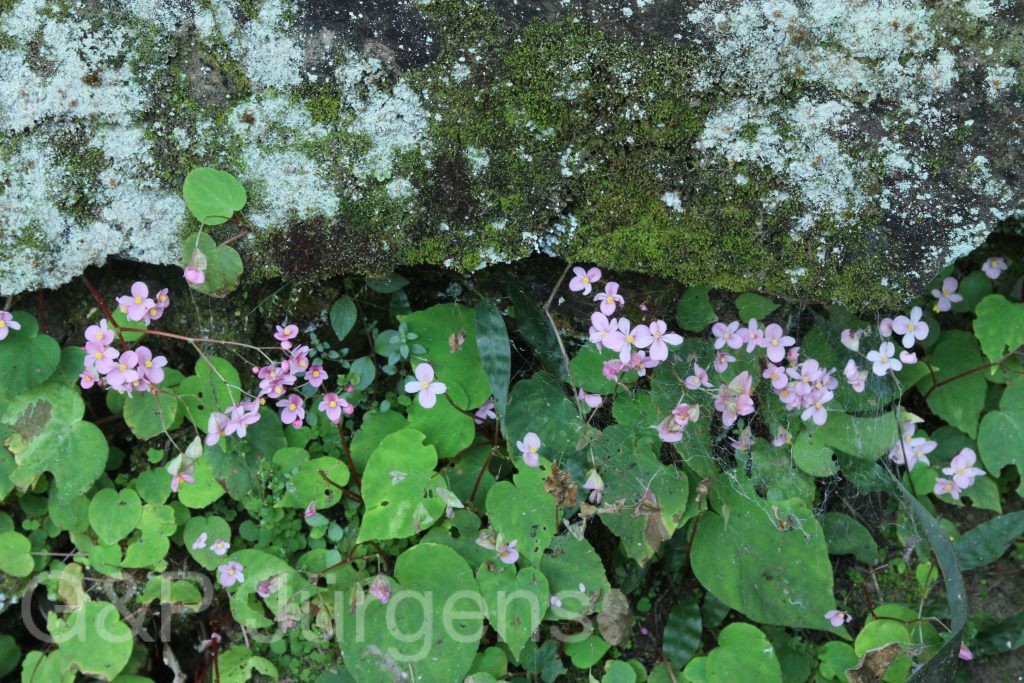
Subtropical (<1500 m)

K.Koch

Bhutan2015 146
Bhutan Galephug 700m, October

Description

Begonia annulata is a Himalayan and Indo-Burmese begonia ranging through India, Bhutan, Bangladesh, Nepal and Myanmar; GBIF lists about 109 occurrences, the lower figure reflecting its restriction to humid lowland and submontane forest. It grows in warm, shaded, perpetually moist habitats, on damp rocks, mossy banks, ravines and forest-floor seepages in evergreen broadleaved forest of the foothills and outer ranges. The photograph from Galephug in southern Bhutan at about 700 m in October shows it in the low, humid subtropical belt along the Himalayan front, fruiting late in the year where high rainfall and dense canopy sustain its succulent growth.

It is a fleshy perennial herb with an erect to ascending, jointed, translucent stem arising from a creeping rhizome or tuberous base. The leaves are alternate, conspicuously asymmetric (oblique) at the base as is typical of the genus, ovate to broadly ovate with an acuminate apex and toothed margin, palmately veined and often bearing scattered hairs, the petioles and nodes sometimes ringed (annulate, the source of the epithet). Plants are monoecious, the flowers white to pale pink and unisexual, borne in axillary cymes; staminate flowers with several stamens and pistillate flowers with a conspicuously winged inferior ovary. The fruit is a three-winged, unequally winged capsule containing very numerous minute seeds.

Begonia is one of the largest angiosperm genera, strongly radiated in the wet forests of tropical Asia, and B. annulata represents the shade- and moisture-demanding rhizomatous group of the eastern Himalaya. Its asymmetric leaves, winged capsules and dust-fine seeds are hallmarks of the family. While not formally assessed as threatened, such narrowly humid-forest specialists are sensitive to lowland deforestation and habitat drying along the Himalayan foothills.

Author: K.Koch · Sources: POWO (Kew), GBIF, Flora of Bhutan, Flora of British India (Hooker), Tebbitt Begonias: Cultivation, Identification and Natural History
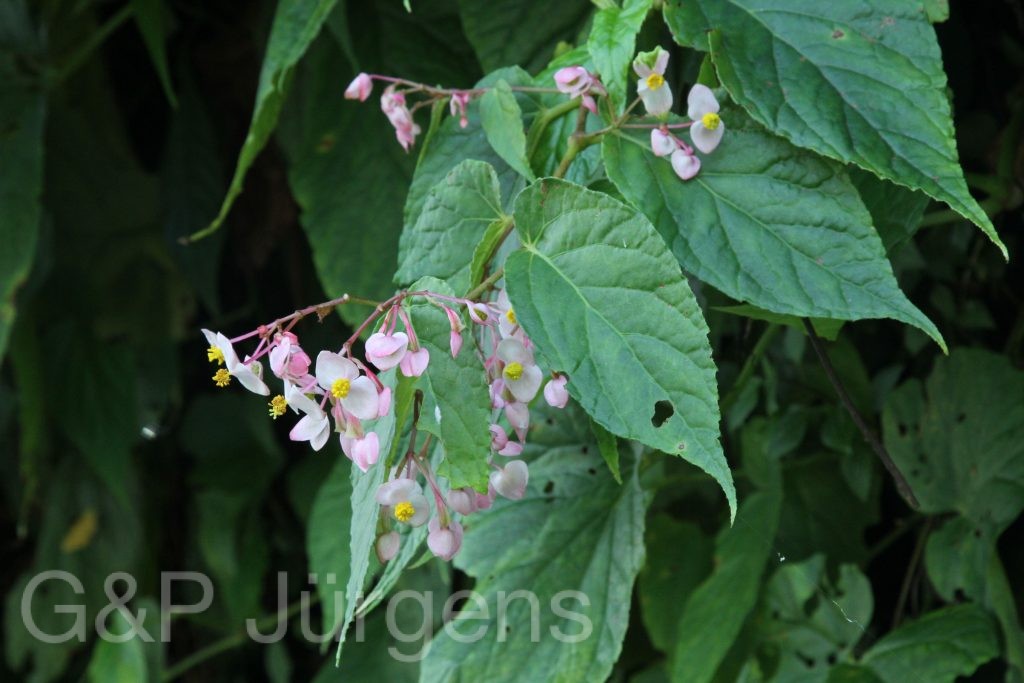
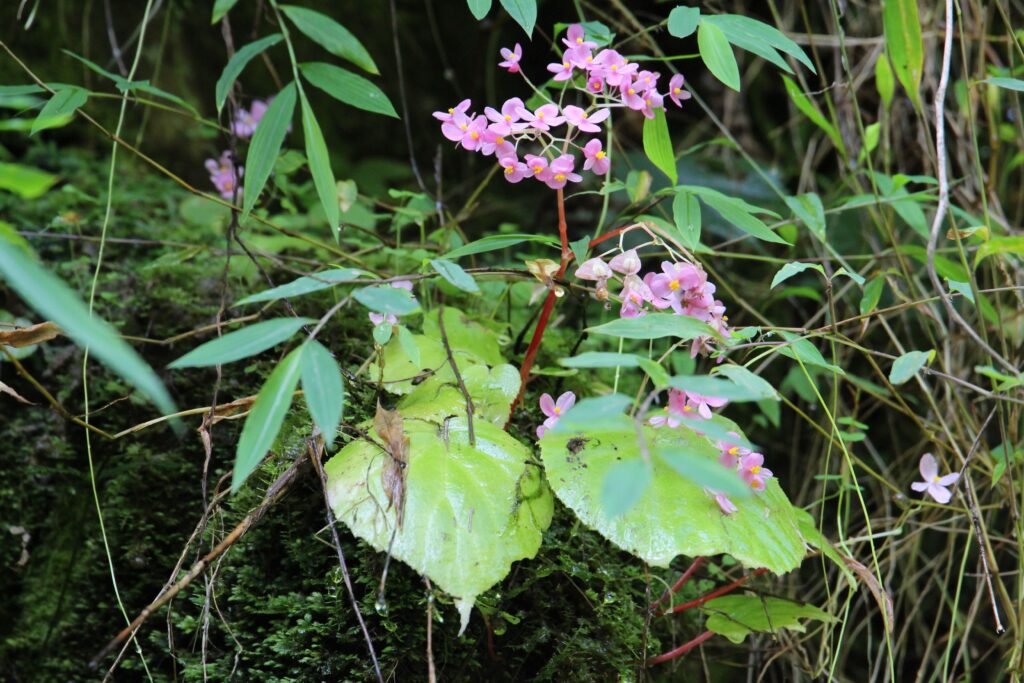
Warb.

Bhutan2015 123
Bhutan Galephug 600m, October
Bhutan2015 126
Bhutan Galephug 600m, October

Description

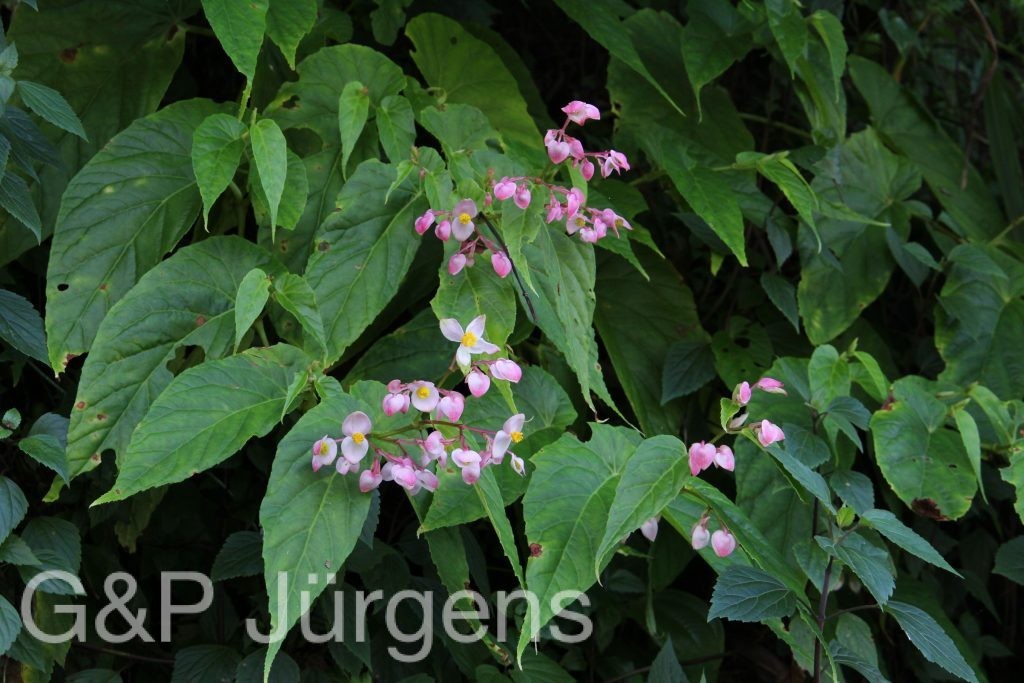
Begonia nepalensis is a robust herbaceous Begonia of the Himalaya and its foothills, recorded by GBIF from Nepal, India, Bhutan, China and elsewhere across about 91 occurrences. It grows in warm, humid, shaded habitats, on moist banks, in ravines, beside streams and on damp rocks within subtropical and lower montane broad-leaved forest, typically at low to middle elevations. The plant photographed at Gelephu (Galephug) in southern Bhutan at about 600 m, in October, reflects this warm, wet foothill setting where the species flourishes in the deep shade and high humidity of the monsoon-fed forest understorey.

The plant is a tall, succulent, erect herb arising from a thick rhizome, with stout, somewhat fleshy, swollen-noded stems. The leaves are alternate, large and markedly asymmetric (oblique) at the base as is characteristic of the genus, broadly ovate, acuminate, with a toothed to shallowly lobed and ciliate margin and palmate venation; the foliage is often somewhat hairy. The plant is monoecious, bearing separate male and female flowers in the same axillary cymes; the white to pinkish flowers have tepals rather than differentiated sepals and petals, the staminate flowers with a cluster of stamens and the pistillate with an inferior, conspicuously winged ovary. The fruit is a three-winged, unequally winged capsule that dries and releases very numerous minute seeds.

Begonia is one of the largest angiosperm genera, hyper-diverse in the wet tropics, and the Himalayan species such as B. nepalensis belong to the assemblage of large-leaved, cane-stemmed forest herbs adapted to shaded, perennially moist habitats. The asymmetric leaves, winged capsules and dust-like seeds are hallmarks of the family. Although not assessed as threatened, the species' dependence on humid, undisturbed forest understorey makes it sensitive to deforestation and drying, and its restriction to the warm Himalayan foothills reflects a tropical-Asian biogeographic affinity.

Author: Warb. · Sources: POWO (Kew), GBIF, Flora of China, Flora of Bhutan, Annotated Checklist of the Flowering Plants of Nepal, Tebbitt "Begonias: Cultivation, Identification, and Natural History"

A.DC.

Bhutan2015 229
Bhutan Zhemgang 950m, October
Bhutan2015 226
Bhutan Zhemgang 950m, October

Description

Begonia ovatifolia A.DC. is an eastern Himalayan herb known from Bhutan, north-eastern India and Nepal, a comparatively narrow-ranging species with few records (GBIF lists about 58 occurrences). It is a plant of shaded, humid situations – moss-covered rock faces, stream banks, damp ravines and the floor of evergreen broad-leaved forest – at low to mid elevations. The illustrated material was collected at Zhemgang in central Bhutan at about 950 m in October, where the monsoon-fed forests provide the perennially moist, sheltered microhabitat that suits the genus.

It is a perennial herb with succulent, often reddish-tinged stems arising from a fibrous-rooted or shortly rhizomatous base. The leaves are alternate, asymmetric (oblique) at the base as is typical of Begonia, ovate in outline with an acuminate apex and a finely serrate to denticulate margin, the lamina sometimes sparsely hairy. The plants are monoecious, bearing unisexual flowers in axillary cymes; the staminate flowers have showy tepals and a cluster of yellow stamens, the pistillate flowers an inferior, conspicuously 3-winged ovary with branched stigmas. The fruit is a winged capsule, one wing usually larger, dehiscing to release very numerous minute seeds.

Begonia (Begoniaceae) is one of the largest angiosperm genera, with the Sino-Himalayan species forming a centre of diversity and high local endemism. B. ovatifolia belongs to this assemblage of forest-floor herbs whose narrow distributions make them sensitive to habitat loss and forest disturbance, though the species is not formally assessed. Its inferior winged ovary and dust-like seeds are characteristic adaptations for dispersal in the humid, low-light understorey it occupies.

Author: A.DC. · Sources: POWO (Kew), GBIF, Flora of Bhutan, Flora of China, Begonia treatment in Flora of British India, Tebbitt studies of Asian Begonia, Camfield & Hughes phylogeny of Begonia

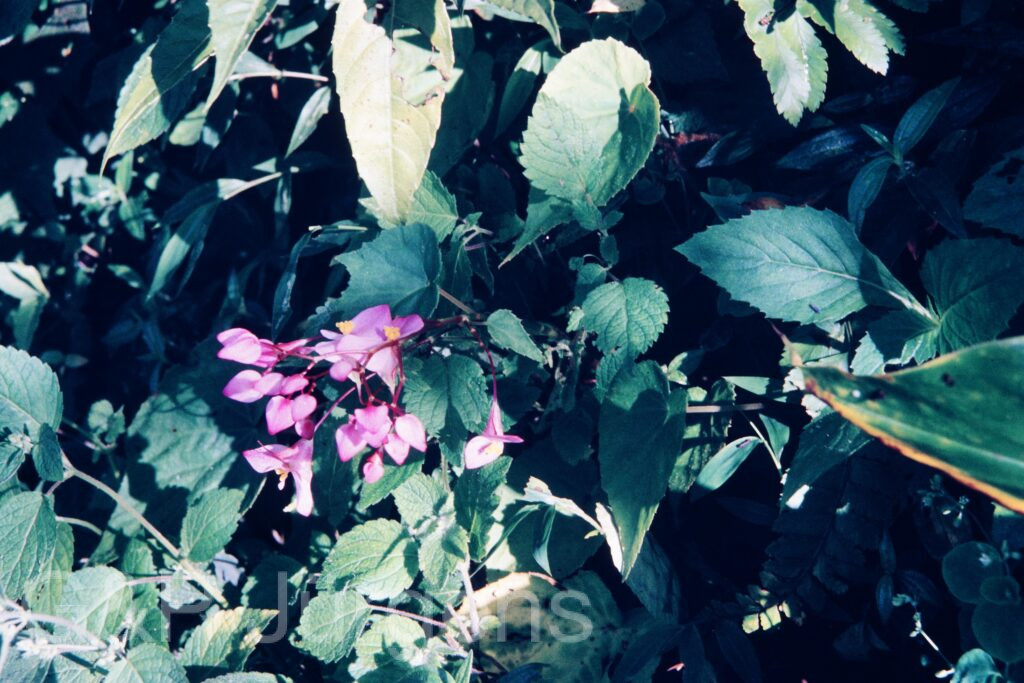
Begonia rubella

by GP Jürgens

Buch.-Ham. ex D.Don

Bhutan2015 228 ergebnis
Bhutan Zhemgang 910m, October

Description

Begonia rubella is a Himalayan herb ranging through Nepal, northern India and Bhutan, with scattered GBIF records (67 occurrences) extending the data to Papua New Guinea, which most likely represents misidentification rather than a genuine disjunction. It is a plant of shaded, humid microhabitats — moist rock faces, stream banks, damp ravines and the floor of broadleaved subtropical to lower-temperate forest — where constant atmospheric moisture and deep shade prevail. The illustrated plant from Zhemgang in central Bhutan at about 910 m, in October at the close of the monsoon, exemplifies its preference for warm, wet, low-montane valleys.

The species is a soft, succulent perennial herb arising from a tuberous or rhizomatous rootstock, with erect to ascending, somewhat fleshy, reddish-tinged stems (the epithet rubella alluding to this colouring). The leaves are alternate, markedly asymmetric (oblique) at the base as is typical of the genus, ovate to broadly ovate, acuminate, irregularly toothed and often flushed red beneath. The flowers are monoecious and zygomorphic, pink to rose, borne in axillary cymes; staminate flowers bear numerous stamens, pistillate flowers an inferior, conspicuously 3-winged ovary. The fruit is the characteristic unequally 3-winged dehiscent capsule shedding minute seeds.

Begonia, the sole large genus of Begoniaceae, is one of the most species-rich angiosperm genera, and the Sino-Himalayan region is a notable centre of diversity. B. rubella belongs to the assemblage of tuberous Himalayan begonias adapted to a strongly seasonal monsoon climate, dying back in the dry winter. Like many narrowly distributed forest begonias it depends on undisturbed humid shade, making it sensitive to forest clearance, though horticultural interest in the group has aided its documentation.

Author: Buch.-Ham. ex D.Don · Sources: POWO (Kew), GBIF, Flora of Bhutan, Flora of British India, Annotated Checklist of the Flowering Plants of Nepal, Begonian Resource (Begoniaceae monographic studies)

C.B.Clarke

Nepal 95 12 P19 ergebnis
Nepal Gorkha 1200m, Octobre

Description

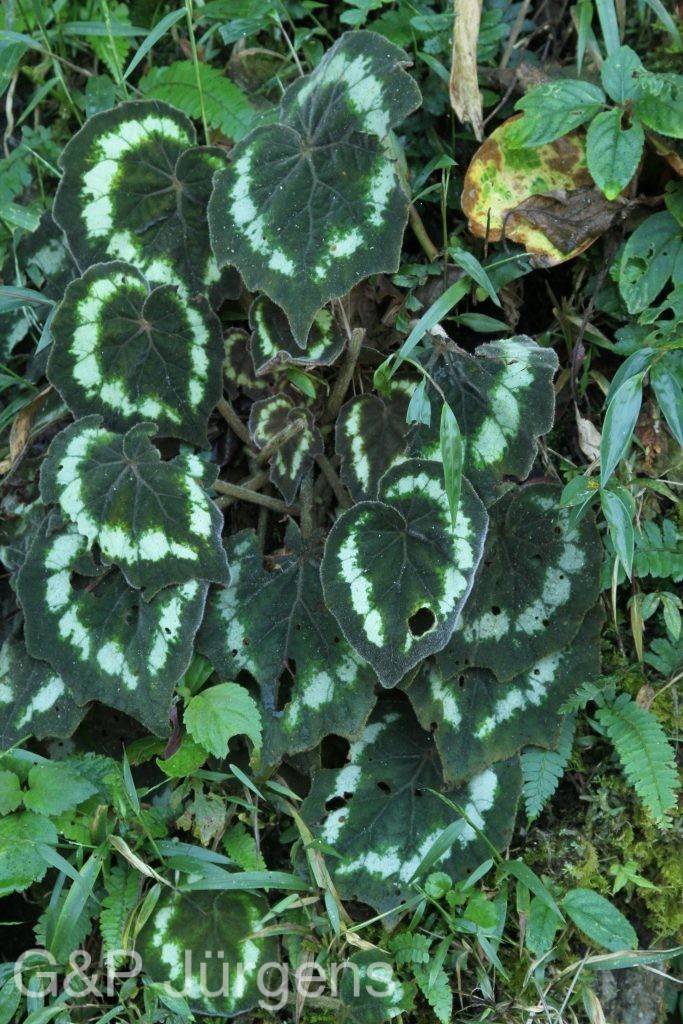
Begonia satrapis C.B.Clarke is a perennial herb of shaded, humid forest in the eastern Himalaya. It is a regional endemic of restricted distribution; GBIF records it only from India and Bhutan with a small number of collections (about 15), and it is also reported from the central Himalaya, consistent with the illustrated plant from Nepal, Gorkha, at 1,200 m in October. It grows in moist subtropical to lower temperate broad-leaved forest, on damp mossy banks, rock ledges and ravine sides where humidity is high and light is diffuse, typically between roughly 1,000 and 2,000 m.

The plant is a monoecious, succulent-stemmed herb with an erect or ascending, often reddish, somewhat fleshy stem. The leaves are alternate, markedly asymmetric (oblique) at the base as is characteristic of the genus, ovate to broadly ovate with an acuminate apex and a serrate to shallowly lobed, ciliate margin, often bearing a reddish flush or marking on the upper surface. Flowers are unisexual and borne in axillary, dichasial cymes; the staminate flowers have a few perianth segments and a cluster of yellow stamens, while the pistillate flowers bear an inferior, conspicuously winged ovary. The fruit is a pendulous, three-winged, many-seeded capsule with one wing typically larger than the others.

Begonia is one of the largest angiosperm genera, and the Sino-Himalayan species form a notable centre of diversity. B. satrapis belongs to the Asian herbaceous assemblage in which winged-capsule morphology and oblique foliage are diagnostic. Its narrow range and dependence on undisturbed humid forest make populations sensitive to habitat loss, although it has not been formally assessed.

Author: C.B.Clarke · Sources: POWO (Kew), GBIF, Flora of Bhutan Vol. 2, Flora of Nepal, Flora of China Vol. 13, Tebbitt: Begonias – Cultivation, Identification and Natural History
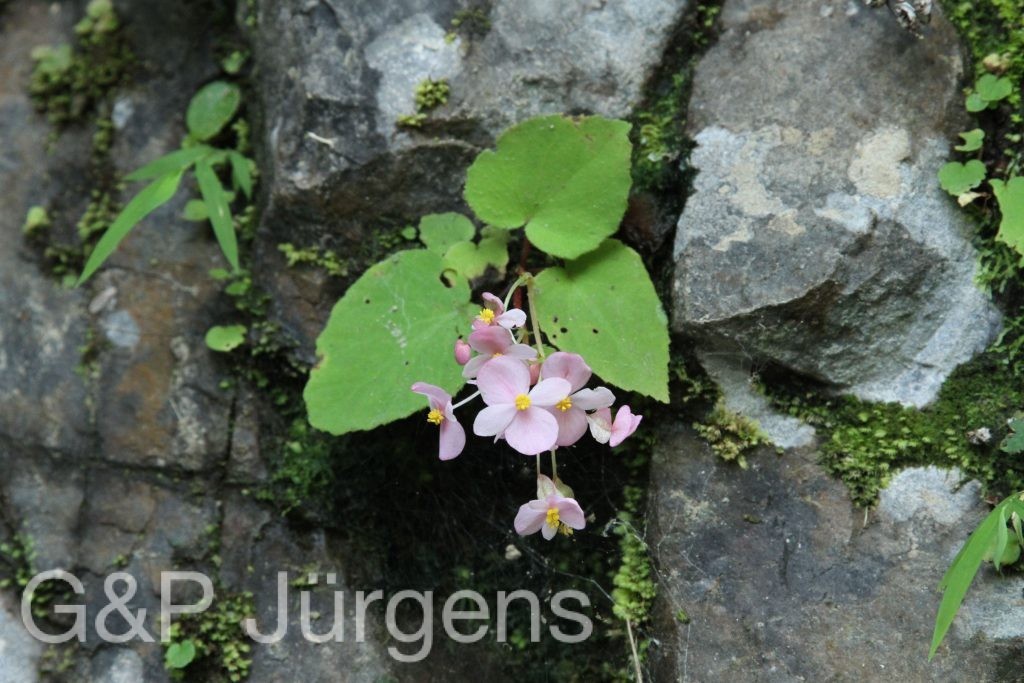
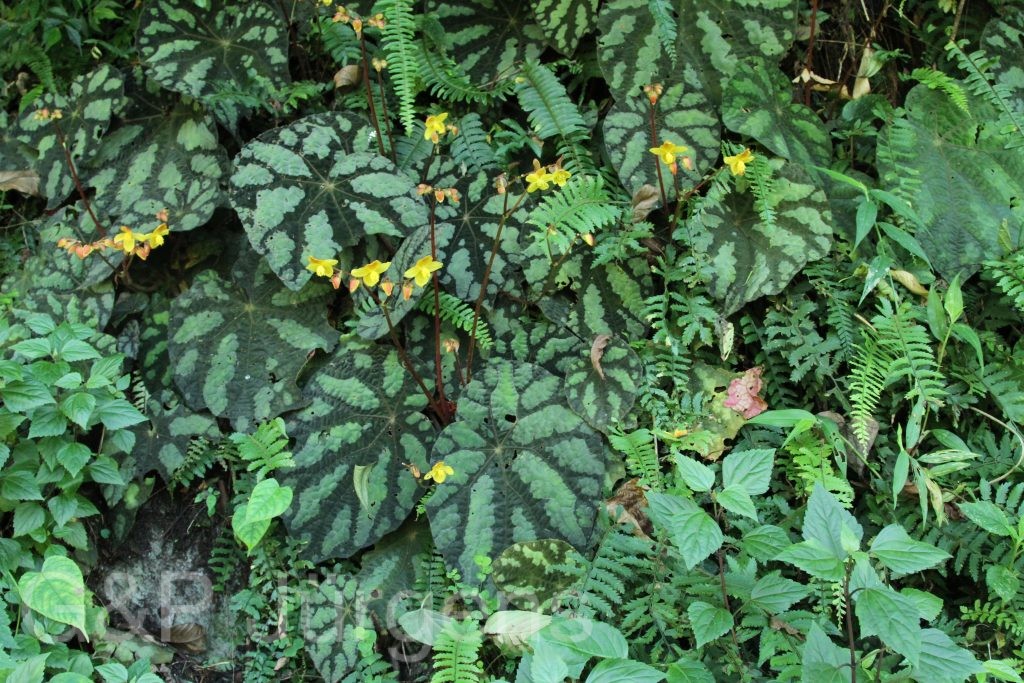
Hook.

Bhutan2015 132
Bhutan Galephug 600m, October
Bhutan2015 135
Bhutan Galephug 600m, October

Description

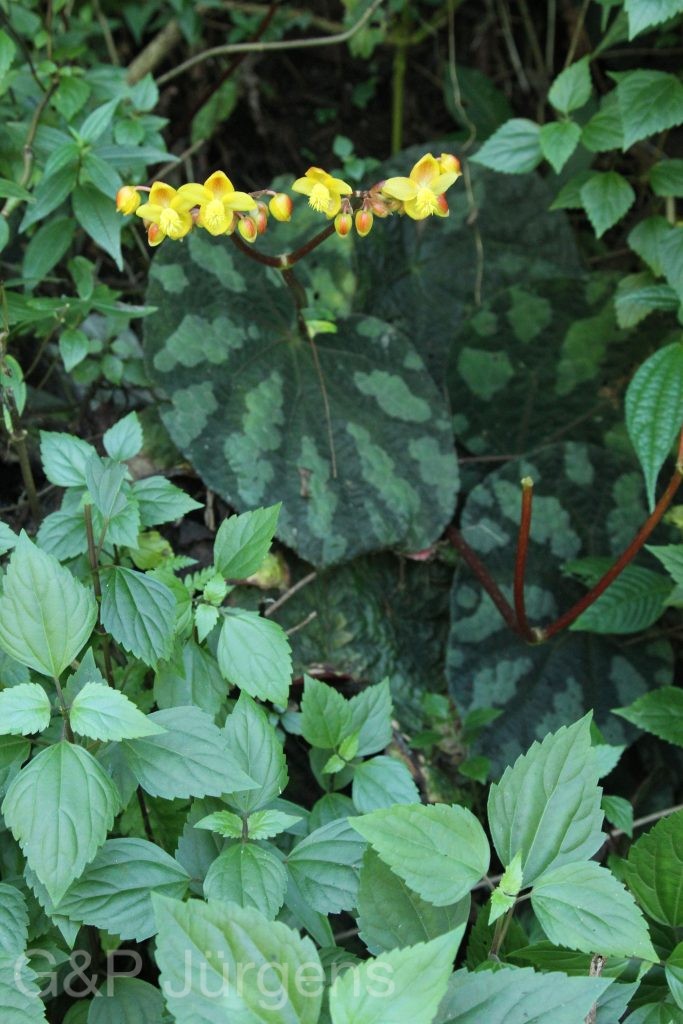
Begonia xanthina is a herbaceous perennial of the eastern Himalaya and adjacent Indo-Burma, recorded from northeastern India, Bhutan, Nepal, southern China and Myanmar, with cultivated occurrences in Belgium and the Netherlands; GBIF holds about 61 georeferenced records. It inhabits shaded, humid evergreen forest, growing on moist rocks, mossy banks, ravine sides and seepage slopes at low to mid elevations, favouring deep shade and the high humidity of monsoon forest. The photographed plant from Gelephu (Galephug) in southern Bhutan at 600 m in October is typical of these warm, wet subtropical foothill forests where it flowers in the post-monsoon season.

It is a rhizomatous, monoecious herb with a stout creeping rhizome and few large basal leaves. The leaves are broadly ovate, markedly asymmetric (oblique) at the base, cordate, often coloured deep green above with reddish or purplish tinting beneath and a long fleshy petiole. The inflorescence is an axillary cyme borne on an erect peduncle, carrying showy nodding flowers; the tepals are yellow, the staminate flowers with four tepals and numerous yellow stamens, the pistillate flowers with an inferior, three-winged ovary bearing unequal wings and twisted bifid stigmas. The fruit is a pendulous winged capsule dehiscing to release minute seeds.

Described by W.J. Hooker, Begonia xanthina is notable as one of the few yellow-flowered Asian begonias, placed in section Platycentrum, and has long been valued in horticulture for its handsome foliage and unusual flower colour. Its monoecious habit and reliance on small generalist insect pollinators are typical of the genus. Restricted to specialised forest microhabitats, it is sensitive to habitat loss, and conservation of intact foothill forest is important for its persistence.

Author: Hook. · Sources: POWO (Kew), GBIF, Flora of China Vol. 13, Flora of Bhutan Vol. 2, Flora of Nepal, Begonias of the Himalaya (Tebbitt)

(Wall.) Brongn.

Nepal 97 582 P1121
Nepal Sabha-Khola 560m May

Description

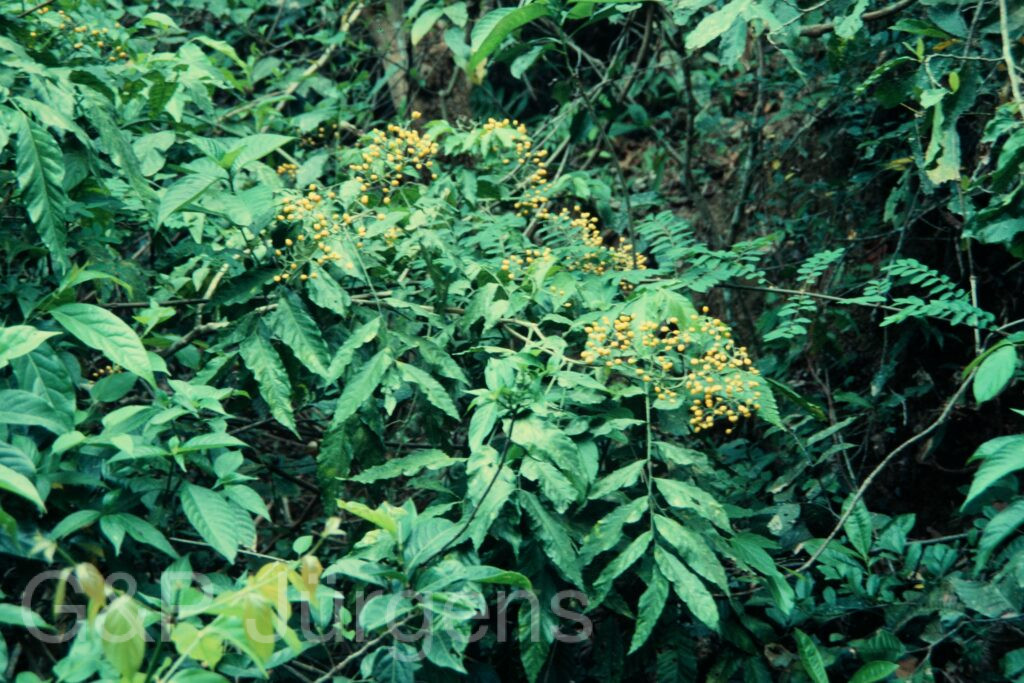
Berchemia floribunda is a widely distributed scrambling shrub or woody climber of East and South Asia, recorded from China, Japan, Korea, Hong Kong, Taiwan, India, Thailand, Nepal, Vietnam, Laos, Myanmar and Bhutan, with more than six thousand documented occurrences. It grows in forest margins, thickets, scrub and hedgerows from the lowlands into the lower montane zone, clambering over shrubs and small trees by means of its long flexuous branches. In Nepal it descends to warm subtropical foothills, as shown by the collection along the Sabha Khola at about 560 m in May, coinciding with its flowering season.

The plant is a deciduous liana with slender, glabrous, often zigzag branchlets. The leaves are alternate, ovate to elliptic, entire, acute to shortly acuminate at the apex and rounded at the base, with numerous fine, parallel, arching lateral veins that give the lamina a neatly pinnate-veined appearance. The inflorescence is a large, lax terminal panicle of many small flowers, the epithet floribunda referring to their abundance; each flower has five greenish to yellowish triangular petals, a five-lobed calyx and five stamens. The fruit is a small, narrowly ellipsoid drupe, green ripening through red to blue-black, seated on the persistent disk.

Berchemia belongs to the tribe Rhamneae within Rhamnaceae and comprises twining or scandent shrubs of Asia and the Americas distinguished by their many-veined leaves and small drupaceous fruits. The fleshy fruits are dispersed by frugivorous birds, while the climbing habit allows the plant to reach light at forest edges. Berchemia floribunda is locally common and economically minor, its tough stems used in basketry and its roots and fruits in folk medicine. Broadly distributed and tolerant of disturbed habitats, it is of no conservation concern.

Author: (Wall.) Brongn. · Sources: POWO (Kew), GBIF, Flora of China Vol. 12, Flora of Bhutan Vol. 2, Flora of Nepal, Flora of Pakistan, Medan & Schirarend treatment of Rhamnaceae

Wedd.

Bhutan2012 693
Bhutan Galephu 900m, September

Description

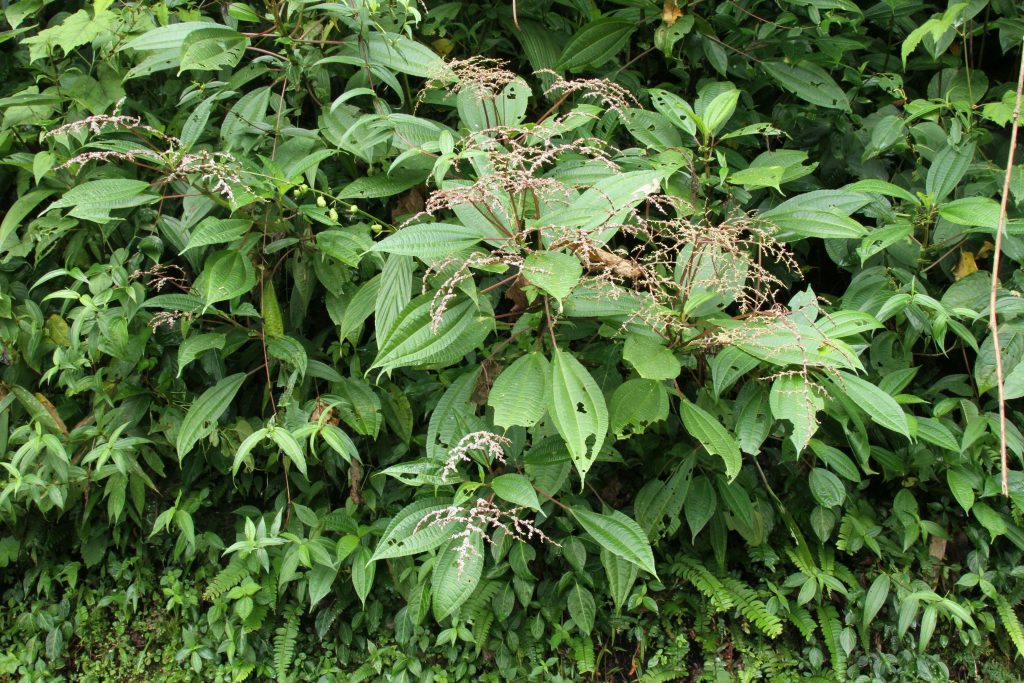
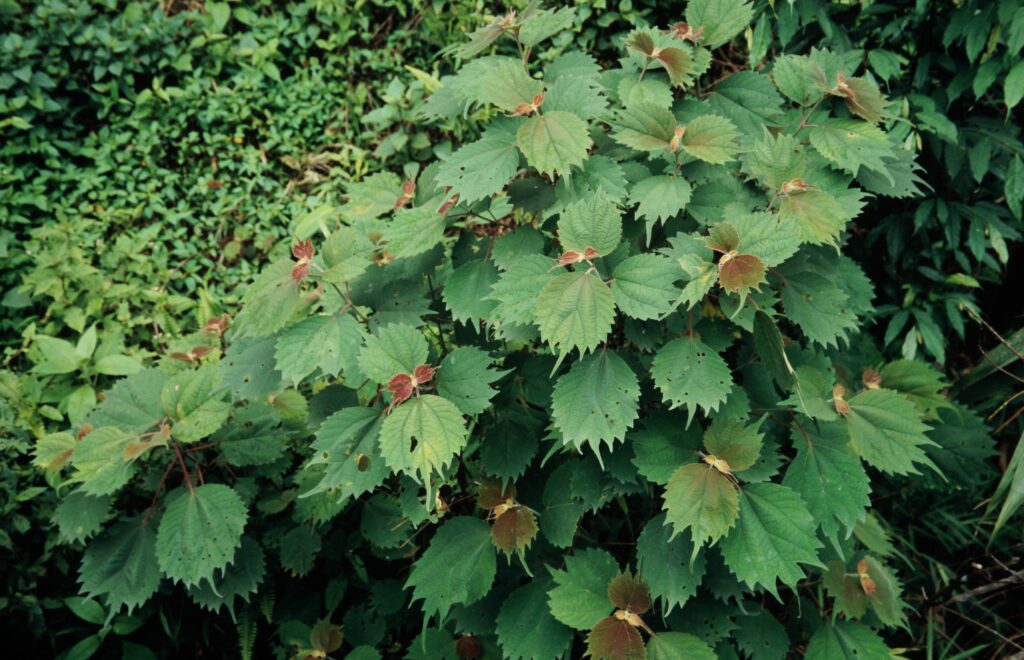
Boehmeria hamiltoniana is a subtropical shrub or tall herb of the Himalayan foothills and adjacent Southeast Asia, recorded from India, China, Nepal, Thailand, Bhutan, Myanmar and Indonesia across some 115 GBIF occurrences. The illustrated plant was photographed at Galephu in southern Bhutan at about 900 m in September. It grows in warm, humid lowland and submontane settings, along forest margins, streamsides, ravines and disturbed ground generally below about 1500 m, favouring shaded, moist, fertile soils.

The plant is a perennial herb or soft-wooded shrub with erect, sometimes pubescent stems. The leaves are opposite or alternate, ovate to ovate-lanceolate, with a serrate or dentate margin and an acuminate apex, three-nerved from the base and often roughish or hairy. As in the Urticaceae the flowers are small, greenish and unisexual, lacking petals; they are densely aggregated into slender, often interrupted axillary spikes or panicles. The female flowers develop into small dry achenes enclosed in the persistent perianth, each containing a single seed.

Boehmeria belongs to the nettle family but, unlike true nettles, lacks stinging hairs. The genus includes the economically important ramie (Boehmeria nivea), valued for its strong bast fibres, and several Himalayan species are used locally for cordage. Wind plays a role in pollination of the inconspicuous flowers. B. hamiltoniana is widespread and ecologically tolerant of disturbance, and is therefore of least conservation concern, persisting readily along trails and forest edges.

Author: Wedd. · Sources: POWO (Kew), GBIF, Flora of China, Flora of Bhutan, Flora of Nepal, Friis & Wilmot-Dear – Revision of Boehmeria (Urticaceae)

Wedd. ex D.G.Long

Bhutan2015 116
Bhutan Galephug 600m, October
Bhutan2015 117
Bhutan Galephug 600m, October

Description

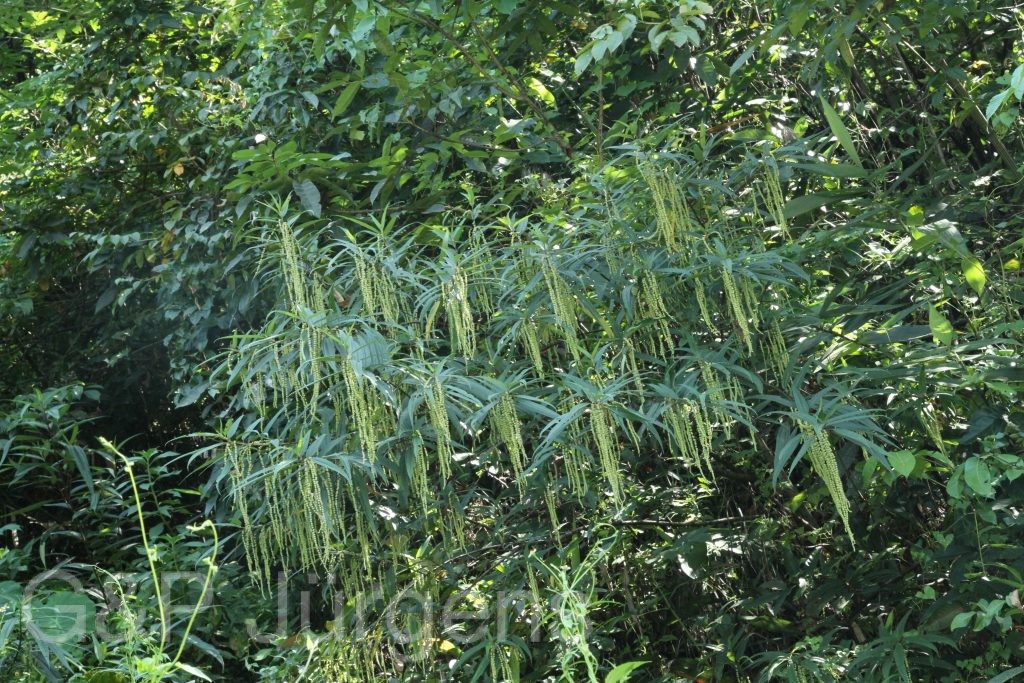
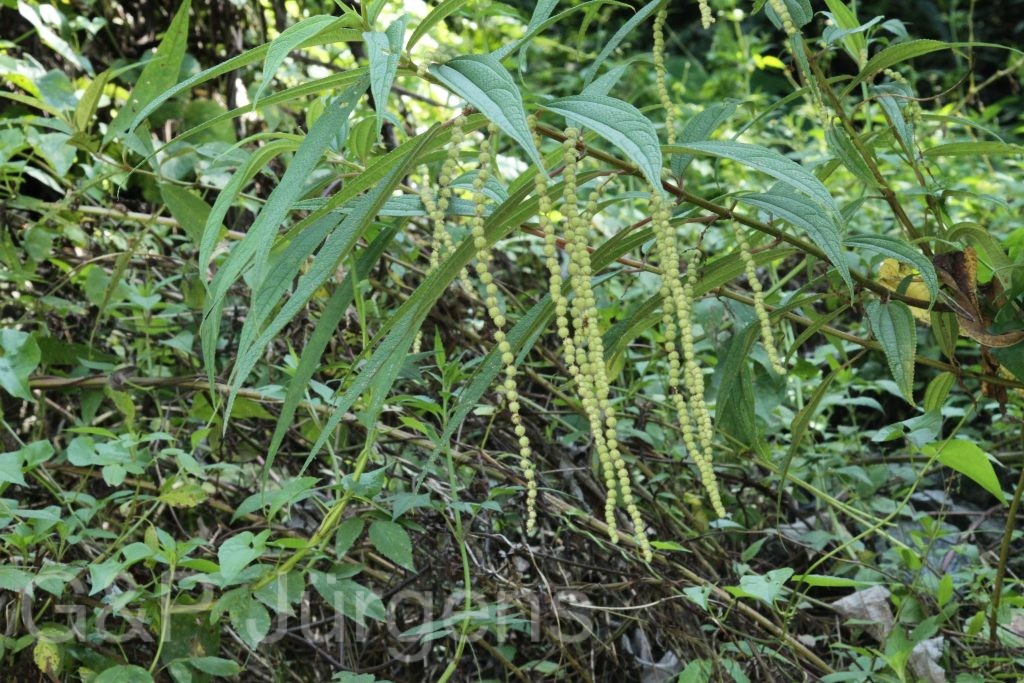
Boehmeria penduliflora is a shrubby false-nettle distributed from the Himalaya and southern China through Indochina and Southeast Asia, with GBIF documenting nearly 2000 occurrences including naturalised records on Indian Ocean islands such as Reunion and Mauritius. It favours warm, humid lowland and submontane settings: streambanks, forest margins, roadside thickets and disturbed scrub on moist soils. The photographed plant grows in southern Bhutan at Gelephu around 600 m, in flower or fruit in October; the species is most frequent below about 1500 m in the subtropical foothill zone where it can form sizeable bushes.

The plant is a much-branched, erect to spreading shrub reaching two to three metres, with terete, finely pubescent young stems and, unlike true nettles, no stinging hairs. The leaves are opposite or subopposite, narrowly lanceolate to elliptic, long-acuminate, serrate-margined and three-nerved from the base, scabrid above and paler beneath. The minute unisexual flowers are densely clustered in glomerules arranged along slender, pendulous axillary spikes, a feature reflected in the epithet penduliflora. The fruit is a small ellipsoid achene enclosed in the persistent perianth.

Boehmeria belongs to the tribe Boehmerieae of the Urticaceae and includes the economically important ramie; B. penduliflora yields a usable bast fibre and is browsed by livestock, with leaves used as fodder and occasionally in traditional medicine. Its drooping inflorescences and lanceolate leaves readily distinguish it within the genus. Widespread, vigorous and tolerant of disturbance, it is of least concern and has naturalised well beyond its native Asian range as a hedge and fibre plant.

Author: Wedd. ex D.G.Long · Sources: POWO (Kew), GBIF, Flora of China, Flora of Bhutan, Boehmeria revision (Wilmot-Dear & Friis)

D.Don

Sikkim 2006 258 ergebnis
India West-Bengal, Lingza 1300m, May

Description

Boehmeria ternifolia is a shrubby member of the nettle family ranging through the eastern Himalaya and adjacent regions, recorded from Nepal, India and Bhutan, with GBIF documenting nearly two hundred occurrences across these countries; scattered records from France and the United States represent herbarium and cultivated holdings rather than wild populations. It is a plant of warm-temperate to subtropical broadleaved forest, favouring shaded ravines, streamsides, moist forest margins and roadside banks, typically between roughly 1000 and 2200 m. The specimen illustrated from Lingza in the Darjeeling district of West Bengal at about 1300 m, in May, is representative of these humid mid-elevation forests of the Sikkim-Darjeeling Himalaya, where high rainfall and deep shade favour the soft-leaved, non-stinging habit of the genus.

The plant is an erect shrub or subshrub with woody lower stems and herbaceous, often four-angled younger branches that lack stinging hairs. The leaves are characteristically arranged in whorls of three (occasionally opposite), the basis of the epithet ternifolia; they are ovate to lanceolate, with a long-acuminate apex, serrate margins and a three-veined base, the lamina thin and somewhat rough above. Stipules are present and soon falling. The minute unisexual flowers are borne in slender, interrupted axillary spikes or glomerules, the staminate flowers with a four-lobed perianth and four stamens, the pistillate flowers tubular and enclosing a single ovary with a filiform stigma. The fruit is a small achene tightly invested by the persistent perianth.

Boehmeria is a pantropical and warm-temperate genus best known for ramie (B. nivea), an important bast-fibre crop, and several Himalayan species likewise yield serviceable cordage fibres from their stems. The whorled, ternate leaf arrangement of B. ternifolia is a useful diagnostic character separating it from the many opposite-leaved congeners of the region. As a common, ecologically tolerant forest-edge shrub with a wide elevational and geographic span, it is of no conservation concern, and its abundance along disturbed margins suggests considerable resilience to moderate human impact within the eastern Himalayan forest belt.

Author: D.Don · Sources: POWO (Kew), GBIF, Flora of China Vol. 5, Flora of Bhutan Vol. 1 Part 2, Flora of Nepal, A Revision of Boehmeria (Urticaceae) (W.T. Wang and C.J. Chen)