
Buch.-Ham. ex D.Don
Description
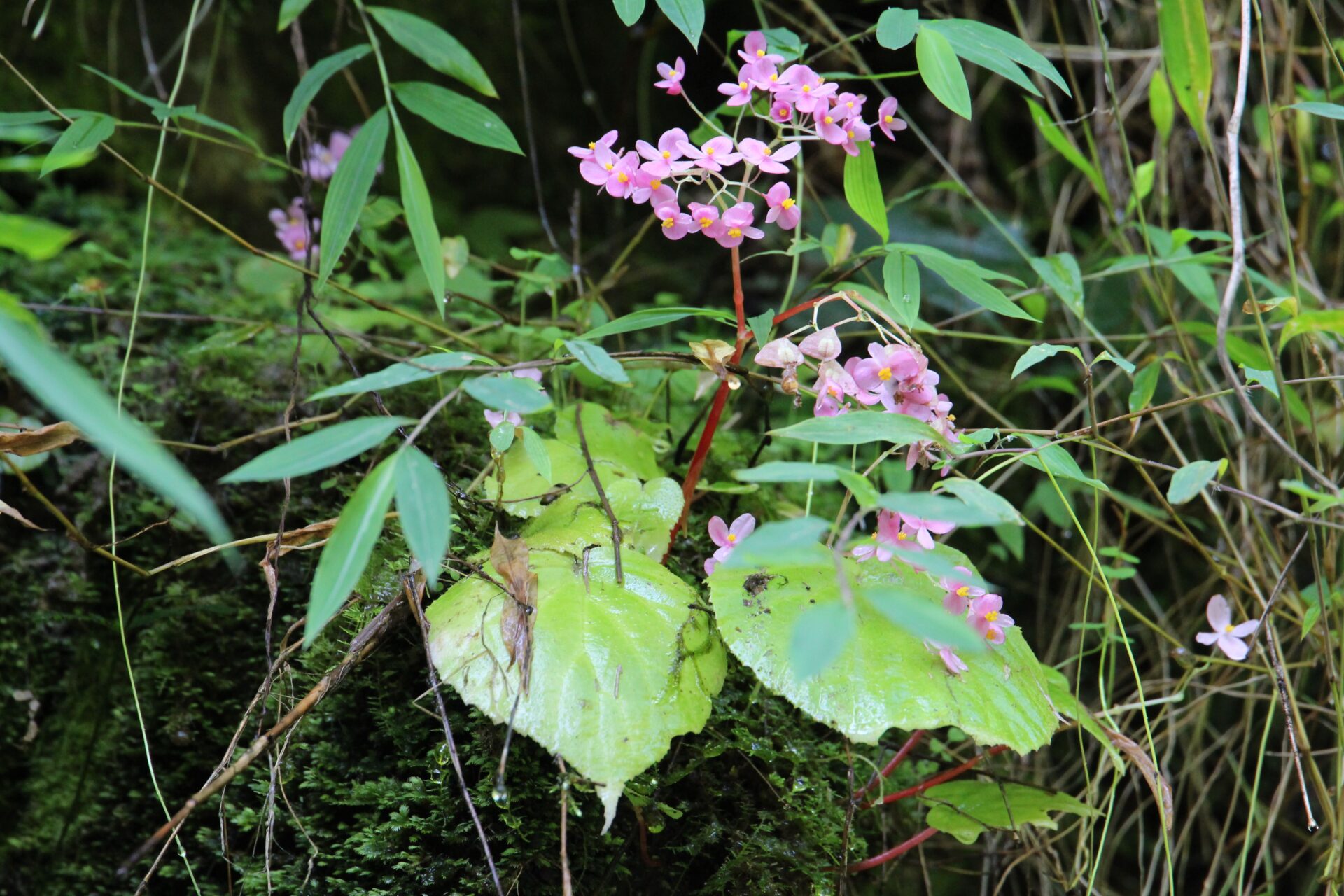
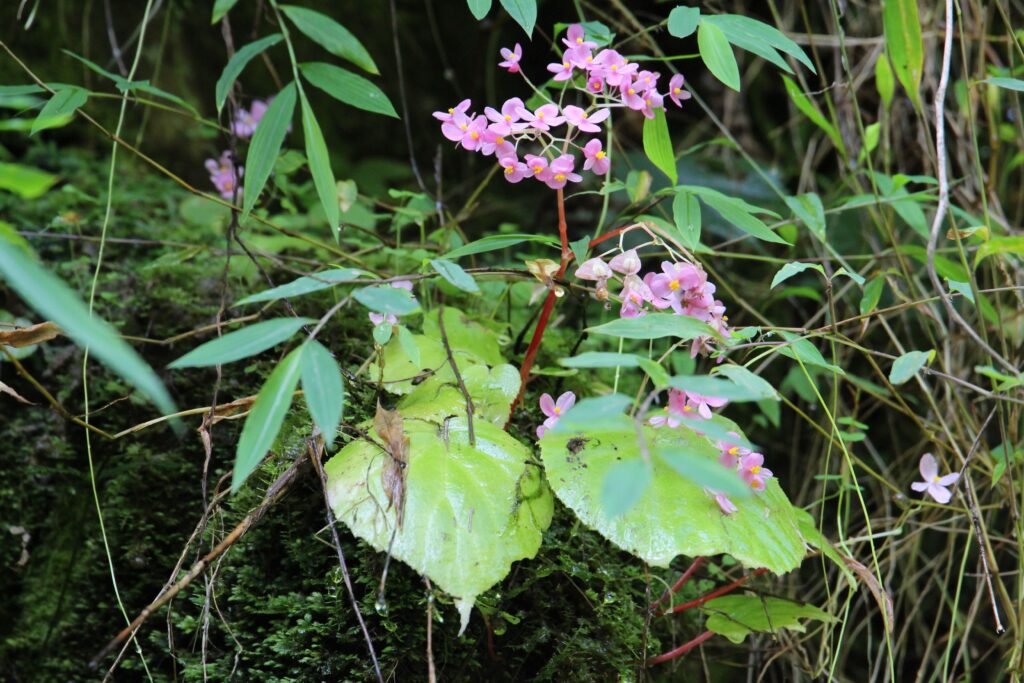
Begonia rubella is a Himalayan herb ranging through Nepal, northern India and Bhutan, with scattered GBIF records (67 occurrences) extending the data to Papua New Guinea, which most likely represents misidentification rather than a genuine disjunction. It is a plant of shaded, humid microhabitats — moist rock faces, stream banks, damp ravines and the floor of broadleaved subtropical to lower-temperate forest — where constant atmospheric moisture and deep shade prevail. The illustrated plant from Zhemgang in central Bhutan at about 910 m, in October at the close of the monsoon, exemplifies its preference for warm, wet, low-montane valleys.
The species is a soft, succulent perennial herb arising from a tuberous or rhizomatous rootstock, with erect to ascending, somewhat fleshy, reddish-tinged stems (the epithet rubella alluding to this colouring). The leaves are alternate, markedly asymmetric (oblique) at the base as is typical of the genus, ovate to broadly ovate, acuminate, irregularly toothed and often flushed red beneath. The flowers are monoecious and zygomorphic, pink to rose, borne in axillary cymes; staminate flowers bear numerous stamens, pistillate flowers an inferior, conspicuously 3-winged ovary. The fruit is the characteristic unequally 3-winged dehiscent capsule shedding minute seeds.
Begonia, the sole large genus of Begoniaceae, is one of the most species-rich angiosperm genera, and the Sino-Himalayan region is a notable centre of diversity. B. rubella belongs to the assemblage of tuberous Himalayan begonias adapted to a strongly seasonal monsoon climate, dying back in the dry winter. Like many narrowly distributed forest begonias it depends on undisturbed humid shade, making it sensitive to forest clearance, though horticultural interest in the group has aided its documentation.
Author: Buch.-Ham. ex D.Don · Sources: POWO (Kew), GBIF, Flora of Bhutan, Flora of British India, Annotated Checklist of the Flowering Plants of Nepal, Begonian Resource (Begoniaceae monographic studies)