Tag:

Autumn

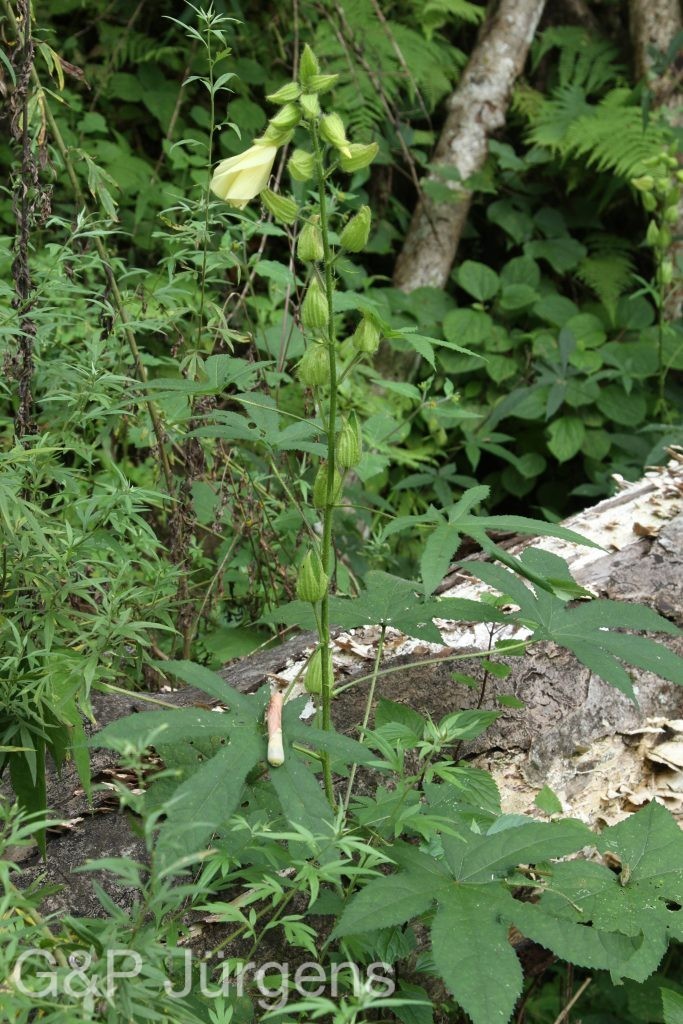
(L.) Medik.

Bhutan2012 1060
Bhutan Anthso 950m, October

Description

Abelmoschus manihot is a tall, robust herb of warm-temperate and subtropical Asia, now pantropically distributed through long cultivation. GBIF records span China, India, Nepal, Japan, Korea and much of Southeast Asia, together with Australia, Pacific islands and the Americas, reflecting both its native Asian range and widespread introduction. In the Himalaya it occupies forest margins, scrub, roadsides, terrace banks and disturbed ground in the foothills and lower montane zone, generally below about 1600 m. The photographed plant grows at Anthso in Bhutan at around 950 m, flowering in October. With more than 3200 occurrences it is among the better-documented Asian mallows.

It is an erect, hispid annual or short-lived perennial reaching 1 to 2 m, the stems bristly with stiff hairs. The leaves are large, long-petiolate, palmately 3- to 7-lobed or sometimes nearly entire, the lobes coarsely toothed, and bear conspicuous narrow segments in the epicalyx. The flowers are large and showy, solitary in the upper leaf axils; the epicalyx comprises several narrow bractlets and the spathaceous calyx splits down one side and falls with the corolla. The five broadly obovate petals are pale to deep yellow with a dark purple-maroon centre. The numerous stamens are united into a staminal column typical of Malvaceae. The fruit is an oblong, hispid loculicidal capsule containing many reniform seeds.

Long cultivated, the species is valued as a leafy vegetable, for its mucilaginous tissues used in papermaking and as a sizing agent, and in traditional medicine; ornamental and food forms exist. Its wide tolerance of disturbance and human dispersal make it abundant, and it is of least conservation concern across its range.

Author: (L.) Medik. · Sources: POWO (Kew), GBIF, Flora of China, Flora of Bhutan, Borssum Waalkes Malesian Malvaceae revision
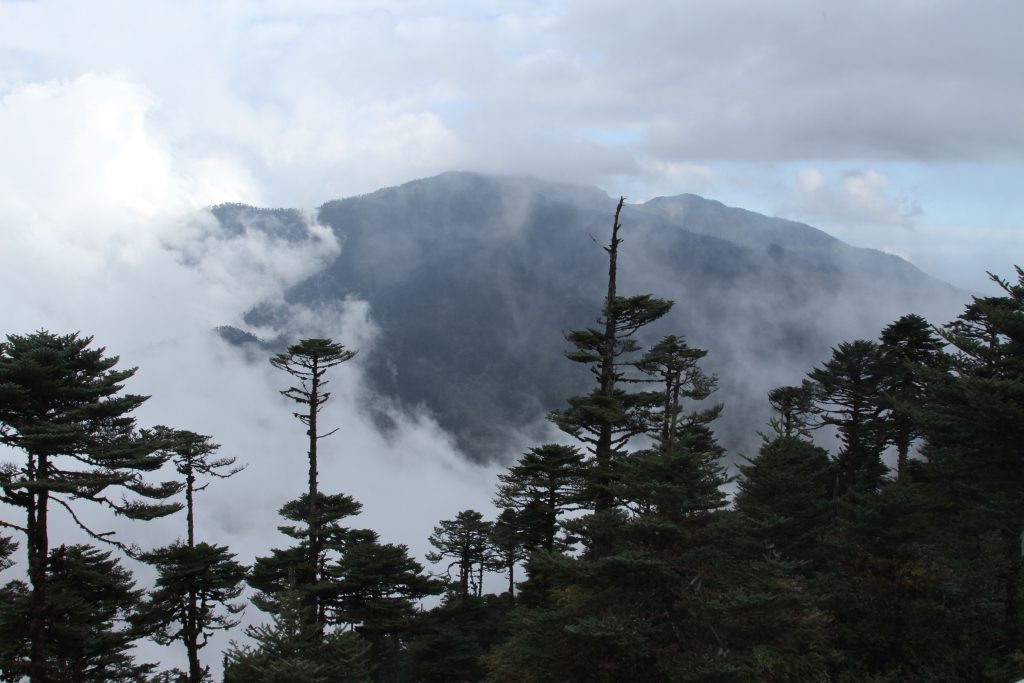
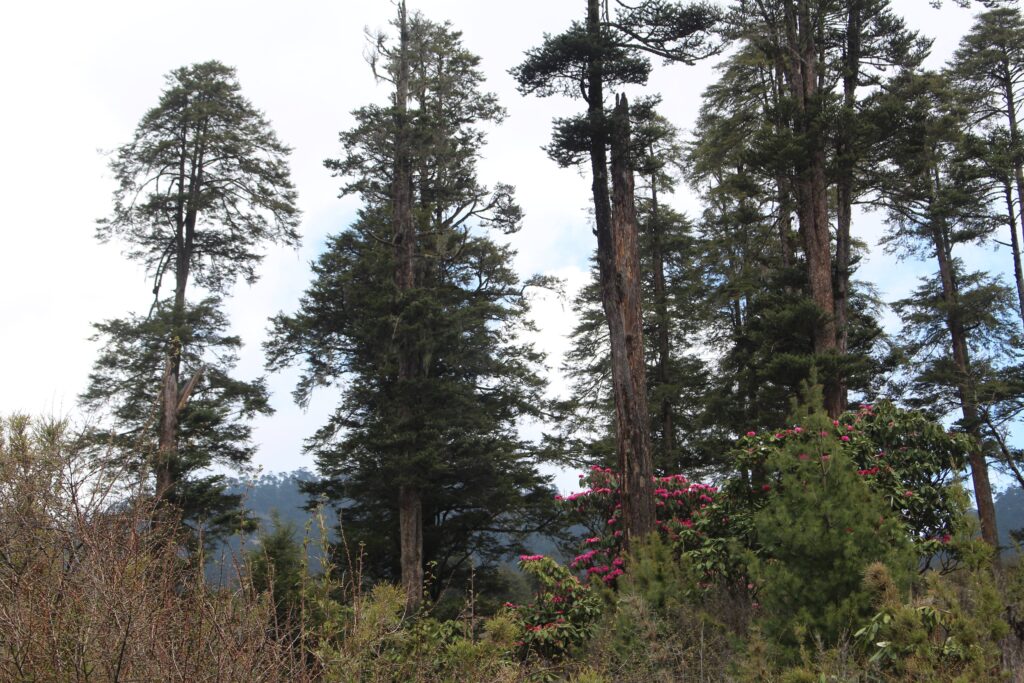
Abies densa

by GP Jürgens

Griff.

Bhutan2015 402
Bhutan Tumching-La 4000m, October
Bhutan2014 420 ergebnis
Bhutan Jakar 2400m, May
Sikkim 2006 82 ergebnis
Sikkim, West-Bengal Kalipokhri 3100m, May

Description

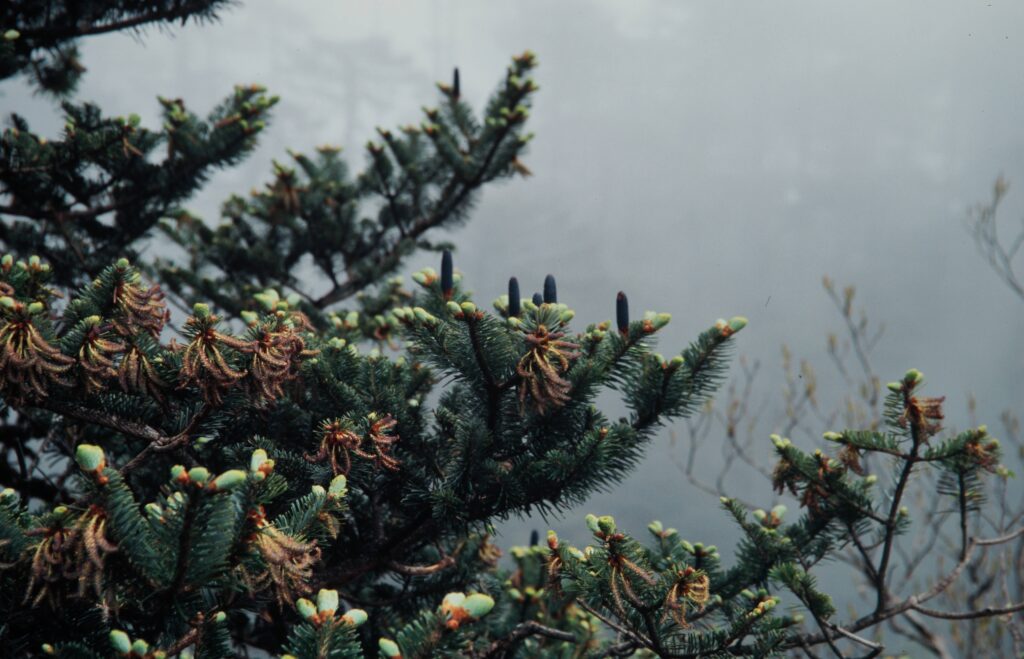
Abies densa, the Bhutan or eastern Himalayan fir, is a large evergreen conifer of the eastern Himalaya, ranging through Bhutan, Sikkim and adjacent India, eastern Nepal, southern China and northern Myanmar (gbif_countries: BT, IN, CN, NP, MM, CA, ZZ, BE), with about 192 GBIF occurrences. It is the dominant tree of the upper subalpine forest belt, forming dense stands often mixed with Rhododendron, birch and juniper and grading into the treeline krummholz. The illustrated records span Jakar in Bhutan at about 2400 m up to Tumching-La near 4000 m and Kalipokhri in the Sikkim–West Bengal borderland at about 3100 m, documenting its occupation of the cool, humid, high-montane to subalpine zone.

The tree reaches considerable height with a straight bole and conical crown, bearing horizontally spreading branches. The needle-like leaves are arranged spirally but pectinately spread, linear and flattened, dark green and glossy above with two whitish stomatal bands beneath, and notched or rounded at the apex. The pollen cones are small and lateral; the seed cones are erect, cylindrical, dark violet to blue-black when young, and, as in all firs, disintegrate on the tree at maturity to release winged seeds, leaving the persistent central axis standing.

Closely allied to Abies spectabilis of the western Himalaya, A. densa is sometimes treated as its eastern vicariant, the two replacing one another along the range. It is an ecologically important timber and watershed species and a keystone of subalpine forest. Though still locally abundant, its treeline populations are sensitive to climate shifts and grazing, and it is assessed as of Least Concern overall while warranting monitoring at range margins.

Author: Griff. · Sources: POWO (Kew), GBIF, Flora of Bhutan, Flora of China, Farjon's A Handbook of the World's Conifers, IUCN Red List conifer assessments

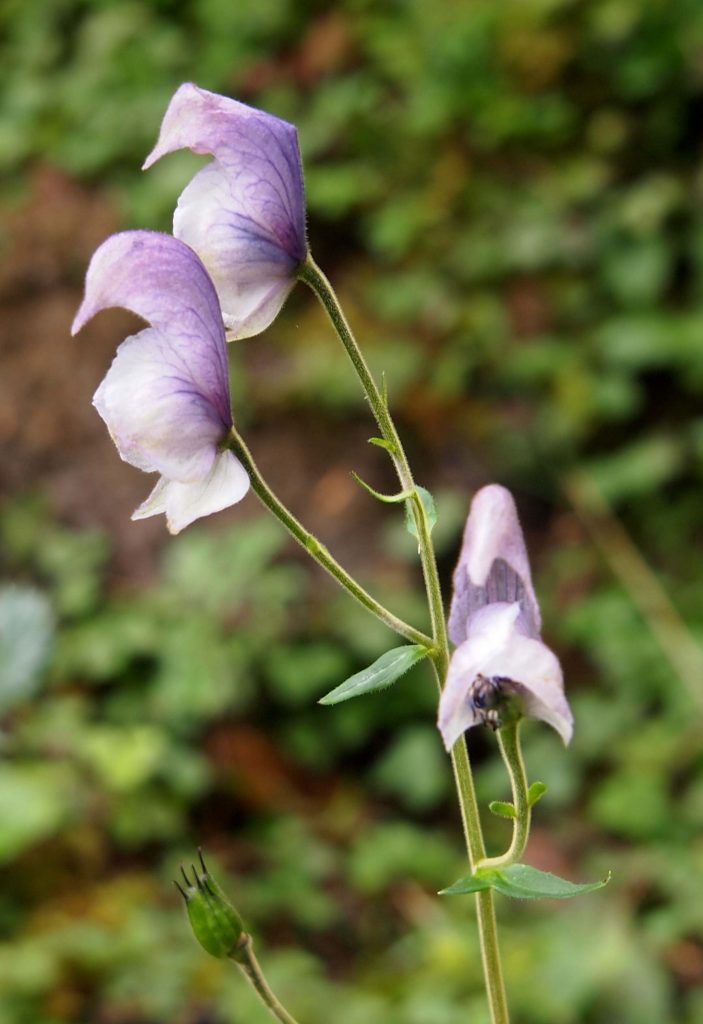
Stapf

Bhutan2012 177
Bhutan Haar-Valley, 3500m September
Bhutan2012 327
Bhutan Dochu-La, 3200m September

Description

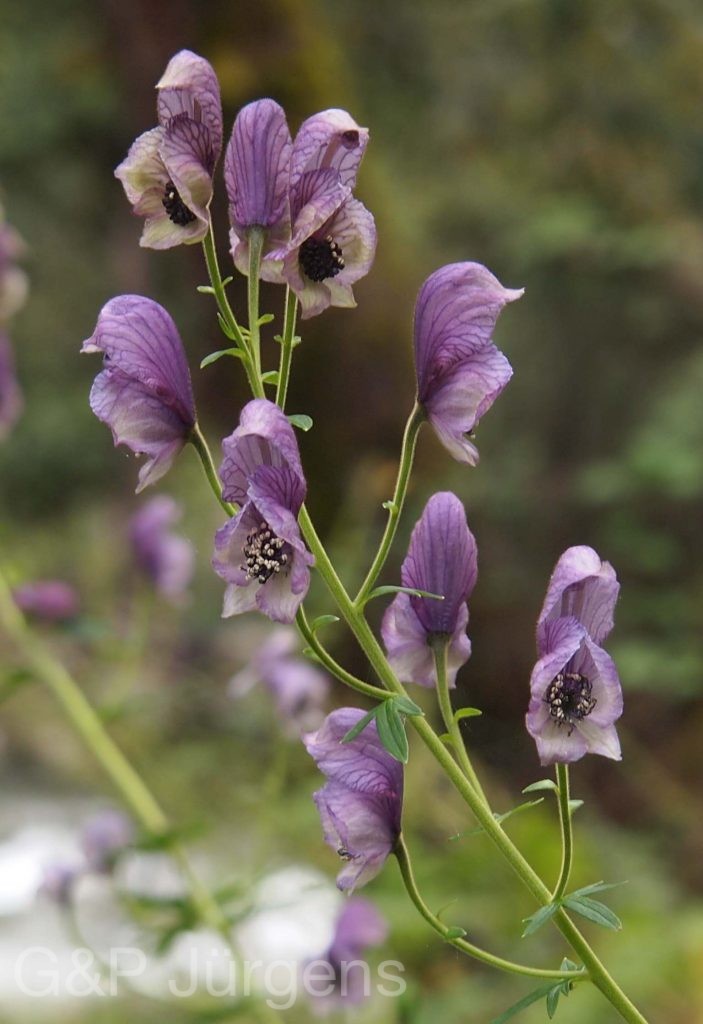
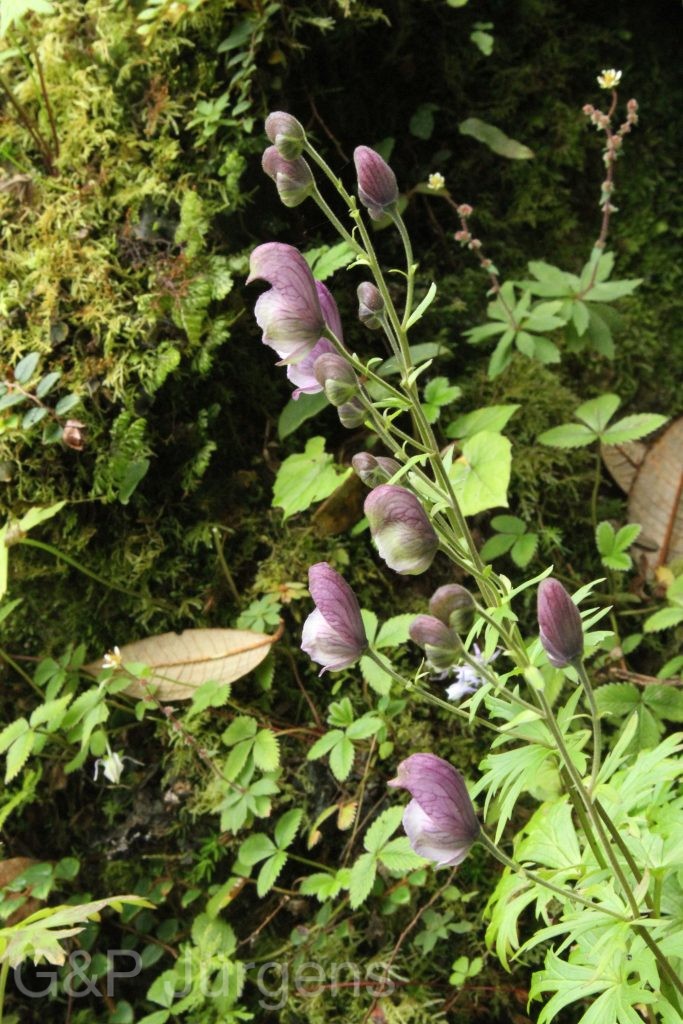
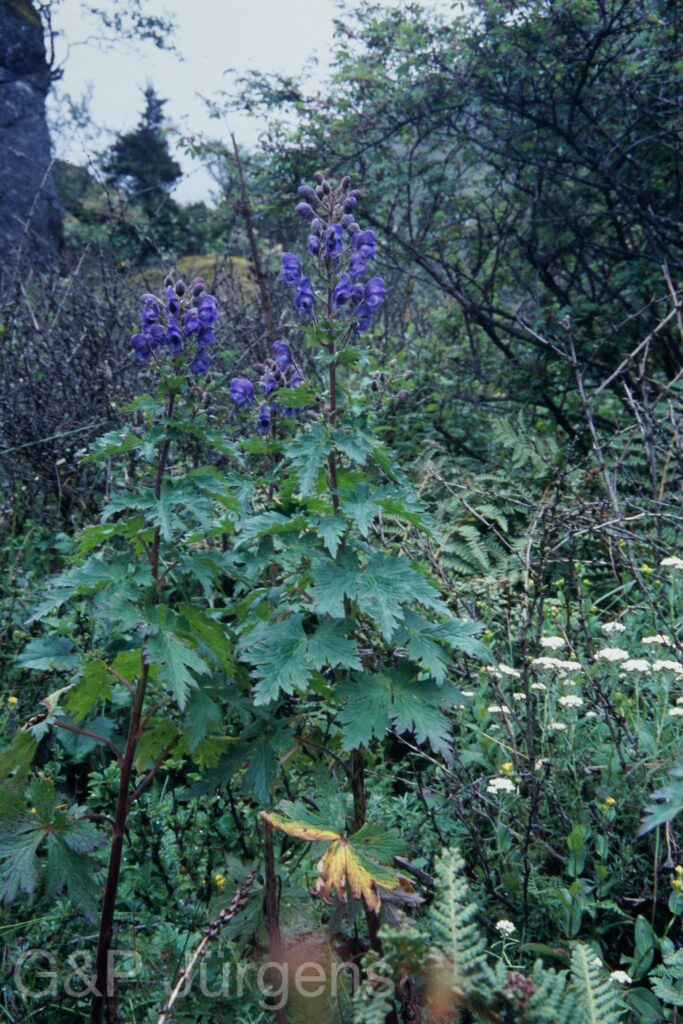
Aconitum heterophylloides is an eastern Himalayan monkshood distributed across Nepal, India, Bhutan and adjacent China, a comparatively narrowly known species with around 68 GBIF occurrences. It grows in subalpine and alpine habitats, on open grassy slopes, scrub margins, forest clearings and damp meadows in the upper temperate to subalpine zone, flowering late in the season. The images document it in Bhutan in the Haar Valley at about 3500 m and at Dochu-La near 3200 m, both in September, when its blue-purple hoods appear among the autumn meadow vegetation.

It is an erect perennial herb arising from paired tuberous roots, with a slender, often somewhat flexuous stem. The leaves are alternate, palmately divided into several lobes, the lower long-petiolate and the upper sessile, with the segments toothed. The inflorescence is a lax terminal raceme of zygomorphic flowers; the conspicuous perianth consists of petaloid sepals, the uppermost forming a tall, helmet- or hood-shaped galea that arches over the two concealed nectariferous petals. The flowers are violet-blue, and the fruit is a cluster of several many-seeded follicles.

Aconitum heterophylloides belongs to the large Sino-Himalayan radiation of the genus, which is taxonomically complex and includes many intergrading montane species; it is allied to the A. heterophyllum group. Like other monkshoods the plant contains diterpenoid alkaloids and is highly toxic, while the hooded flowers are adapted for buzz- and tongue-pollination by bumblebees foraging late in the alpine season. Several Himalayan Aconitum are heavily harvested for medicinal use, making range-restricted species potentially vulnerable to overcollection.

Author: Stapf · Sources: POWO (Kew), GBIF, Flora of China, Flora of Bhutan, Flora of Nepal, Tamura's treatment of Ranunculaceae

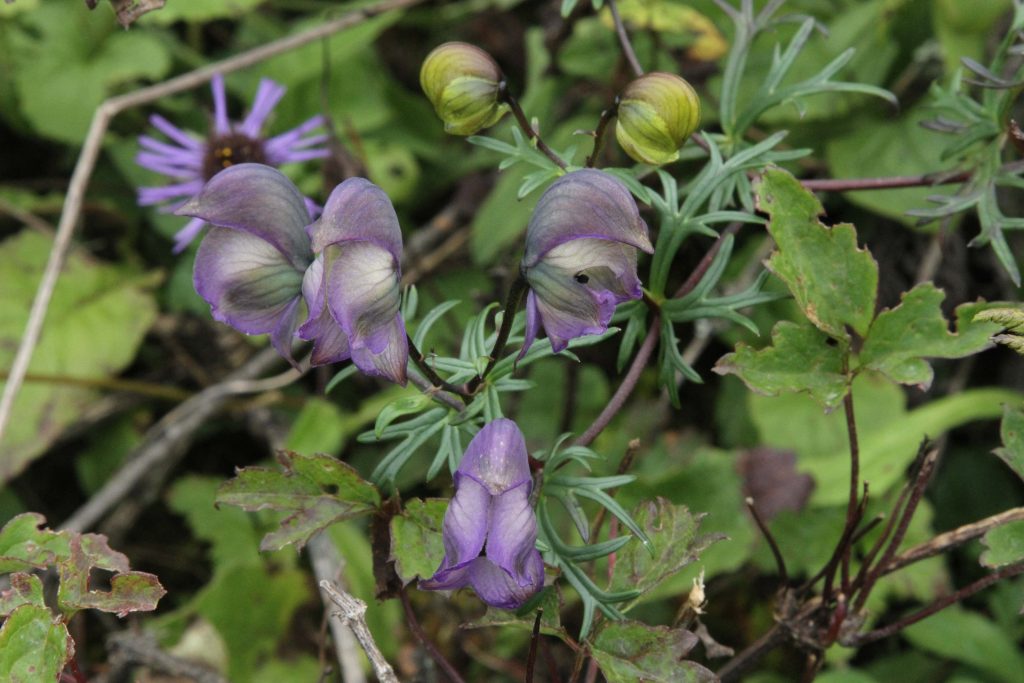
Griff.

Sikkim2003 440 P612
Sikkim Chopta Valley 3900m August
Sikkim2003 441 P613
Sikkim Chopta Valley 3900m August
Bhutan2012 39
Bhutan Shele-La, 3600m September
Bhutan2012 176
Bhutan Haar-Valley 3500m, September

Description

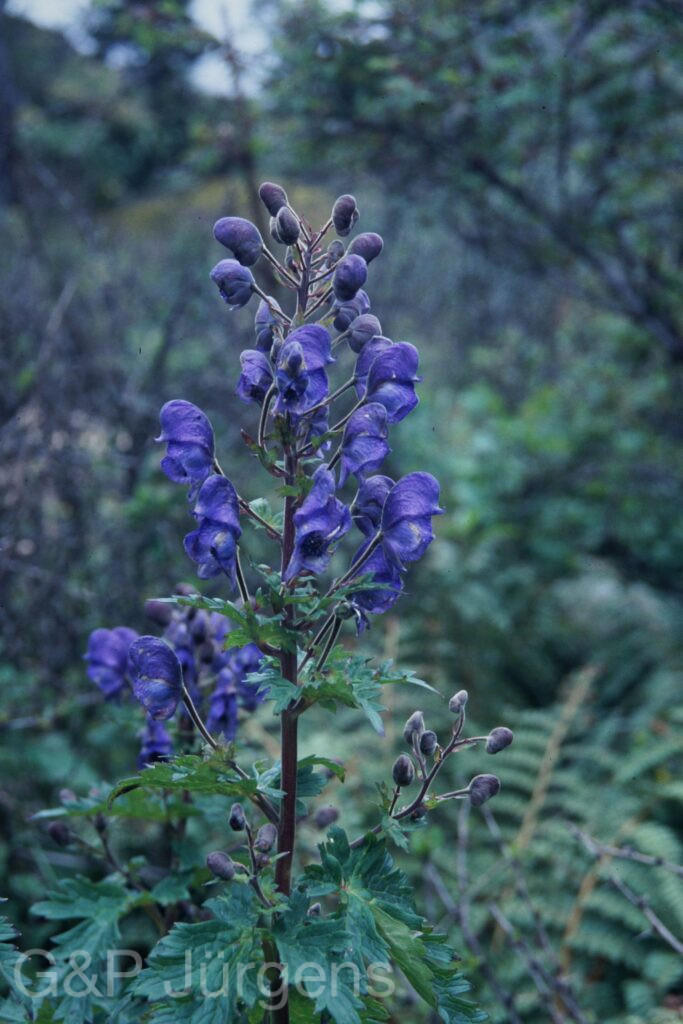
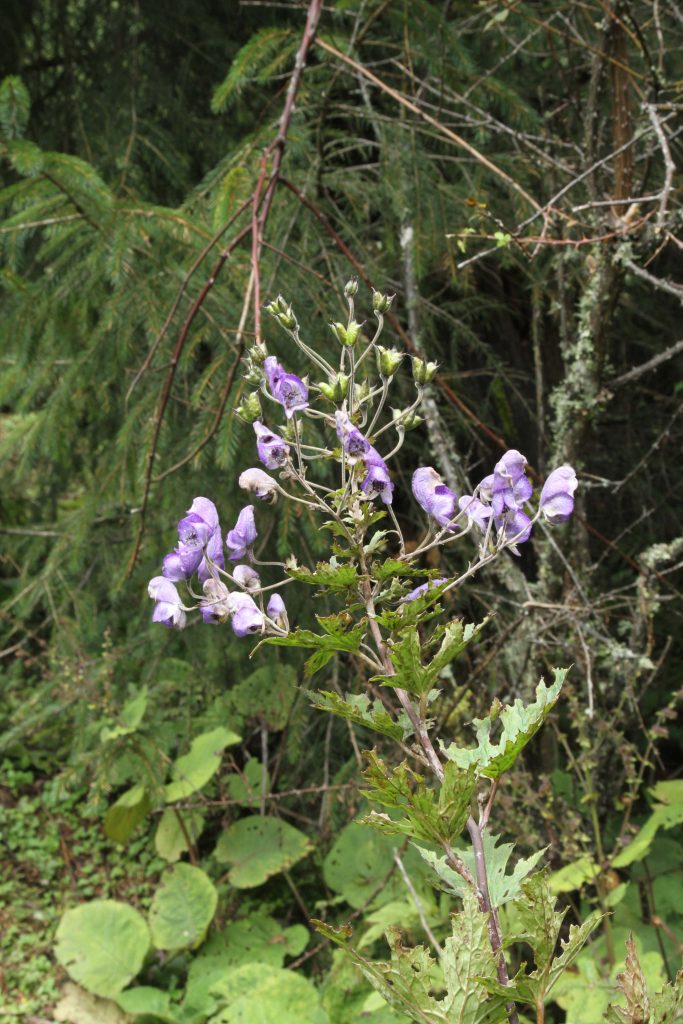
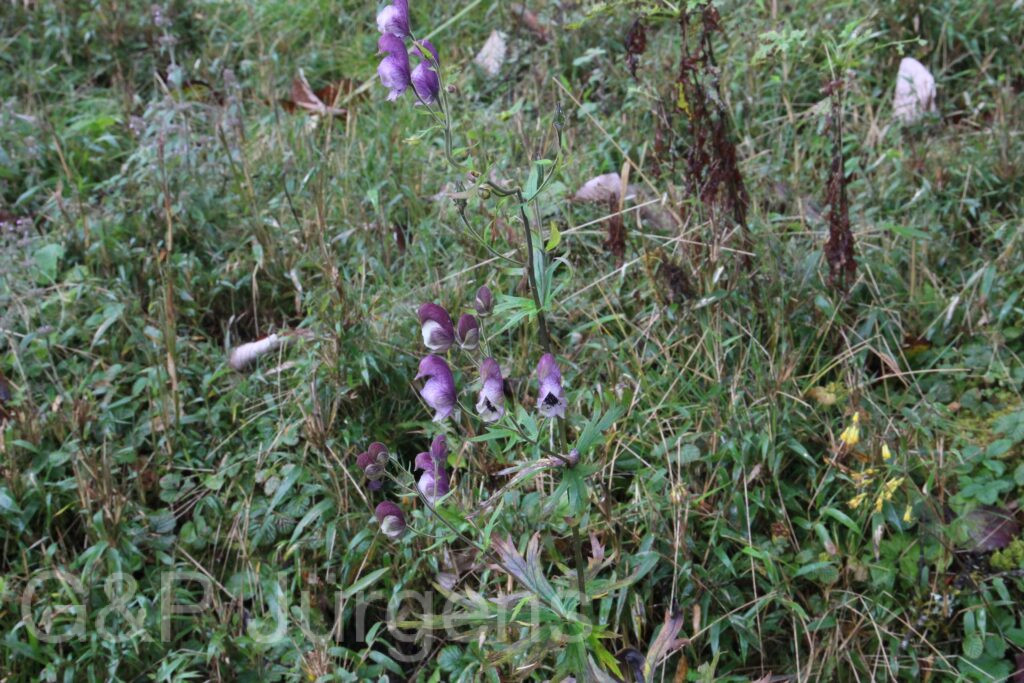
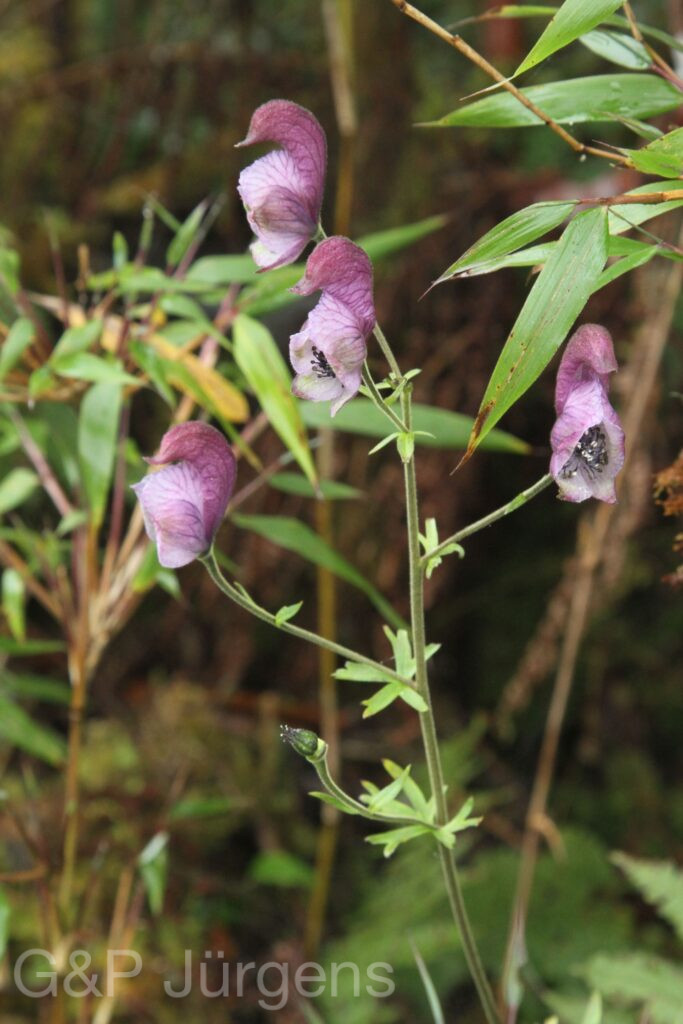
Aconitum lethale is an eastern Himalayan monkshood restricted to Nepal, India and Bhutan, with about 176 GBIF records concentrated in Sikkim and Bhutan. It is a plant of the upper subalpine and alpine zone, growing among tall-herb meadows, rhododendron and juniper scrub, and along moist, open slopes. The cited collections trace its habitat closely: the Chopta Valley in Sikkim at around 3900 m in August, and several Bhutanese sites including Shele-La at about 3600 m, the Haar Valley at 3500 m and Dochu-La near 3000 m, flowering from late summer into October. It favours cool, humid, well-drained mountain soils where the monsoon sustains lush herbaceous growth.

The plant is an erect perennial herb arising from tuberous roots, with a leafy stem bearing palmately divided, deeply lobed leaves whose segments are further incised. The inflorescence is a terminal raceme or panicle of the characteristic zygomorphic flowers, in which the upper sepal is enlarged into a tall, helmet-shaped or hooded galea concealing two long-clawed nectaries; the flowers are typically deep blue to violet. Numerous stamens surround several free carpels, which ripen into a cluster of dehiscent follicles releasing winged or angular seeds.

Described by Griffith, A. lethale is, as both its epithet and generic affinity warn, intensely poisonous, containing diterpenoid alkaloids of the aconitine type throughout the plant and especially in its tubers. Such alkaloids underlie the cautious medicinal use of Himalayan aconites in traditional pharmacopoeias. As a narrow-range endemic of the eastern Himalaya, it warrants attention to grazing pressure and habitat change, though it remains locally frequent within its restricted distribution.

Author: Griff. · Sources: POWO (Kew), GBIF, Flora of Bhutan, Annotated Checklist of the Flowering Plants of Nepal, Tamura's treatment of Aconitum

Tamura

Bhutan2012 288
Bhutan Shele-La, 4100m September

Description

Aconitum nakaoi is a high-alpine monkshood distributed across the eastern Himalaya and the south-eastern Tibetan plateau margin, recorded from Bhutan, China (Xizang and adjacent Yunnan), Nepal and northern India. Its modest documentary record of around 21 georeferenced occurrences reflects both its restricted range and the difficulty of botanizing the steep upper screes and meadows it favours. The species inhabits open alpine turf, the margins of dwarf-shrub thickets and damp stony slopes, typically between about 3,800 and 4,500 m. The photographed plant from Shele-La in Bhutan at 4,100 m, flowering in September, is characteristic of its late-season anthesis in the cool, monsoon-influenced uplands where snowmelt and persistent humidity sustain the short growing season.

The plant is a perennial herb arising from small paired tuberous roots, with slender, often decumbent to ascending stems. The leaves are palmately divided into narrow, deeply incised segments, glabrous to thinly pubescent, the basal leaves long-petiolate and the cauline ones progressively reduced. The inflorescence is a lax few-flowered raceme bearing the zygomorphic, helmet-shaped flowers typical of the genus; the upper sepal forms a high, narrowly conical to galeate hood enclosing two long-clawed nectariferous petals, the colour ranging from violet-blue to dull purplish. The fruit is a cluster of several erect follicles releasing winged seeds.

Like all Aconitum, the species contains diterpenoid alkaloids and is highly toxic. It belongs to the taxonomically intricate Himalayan radiation of section Aconitum, where narrow endemics and clinal variation complicate species delimitation. Though not formally assessed as threatened, its narrow altitudinal band makes it sensitive to upward shifts of the treeline and to grazing pressure on alpine pastures.

Author: Tamura · Sources: POWO (Kew), Flora of China Vol. 6, Flora of Bhutan Vol. 1, GBIF, Tamura: Ranunculaceae in Die natürlichen Pflanzenfamilien

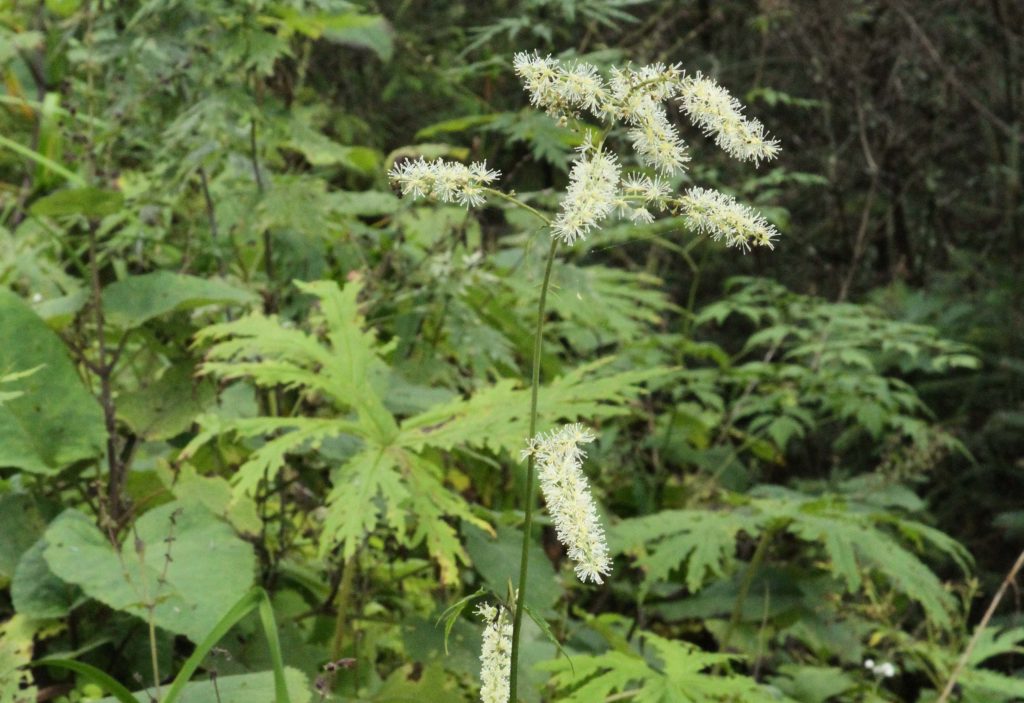
L.

Bhutan2012 41
Bhutan Shele-La, 3600m September
Bhutan2012 42
Bhutan Shele-La, 3600m September

Description

Actaea cimicifuga, the type of the long-segregated genus Cimicifuga and now treated within Actaea, is a temperate Eurasian herb with a vast range spanning Russia, China, Korea, Mongolia, Japan, Nepal, India, Bhutan and parts of central and eastern Europe, reflected in some 2565 georeferenced records. It grows in cool montane and subalpine woodland, forest margins, scrub and tall-herb meadows, in the Himalaya generally between about 2500 and 3800 m. The recorded plant from Shele-La in Bhutan at 3600 m, flowering in September, illustrates its preference for moist, shaded high-montane situations where it blooms late in the season.

It is a tall, erect perennial from a stout woody rhizome, reaching well over a metre. The leaves are large and ternately to bipinnately compound, with ovate, sharply toothed and lobed leaflets. The inflorescence is an elongate, branched panicle of slender racemes bearing many small, short-stalked flowers; the petaloid sepals fall early, the petals are reduced and staminode-like, and the numerous white stamens give the spikes a feathery aspect. The fruit is a cluster of dry, dehiscent, several-seeded follicles, distinguishing it from the berry-fruited typical species of Actaea.

The follicular fruit and tall paniculate habit underlie the historic recognition of Cimicifuga, now subsumed into Actaea on molecular grounds, making the species a focus of generic-circumscription debate. The plant has a strong, unpleasant odour repellent to insects, the source of the name "bugbane," and it has a long history of medicinal use. Widespread and locally common, it is of no conservation concern.

Author: L. · Sources: POWO (Kew), GBIF, Flora of China, Flora of Bhutan, Compton's revision of Cimicifuga and Actaea

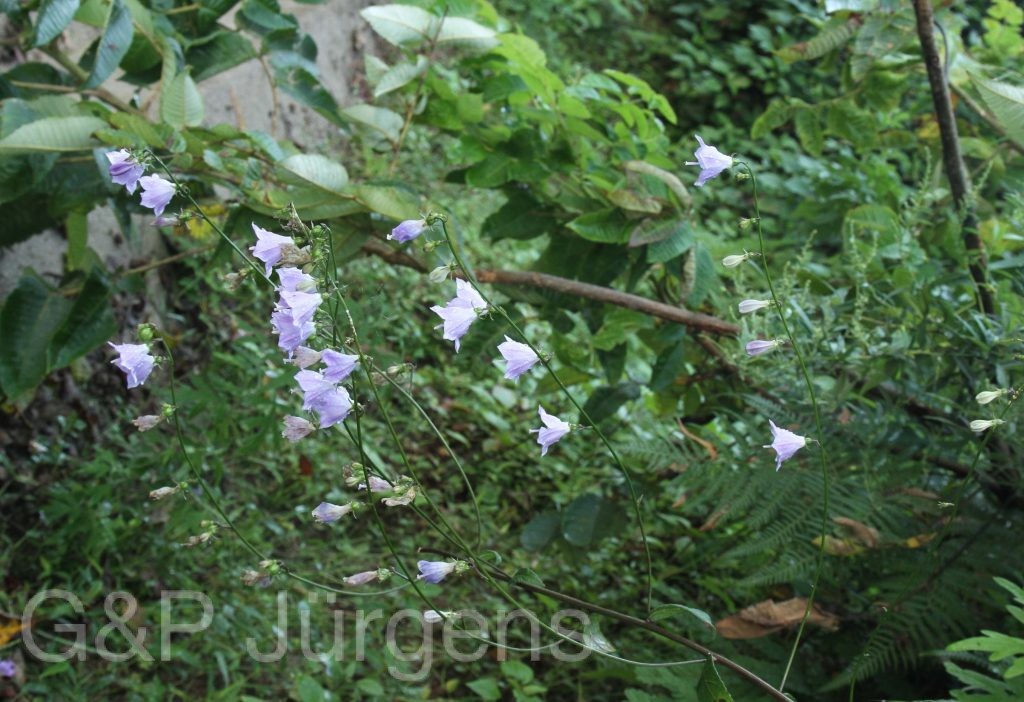
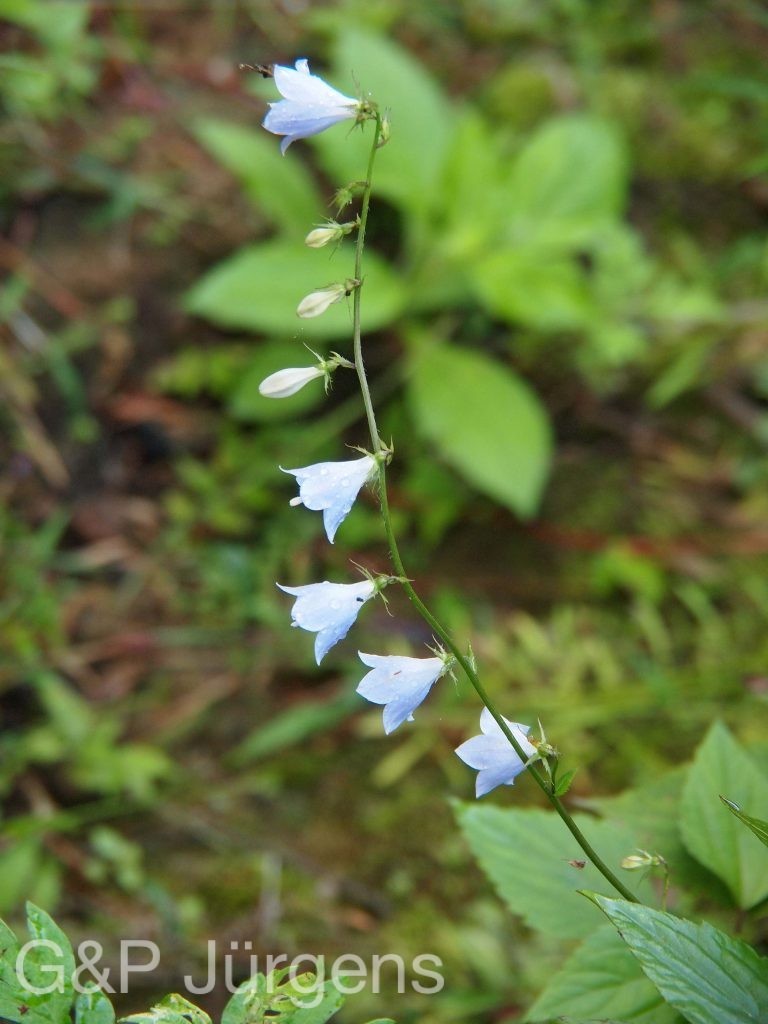
(Hook. f. & Thomson) Collett & Hemsl.

Bhutan2012 517
Bhutan Wangdi 2700m, September
Bhutan2012 518
Bhutan Wangdi 2700m, September

Description

Adenophora khasiana is a Sino-Himalayan ladybell distributed from the eastern Himalaya through northeastern India (including the Khasi Hills, source of the epithet), Bhutan and Myanmar into southern China, with scattered records elsewhere reflecting herbarium and cultivated material; GBIF documents some 327 occurrences. It is a plant of the temperate montane belt, occurring on grassy banks, forest margins, scrub and open rocky slopes, as recorded near Wangdi in Bhutan at 2700 m. Flowering in late summer and autumn (September), it favours well-drained, sunny to lightly shaded sites within the broadleaved and mixed forest zone.

It is an erect perennial herb arising from a thickened, fleshy taproot, the stems simple or sparingly branched and exuding milky latex when broken, as is characteristic of the family. The leaves are alternate, sessile or short-petiolate, ovate to lanceolate and toothed along the margin. The flowers are borne in a lax terminal panicle or raceme; the corolla is campanulate to broadly funnel-shaped and blue to pale violet, with five short lobes. Diagnostic for the genus is the tubular nectary disc surrounding the base of the style, and the elongate style that is usually exserted beyond the corolla. The fruit is a capsule dehiscing by basal pores to shed numerous small seeds.

The species was transferred to Adenophora by Collett & Hemsley from a basionym of Hooker f. & Thomson. Adenophora is distinguished from the closely related Campanula primarily by its conspicuous cylindrical nectariferous disc at the base of the style, a key character in the taxonomy of the Campanulaceae. The protandrous, nectar-rich flowers attract bees and other long-tongued insects. The fleshy roots of several Adenophora species are used in East Asian herbal medicine. Widespread and locally common, A. khasiana is not considered threatened.

Author: (Hook. f. & Thomson) Collett & Hemsl. · Sources: POWO (Kew), GBIF, Flora of China, Flora of Bhutan, Hong's monograph of the genus Adenophora (Campanulaceae)

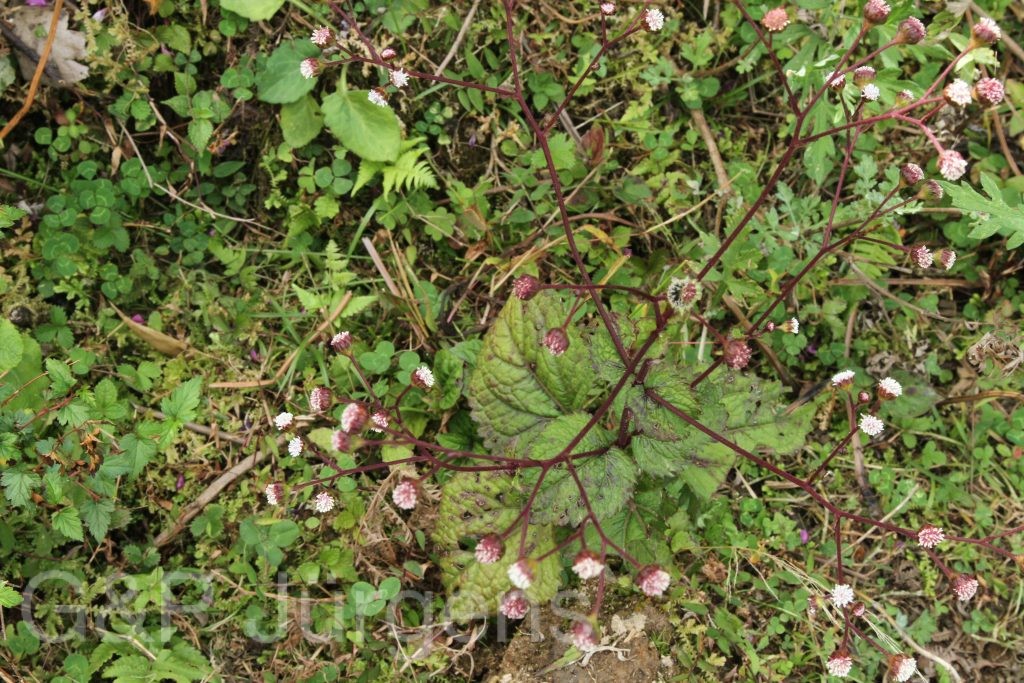
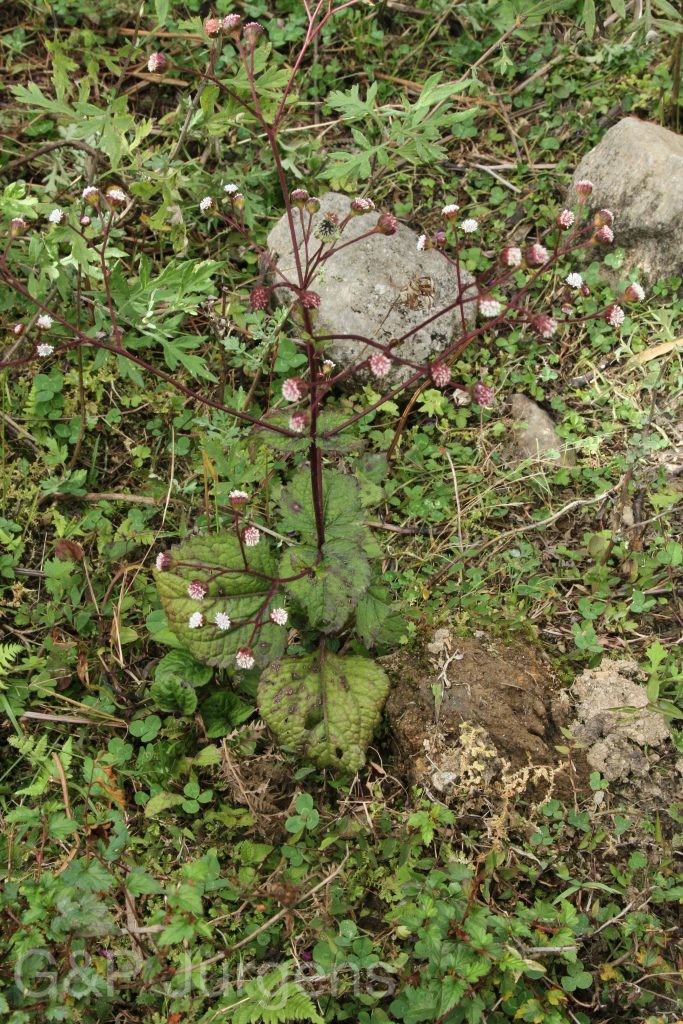
(L.) Kuntze

Bhutan2015 588
Bhutan Mo-Chu 1900m, October
Bhutan2015 589
Bhutan Mo-Chu 1900m, October

Description

Adenostemma lavenia is a near-pantropical composite of remarkably wide distribution, with GBIF documenting some 4700 occurrences across Asia, Australasia, the Americas, Africa and the Pacific, including China, Japan, India, Nepal, Australia, the Philippines, Brazil and many other countries. It is a weed of moist, shaded habitats, favouring streambanks, wet forest margins, ditches and damp disturbed ground, mostly at low to mid elevations. The photographed plant is from the Mo-Chu valley in Bhutan at 1900 m in October, growing in humid riparian thicket within subtropical hill forest.

The species is an erect to ascending annual or short-lived perennial herb with branched, ridged, sparsely pubescent stems. The leaves are opposite, ovate to deltoid, coarsely crenate-serrate, with a cuneate to truncate base narrowing to a winged petiole. The capitula are small, discoid and white, lacking ray florets, arranged in lax terminal corymbose cymes; each holds few tubular florets within a two-seriate involucre of subequal phyllaries. The most diagnostic feature is the cypsela, which is glandular-tuberculate and crowned by a pappus reduced to a few short, stout, gland-tipped (clavate) bristles that act as a clinging burr.

Adenostemma is a small genus of the tribe Eupatorieae, and A. lavenia is the type and most cosmopolitan species, its sticky fruits readily dispersed on animals and clothing, explaining its global spread. Highly variable and broadly circumscribed, it has long been used in folk medicine. It is abundant and weedy, hence of no conservation concern.

Author: (L.) Kuntze · Sources: POWO (Kew), GBIF, Flora of China, Flora of Bhutan, Annotated Checklist of the Flowering Plants of Nepal, Revision of Adenostemma (Eupatorieae)

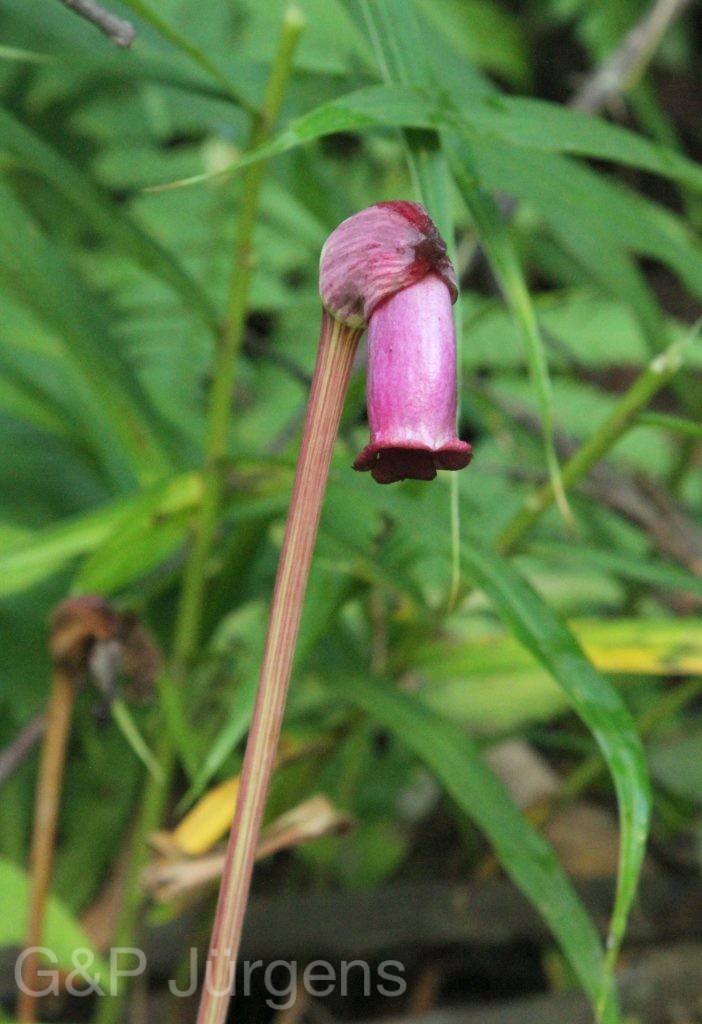
L.

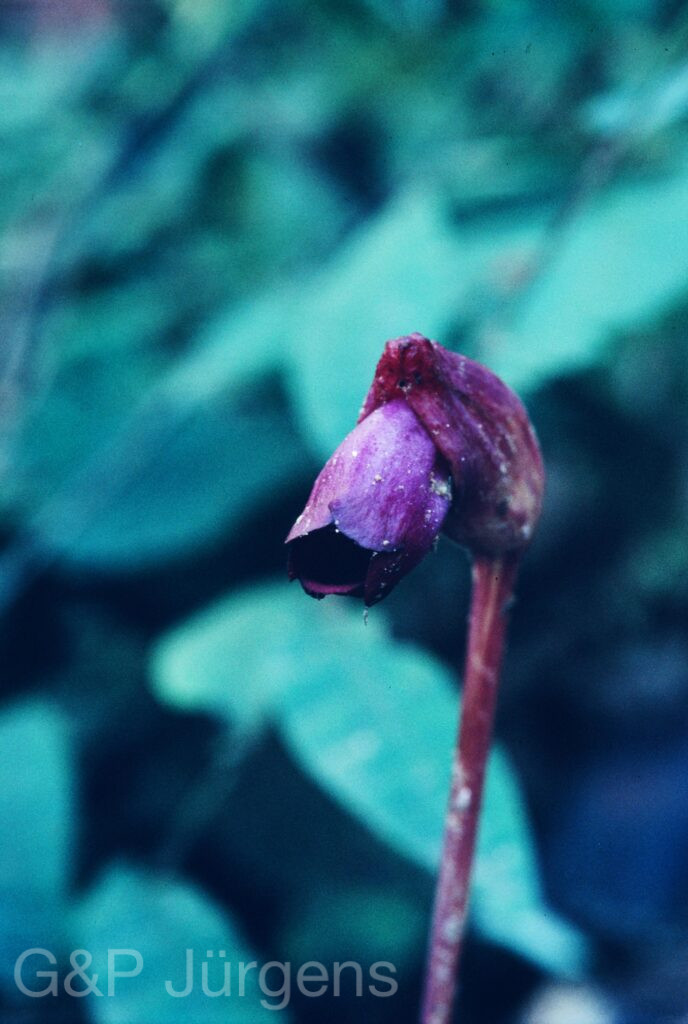
Bhutan2012 456
Bhutan Wangdi 2500m, September
Nepal 95 63 P106 ergebnis
Nepal below Barphak 1400m October

Description

Aeginetia indica is a widespread holoparasitic herb of tropical and subtropical Asia, recorded from Japan, China, Taiwan, Korea and across South and Southeast Asia including India, Nepal, Bhutan, Sri Lanka, Myanmar, Thailand, the Malesian region and beyond; with about 3514 GBIF records it is by far the most frequently collected species in this group. It is a root parasite of grasses and other monocots, occurring in moist forest, grassland, scrub, plantations and field margins from the lowlands up into the lower hills, generally below about 2500 m. The plants illustrated, from Wangdi in Bhutan at around 2500 m in September and below Barphak in Nepal at about 1400 m in October, span this elevational range.

Lacking chlorophyll, the plant is reduced to fleshy, scale-like leaves on a very short underground stem attached to the host roots. The conspicuous part is the flower, borne singly atop a long, stout, purplish or yellowish scape; it is a large, tubular, somewhat curved corolla coloured deep purple to magenta with a paler throat, the five lobes short and the mouth oblique, subtended by a boat-shaped spathe-like calyx. There are four stamens and a superior ovary that ripens into a many-seeded capsule shedding the dust-like seeds characteristic of parasitic plants.

Now placed in the broadened Orobanchaceae following the merger of the old Scrophulariaceae-derived parasites, Aeginetia is an Asian genus of obligate root parasites, and A. indica is notable as a parasite of sugarcane and other grasses, where it can be a minor agricultural pest. Its enormous seed output and broad host and geographic range make it ecologically successful and of no conservation concern. The species is also used in traditional medicine across parts of its range.

Author: L. · Sources: POWO (Kew), GBIF, Flora of China, Flora of Bhutan, Annotated Checklist of the Flowering Plants of Nepal, Nickrent Parasitic Plant Genera of the World

Wall.ex A.DC.

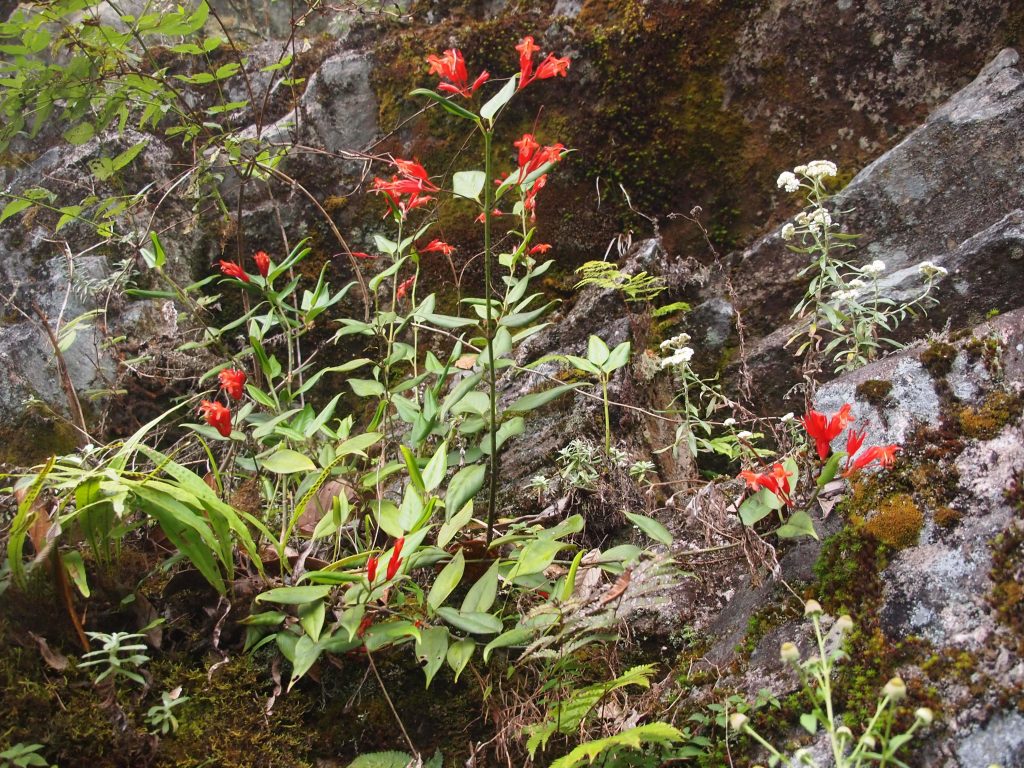
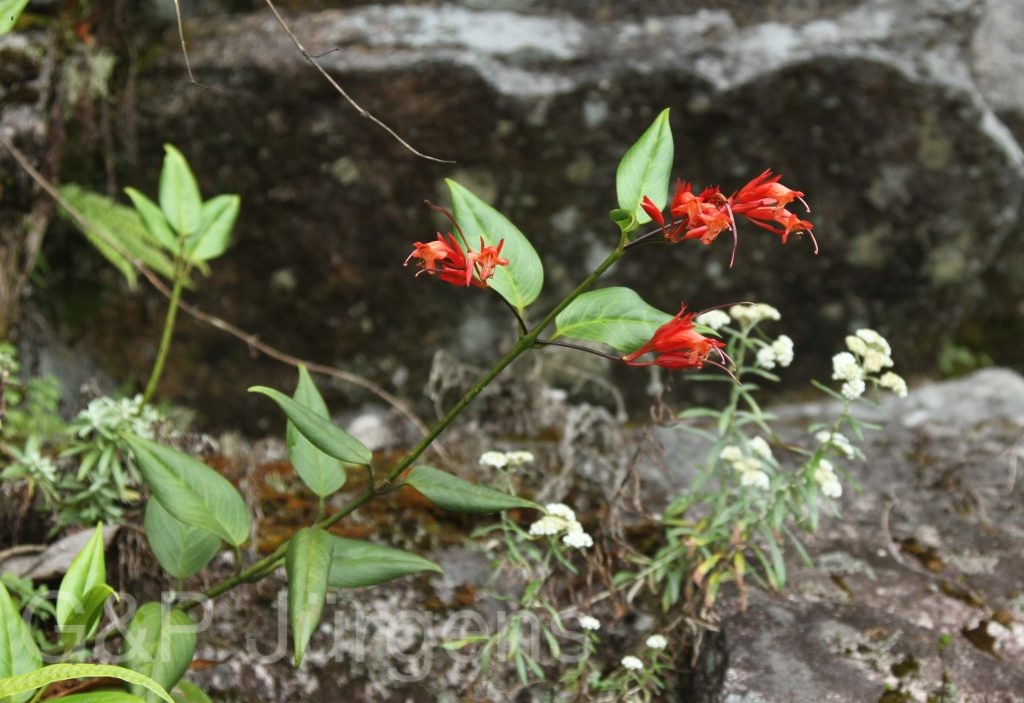
Bhutan2012 946
Bhutan Trithangebe 2100m, October
Bhutan2012 947
Bhutan Trithangebe 2100m, October

Description

Aeschynanthus bracteatus is an epiphytic subshrub of the eastern Himalaya and Indo-Chinese region, distributed from Nepal and northern India through Bhutan and Bangladesh into Myanmar, south-western China, Laos and Vietnam, with around 906 occurrence records. It grows as an epiphyte or lithophyte on mossy tree trunks, branches and shaded rocks in humid evergreen broad-leaved montane forest, typically between about 1500 and 2500 m. The specimen photographed at Trithangbe in Bhutan at 2100 m in October illustrates its autumn flowering within the moist, mist-laden forests where epiphytic gesneriads thrive.

The plant has trailing to pendulous, somewhat fleshy stems rooting at the nodes, bearing opposite, thick, elliptic to lanceolate leaves that are entire and glabrous, with an obscurely veined, leathery texture suited to its epiphytic life. The inflorescences are terminal or axillary clusters subtended by conspicuous bracts, the feature reflected in the epithet bracteatus. The flowers have a tubular, often dark calyx and a curved, tubular two-lipped corolla in shades of red to orange-red, the throat sometimes marked within. The fruit is a long, slender, capsule splitting to release numerous small seeds furnished with hair-like appendages aiding wind dispersal.

Aeschynanthus (Gesneriaceae) is a large palaeotropical genus of climbing and epiphytic herbs and subshrubs; the input file places it under Didymocarpinae, a subtribal name within Gesneriaceae, whereas the genus is conventionally treated in subtribe Loxonia/Trichosporeae allies. The tubular red flowers and protruding stamens indicate bird (sunbird) pollination, while the plumose-appendaged seeds are wind-dispersed. The species is widespread across the Indo-Burmese hills and is of least conservation concern, serving as a characteristic epiphyte of eastern Himalayan cloud forest.

Author: Wall.ex A.DC. · Sources: POWO (Kew), GBIF, Flora of China, Flora of Bhutan, Annotated Checklist of the Flowering Plants of Nepal, Mendum revision of Aeschynanthus