
(L.) Medik.
Description
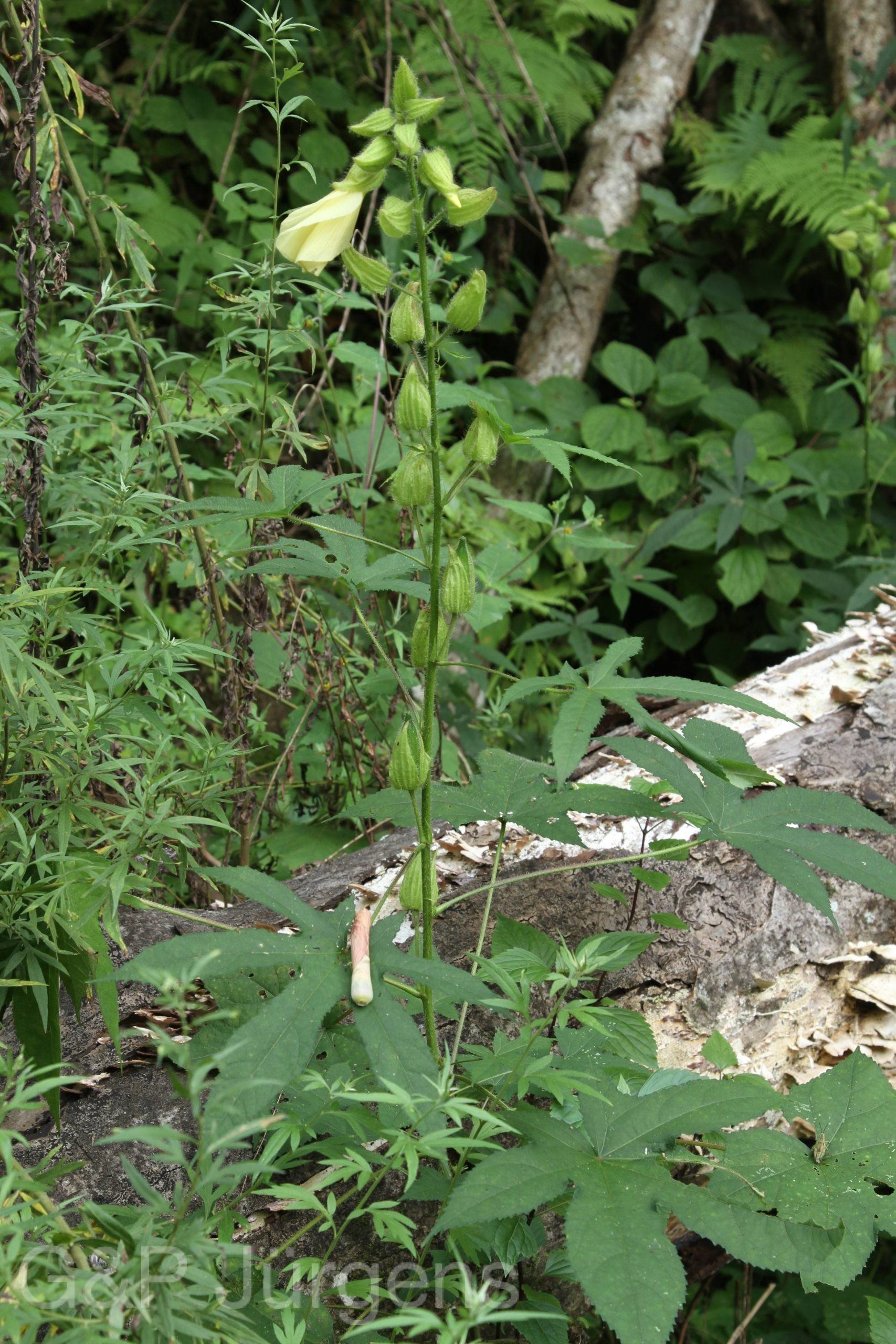
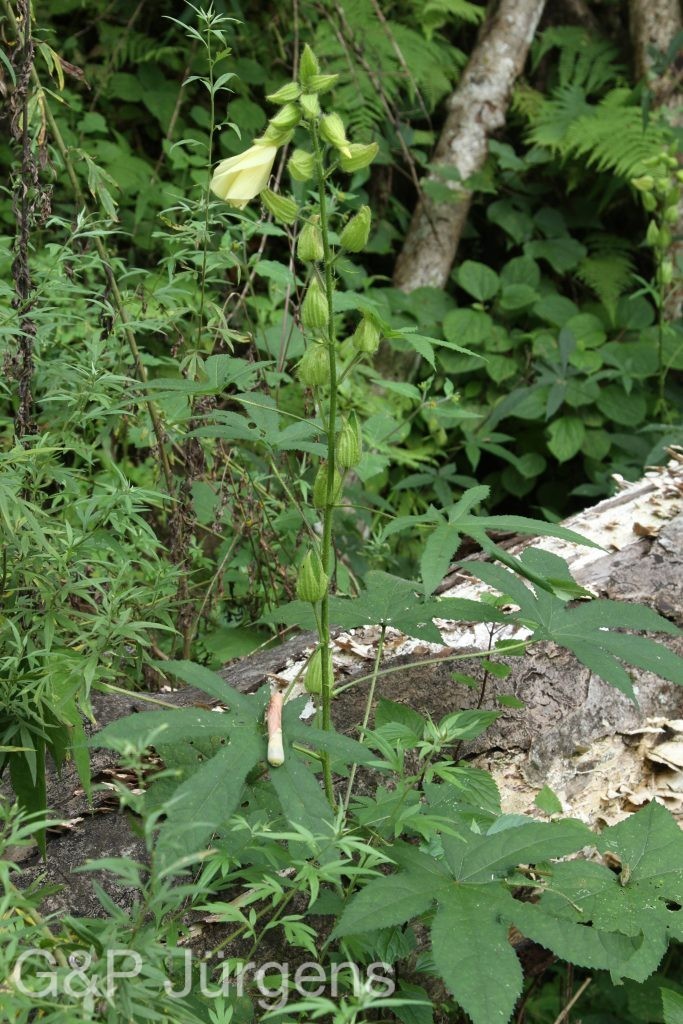
Abelmoschus manihot is a tall, robust herb of warm-temperate and subtropical Asia, now pantropically distributed through long cultivation. GBIF records span China, India, Nepal, Japan, Korea and much of Southeast Asia, together with Australia, Pacific islands and the Americas, reflecting both its native Asian range and widespread introduction. In the Himalaya it occupies forest margins, scrub, roadsides, terrace banks and disturbed ground in the foothills and lower montane zone, generally below about 1600 m. The photographed plant grows at Anthso in Bhutan at around 950 m, flowering in October. With more than 3200 occurrences it is among the better-documented Asian mallows.
It is an erect, hispid annual or short-lived perennial reaching 1 to 2 m, the stems bristly with stiff hairs. The leaves are large, long-petiolate, palmately 3- to 7-lobed or sometimes nearly entire, the lobes coarsely toothed, and bear conspicuous narrow segments in the epicalyx. The flowers are large and showy, solitary in the upper leaf axils; the epicalyx comprises several narrow bractlets and the spathaceous calyx splits down one side and falls with the corolla. The five broadly obovate petals are pale to deep yellow with a dark purple-maroon centre. The numerous stamens are united into a staminal column typical of Malvaceae. The fruit is an oblong, hispid loculicidal capsule containing many reniform seeds.
Long cultivated, the species is valued as a leafy vegetable, for its mucilaginous tissues used in papermaking and as a sizing agent, and in traditional medicine; ornamental and food forms exist. Its wide tolerance of disturbance and human dispersal make it abundant, and it is of least conservation concern across its range.
Author: (L.) Medik. · Sources: POWO (Kew), GBIF, Flora of China, Flora of Bhutan, Borssum Waalkes Malesian Malvaceae revision