Ericaceae

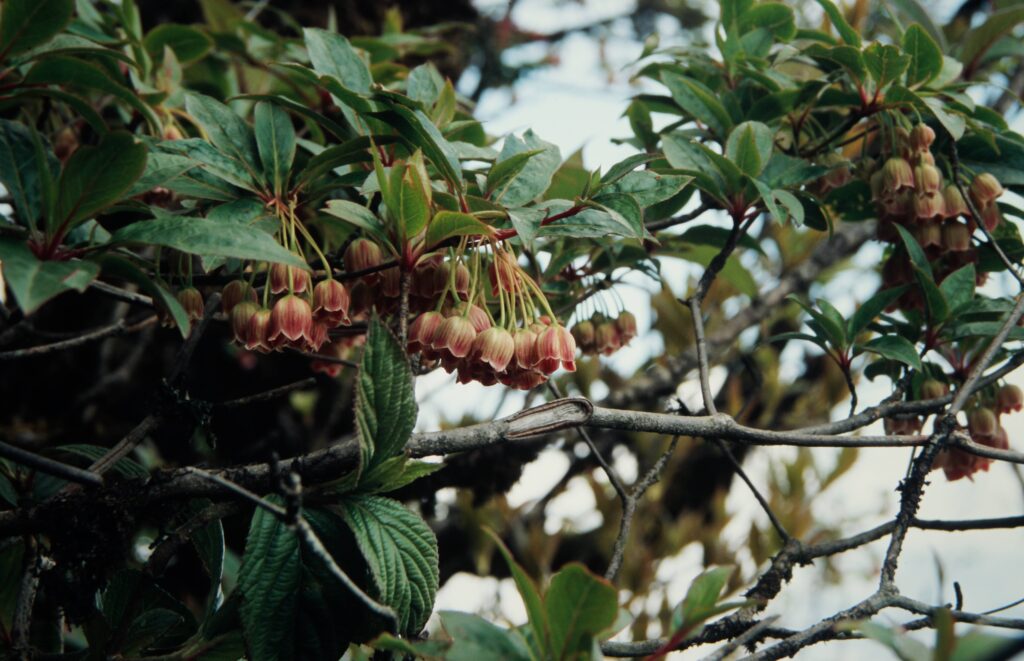
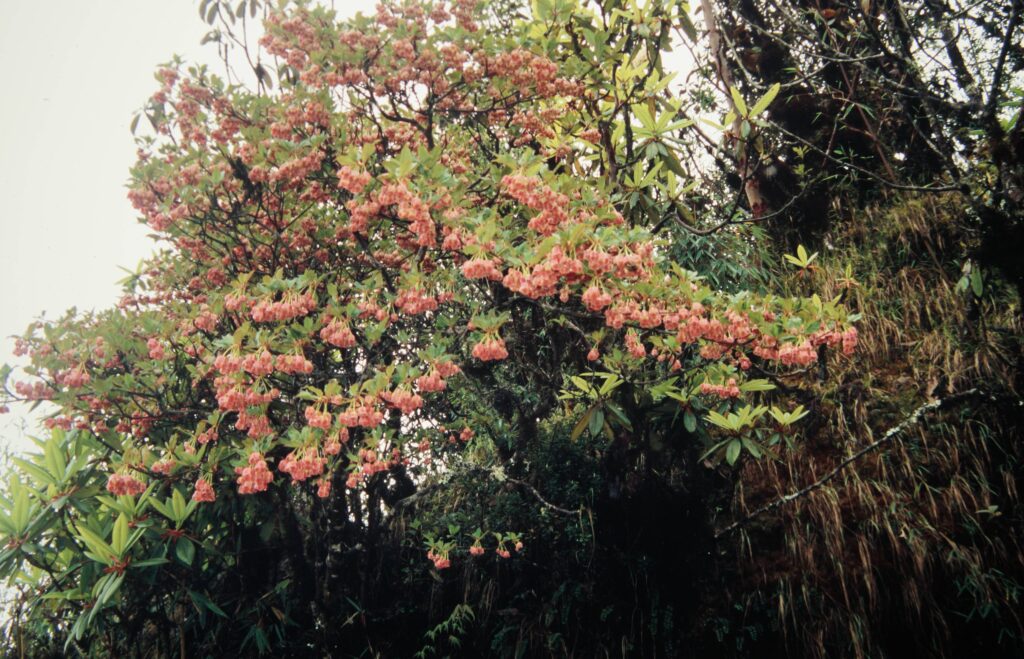
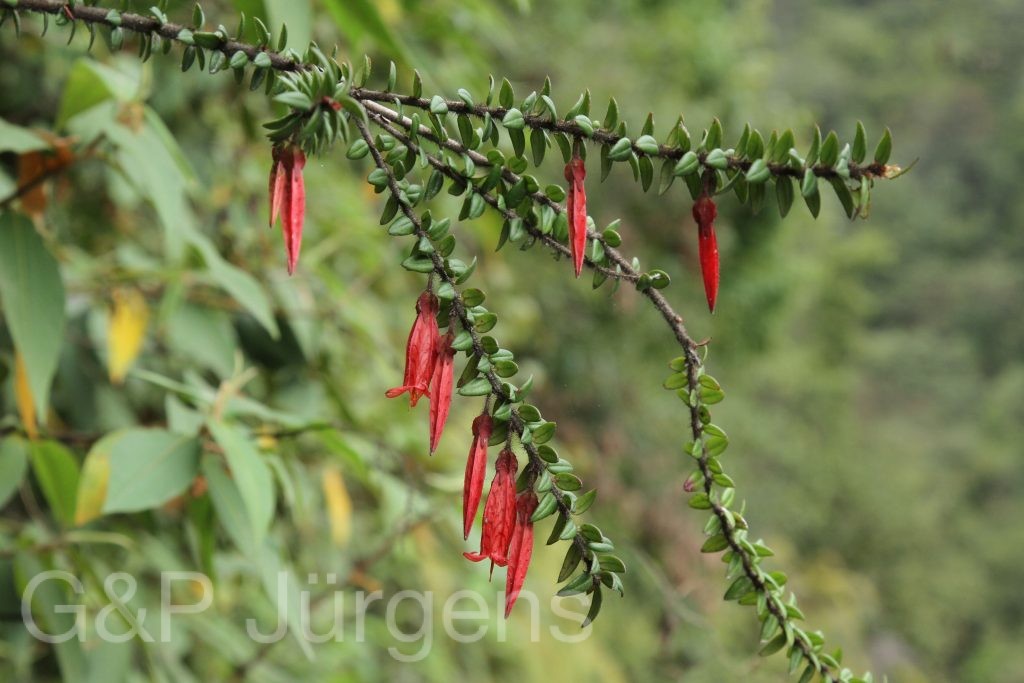
Agapetes serpens

by GP Jürgens

(Wight) Sleumer

Bhutan2014 476
Bhutan Tongsa 2000m, May
Sikkim2004 95 P165
India West-Bengal, Bersay 2700m April
Nepal 97 309 P613
Nepal Honggaon 2360m May
Nepal1992 156 P228 ergebnis
Nepal Simbua-Khola 1800m March 

Description

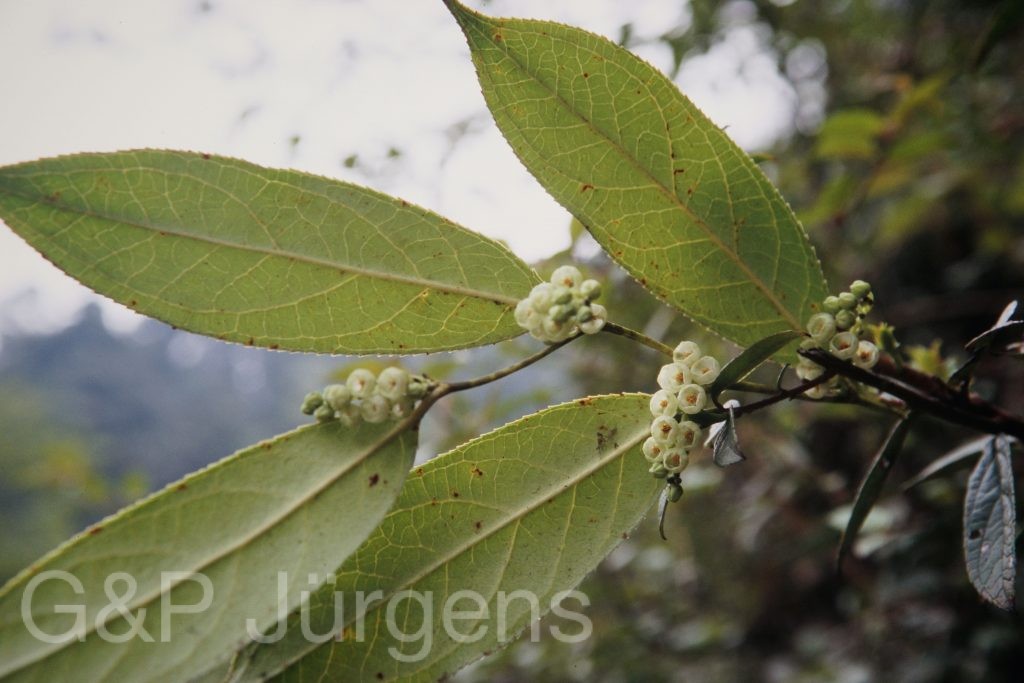
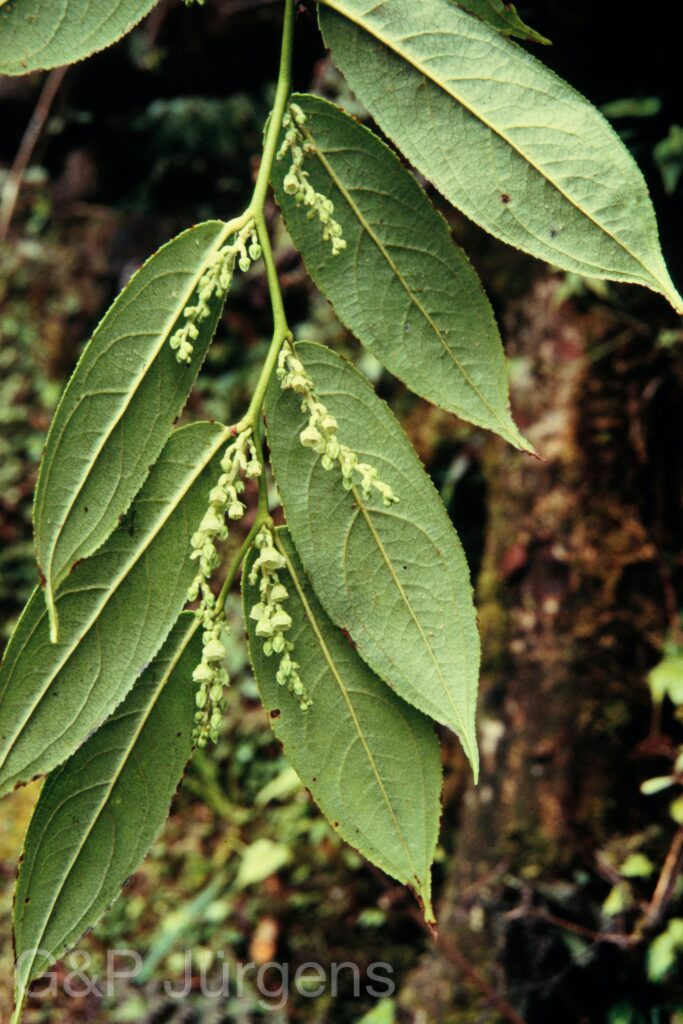
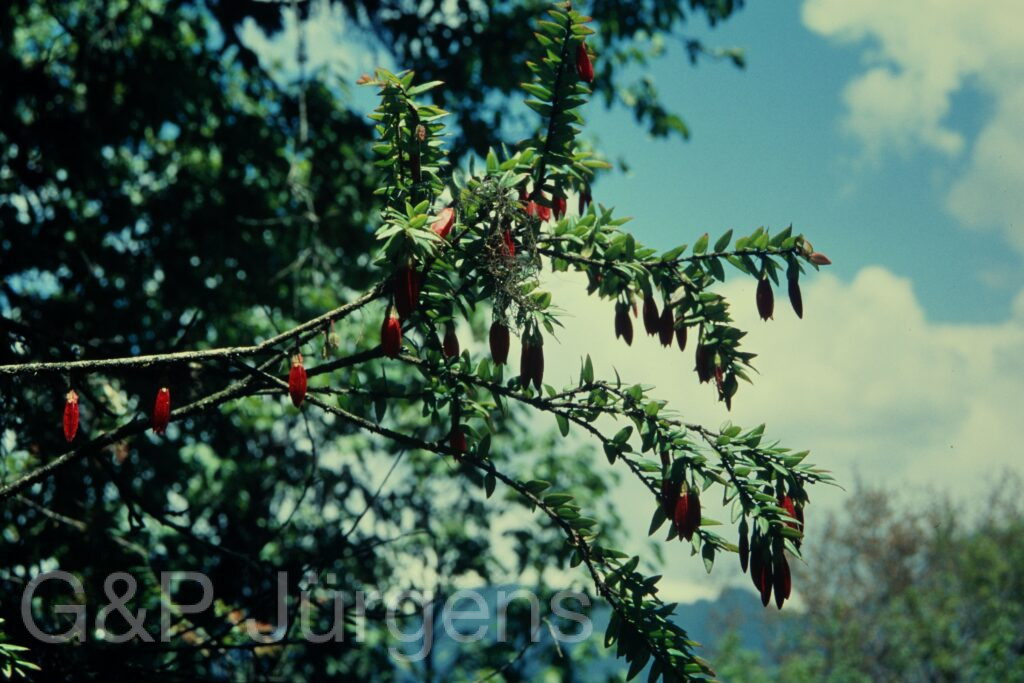
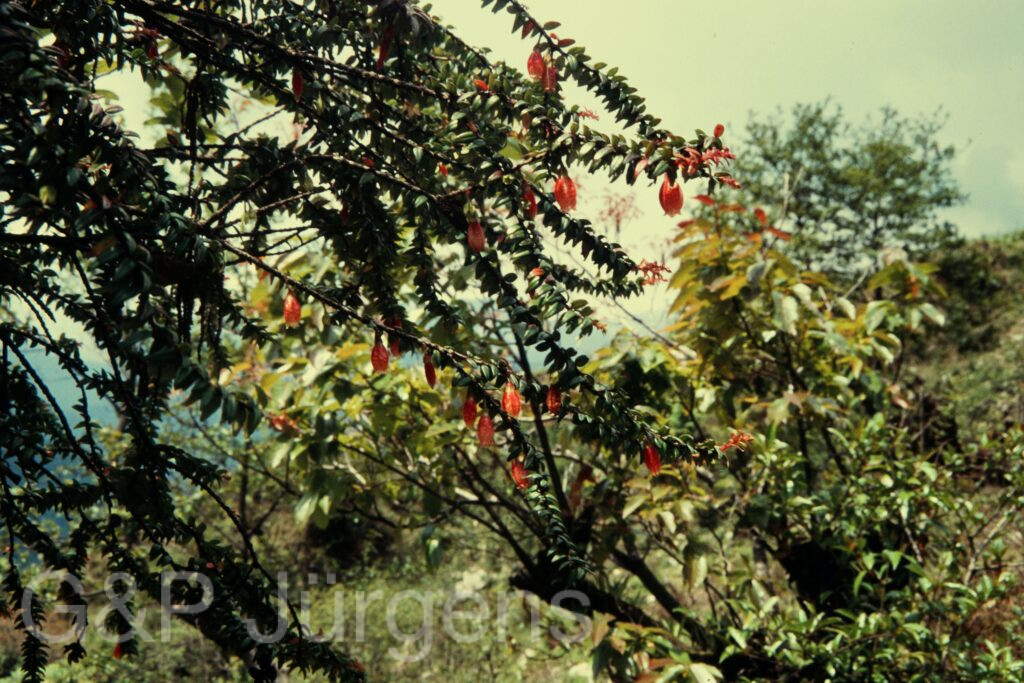
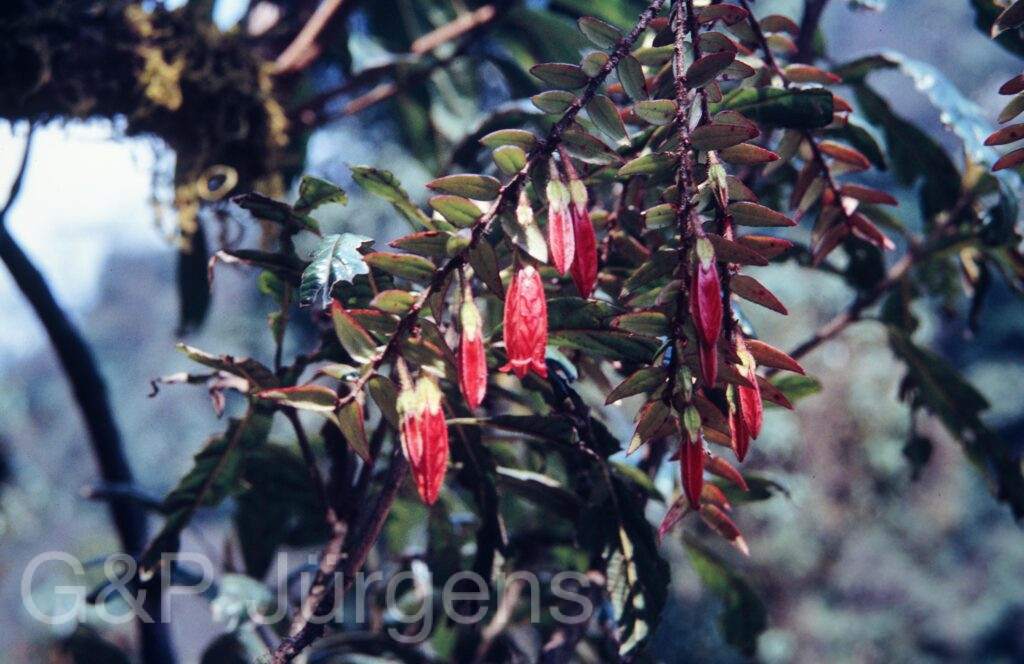
Agapetes serpens is an eastern Himalayan epiphytic shrub distributed across India, Bhutan, Nepal and adjacent China, with around 267 GBIF occurrences; long cultivated for its pendulous flowers, it is recorded in glasshouse collections from Great Britain, Germany, the United States and New Zealand. It grows in humid temperate broad-leaved and mixed forest, perched on mossy tree trunks, branches and shaded rock faces. The images document it across a broad elevational span: Bhutan at Tongsa around 2000 m in May, West Bengal at Bersay near 2700 m in April, and Nepal at Honggaon (2360 m) and the lower Simbua-Khola valley (1800 m).

It is a scrambling to pendent evergreen shrub arising from a swollen, tuberous, woody rootstock, with long arching, bristly-hairy stems. The leaves are small, numerous, lanceolate to elliptic, leathery and arranged distichously along the stems. The flowers hang in profusion from the leaf axils on slender pedicels; the corolla is tubular, five-angled, bright red and marked with darker chevron- or V-shaped lines, with five short reflexed lobes. The stamens are included and the ovary inferior. The fruit is a small fleshy berry.

Agapetes belongs to tribe Vaccinieae of the Ericaceae, the group that includes the blueberries, and the genus is centred on the Sino-Himalayan and Southeast Asian mountains. The tuberous lignotuber is an adaptation to the epiphytic habit, storing water and nutrients, while the tubular red flowers are adapted to bird pollination. Valued as an ornamental, A. serpens is widely grown; in the wild it is locally frequent and not currently regarded as threatened.

Author: (Wight) Sleumer · Sources: POWO (Kew), GBIF, Flora of China, Flora of Bhutan, Flora of Nepal, Airy Shaw revision of Agapetes
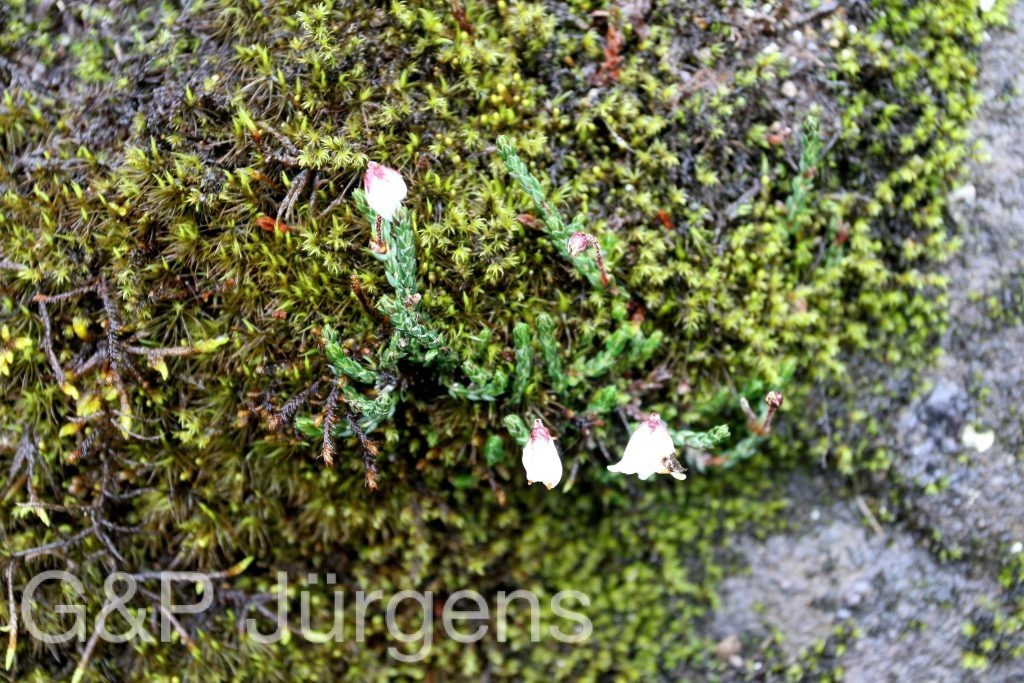
(Wall.) D. Don

Sikkim2011 135
Sikkim Tanghu 4000m, June
Sikkim2011 137
Sikkim Tanghu 4000m, June

Description

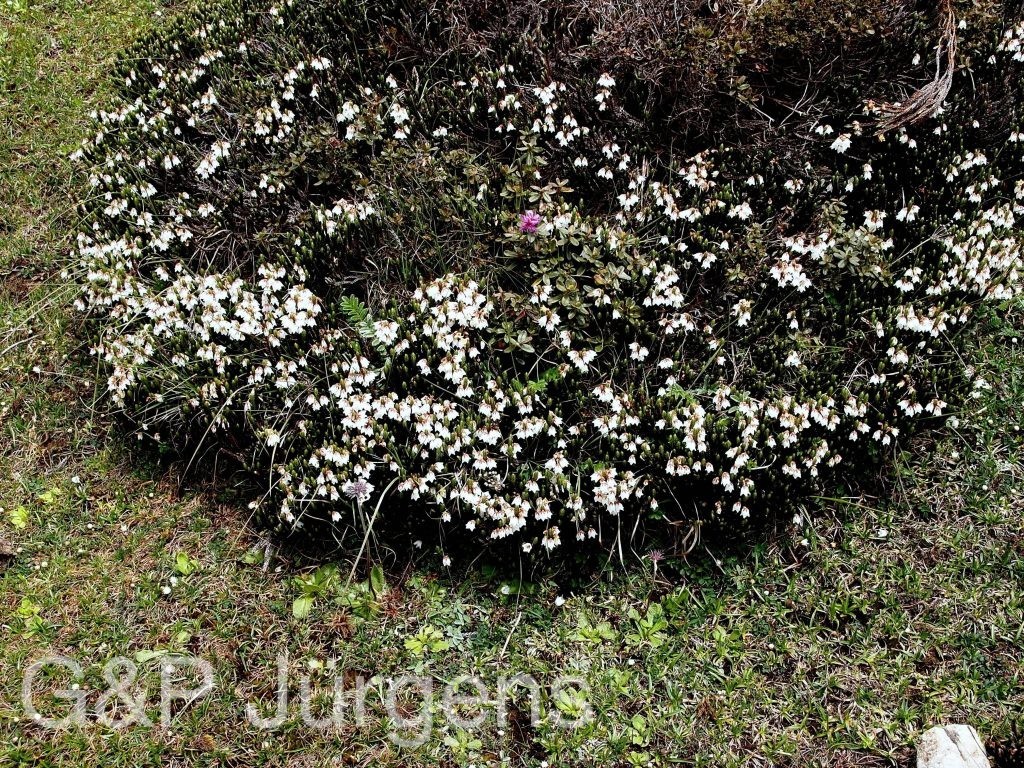
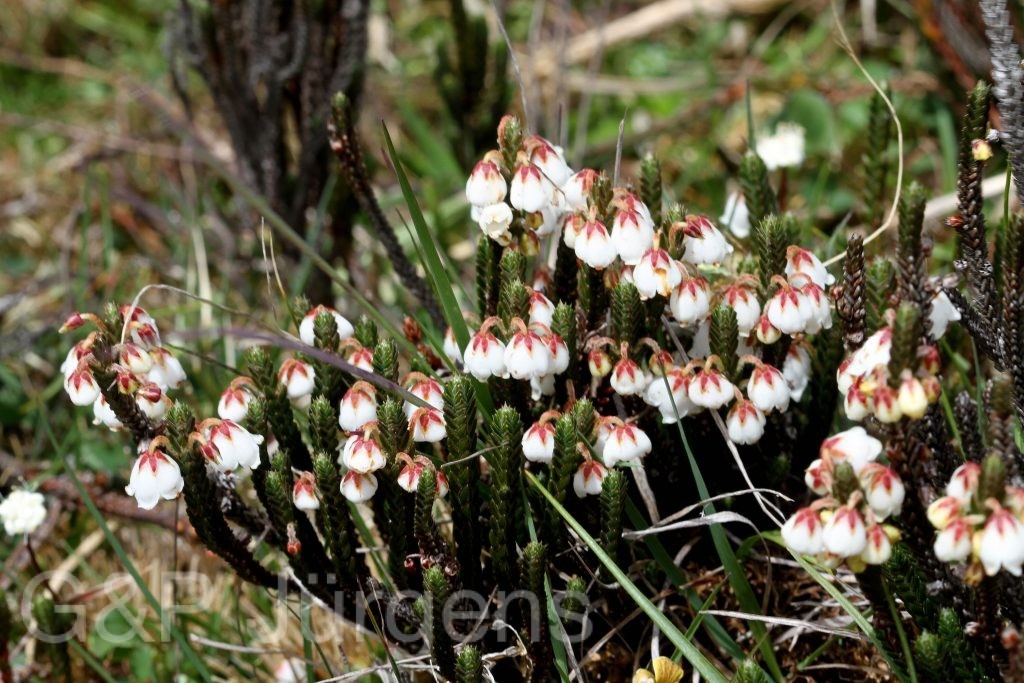
Cassiope fastigiata (Wall.) D. Don is a dwarf evergreen shrublet of the high Himalaya, recorded by GBIF from Nepal, India, China, Bhutan, Pakistan and Bangladesh across some 762 occurrences. It is a characteristic component of the alpine and subalpine zone, forming low cushions and mats on open rocky slopes, moraines, peaty banks and the margins of Rhododendron scrub, typically between 3300 and 4500 m. The plant photographed at Sikkim Tanghu around 4000 m in June, at the onset of the monsoon flowering season, exemplifies its preference for cool, humid, well-drained sites kept moist by snowmelt.

The species forms erect to ascending, much-branched stems clothed in four neat ranks of small, imbricate, scale-like leaves pressed close to the stem in the manner typical of the genus. Each leaf is ovate-oblong and keeled, with a conspicuous narrow membranous white margin and a deep dorsal furrow, giving the shoots a four-angled, whipcord appearance. The solitary nodding flowers arise from the upper leaf axils on slender, often reddish pedicels; the corolla is broadly campanulate, white, five-lobed and about 7-9 mm long, subtended by a reddish calyx. Stamens are ten, with awned anthers, and the fruit is a small globose loculicidal capsule.

Within Ericaceae, Cassiope is placed in the subfamily Cassiopoideae and is distinguished from related heaths by its four-ranked imbricate leaves and campanulate flowers. Cassiope fastigiata is among the most widespread Himalayan species of the genus and is locally abundant, so it is not regarded as threatened, though as a slow-growing alpine specialist it is sensitive to grazing pressure and warming-induced upward shifts of vegetation. It is of biogeographic interest as part of a cold-adapted, largely circum-Himalayan element.

Author: (Wall.) D. Don · Sources: POWO (Kew), GBIF, Flora of Bhutan, Flora of China, Flora of Pakistan, Stevens monograph of Ericaceae

Hook.f. & Thomson

BhutanPG2011 401
Bhutan Warrtlang-La, 4500m June

Description

Cassiope selaginoides is a dwarf, mat-forming alpine shrub of the Himalaya and Sino-Himalayan ranges, documented in GBIF (about 854 occurrences) from China, India, Bhutan, Nepal and Myanmar. It is characteristic of high alpine slopes, rocky ridges, moorland and the upper margins of dwarf-shrub heath, typically growing between 3500 and 4800 m, often forming low cushions and carpets among rocks and moss. The photographed population on the Warrtlang-La in Bhutan at 4500 m in June represents this exposed, high-alpine habitat, where it flowers soon after snowmelt at the start of the brief growing season.

It is a small, prostrate to ascending evergreen shrub with slender, wiry, much-branched stems densely clothed in tiny, imbricate, scale-like leaves arranged in four ranks, giving the shoots a clubmoss-like (selaginoid) appearance from which the epithet derives. The small, nodding flowers are solitary on slender, reddish pedicels arising from the upper leaf axils; each has a persistent calyx and a white, broadly campanulate, five-lobed corolla, sometimes tinged pink, with eight to ten included stamens bearing awned anthers. The fruit is a small, dehiscent, subglobose capsule containing numerous minute seeds.

Cassiope, a small genus of subfamily Cassiopoideae within the Ericaceae, comprises arctic and high-alpine cushion shrubs of which the Himalayan species form a distinctive radiation alongside C. fastigiata and C. wardii. Like other ericaceous heath plants it associates with ericoid mycorrhizal fungi, enabling survival on acidic, nutrient-poor alpine soils. Widespread across the high Himalaya and locally abundant, it is of Least Concern, contributing to the structure and stabilisation of alpine heath communities above the tree line.

Author: Hook.f. & Thomson · Sources: POWO (Kew), GBIF, Flora of China, Flora of Bhutan, Annotated Checklist of the Flowering Plants of Nepal, Stevens revision of Cassiope and Ericaceae

Miq.

BhutanPG2011 74
Bhutan Menchuang, 2700m June

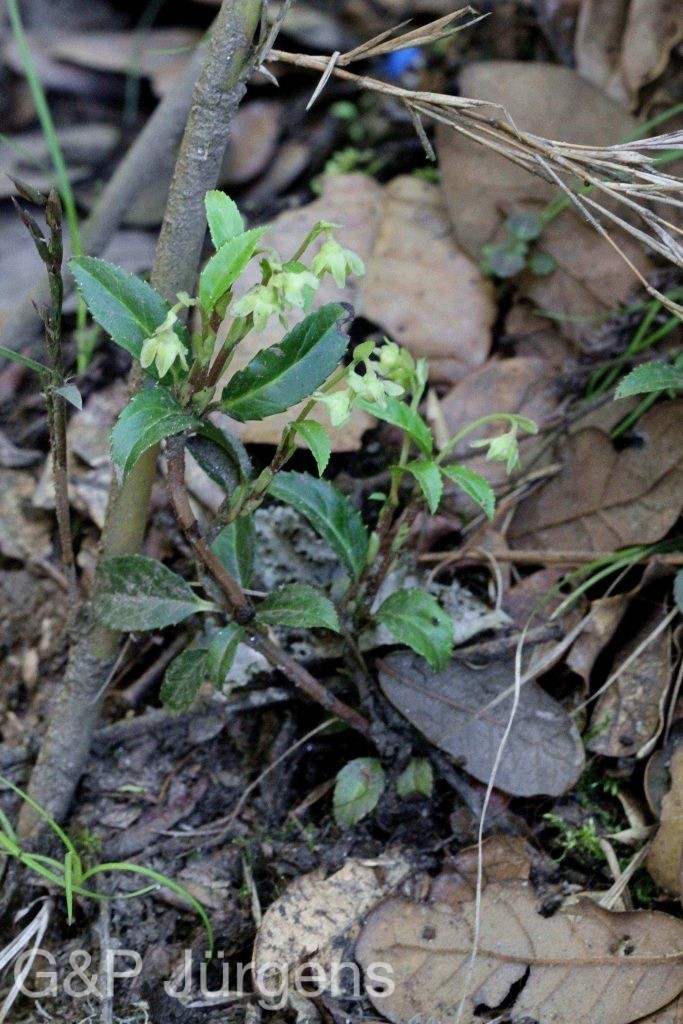
Description

Chimaphila japonica Miq. is a diminutive evergreen subshrub with a wide temperate East Asian and Himalayan range, documented by GBIF from Japan, Korea, China, Russia, Taiwan, Bhutan, India, Myanmar and Nepal across more than 3000 occurrences. It is a plant of shaded, humus-rich coniferous and mixed forest floors, often associated with mossy banks and the litter beneath fir, spruce and oak, generally between 1500 and 3000 m. The individual recorded at Menchuang in Bhutan at about 2700 m in June reflects this montane forest habitat, where the species benefits from the partial mycoheterotrophic nutrition characteristic of the wintergreen group.

The plant produces slender creeping rhizomes from which arise short, erect aerial stems bearing whorled or subverticillate, leathery, evergreen leaves. The leaves are oblanceolate to elliptic, sharply serrate towards the apex, dark green and glossy above, and somewhat clustered in the upper part of the stem. One to several nodding flowers are borne on a terminal peduncle; each flower has five spreading, waxy white to pinkish petals, ten stamens with conspicuously dilated, ciliate filaments and inflated anthers opening by pores, and a stout columnar style topped by a broad peltate stigma. The fruit is an erect, dehiscent globose capsule splitting from the apex.

Chimaphila belongs to the Pyroleae of subfamily Monotropoideae within a broadly circumscribed Ericaceae, partially mycoheterotrophic woodland herbs. Chimaphila japonica is closely allied to the boreal C. umbellata but is distinguished by its smaller stature and leaf form. Given its broad distribution it is not considered threatened, though it depends on intact forest soils and their mycorrhizal networks, making it a useful indicator of mature montane woodland.

Author: Miq. · Sources: POWO (Kew), GBIF, Flora of China, Flora of Japan, Flora of Bhutan, Krisa monograph of Pyrolaceae

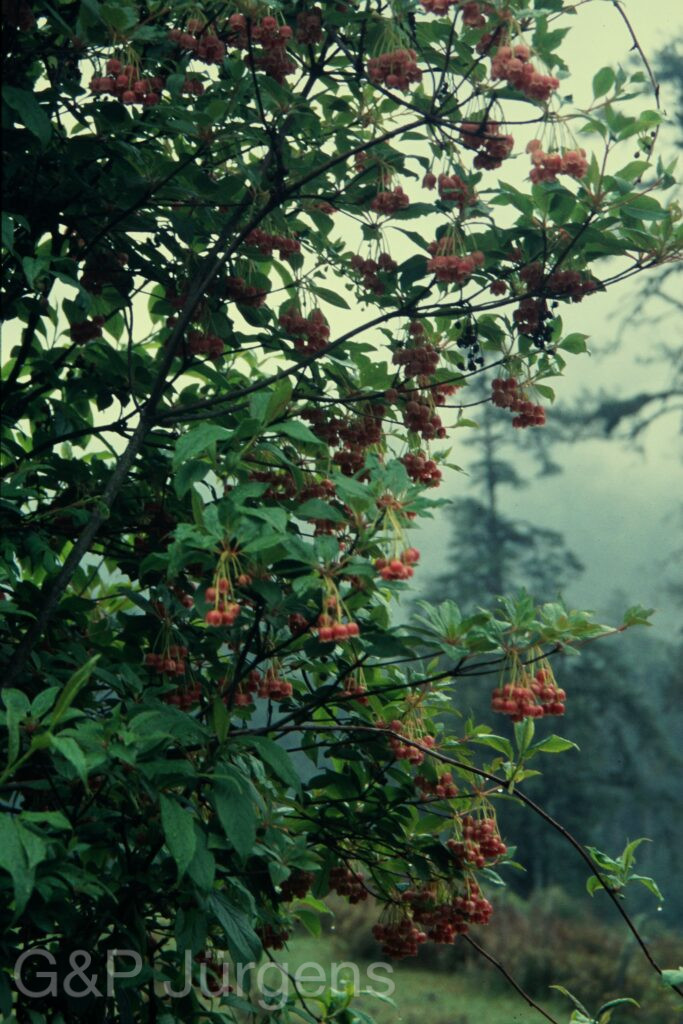
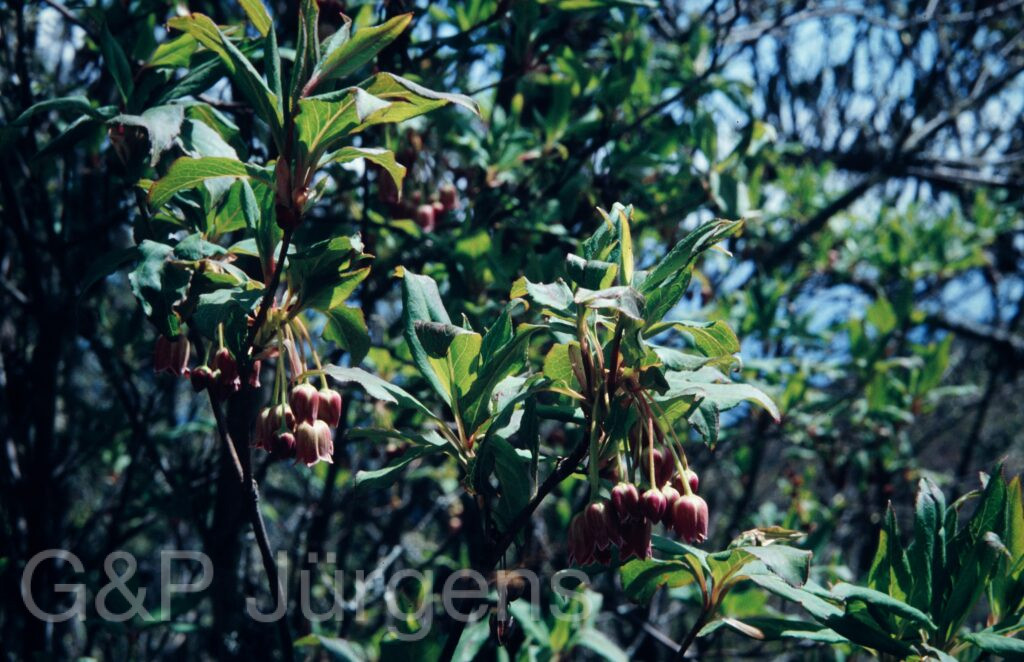
(Griff.) C.K.Schneid.

Sikkim2004 377 G654
Sikkim/India Lachung 2900m May
Nepal 1994 259 ergebnis
Ost-Nepal Milka-Danda 2850m May 

Description

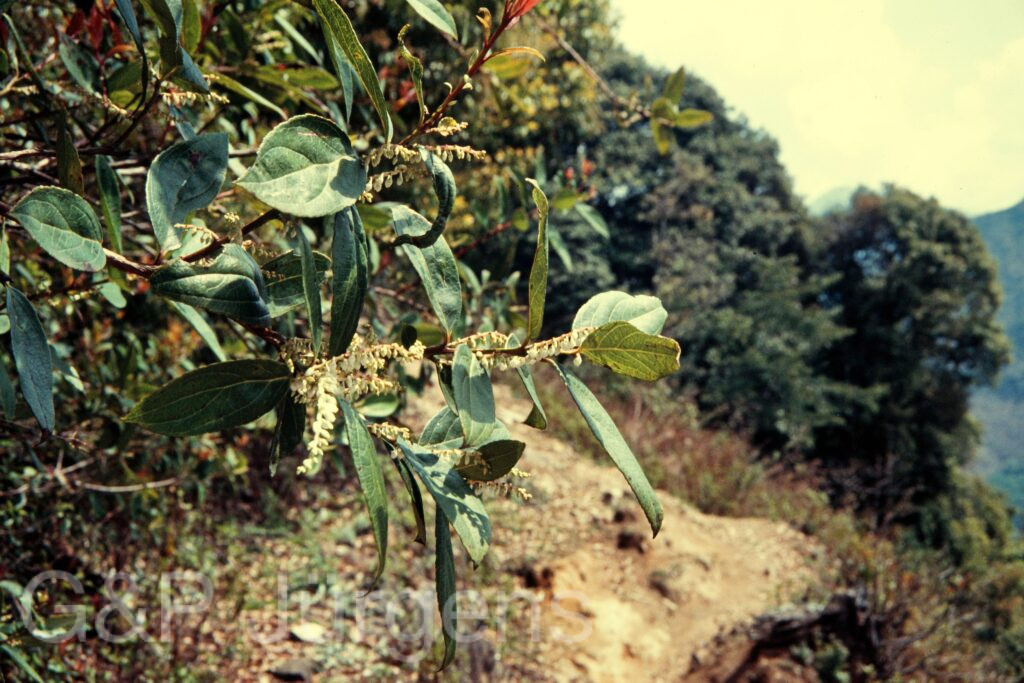
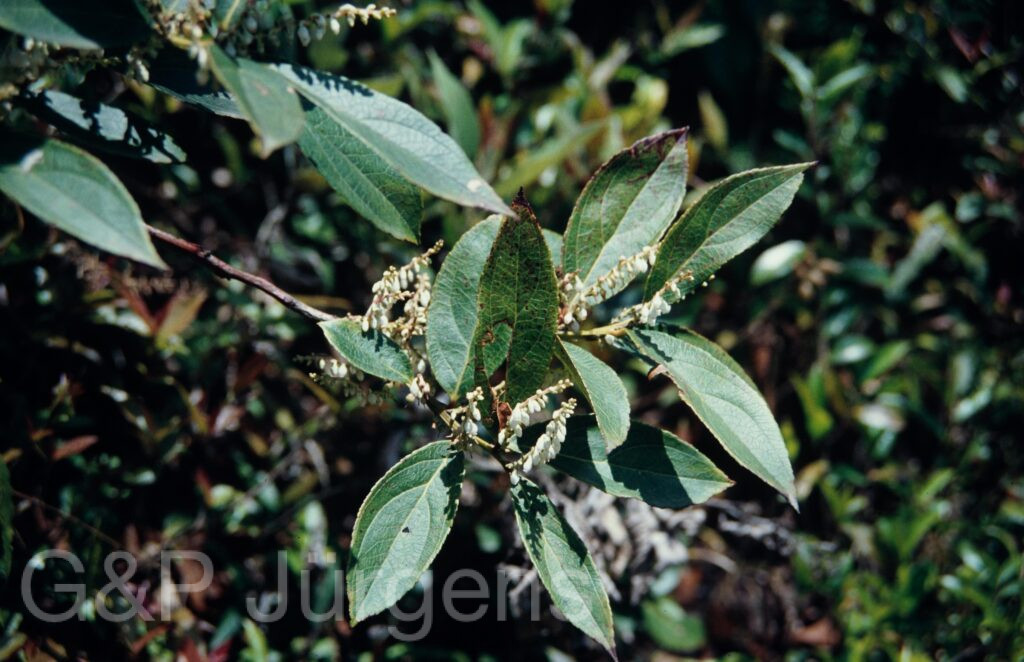
Enkianthus deflexus is a deciduous shrub or small tree of the temperate Himalaya and southwestern China, distributed through China, India, Nepal, Bhutan and Myanmar, and very well documented with around 1667 GBIF records (further records reflect wide cultivation in Europe, North America and East Asia). It forms part of the understorey and forest-margin vegetation of moist temperate forest and Rhododendron-dominated slopes, typically between about 2400 and 3600 m. The cited collections from Lachung in Sikkim (2900 m), Milka Danda in east Nepal (2850 m) and Tonglu in West Bengal (3100 m), all flowering in May, mark its synchronous late-spring anthesis across the cool, humid mid-montane belt.

The species is a many-branched shrub whose leaves cluster toward the ends of the twigs in pseudowhorls; they are obovate to elliptic, finely serrulate, often colouring richly in autumn, and subtended by reddish young growth. The flowers are borne in pendent terminal racemes or umbel-like clusters, each on a slender, often reflexed pedicel (whence deflexus). The corolla is campanulate, creamy to yellowish suffused with red veining, with five short recurved lobes; ten stamens are enclosed within. The fruit is an erect, dehiscent woody capsule on the recurving pedicel, releasing small winged or angled seeds.

Enkianthus is an early-diverging genus of the Ericaceae, sister to much of the rest of the family, and its bell-shaped, nectar-bearing flowers are pollinated by bees and other insects. E. deflexus is valued horticulturally for its dainty blossoms and brilliant autumn foliage, explaining its broad cultivated footprint. Within its native range it is common and not of conservation concern, a characteristic and widespread component of Himalayan temperate forest understoreys.

Author: (Griff.) C.K.Schneid. · Sources: POWO (Kew), GBIF, Flora of Bhutan, Flora of China (Ericaceae), Stevens Revision of Enkianthus

Wall.

Nepal 97 89 P149
Nepal Tankhu 2200m, April
Nepal 1994 186 ergebnis
Ost-Nepal Jaljale Himal
2350 m, April

Description

Gaultheria fragrantissima Wall. is a wide-ranging evergreen shrub of the eastern Himalaya and montane tropical Asia, documented from Nepal, India, Bhutan, China, Myanmar, Sri Lanka, Thailand, Vietnam, Indonesia and Malaysia, with a substantial body of records (GBIF reports some 1,853 occurrences, the higher latitudes among them reflecting cultivation or introduction). It occupies forest margins, open hillsides, secondary scrub and clearings in oak, rhododendron and broad-leaved evergreen forest, typically at 1,500-2,800 m. The photographed material comes from central and eastern Nepal, at Tankhu (2,200 m) and the Jaljale Himal (2,350 m), both in April, where it flowers on sunny, well-drained slopes.

It forms a much-branched shrub 1-3 m tall, the young twigs reddish, bristly or shortly setose. The leaves are alternate, coriaceous, elliptic to lanceolate, 5-12 cm long, with a serrulate-glandular margin, acuminate apex and conspicuously reticulate venation, aromatic when crushed. Inflorescences are axillary or terminal racemes bearing numerous small, urceolate (urn-shaped) white to pinkish corollas about 4-6 mm long, the calyx persistent and accrescent. The fruit is a depressed-globose capsule enclosed by the swollen, fleshy, bluish-purple calyx, forming a berry-like false fruit, dispersed by birds.

A member of the large genus Gaultheria (Ericaceae, subfam. Vaccinioideae), the species yields a methyl-salicylate-rich essential oil ("Indian wintergreen oil") distilled from its foliage and harvested commercially across Nepal and India. This use, with its capacity to colonise disturbed and burnt ground, makes it locally abundant and of no conservation concern. Its broad ecological amplitude and bird-dispersed fleshy fruits underlie its extensive Indo-Malesian distribution.

Author: Wall. · Sources: POWO (Kew), GBIF, Flora of Nepal, Flora of China, Flora of Bhutan, Airy Shaw revision of Asiatic Gaultheria, Middleton monograph of Gaultheria

Wight

Bh2008 154 P253
Bhutan Trongtsa 2120m, April
Nepal 97 115 P198
Nepal Mewa-Khola 2470m April

Description

Gaultheria griffithiana is an evergreen shrub of the eastern Himalaya and Indo-Burmese mountains, distributed through Nepal, Sikkim and Darjeeling in India, Bhutan, southern China (Xizang, Yunnan), Myanmar, Laos and Vietnam, with nearly seven hundred georeferenced records. It grows in temperate broadleaved and conifer forest, on shrubby slopes, forest margins and rocky banks, often on acidic humus-rich soils. The cited collections at Trongtsa in Bhutan around 2120 m and Mewa-Khola in east Nepal at 2470 m, both flowering in April, reflect its spring anthesis in the montane forest belt.

The plant is a much-branched shrub with reddish, often bristly or glandular-setose young branchlets. The leaves are alternate, coriaceous, elliptic to oblong-lanceolate, finely serrate with gland-tipped teeth, glossy above and often with bristly hairs or glands, and aromatic when crushed. The flowers are borne in axillary racemes, each subtended by bracts; the calyx is five-lobed and the corolla is small, urceolate (urn-shaped), white to pinkish, with ten included stamens whose anthers open by terminal pores. The fruit is a small berry-like structure, the capsule being enclosed by the fleshy, accrescent calyx that turns blue-black or dark purple at maturity.

Gaultheria (Ericaceae, subfamily Vaccinioideae) is well represented in the Sino-Himalaya, and this species, named for William Griffith, belongs to the assemblage of wintergreen-scented shrubs containing methyl salicylate. The fleshy fruiting calyces are dispersed by birds, while the urceolate flowers are pollinated by bees. Locally common and ecologically widespread, the species is not regarded as threatened.

Author: Wight · Sources: POWO (Kew), GBIF, Flora of China, Flora of Bhutan, Middleton's revision of Asian Gaultheria (Ericaceae)

C.B.Clarke

Sikkim2003 409 P569
Sikkim Zemu Valley 3400m August

Description

Gaultheria hookeri is an evergreen shrub native to the eastern Himalayas and extending into southwestern China and northern Myanmar. Its range encompasses Nepal, northeast India (Sikkim, Arunachal Pradesh), Bhutan, Myanmar, and China (Yunnan, Xizang, Sichuan). The species is a characteristic element of upper temperate to subalpine forests, occurring at elevations of 2,500–4,000 m in Rhododendron-Abies forests, bamboo thickets, and along stream margins. It is well documented from the Zemu Valley in Sikkim at 3,400 m, where it can be found growing in the understorey of dense montane forests during August.
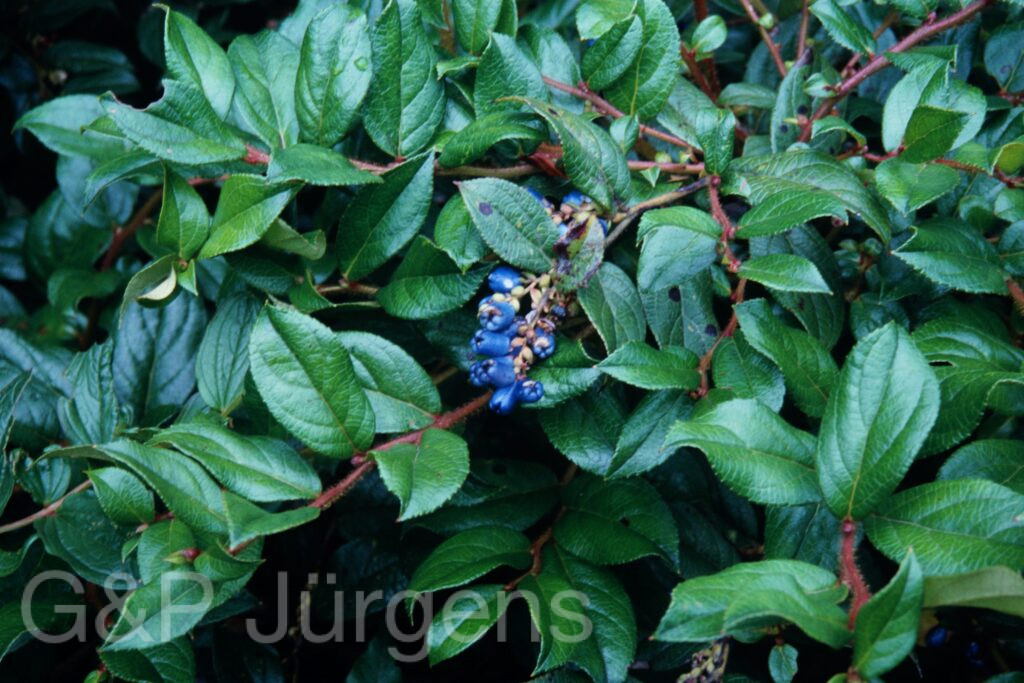
Gaultheria hookeri forms a densely branched, spreading to erect shrub 0.3–1.5 m tall. The young branchlets are setose-hispid with rusty brown hairs. The leaves are alternate, coriaceous, ovate to elliptic-ovate, 4–10 cm long, with a serrate to serrulate margin, the veins impressed above and prominent beneath. The flowers are borne in short axillary racemes; each flower has a campanulate to urceolate corolla, white to pinkish, 4–6 mm long. The calyx is five-lobed and becomes fleshy and enlarged in fruit, enclosing the capsule to form a conspicuous, globose, fleshy pseudoberry that is blue to deep purple-black at maturity, 8–12 mm in diameter.
Described by C.B. Clarke and named in honour of Sir Joseph Dalton Hooker, who extensively explored the Sikkim Himalaya, G. hookeri is one of the more robust and widely collected species in the genus across the eastern Himalayan region. With over 750 occurrence records in GBIF, it is comparatively well documented. The species is of ecological importance as a food source for montane birds and mammals that disperse its fleshy fruits. Its aromatic, wintergreen-scented foliage, rich in methyl salicylate, is occasionally used in traditional medicine. The species has also been introduced to cultivation in botanical gardens in Europe and North America.

Author: C.B.Clarke · Sources: POWO (Kew), GBIF, Flora of Bhutan Vol. 2, Flora of China Vol. 14, Hooker: Flora of British India Vol. 3 (1882)

D.Don

Garw 2005 166 ergebnis ergebnis
India Garhwal Shertoli 3200m, September

Description

Gaultheria nummularioides D.Don is a prostrate, creeping dwarf shrub of the temperate and subalpine Himalaya and adjacent mountains of East and Southeast Asia. Its range extends through Nepal, NE and NW India, Bhutan, Myanmar and SW China, with outlying records in Malesia (Indonesia, Malaysia) and cultivated occurrences in Japan, Great Britain and the United States; GBIF documents over 1,200 collections across this wide span. It typically grows between 2,000 and 4,000 m in mossy forest margins, on damp rocks, banks and epiphytically on tree trunks, as recorded for the photographed plant from Garhwal at Shertoli, 3,200 m, in September. It favours humid, shaded, acidic substrates and is a characteristic component of Rhododendron–oak understorey and bryophyte-rich rock communities.

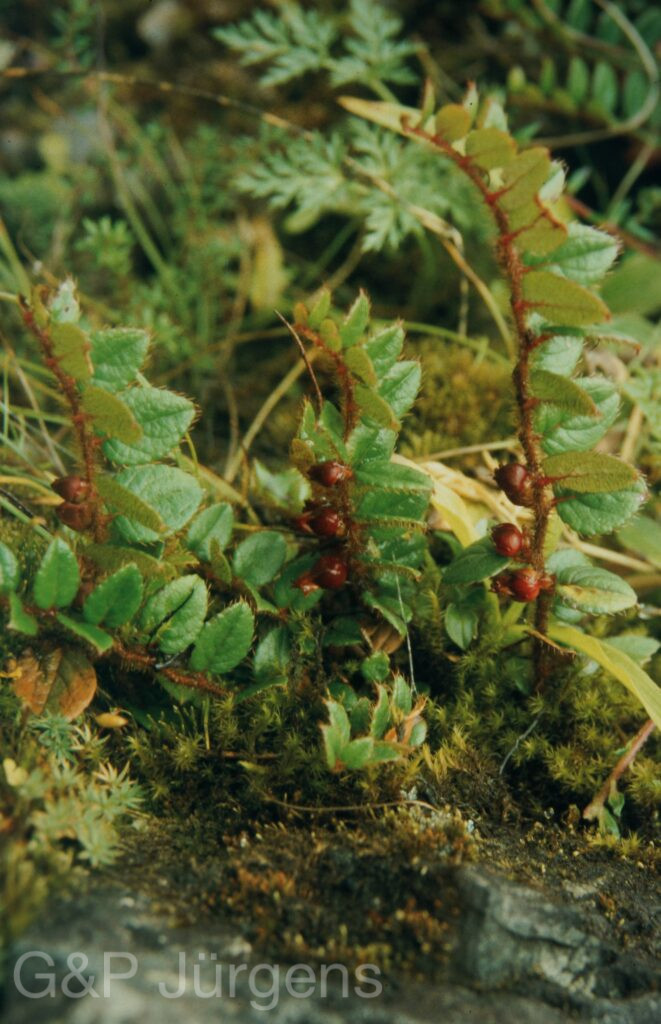
The plant forms wiry, much-branched, reddish-brown procumbent stems clothed in stiff brown bristles, rooting at the nodes to form dense mats. Leaves are small, distichous, ovate to rounded (nummularioides referring to the coin-like blade), 5–12 mm long, coriaceous, dark green and glossy above, the margins finely toothed and ciliate. Flowers are solitary and axillary, pendent on short pedicels, the corolla campanulate to urceolate, white tinged pink, 4–5 mm long with five short recurved lobes; the calyx is often reddish. The fruit is a fleshy blue-black berry-like capsule enclosed by the accrescent succulent calyx.

The genus Gaultheria (subfamily Vaccinioideae) is notable for aromatic foliage rich in methyl salicylate; G. nummularioides is locally used as a fragrant and medicinal plant. Its broad Himalayan-to-Malesian distribution illustrates the floristic continuity of the Sino-Himalayan ericaceous element. The species is common and not of conservation concern across most of its range.

Author: D.Don · Sources: POWO (Kew), GBIF, Flora of China Vol. 14, Flora of Bhutan Vol. 2, Flora of Nepal, Airy Shaw: The Gaultheria-Pernettya complex (Kew Bulletin)

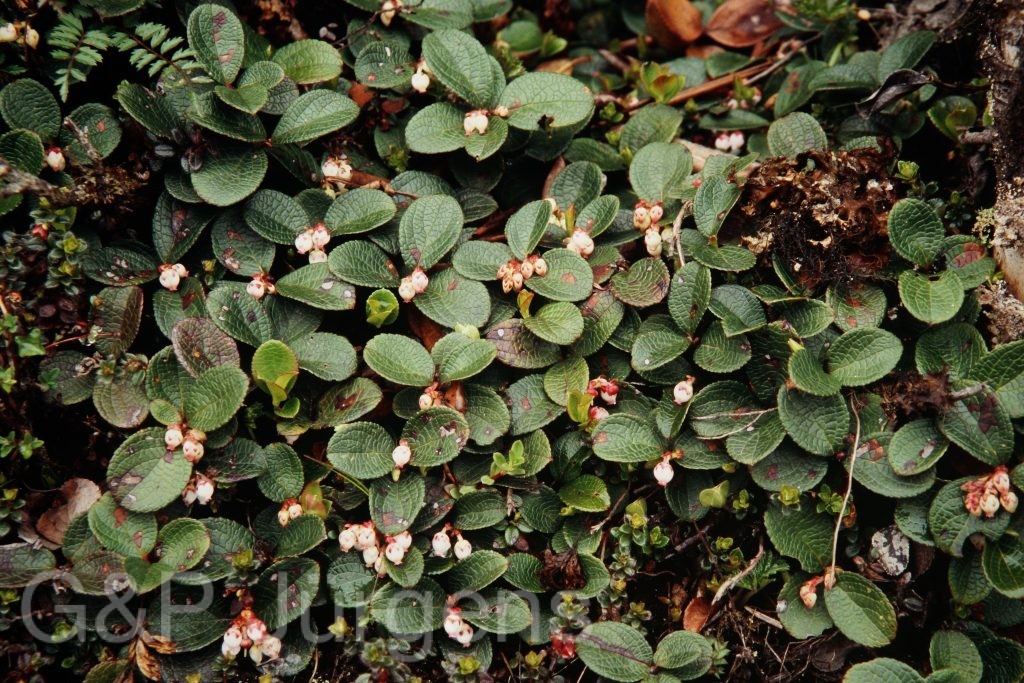
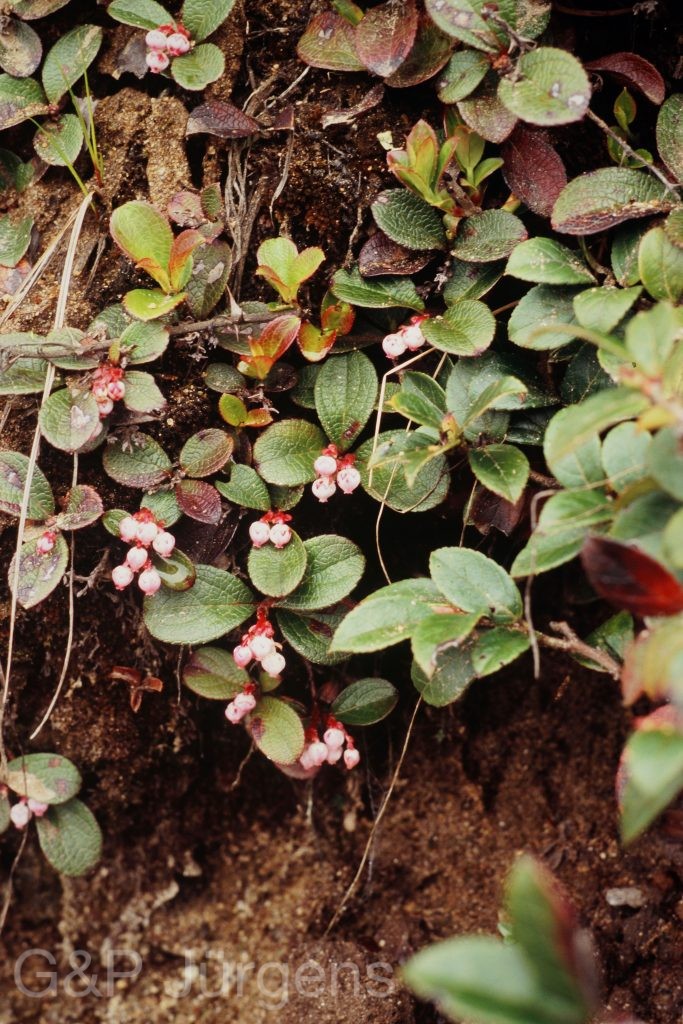
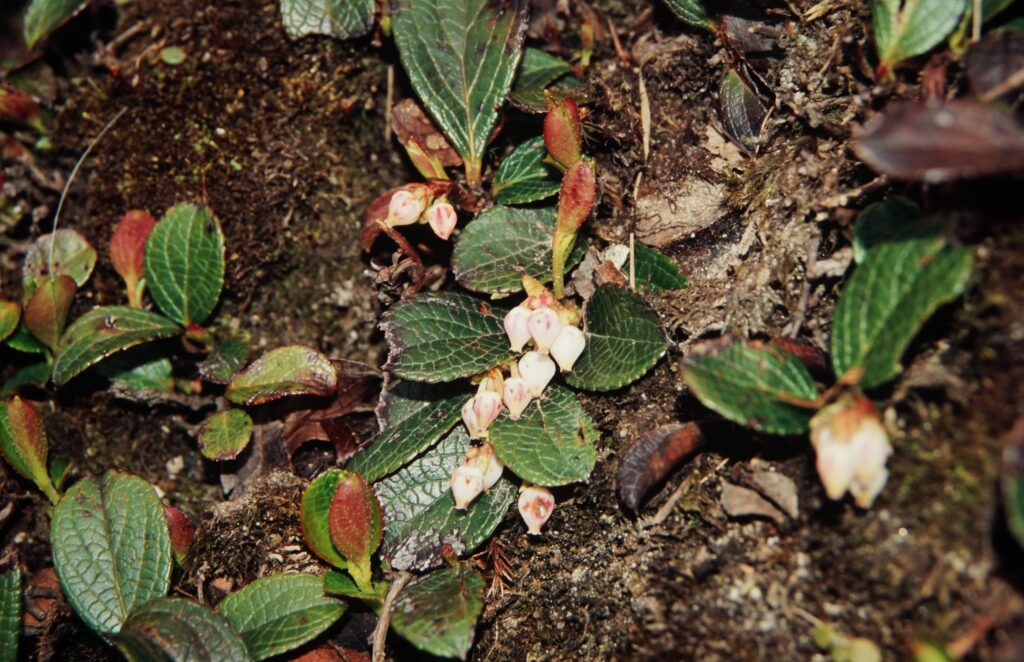
Hook.f. & Thomson ex Miq.

Bh09 327 P536
Bhutan Tumching, 3700m June
Bh09 328 G535
Bhutan Tumching, 3700m June
Sikkim 2006 130 ergebnis
India West-Bengal, Molley 3650m, May

Description

Gaultheria pyroloides is a dwarf evergreen shrublet of the eastern Himalaya and East Asia, with a notably disjunct northern range: its 652 georeferenced records span Japan (JP), China (CN) and the Russian Far East (RU) as well as the core Himalayan countries of Nepal (NP), India (IN) and Bhutan (BT). It is a plant of cool, humid, high-montane to subalpine habitats, growing on mossy banks, in the floor of conifer and rhododendron forest, on humus-rich rocks and at forest margins, generally between about 3000 and 4000 m. The plants documented at Tumching in Bhutan at 3700 m in June and at Molley in West Bengal at 3650 m in May are typical of these shaded, moss-rich montane situations.

It is a low, creeping to ascending undershrub forming mats, with slender, often reddish-bristly stems rooting at the nodes. The leaves are crowded toward the stem tips, more or less rosulate, obovate to broadly elliptic, leathery, glossy, with a finely serrulate, bristle-margined edge and a Pyrola-like aspect that gives the epithet pyroloides. The flowers are usually few, axillary or in short terminal racemes, the corolla urceolate to campanulate, white or pink-flushed, with a five-lobed limb. As in many of its relatives the calyx becomes fleshy and accrescent in fruit, enclosing or partly enclosing the small capsule to form a berry-like, blue to blue-black false fruit attractive to birds.

Gaultheria (Ericaceae, subfamily Vaccinioideae) is exceptionally diverse in the Himalaya, and the prostrate, rosette-leaved species such as G. pyroloides occupy the dwarf, ground-hugging end of the genus's growth-form spectrum. The wide but fragmented distribution into temperate East Asia points to a once more continuous circum-montane forest range. The species is not regarded as threatened, but its reliance on undisturbed, moist forest understorey renders it sensitive to disturbance.

Author: Hook.f. & Thomson ex Miq. · Sources: POWO (Kew), GBIF, Flora of Bhutan, Flora of China, Flora of Japan, Airy Shaw and Fritsch revisions of Gaultheria (Ericaceae)