

Wight
Description
Gaultheria griffithiana is an evergreen shrub of the eastern Himalaya and Indo-Burmese mountains, distributed through Nepal, Sikkim and Darjeeling in India, Bhutan, southern China (Xizang, Yunnan), Myanmar, Laos and Vietnam, with nearly seven hundred georeferenced records. It grows in temperate broadleaved and conifer forest, on shrubby slopes, forest margins and rocky banks, often on acidic humus-rich soils. The cited collections at Trongtsa in Bhutan around 2120 m and Mewa-Khola in east Nepal at 2470 m, both flowering in April, reflect its spring anthesis in the montane forest belt.
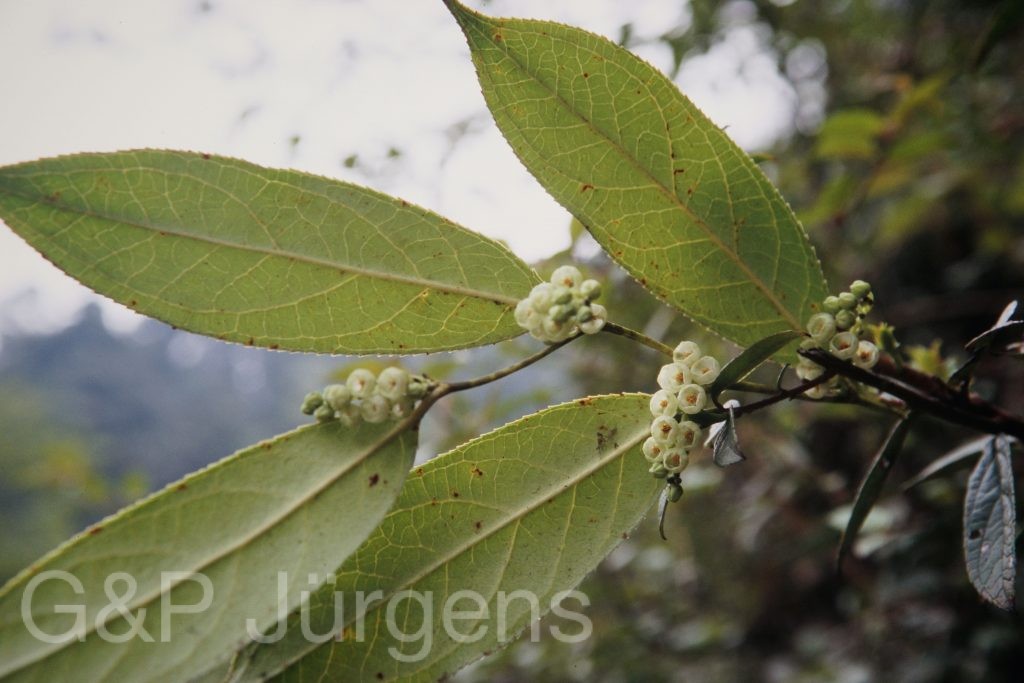
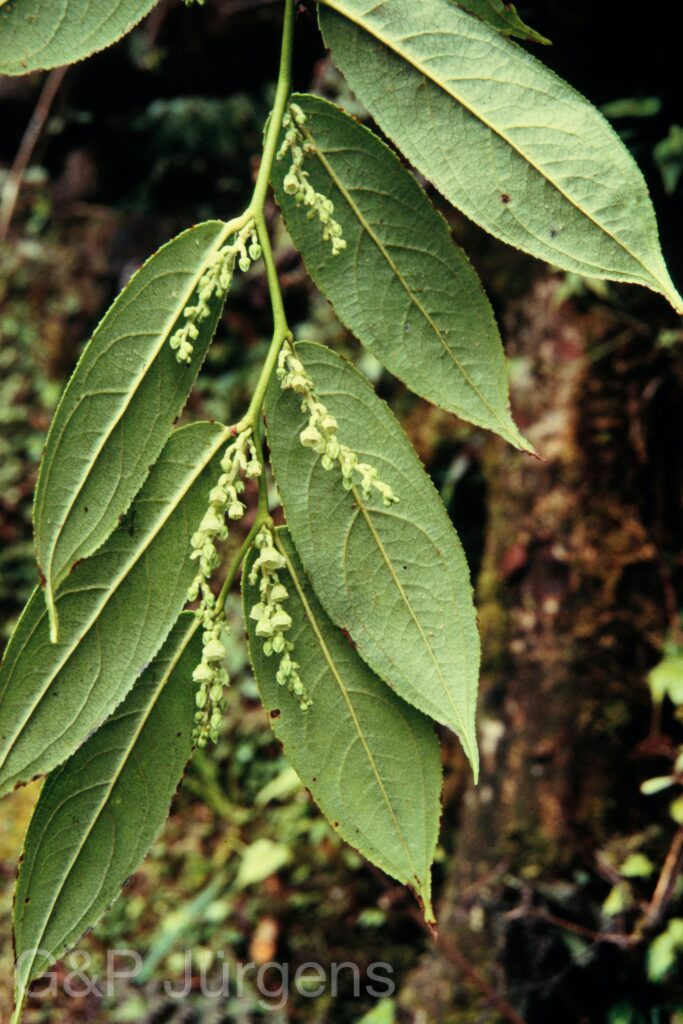
The plant is a much-branched shrub with reddish, often bristly or glandular-setose young branchlets. The leaves are alternate, coriaceous, elliptic to oblong-lanceolate, finely serrate with gland-tipped teeth, glossy above and often with bristly hairs or glands, and aromatic when crushed. The flowers are borne in axillary racemes, each subtended by bracts; the calyx is five-lobed and the corolla is small, urceolate (urn-shaped), white to pinkish, with ten included stamens whose anthers open by terminal pores. The fruit is a small berry-like structure, the capsule being enclosed by the fleshy, accrescent calyx that turns blue-black or dark purple at maturity.
Gaultheria (Ericaceae, subfamily Vaccinioideae) is well represented in the Sino-Himalaya, and this species, named for William Griffith, belongs to the assemblage of wintergreen-scented shrubs containing methyl salicylate. The fleshy fruiting calyces are dispersed by birds, while the urceolate flowers are pollinated by bees. Locally common and ecologically widespread, the species is not regarded as threatened.
Author: Wight · Sources: POWO (Kew), GBIF, Flora of China, Flora of Bhutan, Middleton's revision of Asian Gaultheria (Ericaceae)