

C.B.Clarke
Description
Gaultheria hookeri is an evergreen shrub native to the eastern Himalayas and extending into southwestern China and northern Myanmar. Its range encompasses Nepal, northeast India (Sikkim, Arunachal Pradesh), Bhutan, Myanmar, and China (Yunnan, Xizang, Sichuan). The species is a characteristic element of upper temperate to subalpine forests, occurring at elevations of 2,500–4,000 m in Rhododendron-Abies forests, bamboo thickets, and along stream margins. It is well documented from the Zemu Valley in Sikkim at 3,400 m, where it can be found growing in the understorey of dense montane forests during August.
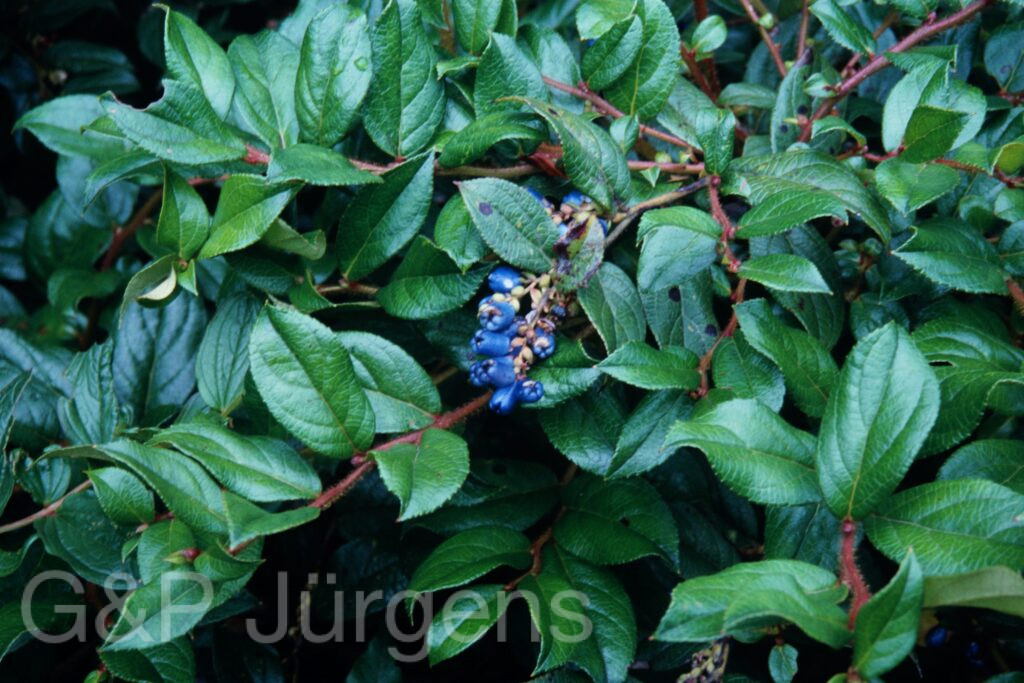
Gaultheria hookeri forms a densely branched, spreading to erect shrub 0.3–1.5 m tall. The young branchlets are setose-hispid with rusty brown hairs. The leaves are alternate, coriaceous, ovate to elliptic-ovate, 4–10 cm long, with a serrate to serrulate margin, the veins impressed above and prominent beneath. The flowers are borne in short axillary racemes; each flower has a campanulate to urceolate corolla, white to pinkish, 4–6 mm long. The calyx is five-lobed and becomes fleshy and enlarged in fruit, enclosing the capsule to form a conspicuous, globose, fleshy pseudoberry that is blue to deep purple-black at maturity, 8–12 mm in diameter.
Described by C.B. Clarke and named in honour of Sir Joseph Dalton Hooker, who extensively explored the Sikkim Himalaya, G. hookeri is one of the more robust and widely collected species in the genus across the eastern Himalayan region. With over 750 occurrence records in GBIF, it is comparatively well documented. The species is of ecological importance as a food source for montane birds and mammals that disperse its fleshy fruits. Its aromatic, wintergreen-scented foliage, rich in methyl salicylate, is occasionally used in traditional medicine. The species has also been introduced to cultivation in botanical gardens in Europe and North America.
Author: C.B.Clarke · Sources: POWO (Kew), GBIF, Flora of Bhutan Vol. 2, Flora of China Vol. 14, Hooker: Flora of British India Vol. 3 (1882)