Tag:

Myanmar

Flowers of the Myanmar Himalaya — 604 species recorded from northern Myanmar (Burma) and the eastern Himalayan borderlands, a biodiversity hotspot linking the Himalaya to the mountains of Yunnan and Southeast Asia. The region’s forests and alpine slopes hold a rich flora of rhododendrons, orchids, balsams and gentians. Every page gives a botanical description, distribution, habitat and flowering time with the original photograph.

Abies densa

by GP Jürgens

Griff.

Bhutan2015 402
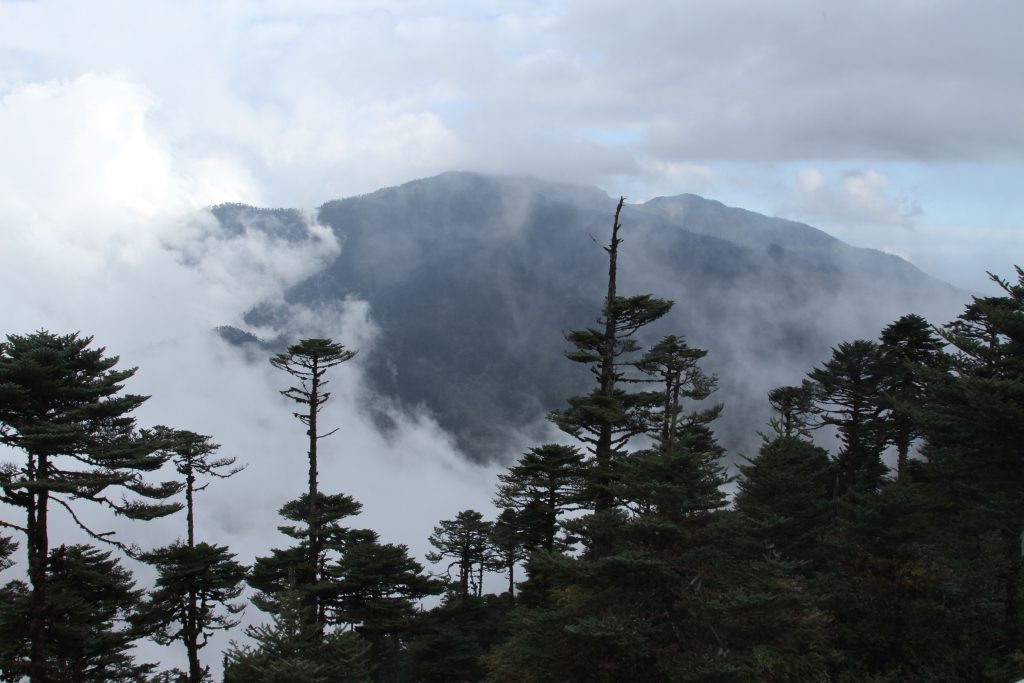
Bhutan Tumching-La 4000m, October
Bhutan2014 420 ergebnis
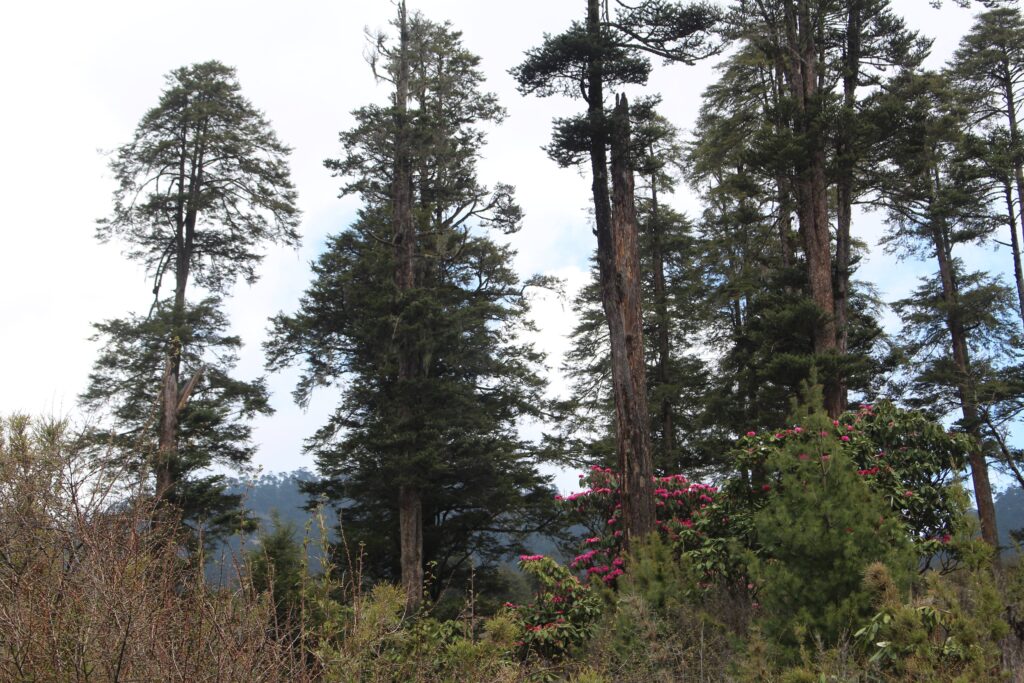
Bhutan Jakar 2400m, May
Sikkim 2006 82 ergebnis
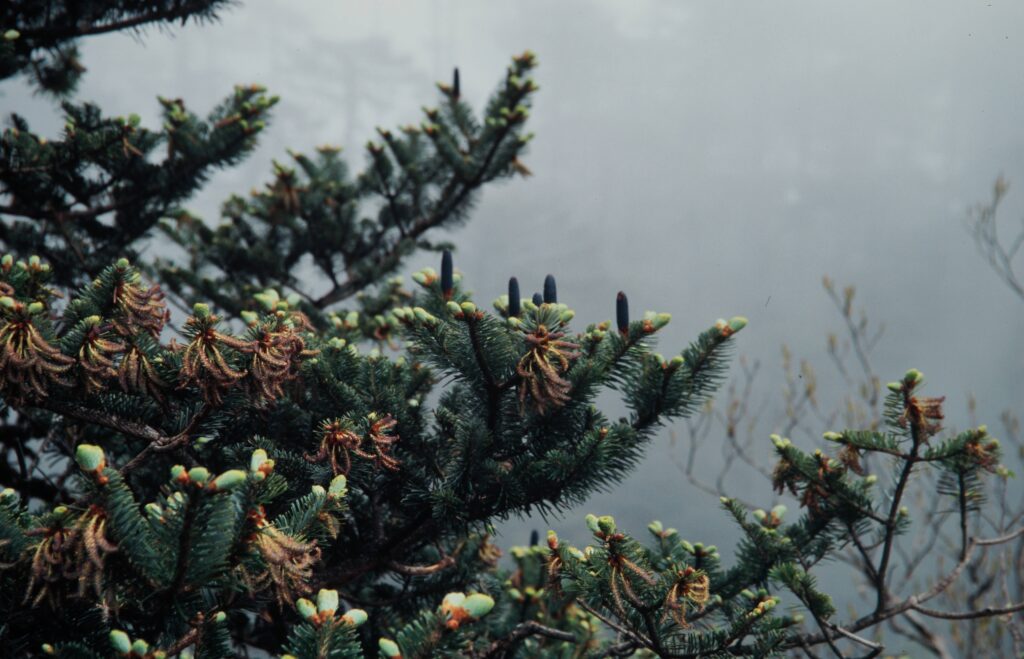
Sikkim, West-Bengal Kalipokhri 3100m, May

Description

Abies densa, the Bhutan or eastern Himalayan fir, is a large evergreen conifer of the eastern Himalaya, ranging through Bhutan, Sikkim and adjacent India, eastern Nepal, southern China and northern Myanmar (gbif_countries: BT, IN, CN, NP, MM, CA, ZZ, BE), with about 192 GBIF occurrences. It is the dominant tree of the upper subalpine forest belt, forming dense stands often mixed with Rhododendron, birch and juniper and grading into the treeline krummholz. The illustrated records span Jakar in Bhutan at about 2400 m up to Tumching-La near 4000 m and Kalipokhri in the Sikkim–West Bengal borderland at about 3100 m, documenting its occupation of the cool, humid, high-montane to subalpine zone.

The tree reaches considerable height with a straight bole and conical crown, bearing horizontally spreading branches. The needle-like leaves are arranged spirally but pectinately spread, linear and flattened, dark green and glossy above with two whitish stomatal bands beneath, and notched or rounded at the apex. The pollen cones are small and lateral; the seed cones are erect, cylindrical, dark violet to blue-black when young, and, as in all firs, disintegrate on the tree at maturity to release winged seeds, leaving the persistent central axis standing.

Closely allied to Abies spectabilis of the western Himalaya, A. densa is sometimes treated as its eastern vicariant, the two replacing one another along the range. It is an ecologically important timber and watershed species and a keystone of subalpine forest. Though still locally abundant, its treeline populations are sensitive to climate shifts and grazing, and it is assessed as of Least Concern overall while warranting monitoring at range margins.

Author: Griff. · Sources: POWO (Kew), GBIF, Flora of Bhutan, Flora of China, Farjon's A Handbook of the World's Conifers, IUCN Red List conifer assessments
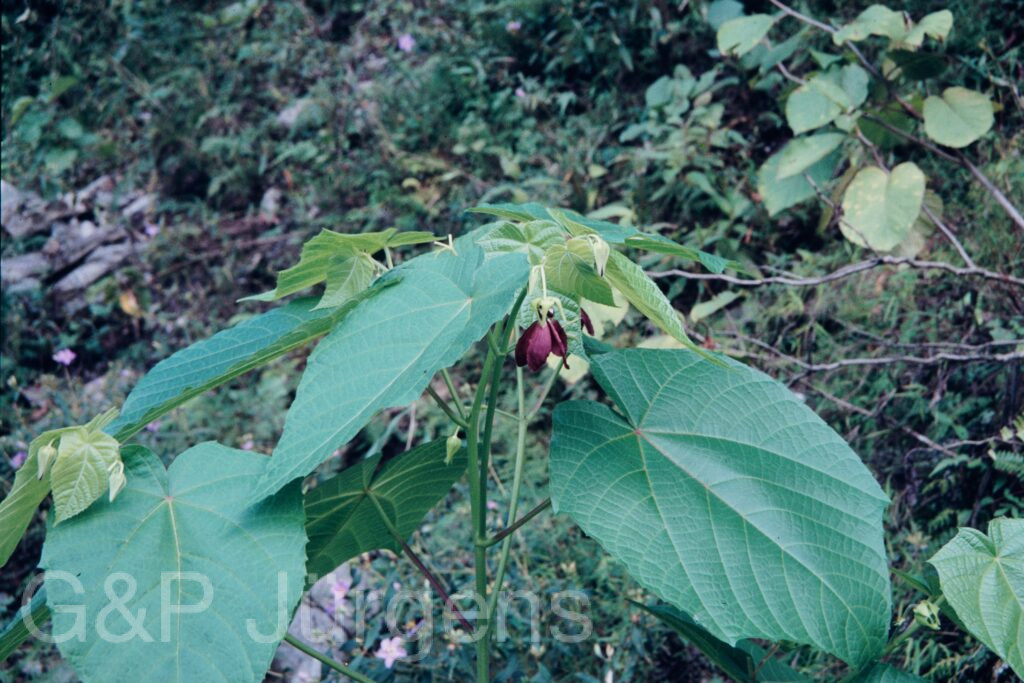
Abroma augustum

by GP Jürgens

(L.) L.f.

Nepal 95 31 P53 ergebnis
Nepal Morandi-Khola 670m Octobre

Description

Abroma augustum (L.) L.f. is a soft-wooded shrub or small tree of tropical and subtropical Asia, ranging from India, Nepal and Myanmar through southern China, Indochina and Malesia to New Guinea and Australia, and widely introduced elsewhere; GBIF documents around 2,078 occurrences across this broad Indo-Pacific span. It favours moist lowland forest margins, riverbanks, secondary thickets and disturbed ground at low elevations. The photographed specimen comes from the Morandi-Khola in lowland Nepal at about 670 m, flowering in October, consistent with its preference for warm, humid foothill habitats.

It is a fast-growing shrub or small tree 2-4 m tall, the young stems, petioles and inflorescence clothed in stellate and stinging-irritant hairs. The leaves are alternate, large, often somewhat dimorphic, the lower broadly ovate-cordate and shallowly 3-5 lobed, the upper smaller and oblong, all with palmate venation. The flowers are showy, pendent and about 3-5 cm across, with five reflexed dark maroon to purplish petals, each bearing a concave nectariferous basal scale, and a staminal tube enclosing five fertile stamens alternating with broad staminodes. The fruit is a distinctive 5-winged, truncate, membranous capsule with longitudinal angles, opening to release numerous small seeds embedded in irritant hairs.

Now placed in Malvaceae (subfam. Byttnerioideae, formerly the segregate Sterculiaceae), Abroma is closely allied to Theobroma and Guazuma. The stem bark yields a strong bast fibre ("devil's cotton") used for cordage, and the bark features in South Asian ethnomedicine as an emmenagogue. Widespread, weedy and often cultivated, the species is of no conservation concern, its success owing to rapid growth, copious wind- and water-dispersed seed, and tolerance of disturbance.

Author: (L.) L.f. · Sources: POWO (Kew), GBIF, Flora of China, Flora of Nepal, Flora Malesiana, Wilkie et al. phylogeny of Byttnerioideae (Malvaceae), Masters treatment of Sterculiaceae in Flora of British India

Wall.

BhutanPG2011 59
Bhutan Jakar, 2100m June
BhutanPG2011 60
Bhutan Jakar, 2100m June

Description

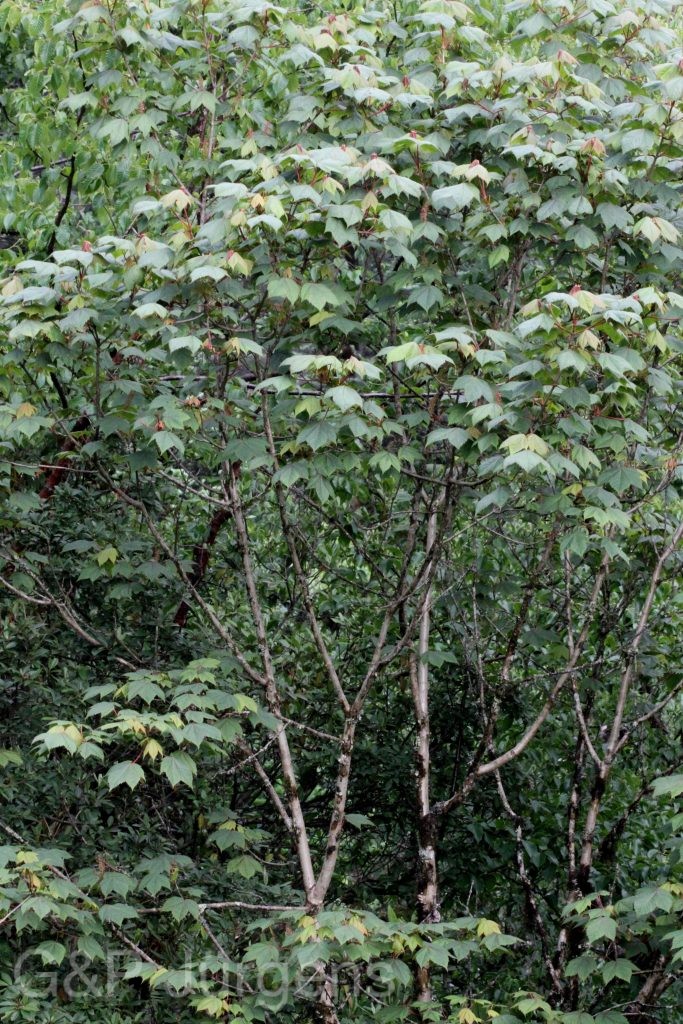
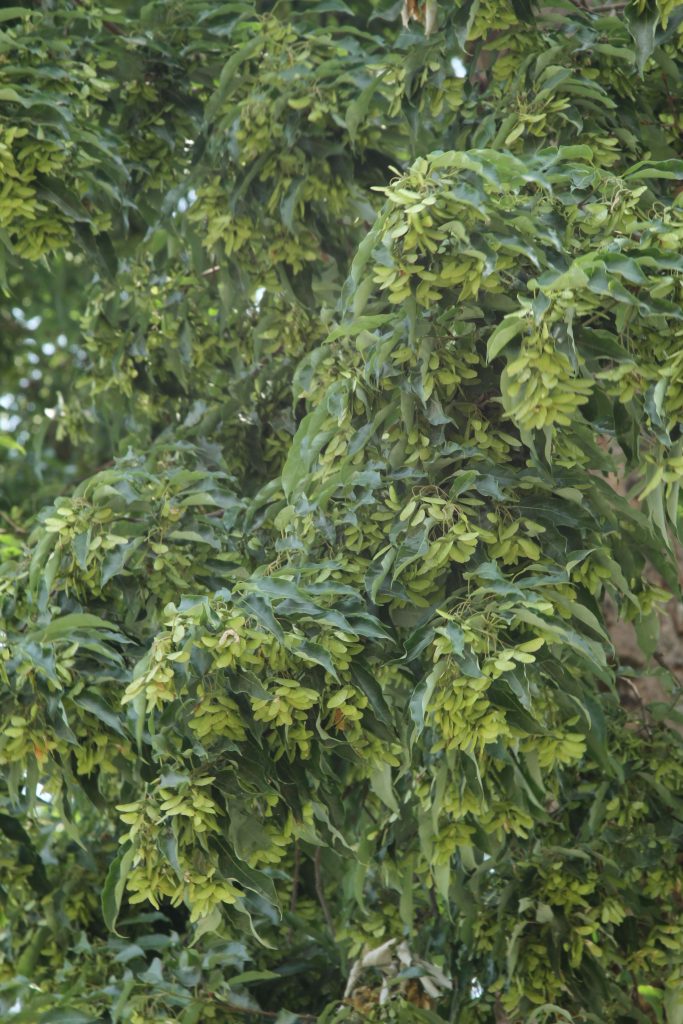
Acer caudatum is a deciduous maple of the Himalaya and the mountains of China, distributed through China, Nepal, India, Bhutan, Myanmar, Afghanistan and into Russia, with over two thousand recorded occurrences across this broad range. It is a tree of moist temperate and subalpine forest, growing in mixed broad-leaved and conifer woodland, along ravines and on cool shaded slopes on humus-rich soils. In Bhutan it occurs in the middle montane belt, as illustrated by the collection near Jakar in the Bumthang region at about 2100 m in June, when the trees are in full leaf and flower.

The species is a small to medium-sized tree with smooth greyish bark and slender branchlets. The leaves are opposite, long-petiolate and orbicular in outline, palmately five- to seven-lobed with the lobes ovate-acuminate and the margins sharply and doubly serrate, often softly hairy on the veins beneath. The inflorescence is an erect terminal raceme or narrow panicle bearing numerous small yellowish-green flowers. The fruit is the typical maple double samara, the two nutlets each bearing a membranous wing, the wings spreading at a wide to nearly horizontal angle to enable anemochorous dispersal of the seeds.

Acer caudatum, described by Wallich and now placed in Sapindaceae following the merger of the former Aceraceae, is a variable species classified within section Spicata, the group of maples with erect spike-like inflorescences. Several geographical varieties have been recognised across its range, reflecting its wide montane distribution. The species is a normal component of Himalayan temperate forest and is not threatened, contributing to autumn colour and, through its winged fruits, to the regeneration dynamics of mid-elevation woodland.

Author: Wall. · Sources: POWO (Kew), GBIF, Flora of China Vol. 11, Flora of Bhutan Vol. 2, Flora of Nepal, Flora of Pakistan, van Gelderen et al. Maples of the World

Acer oblongum

by GP Jürgens

Wall. ex DC.

Bhutan2014 657
Bhutan Wangdi-Phodrang 2300m, May

Description

Acer oblongum, the evergreen or Himalayan maple, is a broadly distributed tree of the southern and eastern Himalaya and the mountains of southern and central China, recorded by GBIF from China, India, Nepal, Bhutan, Myanmar, Thailand, Vietnam, Pakistan and Taiwan (with numerous cultivated records in Europe and North America) across some 3,600 georeferenced occurrences. It grows in subtropical to warm-temperate broadleaf and mixed forest, on hill slopes, ridges, riverine forest and forest margins, generally between about 600 and 2,500 m. The photographed tree from Wangdi-Phodrang in western Bhutan at around 2,300 m in May represents its upper montane occurrence, where it flowers in spring with the flush of new growth.

Unusually for a maple, A. oblongum is evergreen or semi-evergreen, and equally atypical are its leaves, which are simple, entire and unlobed, oblong-lanceolate to ovate-oblong, leathery, glossy dark green above and conspicuously glaucous or whitish beneath, with pinnate or triplinerved venation rather than the palmate lobing characteristic of most of the genus. The flowers are small, greenish-yellow, andromonoecious or polygamous, borne in corymbose or paniculate clusters. The fruit is the typical maple double samara, the two nutlets each bearing a membranous wing; in this species the wings are spreading at an acute to nearly parallel angle, adapted to autorotating wind dispersal.

Acer oblongum is treated within section Pentaphylla (series Trifida) of the genus Acer, now placed in an enlarged Sapindaceae following the merger of the former Aceraceae. Its entire, evergreen leaves make it one of the most distinctive of the Asian maples and a noteworthy example of foliar reduction within a predominantly palmately-lobed genus, of interest to studies of leaf-form evolution. The species is widespread, locally common, and valued horticulturally and for its timber; it is not considered globally threatened, although particular regional populations face pressure from forest clearance.

Author: Wall. ex DC. · Sources: POWO (Kew), GBIF, Flora of China Vol. 11, Flora of Bhutan Vol. 2, Flora of Nepal, Flora of Pakistan, van Gelderen, de Jong & Oterdoom: Maples of the World

Stapf

Sikkim2003 256 P351
Sikkim Dzongri 4200m August

Description

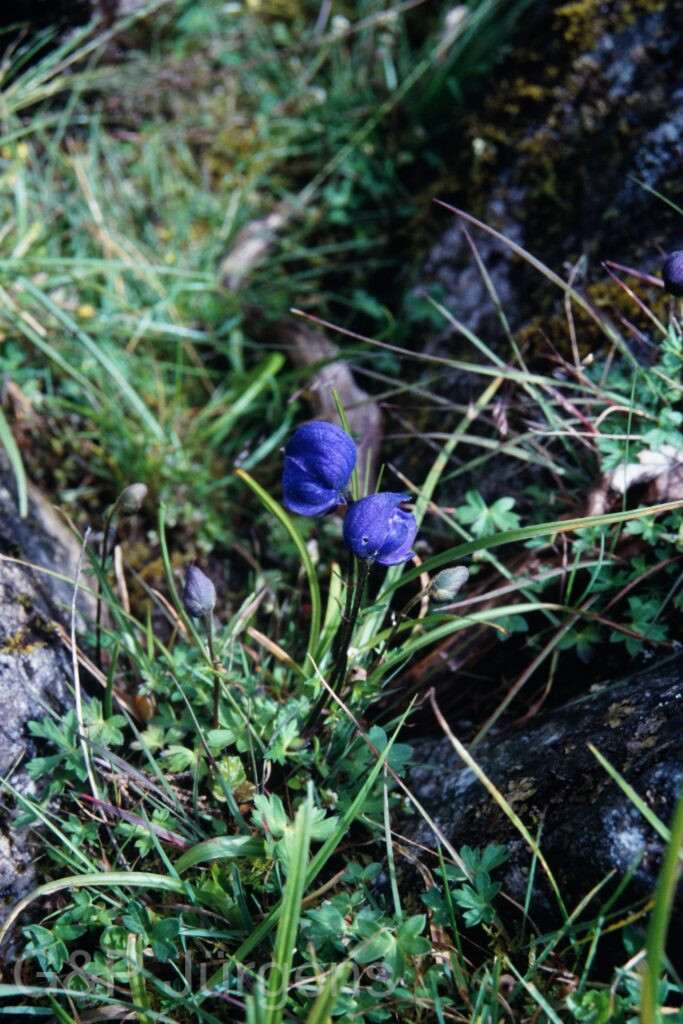
Aconitum naviculare is a high-alpine monkshood of the eastern and central Himalaya, ranging from Nepal through Sikkim and northern India into Bhutan, south-western China (Xizang) and northern Myanmar; its modest tally of around 110 georeferenced occurrences (CN, NP, BT, IN, MM) reflects its specialised montane niche. It occupies open alpine meadows, screes, moist turf and rocky slopes at high elevation, typically between about 3500 and 4800 m. The plant photographed at Dzongri in Sikkim at 4200 m in August, flowering at the height of the monsoon-influenced alpine summer, exemplifies its cold, exposed habitat near the upper limit of vascular plant growth.

It is a small perennial herb arising from a slender tuberous rootstock, with an erect or somewhat flexuous stem usually under 30 cm. The leaves are palmately divided into narrow, deeply cut segments. The flowers are few and borne in a lax terminal raceme; as in all Aconitum the five petaloid sepals are zygomorphic, the uppermost forming the characteristic helmet or hood (galea), here narrowly boat-shaped (navicular, whence the epithet), bluish-purple and often paler within. Two long-clawed nectariferous petals are concealed beneath the hood, with numerous stamens and three to five free carpels ripening into a cluster of follicles containing winged seeds.

Aconitum naviculare belongs to subgenus Aconitum and is a noted constituent of Himalayan alpine flora, valued and harvested in Tibetan and folk medicine as "Bonga" for its diterpenoid alkaloids, which render the whole plant highly toxic. Such harvesting, combined with its restricted high-altitude range, raises local conservation concern, although it remains frequent within intact alpine grassland.

Author: Stapf · Sources: POWO (Kew), GBIF, Flora of China, Flora of Bhutan, Flora of Nepal, Stapf's monograph of the Asiatic species of Aconitum

(Hook.f.) H.Hara

Sikkim2003 70 P95
Sikkim Choka 2900m, August

Description

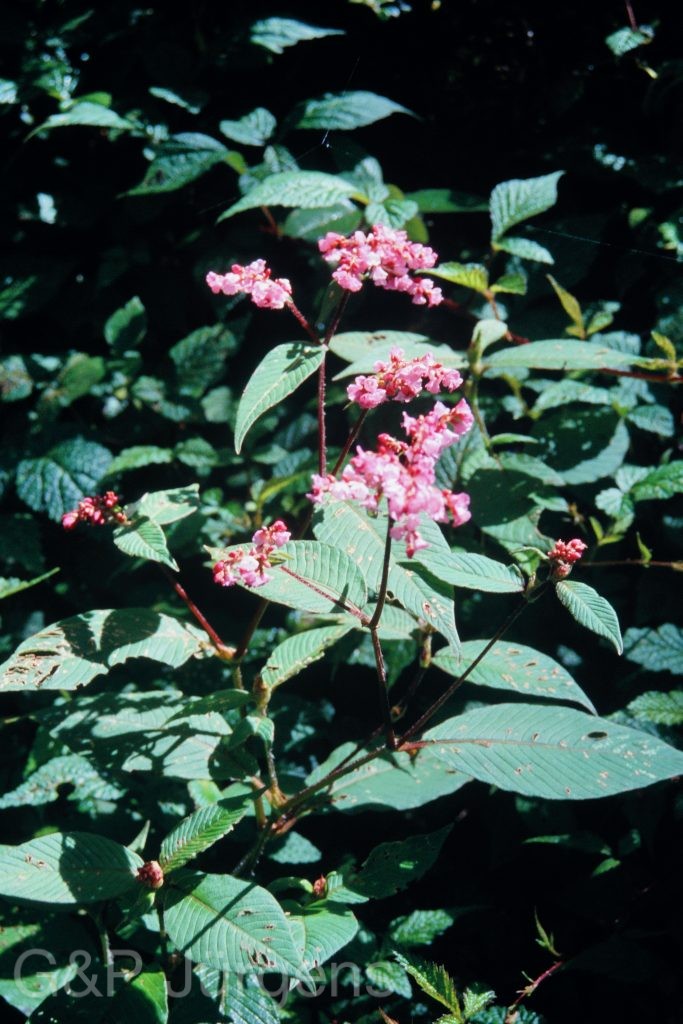
Aconogonum campanulatum, treated by GBIF as a synonym of the accepted Aconogonon campanulatum, is a Sino-Himalayan perennial herb distributed from Nepal and northern India through Sikkim and Bhutan into Myanmar and south-western China. Its 372 GBIF records lie mostly within this native range, with scattered European, North and South American and New Zealand points reflecting cultivated and herbarium material. It grows in subalpine and alpine meadows, forest clearings, shrubberies and along streamsides and banks, commonly between about 2700 and 4000 m. The plant photographed at Choka in Sikkim at 2900 m in August captures it flowering in moist, herb-rich montane vegetation during the monsoon.

It is a robust, branching perennial arising from a woody rootstock, with erect leafy stems. The leaves are alternate, ovate to ovate-lanceolate, often somewhat cordate to rounded at the base and acuminate at the apex, frequently white-tomentose beneath, with membranous sheathing ochreae at the nodes. The flowers are borne in lax, branched, paniculate inflorescences; each has a five-parted, campanulate, white to pinkish perianth (the source of the epithet), with eight stamens and a trifid style. The fruit is a small, trigonous, shining brown nut.

The species belongs to Aconogonon (often spelled Aconogonum), a segregate of the broadly defined Polygonum embracing the alpine knotweeds, and the accepted name is Aconogonon campanulatum. Its woody rootstock and tall leafy habit suit the tall-herb communities of moist Himalayan slopes. Widely distributed and locally abundant, it is of no conservation concern and forms a conspicuous element of subalpine meadow vegetation.

Author: (Hook.f.) H.Hara · Sources: POWO (Kew), GBIF, Flora of Bhutan, Flora of China, Annotated Checklist of the Flowering Plants of Nepal

Lindl.

Bh09 44 P81
Bhutan Paro 2500m, June

Description

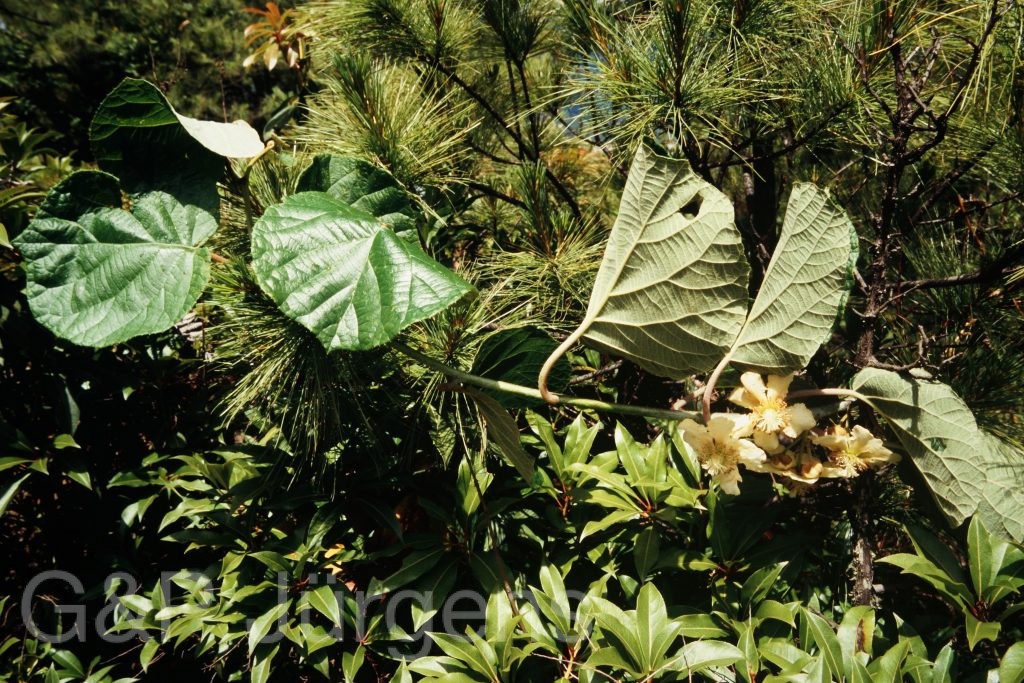
Actinidia callosa Lindl. is a woody climber of the Actinidiaceae, the kiwifruit family, distributed widely through the Himalaya and East and Southeast Asia. GBIF (about 3,400 occurrences) records it from China, Taiwan, Nepal, India, Japan, Vietnam, Myanmar, Bhutan and Indonesia, where it scrambles through montane broad-leaved and mixed forest, along forest margins, thickets and stream banks. It occupies a broad temperate to warm-temperate belt; the plant photographed at Paro in Bhutan at 2,500 m in June illustrates its flowering in mid-elevation forest, where it climbs over shrubs and trees for support.

The plant is a deciduous, twining liana with terete, lenticellate stems and a pith that is typically lamellate (chambered) or solid, a diagnostic character within the genus. Leaves are alternate, long-petiolate, ovate to elliptic, with finely serrate margins bearing callose-tipped teeth, the feature giving the epithet "callosa"; the lower surface is often glabrous to sparsely hairy with conspicuous venation. The flowers are borne in axillary cymes, are usually functionally unisexual (the plants more or less dioecious), and have white to greenish-white petals; the numerous stamens bear dark anthers, and the superior ovary develops many styles. The fruit is a many-seeded berry, ovoid to oblong, greenish to brownish and spotted, edible though far smaller than the cultivated kiwifruit.

Actinidia callosa is a polymorphic species with several recognised varieties differing in leaf indumentum, dentition and fruit characters, and it belongs to the same genus as the commercial kiwifruit (A. deliciosa and A. chinensis), making the wild Himalayan members of interest as genetic resources. Ecologically it is a characteristic forest liana, its berries dispersed by birds and mammals, and it contributes to the structural complexity of mid-montane Asian forests.

Author: Lindl. · Sources: POWO (Kew), Flora of China Vol. 12, Flora of Bhutan Vol. 1, GBIF, Li, Li & Soejarto: Actinidiaceae in Flora of China

(Hook. f. & Thomson) Collett & Hemsl.

Bhutan2012 517
Bhutan Wangdi 2700m, September
Bhutan2012 518
Bhutan Wangdi 2700m, September

Description

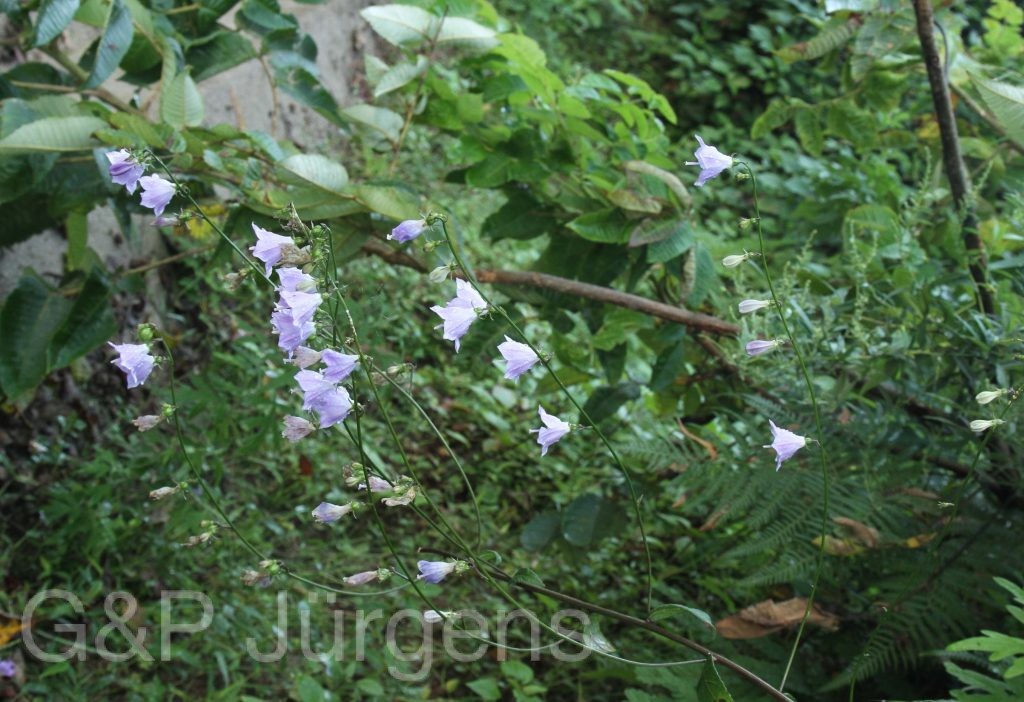
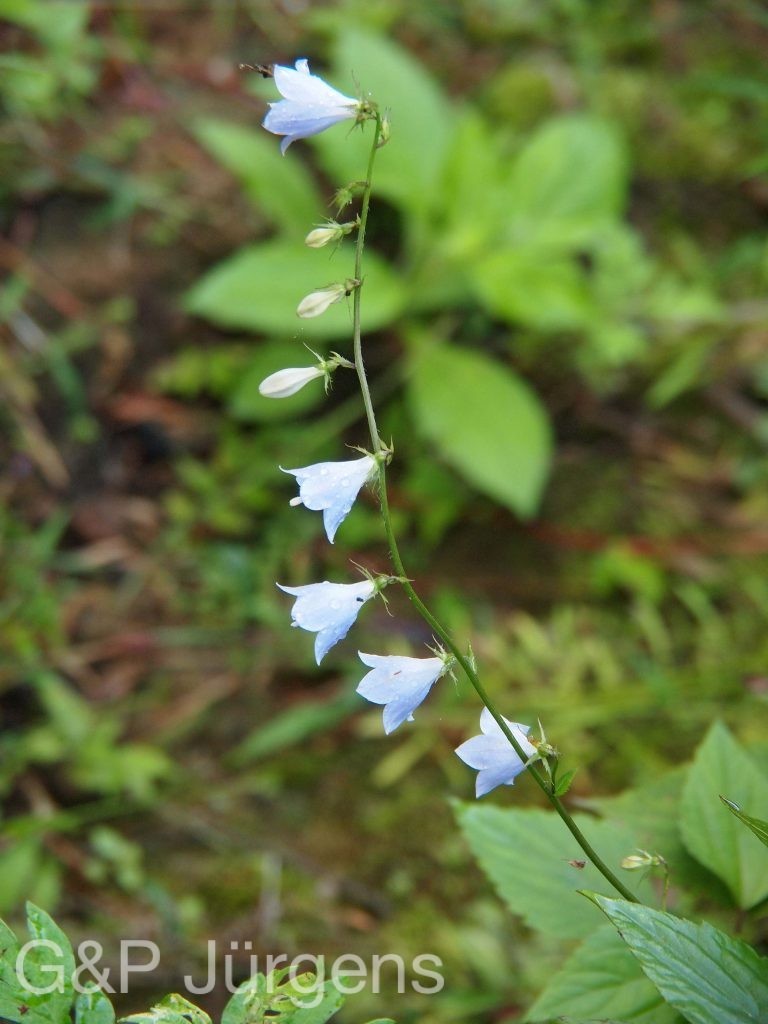
Adenophora khasiana is a Sino-Himalayan ladybell distributed from the eastern Himalaya through northeastern India (including the Khasi Hills, source of the epithet), Bhutan and Myanmar into southern China, with scattered records elsewhere reflecting herbarium and cultivated material; GBIF documents some 327 occurrences. It is a plant of the temperate montane belt, occurring on grassy banks, forest margins, scrub and open rocky slopes, as recorded near Wangdi in Bhutan at 2700 m. Flowering in late summer and autumn (September), it favours well-drained, sunny to lightly shaded sites within the broadleaved and mixed forest zone.

It is an erect perennial herb arising from a thickened, fleshy taproot, the stems simple or sparingly branched and exuding milky latex when broken, as is characteristic of the family. The leaves are alternate, sessile or short-petiolate, ovate to lanceolate and toothed along the margin. The flowers are borne in a lax terminal panicle or raceme; the corolla is campanulate to broadly funnel-shaped and blue to pale violet, with five short lobes. Diagnostic for the genus is the tubular nectary disc surrounding the base of the style, and the elongate style that is usually exserted beyond the corolla. The fruit is a capsule dehiscing by basal pores to shed numerous small seeds.

The species was transferred to Adenophora by Collett & Hemsley from a basionym of Hooker f. & Thomson. Adenophora is distinguished from the closely related Campanula primarily by its conspicuous cylindrical nectariferous disc at the base of the style, a key character in the taxonomy of the Campanulaceae. The protandrous, nectar-rich flowers attract bees and other long-tongued insects. The fleshy roots of several Adenophora species are used in East Asian herbal medicine. Widespread and locally common, A. khasiana is not considered threatened.

Author: (Hook. f. & Thomson) Collett & Hemsl. · Sources: POWO (Kew), GBIF, Flora of China, Flora of Bhutan, Hong's monograph of the genus Adenophora (Campanulaceae)

L.

Bhutan2012 456
Bhutan Wangdi 2500m, September
Nepal 95 63 P106 ergebnis
Nepal below Barphak 1400m October

Description

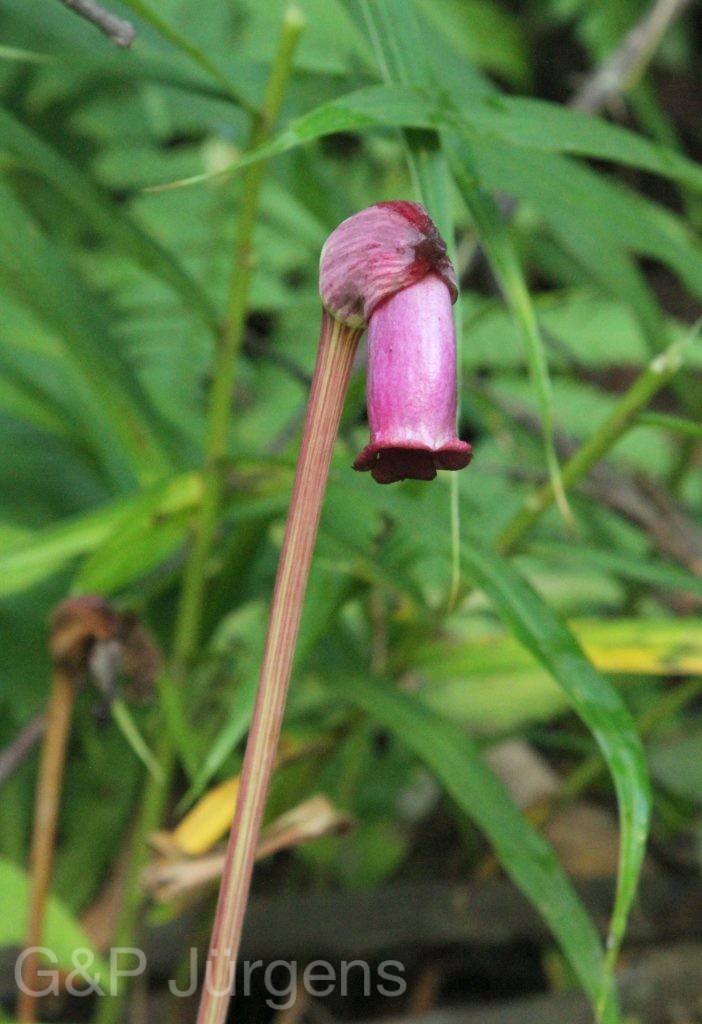
Aeginetia indica is a widespread holoparasitic herb of tropical and subtropical Asia, recorded from Japan, China, Taiwan, Korea and across South and Southeast Asia including India, Nepal, Bhutan, Sri Lanka, Myanmar, Thailand, the Malesian region and beyond; with about 3514 GBIF records it is by far the most frequently collected species in this group. It is a root parasite of grasses and other monocots, occurring in moist forest, grassland, scrub, plantations and field margins from the lowlands up into the lower hills, generally below about 2500 m. The plants illustrated, from Wangdi in Bhutan at around 2500 m in September and below Barphak in Nepal at about 1400 m in October, span this elevational range.

Lacking chlorophyll, the plant is reduced to fleshy, scale-like leaves on a very short underground stem attached to the host roots. The conspicuous part is the flower, borne singly atop a long, stout, purplish or yellowish scape; it is a large, tubular, somewhat curved corolla coloured deep purple to magenta with a paler throat, the five lobes short and the mouth oblique, subtended by a boat-shaped spathe-like calyx. There are four stamens and a superior ovary that ripens into a many-seeded capsule shedding the dust-like seeds characteristic of parasitic plants.

Now placed in the broadened Orobanchaceae following the merger of the old Scrophulariaceae-derived parasites, Aeginetia is an Asian genus of obligate root parasites, and A. indica is notable as a parasite of sugarcane and other grasses, where it can be a minor agricultural pest. Its enormous seed output and broad host and geographic range make it ecologically successful and of no conservation concern. The species is also used in traditional medicine across parts of its range.

Author: L. · Sources: POWO (Kew), GBIF, Flora of China, Flora of Bhutan, Annotated Checklist of the Flowering Plants of Nepal, Nickrent Parasitic Plant Genera of the World

Roxb.

Sikkim2004 445 G776
Sikkim/India Tista-Valley 2000m May

Description

Aerides multiflora is an epiphytic orchid of the subtribe Aeridinae, native to the eastern Himalayas and extending into Southeast Asia. Its natural range encompasses Nepal, northeast India (Sikkim, Assam, Meghalaya, Arunachal Pradesh), Bhutan, Myanmar, Thailand, and southwest China (Yunnan). The species inhabits humid, semi-deciduous and evergreen forests at elevations of 200–2,000 m, typically growing on mossy tree trunks and branches in well-lit positions.

The plant produces stout, terete stems 20–40 cm long, clothed with distichous, coriaceous, strap-shaped leaves that are 15–25 cm long and unequally bilobed at the apex. The inflorescence is a densely many-flowered, pendent raceme 15–30 cm long, bearing 20–40 fragrant flowers. Individual flowers are 2–2.5 cm across, white to pale rose-pink with purple spots, the lip trilobed with a prominent forward-pointing spur. The mid-lobe is fleshy and tongue-shaped. Flowering occurs from April to June.

Aerides multiflora is valued in horticulture for its abundant, sweetly fragrant blooms. The species is under pressure from overcollection and habitat degradation across its range. Like all orchids, it is listed under CITES Appendix II, regulating international trade.

Author: Roxb. · Sources: POWO (Kew), Flora of Bhutan Vol. 3, GBIF, Pearce & Cribb: The Orchids of Bhutan (2002)