Tag:

Myanmar

Flowers of the Myanmar Himalaya — 604 species recorded from northern Myanmar (Burma) and the eastern Himalayan borderlands, a biodiversity hotspot linking the Himalaya to the mountains of Yunnan and Southeast Asia. The region’s forests and alpine slopes hold a rich flora of rhododendrons, orchids, balsams and gentians. Every page gives a botanical description, distribution, habitat and flowering time with the original photograph.

Wall.ex A.DC.

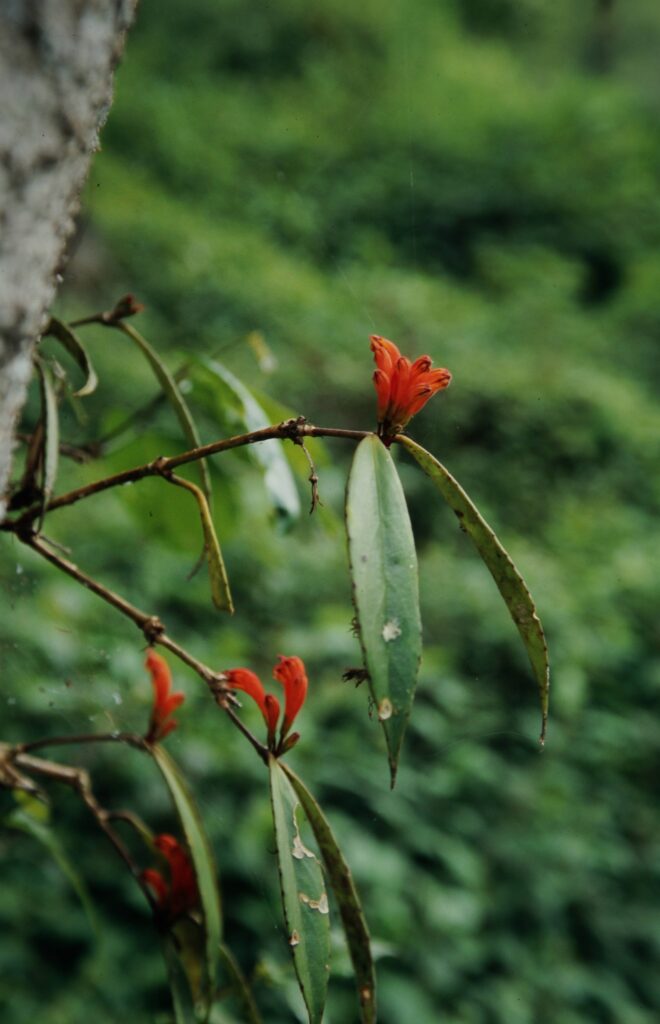
Bhutan2012 946
Bhutan Trithangebe 2100m, October
Bhutan2012 947
Bhutan Trithangebe 2100m, October

Description

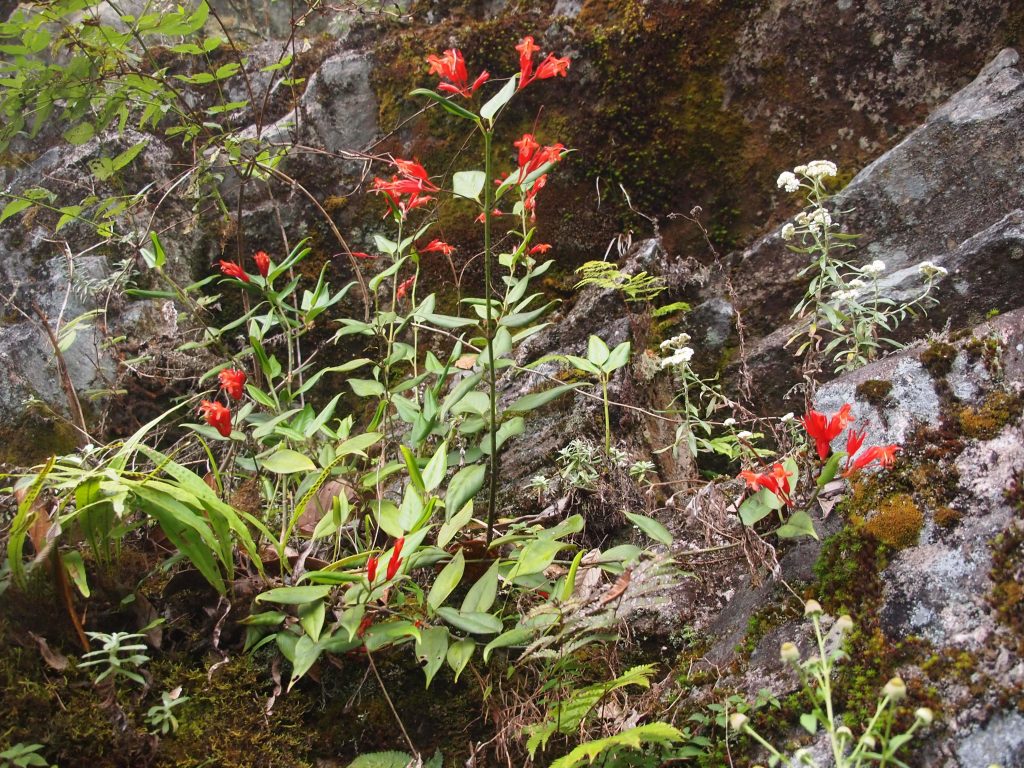
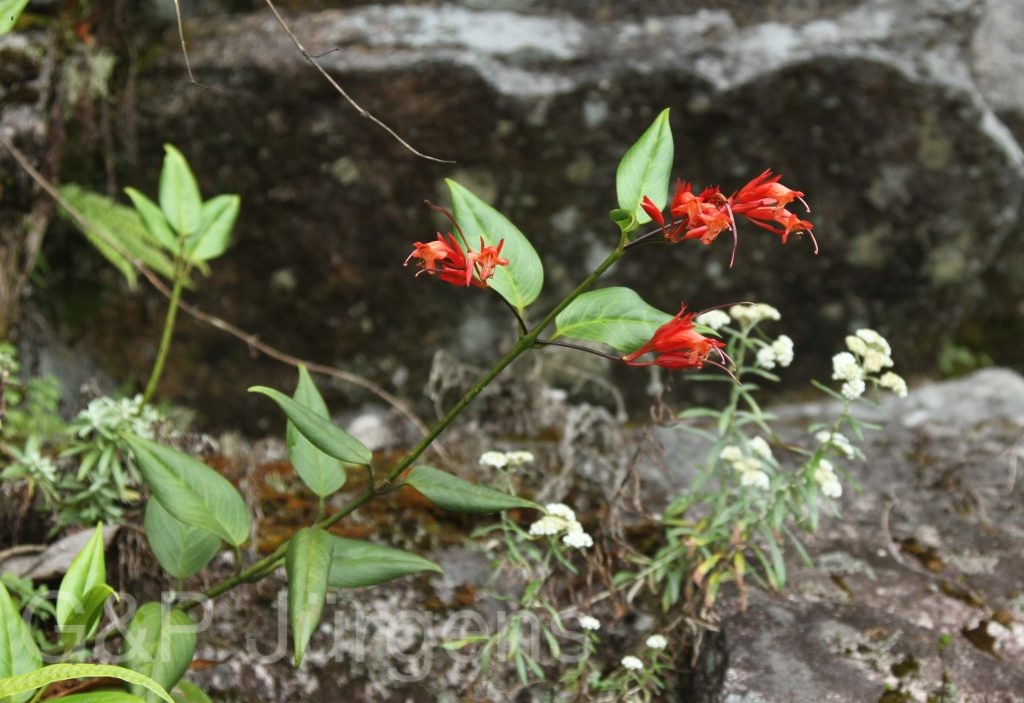
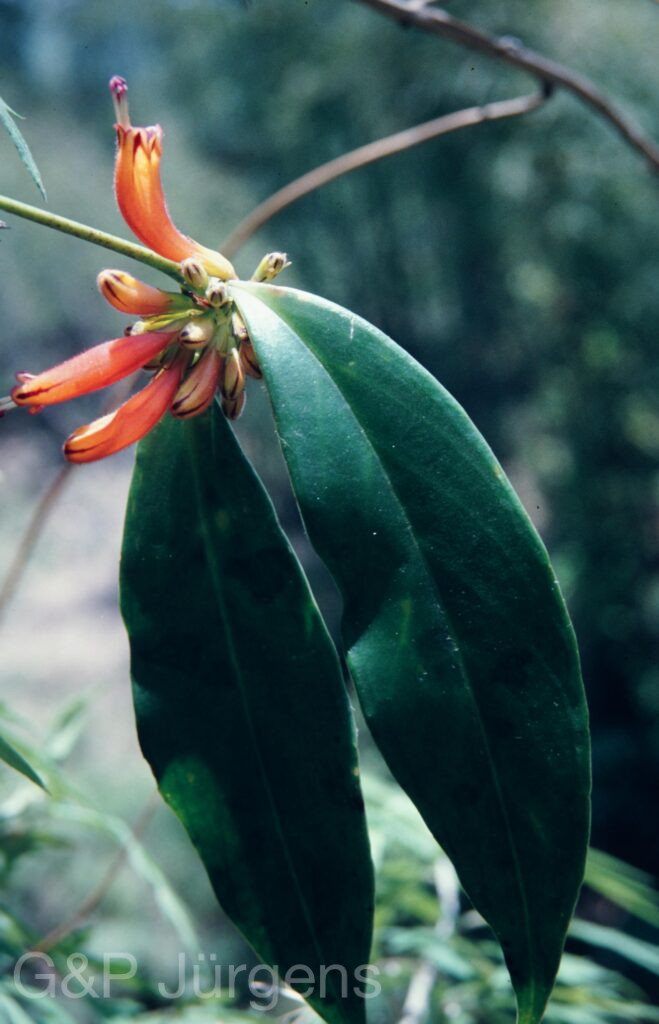
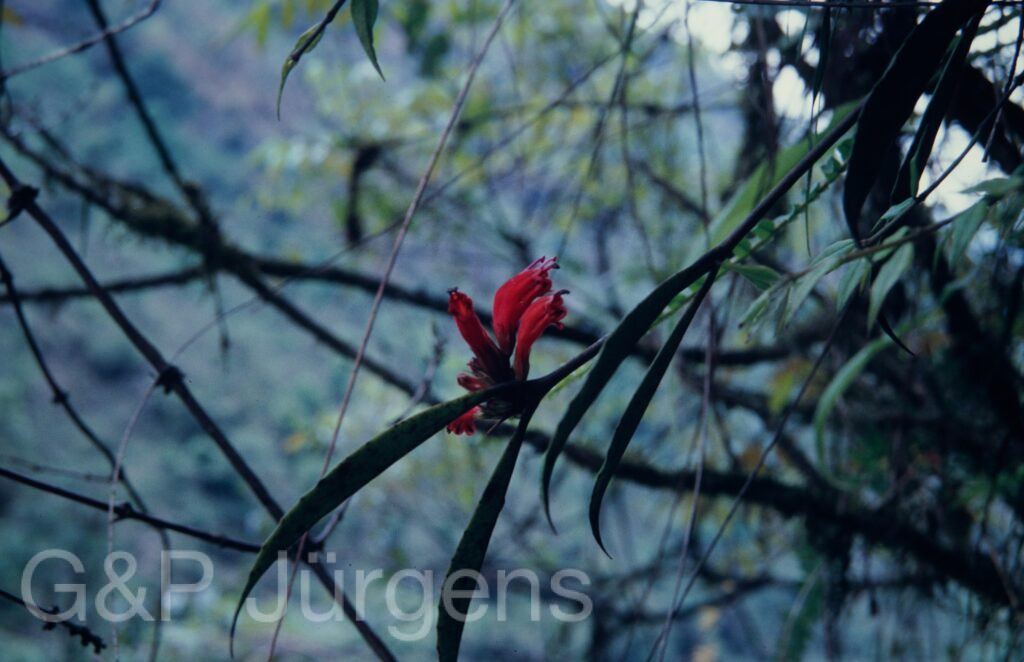
Aeschynanthus bracteatus is an epiphytic subshrub of the eastern Himalaya and Indo-Chinese region, distributed from Nepal and northern India through Bhutan and Bangladesh into Myanmar, south-western China, Laos and Vietnam, with around 906 occurrence records. It grows as an epiphyte or lithophyte on mossy tree trunks, branches and shaded rocks in humid evergreen broad-leaved montane forest, typically between about 1500 and 2500 m. The specimen photographed at Trithangbe in Bhutan at 2100 m in October illustrates its autumn flowering within the moist, mist-laden forests where epiphytic gesneriads thrive.

The plant has trailing to pendulous, somewhat fleshy stems rooting at the nodes, bearing opposite, thick, elliptic to lanceolate leaves that are entire and glabrous, with an obscurely veined, leathery texture suited to its epiphytic life. The inflorescences are terminal or axillary clusters subtended by conspicuous bracts, the feature reflected in the epithet bracteatus. The flowers have a tubular, often dark calyx and a curved, tubular two-lipped corolla in shades of red to orange-red, the throat sometimes marked within. The fruit is a long, slender, capsule splitting to release numerous small seeds furnished with hair-like appendages aiding wind dispersal.

Aeschynanthus (Gesneriaceae) is a large palaeotropical genus of climbing and epiphytic herbs and subshrubs; the input file places it under Didymocarpinae, a subtribal name within Gesneriaceae, whereas the genus is conventionally treated in subtribe Loxonia/Trichosporeae allies. The tubular red flowers and protruding stamens indicate bird (sunbird) pollination, while the plumose-appendaged seeds are wind-dispersed. The species is widespread across the Indo-Burmese hills and is of least conservation concern, serving as a characteristic epiphyte of eastern Himalayan cloud forest.

Author: Wall.ex A.DC. · Sources: POWO (Kew), GBIF, Flora of China, Flora of Bhutan, Annotated Checklist of the Flowering Plants of Nepal, Mendum revision of Aeschynanthus
Spreng.

Nepal 1994 226 ergebnis
Ost-Nepal Mewa-Khola 1900m April 
Nepal 1994 218 ergebnis
Ost-Nepal Mewa-Khola 1900m April 
Sikkim 2006 301 ergebnis
India West-Bengal, Chaana 1750m, May

Description

Aeschynanthus parviflorus is an epiphytic gesneriad widely distributed through the eastern Himalaya and into Southeast Asia, with GBIF records from Nepal, northeast India, Bhutan, Bangladesh, Myanmar, Thailand, Vietnam and southern China (additional codes represent herbaria and cultivation). It grows as an epiphyte or lithophyte on mossy trunks, branches and shaded rocks in humid broad-leaved evergreen and subtropical forest, mainly between 1,000 and 2,200 m. The featured collections come from the Mewa Khola in eastern Nepal at about 1,900 m in April and from Chaana in West Bengal at around 1,750 m in May, within its core mid-montane belt.

The plant has pendent to scrambling, somewhat fleshy stems rooting at the nodes and bearing opposite, coriaceous, elliptic to lanceolate leaves with entire margins and an acuminate apex. The flowers are clustered in the leaf axils or at the branch tips; the calyx is short and cupular, and the corolla is a curved, narrowly tubular structure, red to orange-red, with small spreading lobes, suited to nectarivorous bird and insect pollination. The fruit is a long, slender, two-valved capsule releasing numerous minute seeds, each furnished with a tuft of fine hairs that aids wind dispersal in the canopy.

The species is treated within Gesneriaceae (subtribe Didymocarpinae, genus Aeschynanthus), a large Asian genus of canopy epiphytes whose long-tubed flowers exemplify ornithophily in the Old World tropics. Aeschynanthus parviflorus is common and not regarded as threatened, but as a canopy specialist it depends on intact humid forest and declines where mid-elevation forest is fragmented or logged.

Author: Spreng. · Sources: POWO (Kew), GBIF, Flora of China Vol. 18 (Gesneriaceae), Grierson & Long: Flora of Bhutan Vol. 2, Mendum et al.: Revision of Aeschynanthus (Gesneriaceae)
Ainsliaea aptera

by GP Jürgens

DC.

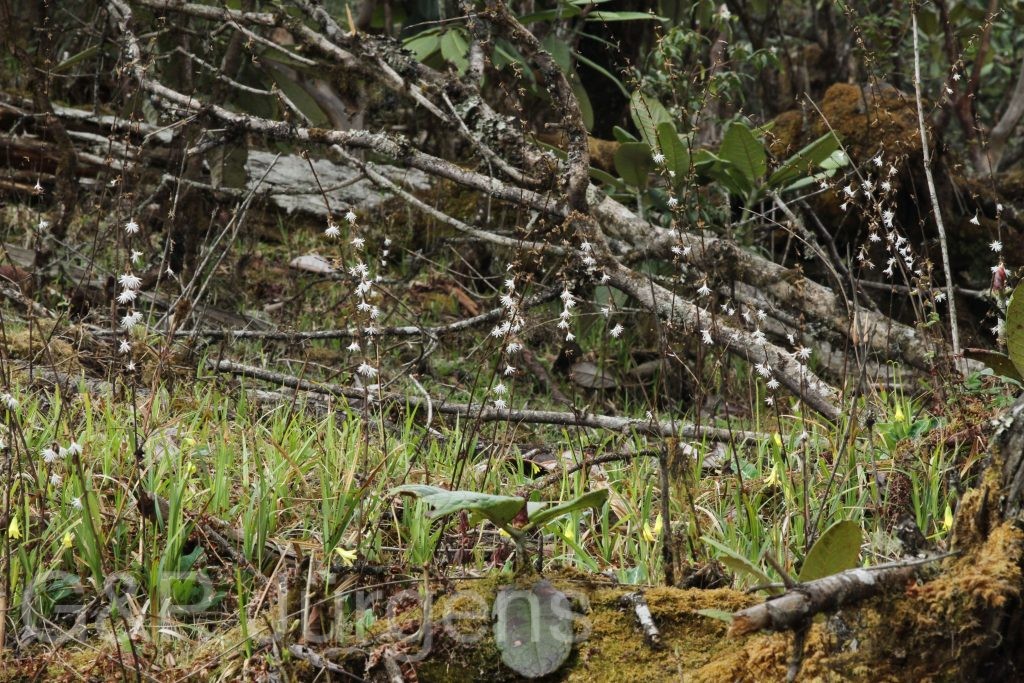
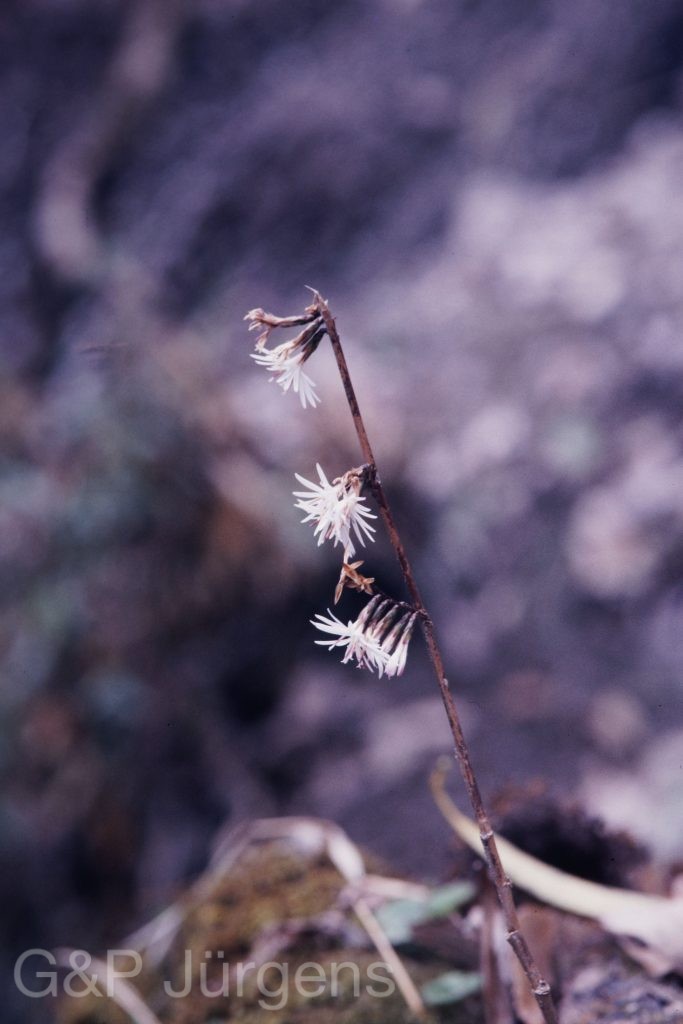
Bhutan2014 513
Bhutan Yatong-La 3200m, May
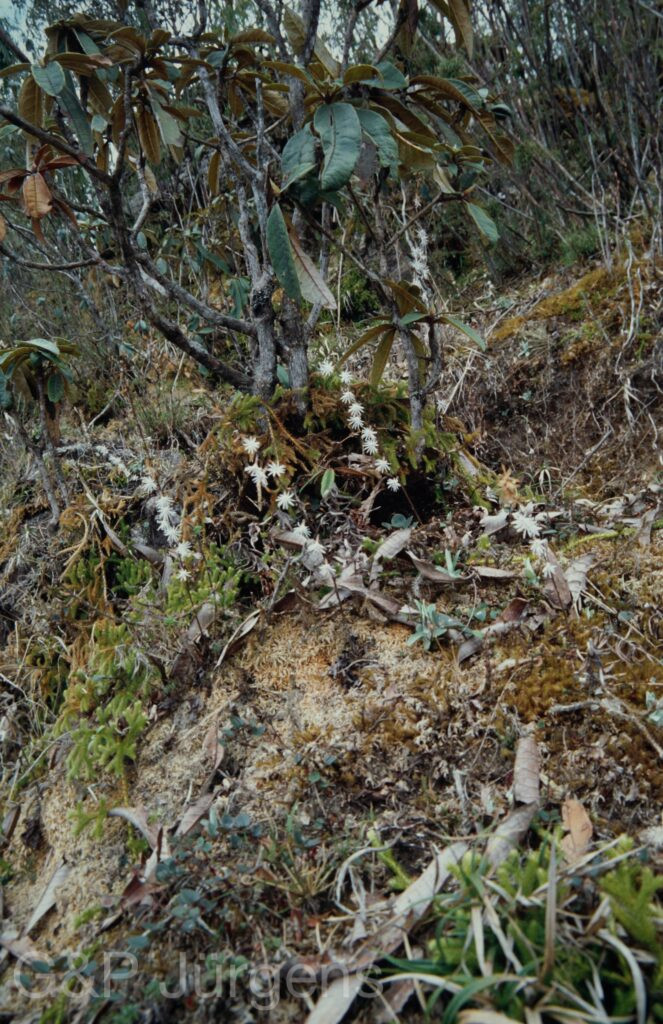
Nepal 1989 58
Nepal Bagachap 2300m, April
Nepal 1994 76 ergebnis
Ost-Nepal Jaljale Himal
3000m April

Description

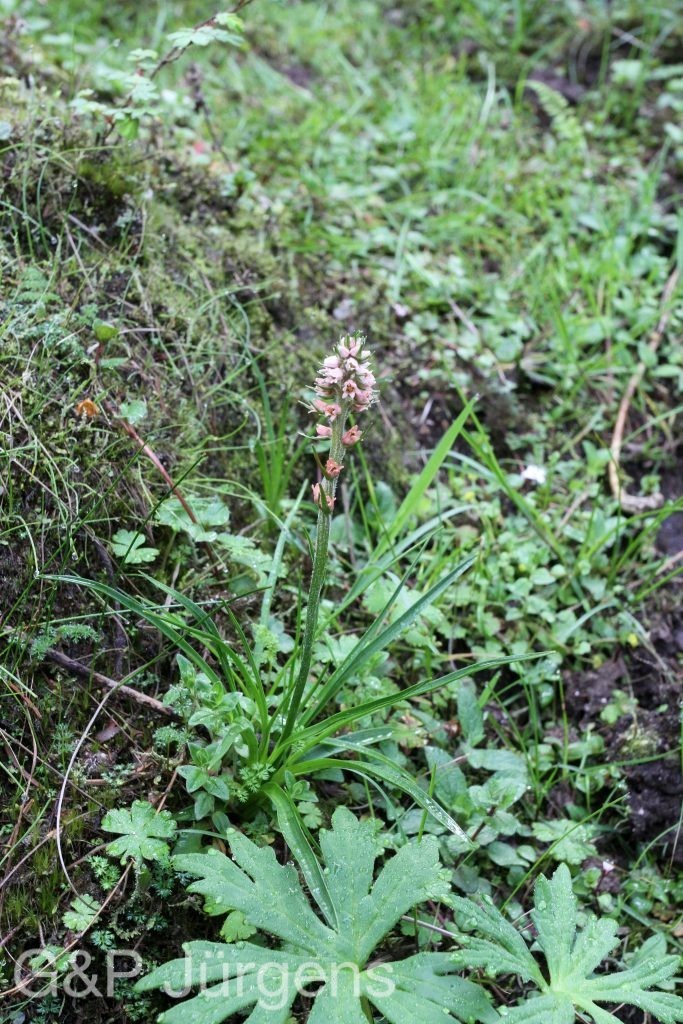
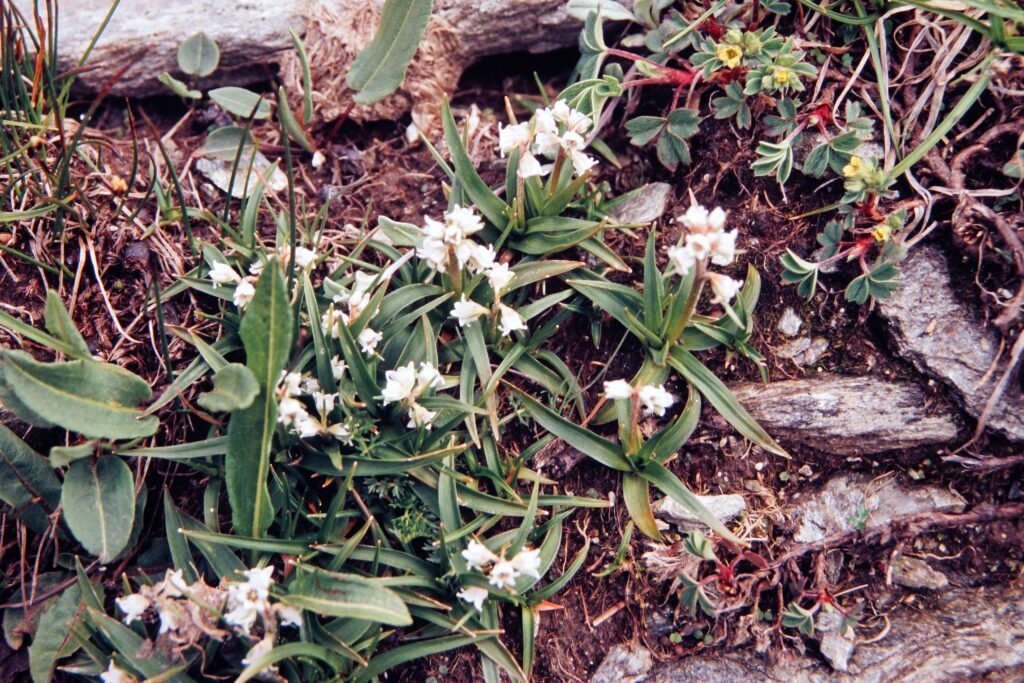
Ainsliaea aptera is a Himalayan rosette herb distributed along the range from Afghanistan and Pakistan through India, Nepal and Bhutan into China and Myanmar, with 358 GBIF occurrences. It grows in the understorey and on shaded banks of temperate broadleaved and conifer forest, on mossy slopes and rock ledges, generally between about 2000 and 3500 m. The illustrated material spans Bhutan's Yatong-La at 3200 m in May, Bagachap in central Nepal at 2300 m in April, and the Jaljale Himal of eastern Nepal at 3000 m in April, indicating a spring-flowering plant of cool, humid forest floors.

It is a perennial herb with a short rhizome bearing a basal rosette of ovate to elliptic, long-petiolate leaves that are firm, with cordate to rounded bases, entire or shallowly toothed margins, and often a sparse covering of hairs. From the centre rises a slender, nearly leafless scape carrying a narrow, spike-like or racemose arrangement of small, sessile capitula. Each head contains a few tubular florets with slender, deeply lobed, white to pinkish corollas. The cypselae are ribbed and clothed in a pappus of plumose (feathery) bristles, a diagnostic feature of the genus.

Described by de Candolle, Ainsliaea belongs to the basal asteraceous tribe Pertyeae (formerly Mutisieae), an Asian lineage notable for its plumose pappus and frequently spike-like inflorescences. The genus is centred on the Sino-Himalayan region and is of interest for the phylogeny of early-diverging Asteraceae. Widespread along the Himalayan forest belt, A. aptera is not regarded as threatened, though it depends on intact shaded forest habitat.

Author: DC. · Sources: POWO (Kew), GBIF, Flora of Bhutan, Flora of China, Revision of Ainsliaea (Mitsui & others), Flowers of the Himalaya (Polunin & Stainton)

 (D.Don) Sch.Bip.

Bh2008 62 G102
Bhutan Punaka-Chu, 1500m April

Description

Ainsliaea latifolia is a widely distributed perennial herb of the Sino-Himalayan and Southeast Asian region, recorded from China, India, Nepal, Bhutan, Pakistan, Bangladesh, Sri Lanka, Myanmar, Thailand, Vietnam, Taiwan, Malaysia and Indonesia, with over a thousand documented occurrences. It is a characteristic understorey plant of subtropical and warm-temperate broadleaved forest, growing on shaded banks, forest floors, grassy clearings and stream margins from the foothills to the middle hills. The individual shown was recorded along the Punakha Chu in western Bhutan at about 1500 m in April, a setting typical of its preference for moist, humus-rich ground beneath oak and evergreen forest.

The plant arises from a short, stout rhizome and is conspicuous for its basal rosette of broad, long-petiolate leaves; the laminae are ovate to broadly ovate or orbicular, cordate at the base, with a shortly acuminate apex and entire to denticulate margins, often purplish and pubescent beneath. From the centre of the rosette rises a slender, leafless or bracteate scape bearing an elongate, spike-like to narrowly paniculate inflorescence. The small capitula are cylindrical and characteristically three-flowered, each floret with a deeply lobed, bilabiate corolla typical of the Mutisioideae. The achenes are ribbed and pubescent, crowned by a copious pappus of plumose, reddish-brown bristles.

The species belongs to Ainsliaea, a genus of the basal asteraceous subfamily Mutisioideae centred on East Asia and the Himalaya, distinguished by its three-flowered heads and rosulate habit. It exhibits considerable variation in leaf shape and indumentum across its extensive range, and several infraspecific taxa have been recognised. Long used in regional folk medicine, it is locally common and faces no significant conservation concern across most of its distribution.

Author: (D.Don) Sch.Bip. · Sources: POWO (Kew), GBIF, Flora of China, Flora of Bhutan, Flora of British India, Revision of the genus Ainsliaea (Mutisieae)

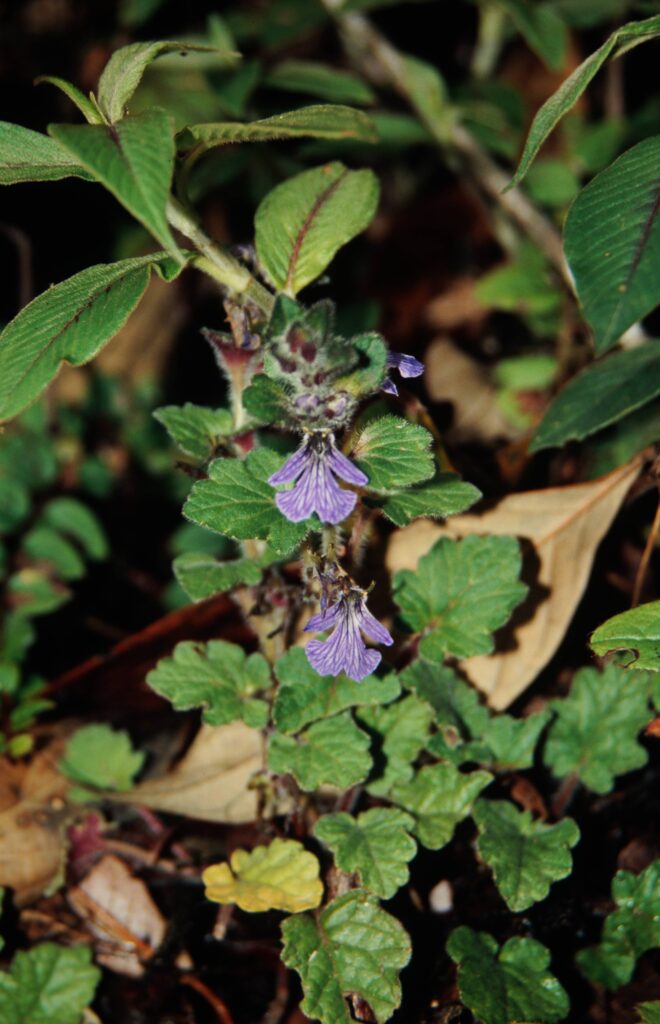
Ajuga lobata 

by G & P Jürgens

D.Don

Sikkim 2006 23 ergebnis
India West-Bengal Tonglu 3100m, May

Description

Ajuga lobata is an eastern Himalayan and Sino-Himalayan element distributed across Nepal, northern India, Bhutan, northern Myanmar and adjacent south-western China, with some 172 georeferenced occurrences documented. It is a plant of cool-temperate forest margins, mossy banks and open grassy slopes within the upper-montane to subalpine belt, typically between about 2400 and 3500 m. The population photographed at Tonglu (3100 m) on the Singalila ridge of West Bengal in May, flowering as the monsoon approaches, is characteristic: it favours humus-rich, freely draining soils in light shade beneath Rhododendron and oak.

It is a low, perennial, somewhat creeping herb arising from a slender rootstock, the quadrangular stems frequently decumbent at the base and rooting at the lower nodes before ascending. The leaves are opposite, ovate to obovate, the lamina conspicuously lobed or coarsely crenate-dentate, narrowed into a winged petiole and often tinged purplish beneath. Flowers are borne in axillary verticillasters forming a leafy terminal spike; the corolla is bluish to violet, two-lipped with a strongly reduced upper lip and a prominent, spreading three-lobed lower lip, the four didynamous stamens exserted. The fruit comprises four reticulate-rugose nutlets seated in the persistent campanulate calyx.

Within Ajuga (Ajugoideae) the species is distinguished by its markedly lobed leaves, a feature echoed in the epithet. Its montane distribution makes it a useful indicator of intact temperate forest ecosystems, and like many bugles it is visited by bees and serves as a minor nectar source. No conservation concern is presently recognised given its broad range, though it is locally restricted to suitable forest habitat.

Author: D.Don · Sources: POWO (Kew), GBIF, Flora of China Vol. 17, Flora of Bhutan Vol. 2, Flora of Nepal, A Revision of the Genus Ajuga (Labiatae)

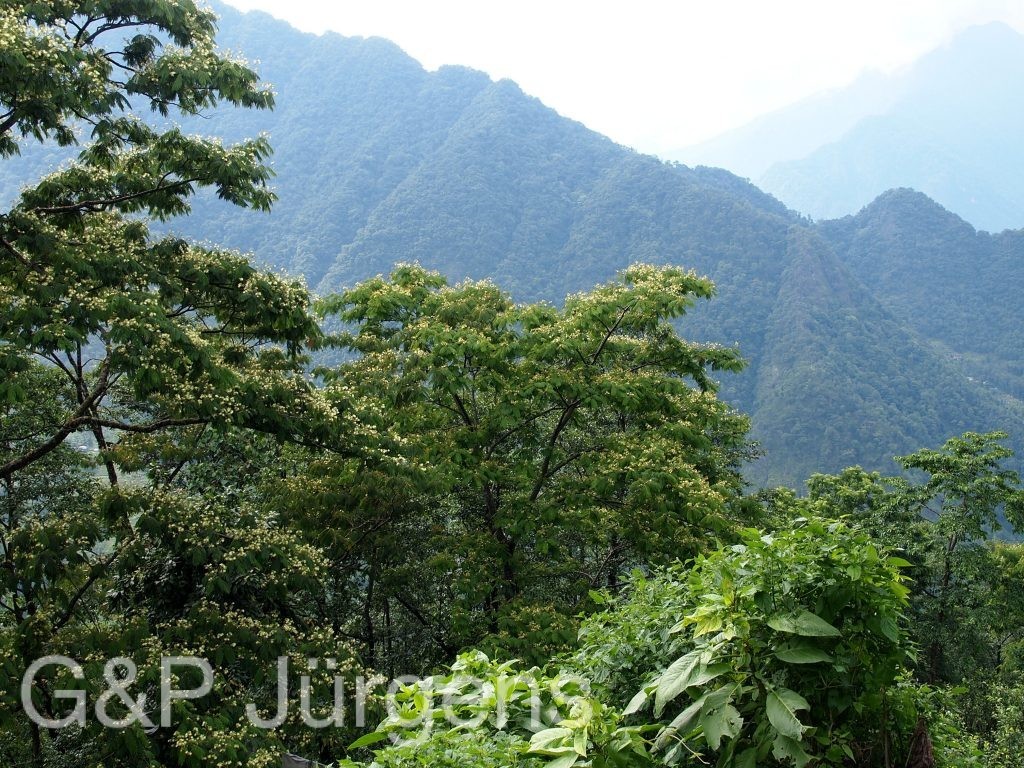
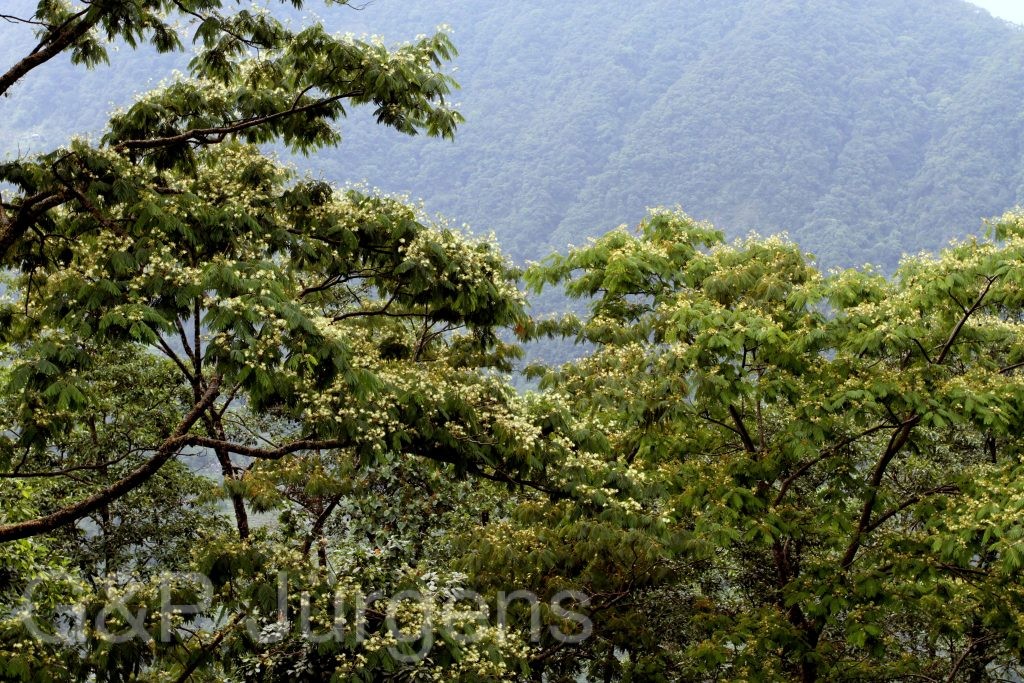
(L.f.) Benth.

Sikkim2011 12
India Sikkim Tista valley 1800m, June
Sikkim2011 13
India Sikkim Tista valley 1800m, June

Description

Albizia odoratissima is a deciduous tree of broadly tropical and subtropical distribution, ranging across the Indian subcontinent and continental Southeast Asia into southern China, with records from Nepal, Bangladesh, Myanmar, Thailand, Laos, Vietnam, Sri Lanka, Malaysia and Indonesia; it has been widely introduced elsewhere, including East Africa, Nigeria, Mozambique and the Americas, and is documented from over a thousand georeferenced collections. In the eastern Himalaya it ascends warm submontane forest, as in the Tista valley of Sikkim around 1800 m photographed in June, favouring moist deciduous and semi-evergreen forest, riverine slopes and forest margins.

The tree reaches 15-25 m, with a spreading crown, grey-brown bark and finely pubescent branchlets. The leaves are bipinnate, with 3-6 pairs of pinnae, each pinna bearing numerous small oblong-falcate leaflets oblique at the base; a gland sits on the petiole. The fragrant flowers are arranged in pedunculate globose heads grouped into terminal panicles, each with a small campanulate calyx, funnel-shaped corolla and numerous long, white to greenish-cream exserted stamens united below into a tube. The fruit is a flat, thin, oblong dehiscent legume, glabrous and reddish-brown.

A member of the mimosoid clade of Fabaceae, A. odoratissima was described as Mimosa odoratissima by the younger Linnaeus and transferred to Albizia by Bentham. It is valued as a nitrogen-fixing timber and fodder species and is widely planted for shade, agroforestry and reforestation, which accounts for its naturalised occurrences far beyond its native Asian range. Locally esteemed for its hard, durable wood, it remains common and is not regarded as threatened, though native populations are affected by selective logging and forest conversion.

Author: (L.f.) Benth. · Sources: POWO (Kew), GBIF, Flora of China, Flora of Bhutan, Flora of British India, Nielsen monograph of Asian Albizia (Mimosoideae)

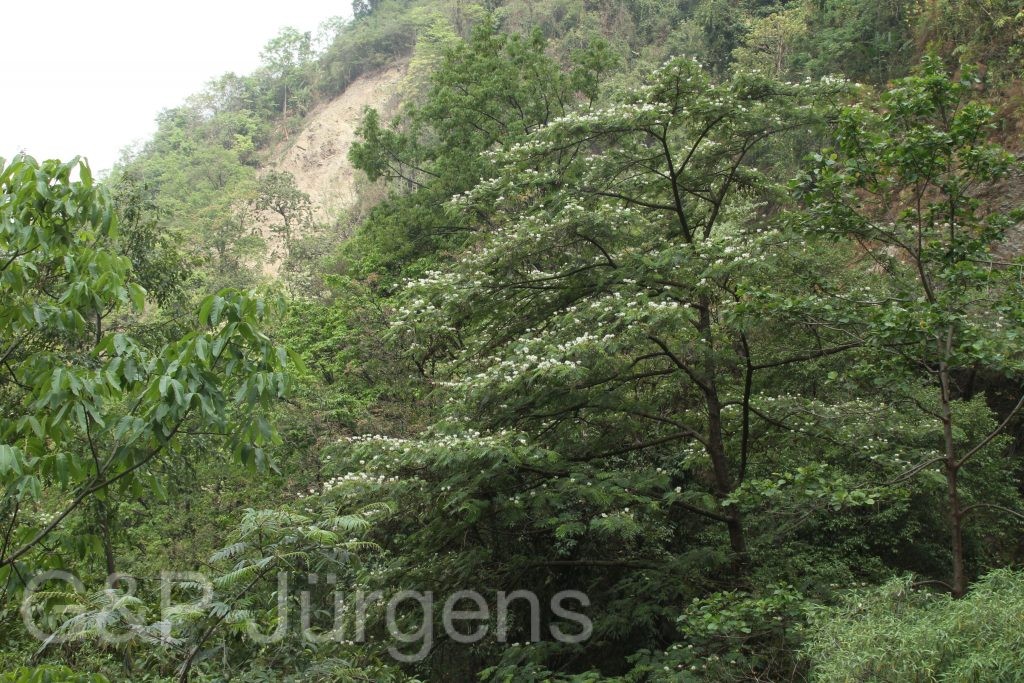
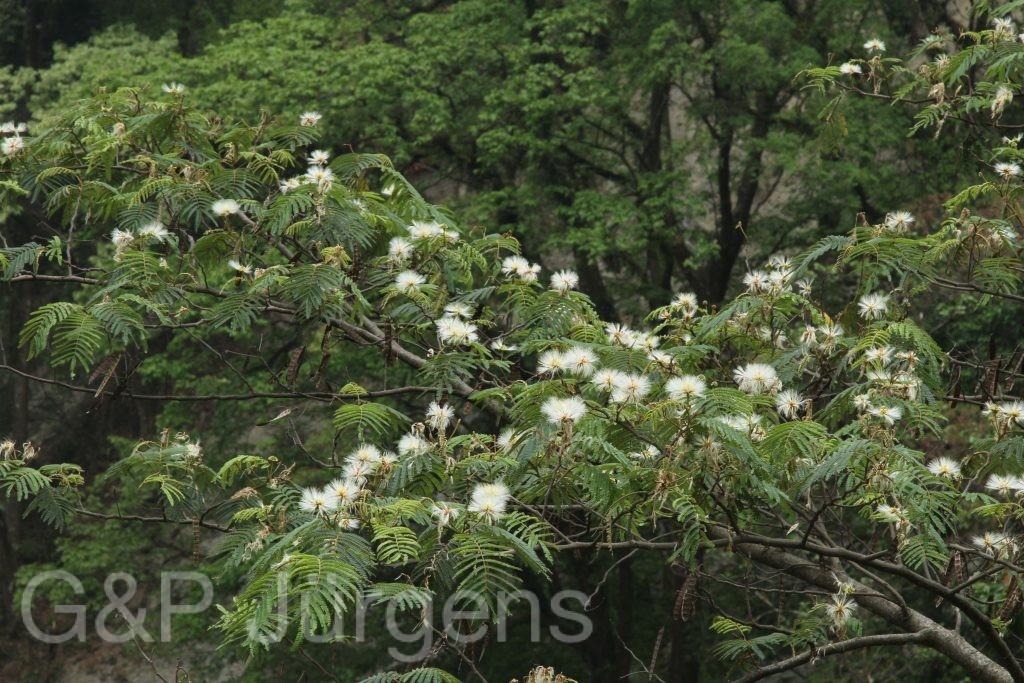
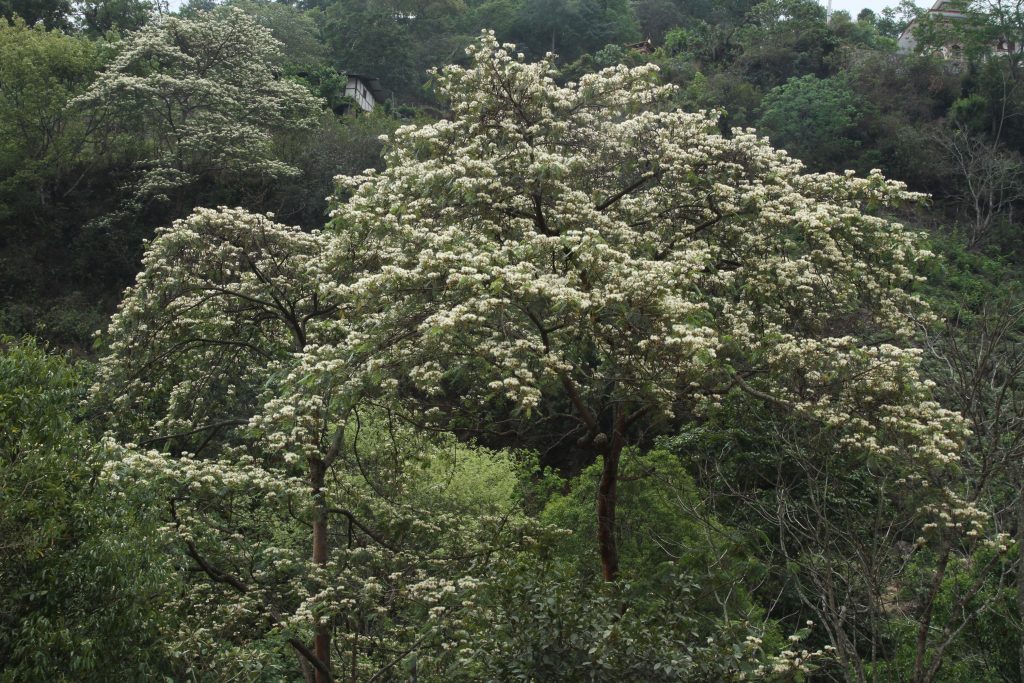
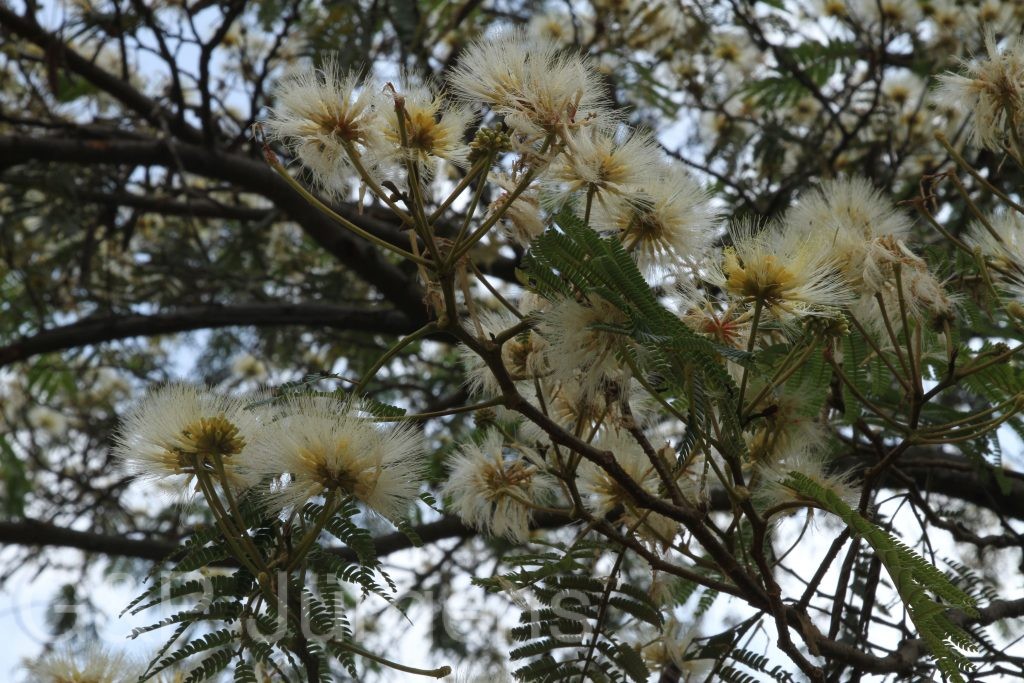
Albizia sherriffii

by GP Jürgens

Baker f.

Bhutan2014 3
Bhutan Sandrup 750m, May
Bhutan2014 5
Bhutan Sandrup 750m, May
Bhutan2014 224
Bhutan Karu-Chu 1800m, May
Bhutan2014 229
Bhutan Karu-Chu 1800m, May

Description

Albizia sherriffii is a tree of the eastern Himalayan foothills and adjoining ranges, recorded from Bhutan, north-east India, Myanmar and southern China, with GBIF holding about 65 occurrences that indicate a fairly restricted distribution. It occurs in warm subtropical to lower-temperate broad-leaved forest and along forest margins and river valleys, broadly between 700 and 1800 m, where the monsoon climate is warm and humid. The two illustrated Bhutanese gatherings, from Sandrup at 750 m and Karu-Chu at 1800 m, both in May, bracket its elevational range and show its flowering at the onset of the rains.

It is a medium-sized to large deciduous tree with spreading branches and bipinnate leaves bearing several pairs of pinnae, each with numerous small, oblong leaflets, the foliage often subtended by a gland on the petiole as is characteristic of the genus. The flowers are grouped in capitate or umbellate heads and, as in Albizia generally, owe their showy appearance to the long, numerous, exserted stamens united below into a tube, the small corolla being inconspicuous. The fruit is a flat, oblong, dehiscent legume (pod) containing several compressed seeds.

Named for the plant collector George Sherriff, A. sherriffii belongs to the mimosoid legumes (Fabaceae subfamily Caesalpinioideae, mimosoid clade), within which Albizia is distinguished from Acacia and allied genera by its stamen and pod characters. As a relatively narrowly distributed Himalayan tree, it is potentially sensitive to lowland forest clearance, though it has not been formally assessed in detail.

Author: Baker f. · Sources: POWO (Kew), GBIF, Flora of Bhutan, Legumes of the World (Lewis et al.), Flora of China

(Klotzsch) Hand.-Mazz.

BhutanPG2011 136
Bhutan Tsochenchen, 3550m June
Garh 07 412 ergebnis
India Garhwal Khiar Kutti 4050m, June

Description

Aletris pauciflora is a small alpine colic-root distributed across the Himalaya and the south-eastern Tibetan plateau into south-western China, with GBIF records from China, Nepal, India, Bhutan, Myanmar, Bangladesh and Pakistan and a substantial 1,651 occurrences indicating it is locally common. It grows in open alpine and subalpine meadows, moist turf, peaty grassland and the margins of dwarf-shrub heath, generally between about 3,000 and 4,500 m. The two cited plants, from Tsochenchen in Bhutan at 3,550 m and from Khiar Kutti in Garhwal, India, at 4,050 m, both flowering in June, span its broad longitudinal range and confirm its early-summer anthesis across the high Himalayan grasslands.

The plant is a small tufted rhizomatous perennial herb. The leaves form a basal rosette and are narrowly lanceolate to linear, grass-like, with parallel venation. From the rosette rises a slender, usually scapose flowering stem bearing a short terminal raceme of few flowers (reflected in the epithet pauciflora). Each flower has a campanulate to urceolate, six-lobed perianth that is white to pinkish and characteristically mealy or roughened on the outer surface, with six included stamens and a superior to half-inferior ovary. The fruit is a small loculicidal capsule containing numerous minute seeds.

Aletris is now placed in the family Nartheciaceae within the monocot order Dioscoreales, a position established by molecular phylogenetics that removed it from the broadly circumscribed lily and Liliaceae groupings where it was traditionally placed. Several infraspecific variants of A. pauciflora have been recognised across its range. Widespread and abundant, it is of no conservation concern.

Author: (Klotzsch) Hand.-Mazz. · Sources: POWO (Kew), Flora of China Vol. 24, Flora of Bhutan Vol. 3, GBIF, Tamura: Nartheciaceae in The Families and Genera of Vascular Plants

C.H.Wright

Sikkim2003 206 P288
Sikkim Dzongri 4000m, August

Description

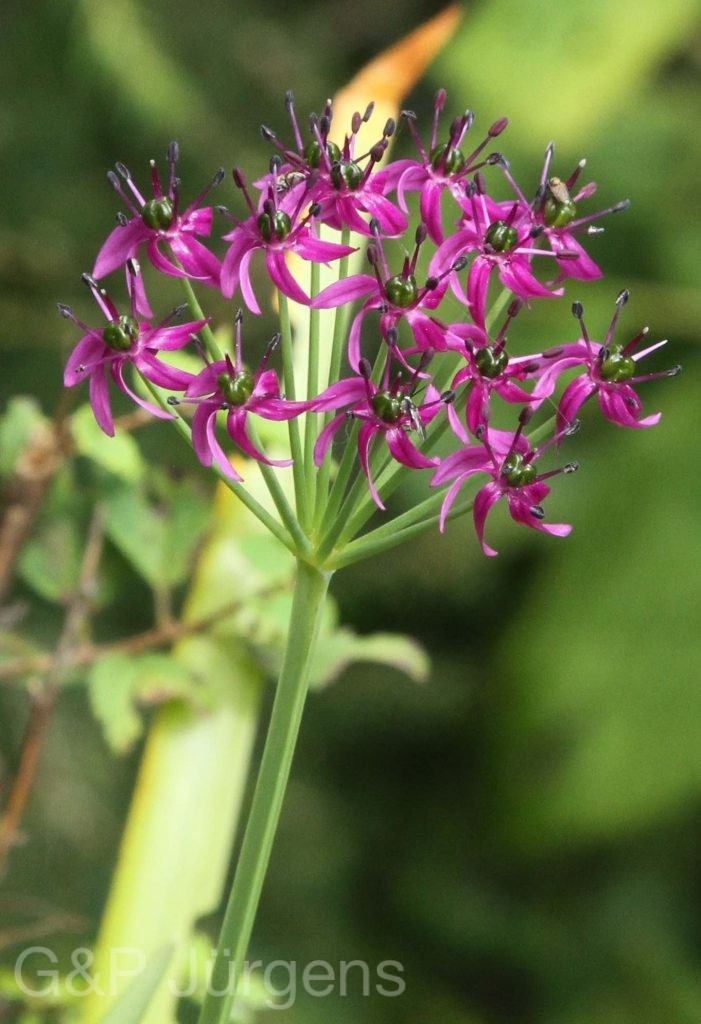
Allium prattii is a widespread alpine onion of the Himalaya and adjacent ranges, distributed across China, Nepal, Bhutan, India, Afghanistan, Myanmar and Mongolia, and is among the better-documented species in this set with nearly 1500 georeferenced records in GBIF. It grows in subalpine and alpine meadows, forest clearings, scrub and damp grassy slopes, generally between about 2500 and 4500 m. The plant illustrated was photographed at Dzongri in Sikkim at 4000 m in August, a characteristic high-alpine setting where it flowers during the summer monsoon.

The species is a bulbous perennial with a narrowly cylindrical to ovoid bulb sheathed in fibrous to membranous tunics. It typically bears two flat, lanceolate to elliptic basal leaves that are shorter than to about equalling the scape. The leafless flowering stem is erect and terete, bearing a terminal, more or less hemispherical umbel subtended by a persistent papery spathe. The flowers are stellate to campanulate, with six purplish-red, rose to lilac tepals, exserted stamens and a superior ovary; the fruit is a small loculicidal capsule containing black seeds.

Allium prattii is placed in Allium (Amaryllidaceae, subfamily Allioideae), a very large genus whose Himalayan and Central Asian members form a notable centre of diversity. Like several relatives it is edible, gathered locally as a wild vegetable and seasoning, and grazed by livestock. Its broad geographic and altitudinal range and large population base make it secure overall, and it is not regarded as threatened, though particular alpine stands are subject to heavy collection and grazing pressure in well-frequented high-pasture areas.

Author: C.H.Wright · Sources: POWO (Kew), GBIF, Flora of China, Flora of Bhutan, Annotated Checklist of the Flowering Plants of Nepal, Stearn Monograph of the Genus Allium

Allium wallichii

by GP Jürgens

Kunth

Bhutan2012 30
Bhutan Chele-La 3400m, September

Description

Allium wallichii is a Himalayan and Sino-Himalayan onion widely distributed through SW China, Nepal, NE India, Bhutan, Myanmar and Pakistan, GBIF recording around 1,300 occurrences (with cultivated records reaching Europe). It is a plant of the subalpine and alpine zone, growing in open meadows, grassy slopes, forest clearings and damp pastures, generally between about 2,300 and 4,800 m. The photographed plant from Chele-La in western Bhutan at 3,400 m (September) is characteristic, flowering in the late-monsoon period when the high meadows are at their richest.

It is a perennial herb arising from a slender, oblique rhizome bearing a poorly developed, narrowly conic bulb. The leaves are basal, several, narrowly linear to lorate and flat or shallowly keeled, sheathing the lower part of the triangular or angled scape. The inflorescence is a terminal, many-flowered umbel that is hemispherical to globose and lacks bulbils; the flowers are stellate, with six spreading purple to reddish-purple (rarely whitish) tepals, exserted stamens and a superior ovary. The fruit is a small loculicidal capsule.

The family is given verbatim as Alliaceae, the segregate now generally subsumed within Amaryllidaceae subfamily Allioideae. Allium wallichii is gathered as a wild vegetable and flavouring (jimbu and related condiments) across the Himalaya and is used medicinally, which together with grazing places local pressure on accessible populations. The species is morphologically variable across its wide range, and its rhizomatous, non-bulbous habit and flat leaves distinguish it within the alpine Himalayan alliums; it is not currently regarded as globally threatened.

Author: Kunth · Sources: POWO (Kew), Flora of Bhutan Vol. 2, GBIF, Flora of China Vol. 24, Stearn: The Genus Allium in the Himalaya