D.Don
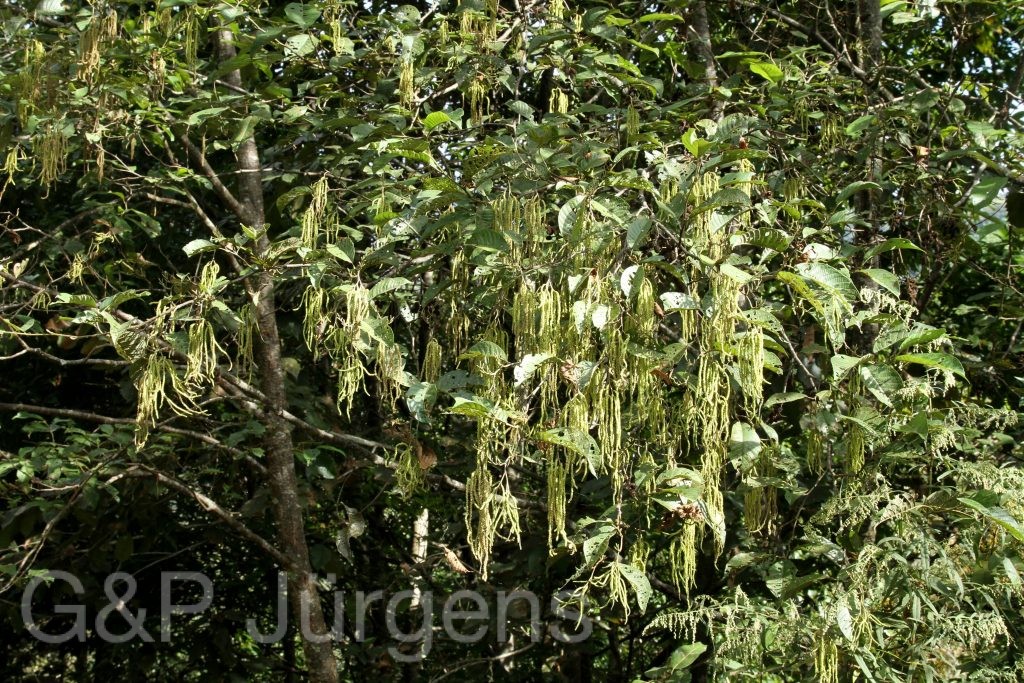
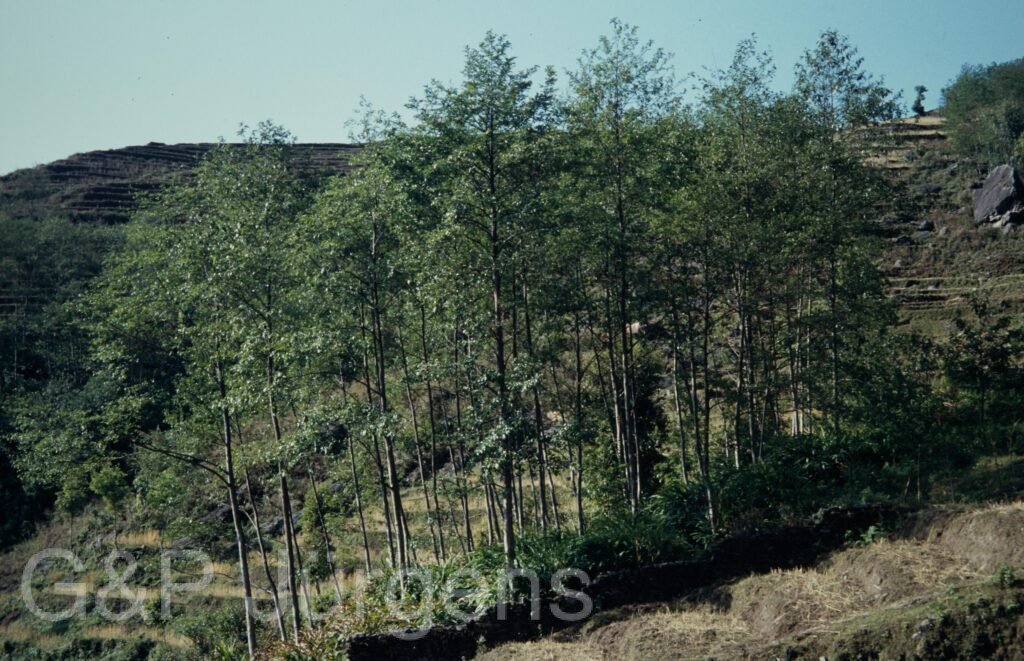
1800m, April
Description
Alnus nepalensis D.Don, the Nepalese alder, is a deciduous tree of the Betulaceae distributed throughout the Himalaya and adjacent ranges, from Nepal and India through Bhutan to southwestern China, Myanmar and Vietnam (GBIF: c. 1,931 occurrences). It is a fast-growing pioneer of moist temperate and subtropical zones, colonising landslides, river terraces, abandoned fields and forest gaps, typically between about 900 and 2,700 m. The photographed trees from Tashiyangtse in eastern Bhutan (c. 1,750 m) and the Mewa-Khola in eastern Nepal (c. 1,800 m) exemplify its dominance on moist, disturbed mid-montane slopes.
The tree reaches 10–25 m, with smooth grey bark becoming fissured with age. The leaves are alternate, broadly elliptic to ovate, acuminate, with finely serrate to nearly entire margins and prominent pinnate venation. Unusually for the genus, A. nepalensis flowers in autumn: the slender pendulous male catkins and short erect female inflorescences appear together, and the female structures mature into small, woody, cone-like infructescences (strobiles) that persist on the tree and release tiny winged nutlets (samaras) for wind dispersal.
Alnus nepalensis is ecologically and economically significant as a nitrogen-fixing species, harbouring symbiotic actinomycetes of the genus Frankia in root nodules; this enables it to enrich degraded soils, making it valuable in agroforestry, soil reclamation, watershed restoration and as a shade tree in cardamom cultivation. The wood is used for timber, fuel and matchwood. The species is abundant and of least conservation concern.
Author: D.Don · Sources: POWO (Kew), Flora of China Vol. 4, Flora of Bhutan Vol. 1, Flora of Nepal, GBIF, Chen & Li: Betulaceae of China