
(Spreng.) Hand.-Mazz.
Description
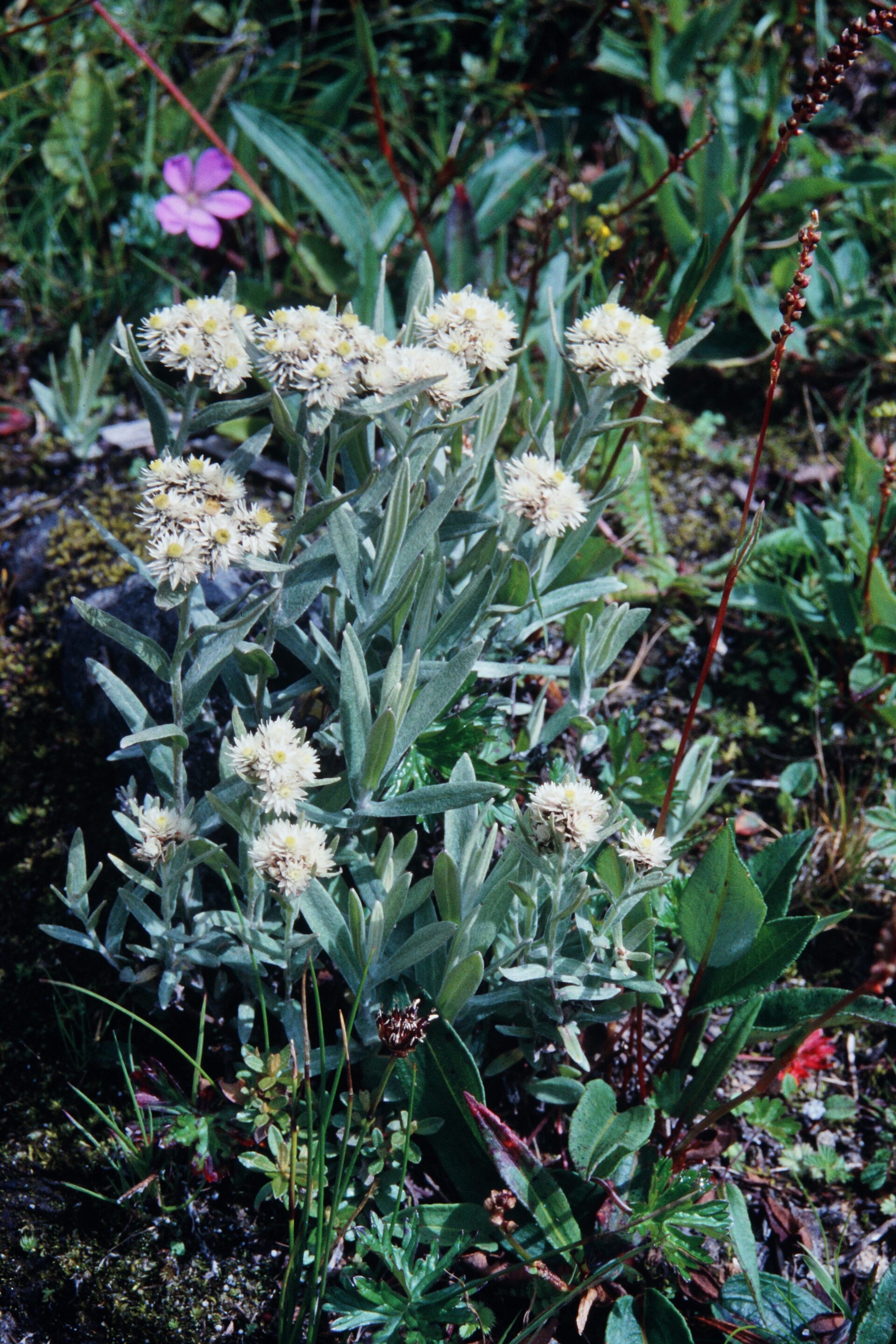
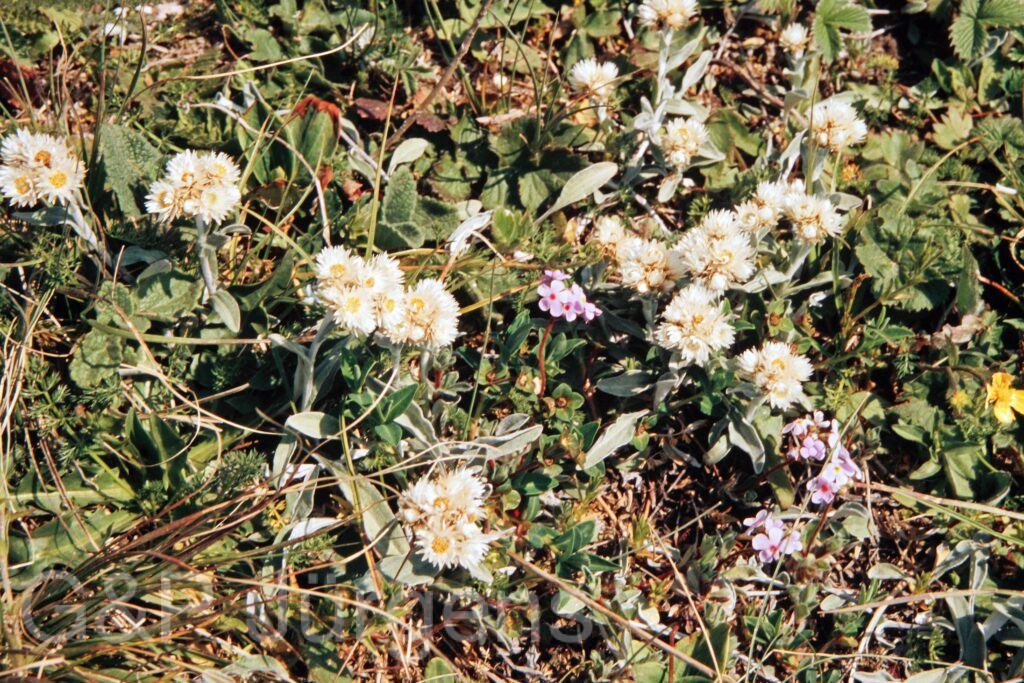
Anaphalis nepalensis is a widespread Sino-Himalayan everlasting distributed across China, Taiwan, Nepal, India, Pakistan, Bhutan, Afghanistan and Myanmar, with over 3600 georeferenced records making it one of the better-documented Himalayan composites. It occupies open alpine and subalpine meadows, grassy slopes, rocky pastures and forest clearings, generally between about 3000 and 4500 m. The photographed plant from Panwali in the Garhwal Himalaya at 3300 m, flowering in June, typifies its grassy mid-alpine habitat where it forms low cushions or spreading patches in short turf.
It is a perennial, white-woolly herb arising from a creeping rhizome, with prostrate to ascending stems clothed in dense grey-white tomentum. The leaves are oblanceolate to spathulate, often crowded in a basal rosette and reducing upward, cottony on both surfaces. The capitula are arranged singly or in small terminal clusters and are dioecious or subdioecious; the conspicuous part is the spreading ring of dry, papery, pearly-white involucral bracts surrounding the small yellowish disc florets, an arrangement that gives the genus its "pearly everlasting" character. The achenes bear a pappus of fine barbellate bristles.
The persistent, scarious bracts retain their form long after flowering, an adaptation suiting the plant to harsh, exposed alpine conditions and aiding identification. Anaphalis nepalensis is a variable species with several recognised varieties differing in stature and leaf form, and it is sometimes confused with related Himalayan congeners. Common and ecologically adaptable, it is not of conservation concern and is occasionally grown as a rock-garden ornamental.
Author: (Spreng.) Hand.-Mazz. · Sources: POWO (Kew), GBIF, Flora of China, Annotated Checklist of the Flowering Plants of Nepal, Compositae monographs (Handel-Mazzetti)