
Lindl.
Description
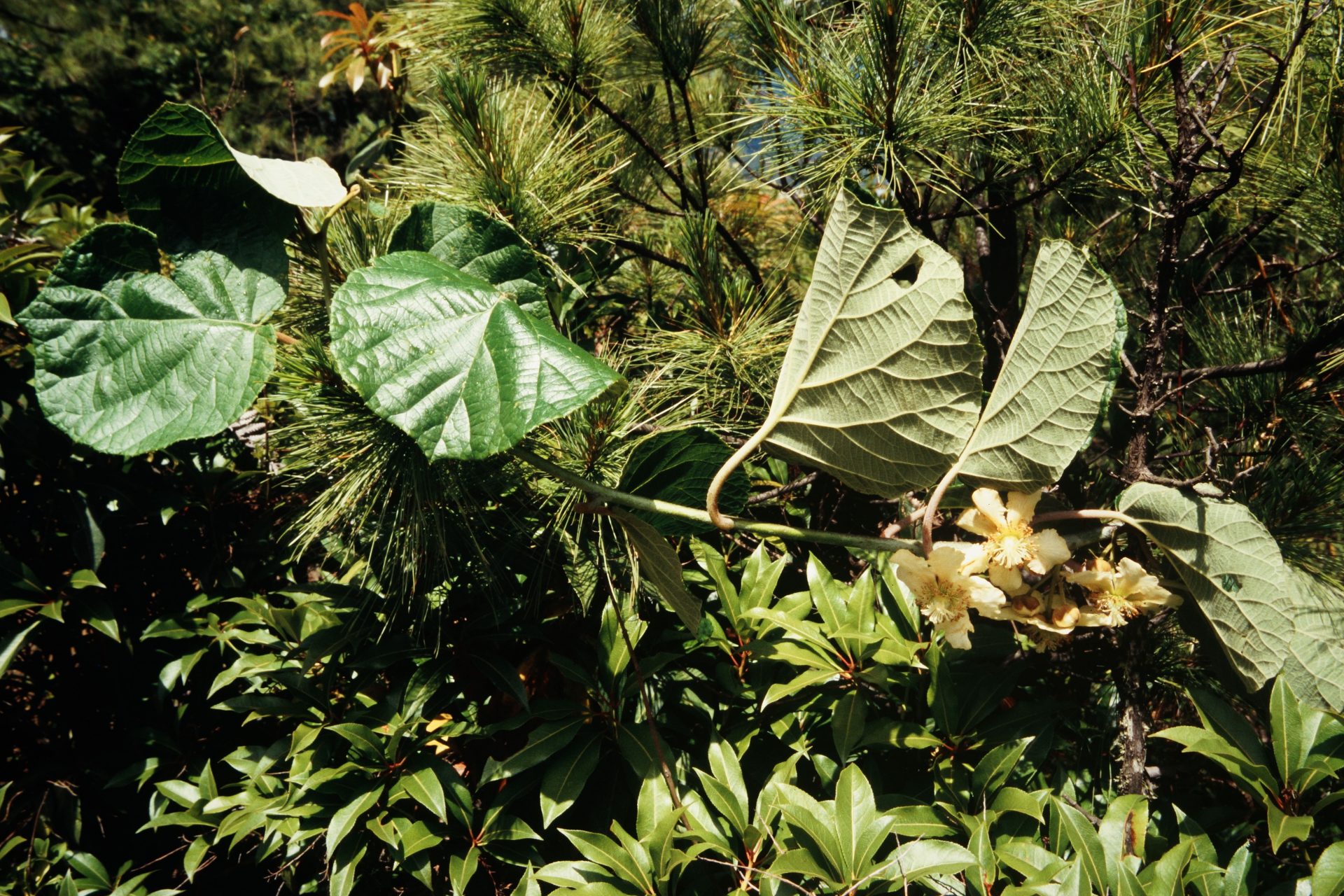
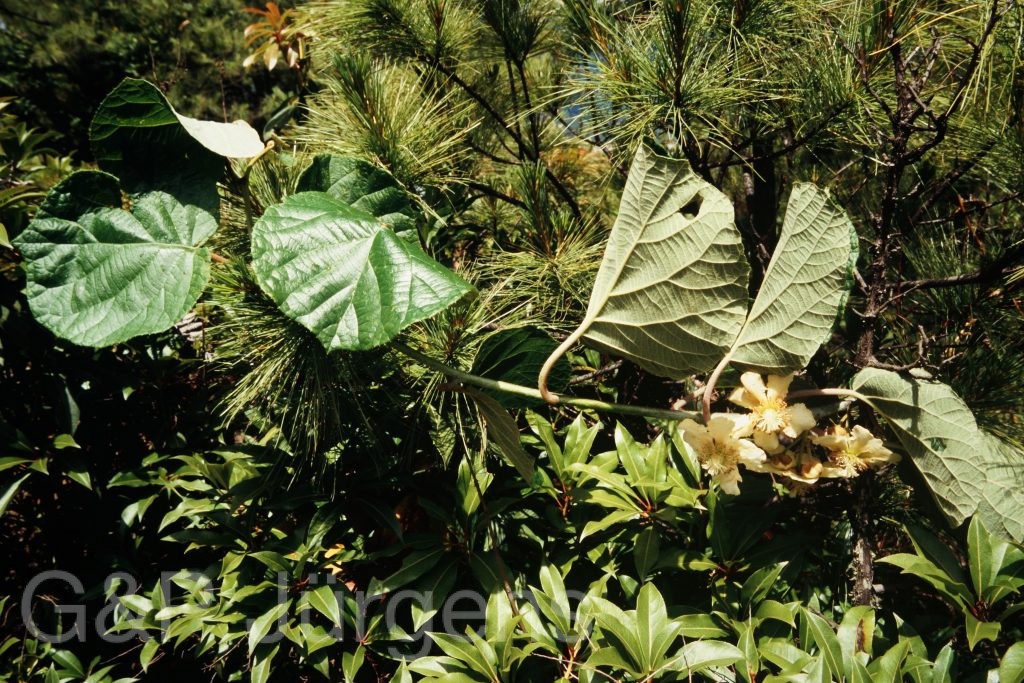
Actinidia callosa Lindl. is a woody climber of the Actinidiaceae, the kiwifruit family, distributed widely through the Himalaya and East and Southeast Asia. GBIF (about 3,400 occurrences) records it from China, Taiwan, Nepal, India, Japan, Vietnam, Myanmar, Bhutan and Indonesia, where it scrambles through montane broad-leaved and mixed forest, along forest margins, thickets and stream banks. It occupies a broad temperate to warm-temperate belt; the plant photographed at Paro in Bhutan at 2,500 m in June illustrates its flowering in mid-elevation forest, where it climbs over shrubs and trees for support.
The plant is a deciduous, twining liana with terete, lenticellate stems and a pith that is typically lamellate (chambered) or solid, a diagnostic character within the genus. Leaves are alternate, long-petiolate, ovate to elliptic, with finely serrate margins bearing callose-tipped teeth, the feature giving the epithet "callosa"; the lower surface is often glabrous to sparsely hairy with conspicuous venation. The flowers are borne in axillary cymes, are usually functionally unisexual (the plants more or less dioecious), and have white to greenish-white petals; the numerous stamens bear dark anthers, and the superior ovary develops many styles. The fruit is a many-seeded berry, ovoid to oblong, greenish to brownish and spotted, edible though far smaller than the cultivated kiwifruit.
Actinidia callosa is a polymorphic species with several recognised varieties differing in leaf indumentum, dentition and fruit characters, and it belongs to the same genus as the commercial kiwifruit (A. deliciosa and A. chinensis), making the wild Himalayan members of interest as genetic resources. Ecologically it is a characteristic forest liana, its berries dispersed by birds and mammals, and it contributes to the structural complexity of mid-montane Asian forests.
Author: Lindl. · Sources: POWO (Kew), Flora of China Vol. 12, Flora of Bhutan Vol. 1, GBIF, Li, Li & Soejarto: Actinidiaceae in Flora of China