Tag:

Autumn

(DC.) Hand.-Mazz.

Sikkim2003 187 P255
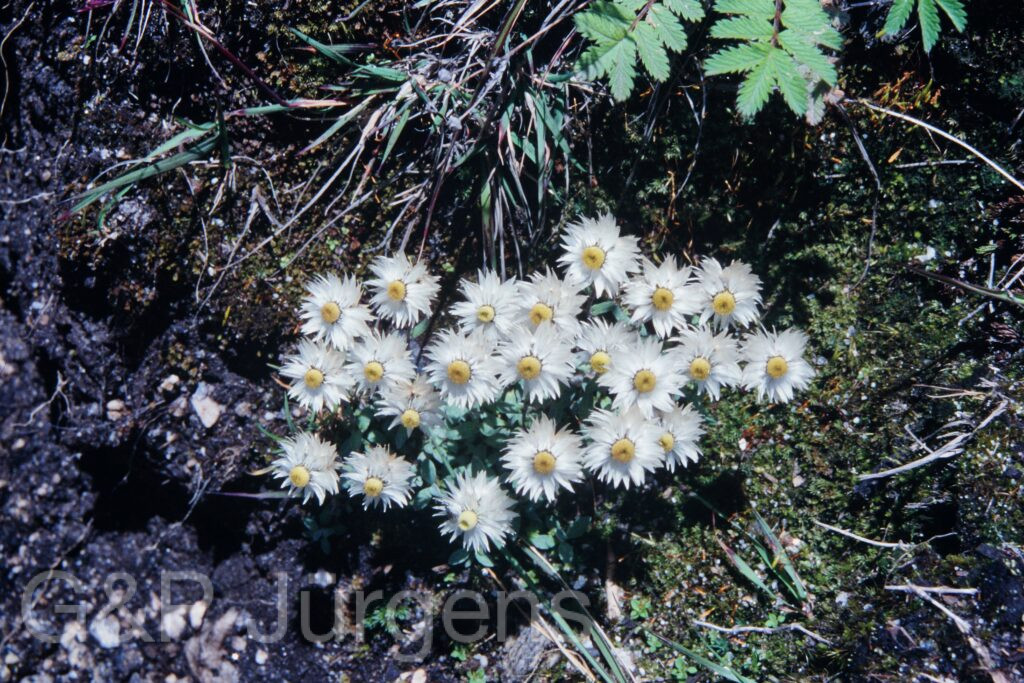
Sikkim Dzongri 4000m 08.2003
Nepal 99 274 ergebnis
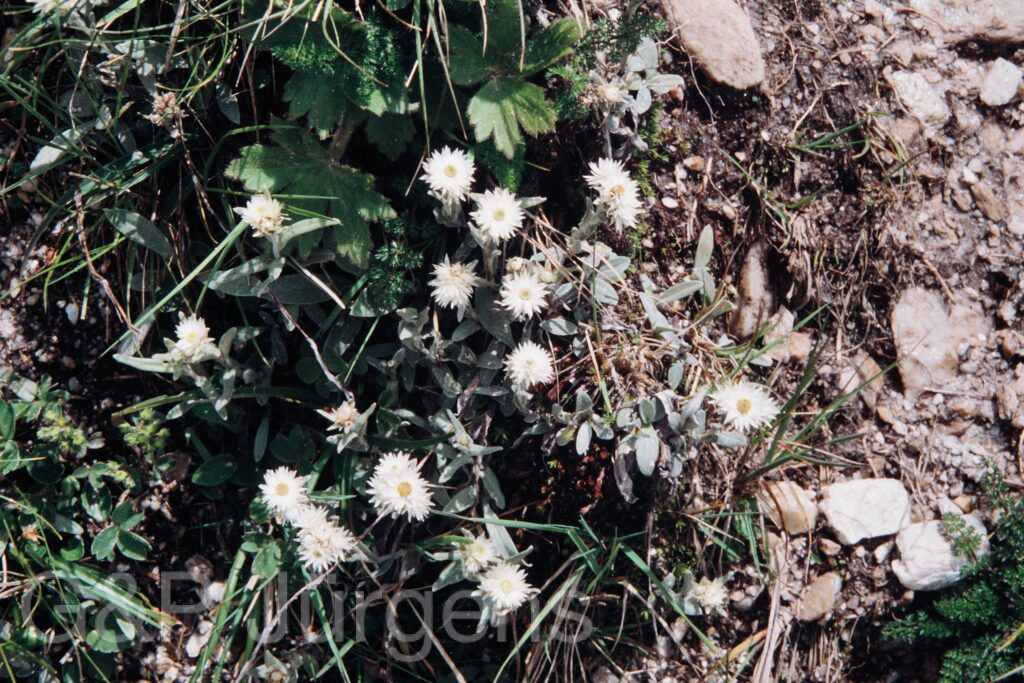
West-Nepal Loccu 3800m, June
Garw 2005 150 ergebnis ergebnis
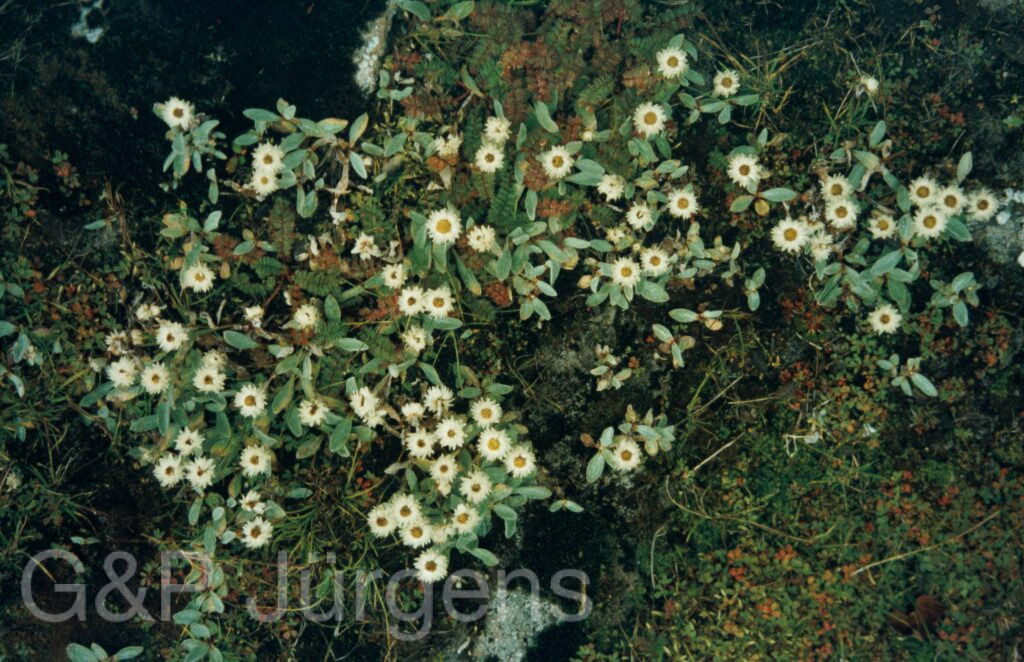
India Garhwal Kuari-Pass 3900m, September

Description

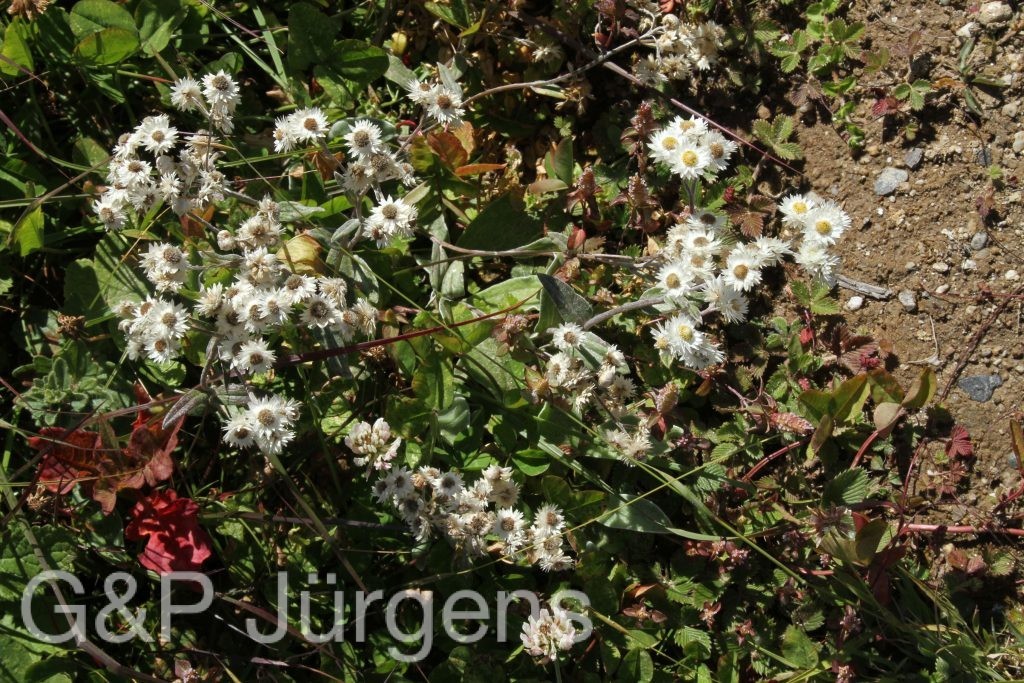
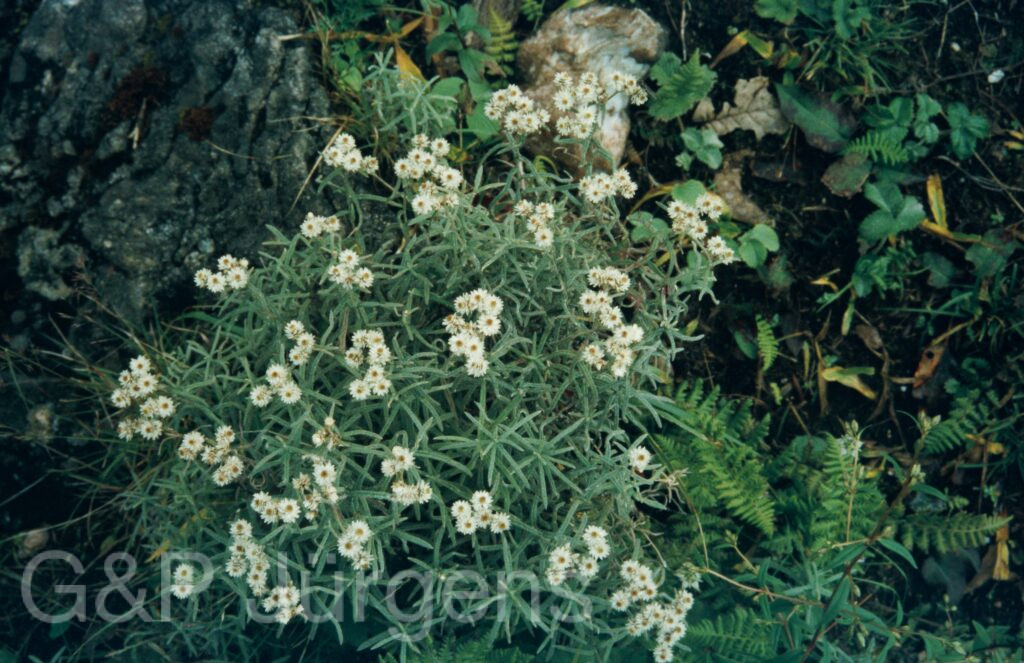
Anaphalis nepalensis var. monocephala is a high-alpine pearly everlasting of the Himalaya and adjacent China, recorded from Nepal, India, Bhutan, Pakistan, Taiwan and south-west China across 426 georeferenced occurrences. It occupies open alpine turf, screes, rocky slopes and gravelly moraine in the upper alpine zone. The cited collections at Dzongri in Sikkim (4000 m), Loccu in west Nepal (3800 m) and the Kuari Pass in Garhwal (3900 m) confirm its preference for elevations of roughly 3500-4800 m, where it flowers through the short summer and into early autumn. The variety is distinguished from typical A. nepalensis chiefly by its solitary or few terminal capitula on dwarf, cushion-forming stems.

It is a low, mat- or cushion-forming perennial herb with a branched woody caudex and short, white-woolly (lanate) stems and foliage. The leaves are spathulate to oblanceolate, crowded toward the base, densely grey-tomentose and frequently bearing a tuft of wool at the apex. The capitula are usually solitary (monocephalous), comparatively large, and surrounded by numerous papery, pearly-white, radiating involucral bracts that simulate ray florets; the true florets are small and yellowish, the plant being functionally dioecious. The fruit is a tiny cypsela crowned by a pappus of barbellate bristles.

The genus Anaphalis belongs to tribe Gnaphalieae (the cudweeds and everlastings), in which dry, persistent scarious bracts give the inflorescences their lasting quality. The white bracts and clustered florets attract small flies and bees, while the plumed cypselae are wind-dispersed. The variety is locally frequent in high Himalayan pastures and is not considered threatened, though sensitive to heavy grazing and trampling.

Author: (DC.) Hand.-Mazz. · Sources: POWO (Kew), GBIF, Flora of Bhutan, Flora of China, Flora of Nepal, Hilliard & Burtt Gnaphalieae studies
DC.

Garw 2005 297 ergebnis
India Garhwal Patanathi 3750m, October
Garw 2005 50 ergebnis

Description

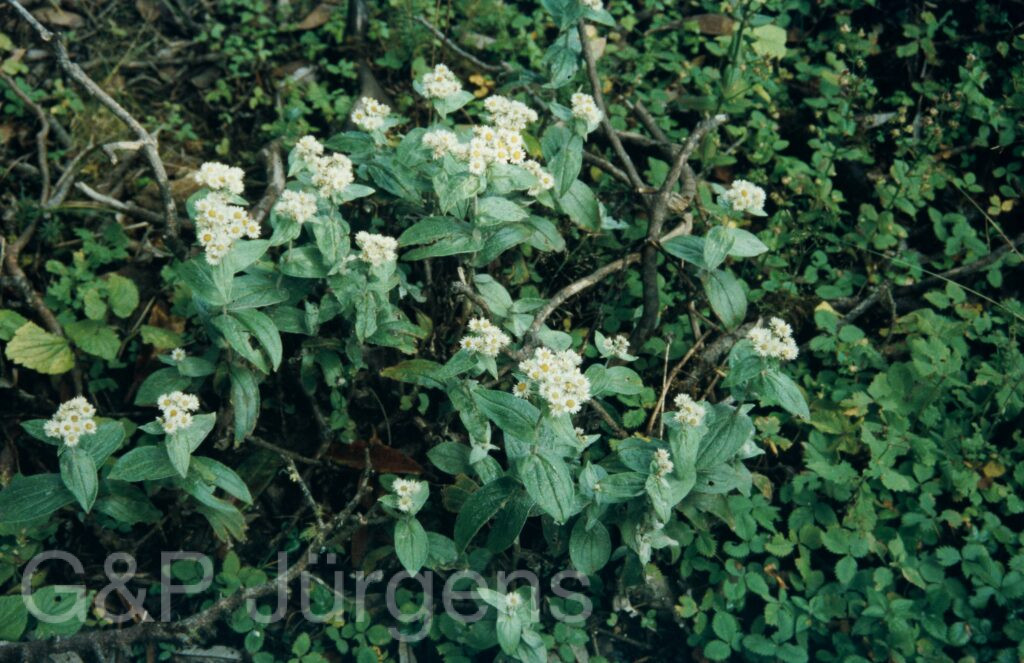
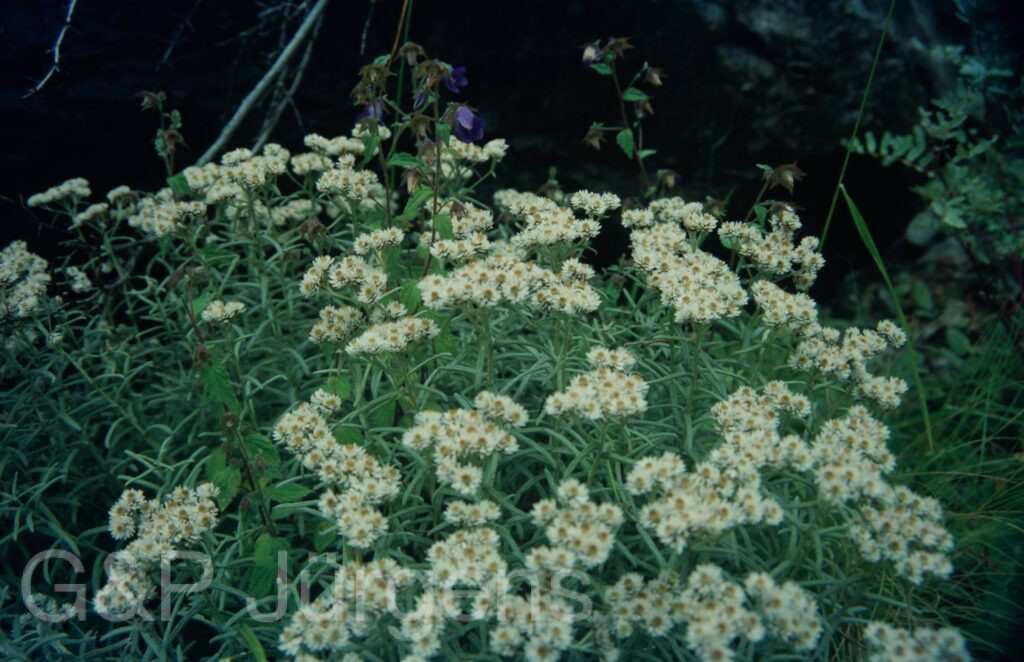
Anaphalis royleana is a high-montane to subalpine perennial widely distributed across the Sino-Himalayan region, recorded from India, Nepal, Pakistan, Bhutan, Bangladesh, Myanmar, China and Taiwan. With 482 georeferenced occurrences, it is one of the more frequently collected members of the genus, occupying open stony slopes, alpine meadows, grazed pastures and the margins of rhododendron and birch scrub. The species typically ranges between roughly 3000 and 4500 m; the plant photographed at Patanathi in Garhwal, India, at 3750 m in October exemplifies its preference for well-drained, sunny situations where it flowers and fruits late into the season.

The plant forms tufted clumps from a woody rootstock, with erect, simple, white-woolly (lanate) stems. The leaves are alternate, sessile and frequently decurrent, linear to oblong-lanceolate, entire-margined, and densely grey- to white-tomentose, the lower surface usually more persistently floccose than the upper. The capitula are small, numerous, and aggregated into dense terminal corymbs. Each head is subtended by several rows of dry, papery (scarious), pearly-white involucral bracts that give the genus its garden name; the florets are functionally unisexual, the central disc florets staminate and the marginal florets pistillate. The fruit is a small cylindrical cypsela crowned by a pappus of slender, barbellate bristles facilitating wind dispersal.

Anaphalis is a large Old World genus closely allied to Helichrysum and Gnaphalium within the tribe Gnaphalieae, characterised by its dioecious or subdioecious capitula. A. royleana belongs to a taxonomically intricate complex of Himalayan everlastings in which leaf indumentum and bract form provide the principal diagnostic characters. Its broad elevational and geographic amplitude, tolerance of grazing, and effective anemochory render it secure, and it is not considered threatened.

Author: DC. · Sources: POWO (Kew), GBIF, Flora of China, Flora of Bhutan, Flowers of the Himalaya (Polunin & Stainton), Anaphalis revisionary studies in Gnaphalieae

Sims ex C.B.Clarke

Bhutan2015 408
Bhutan Tumching-La 4000m, October
Garw 2005 296 ergebnis
India Garhwal Kunol 2900m, September

Description

Anaphalis triplinervis is a widespread Himalayan everlasting recorded natively from Nepal, India, China, Pakistan, Bhutan, Myanmar and Afghanistan, and widely grown in gardens (hence European and North American records); GBIF holds over 900 occurrences. It is a plant of open subalpine and alpine slopes, grassy meadows, forest clearings and stony banks, ranging from about 2000 to over 4000 m. The photographed material is from Tumching-La in Bhutan at 4000 m in October and from Kunol in Garhwal, India, at 2900 m in September, spanning the autumn flowering across the central and eastern Himalaya.

The species is a tufted perennial herb with creeping rhizomes and erect, white-woolly stems. The leaves are alternate, oblong to obovate-lanceolate, sessile and often somewhat decurrent, with the three prominent longitudinal nerves that give the epithet "triplinervis"; they are green and thinly cobwebby above and densely white-tomentose beneath. The capitula are small and crowded in dense terminal corymbs, each surrounded by spreading, papery, pearly-white involucral bracts that form the showy "flower"; the true florets are small and yellowish, the plants typically dioecious or functionally so. The fruit is a tiny cypsela with a pappus of barbellate bristles.

Anaphalis belongs to the tribe Gnaphalieae, the cudweeds, and A. triplinervis is among the most familiar Himalayan species, its persistent papery bracts making it a popular everlasting for drying. Abundant and ecologically tolerant of grazed and disturbed slopes, it is of no conservation concern.

Author: Sims ex C.B.Clarke · Sources: POWO (Kew), GBIF, Flora of Bhutan, Flora of China, Annotated Checklist of the Flowering Plants of Nepal, Revision of Asiatic Anaphalis (Gnaphalieae)

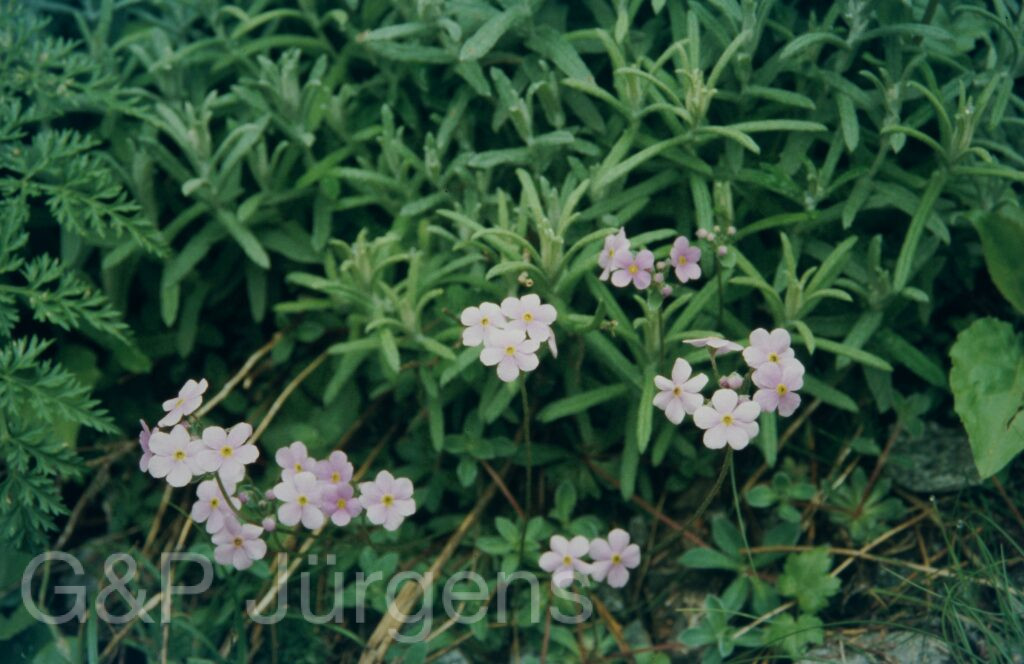
(Duby) Govaerts

Nepal 99 77 ergebnis
West-Nepal Chanta 2700m, June
Nepal 99 78 ergebnis
West-Nepal Chanta 2700m, June
Garw 2005 42 ergebnis ergebnis
India Garhwal Valley of flowers 3250m, September

Description

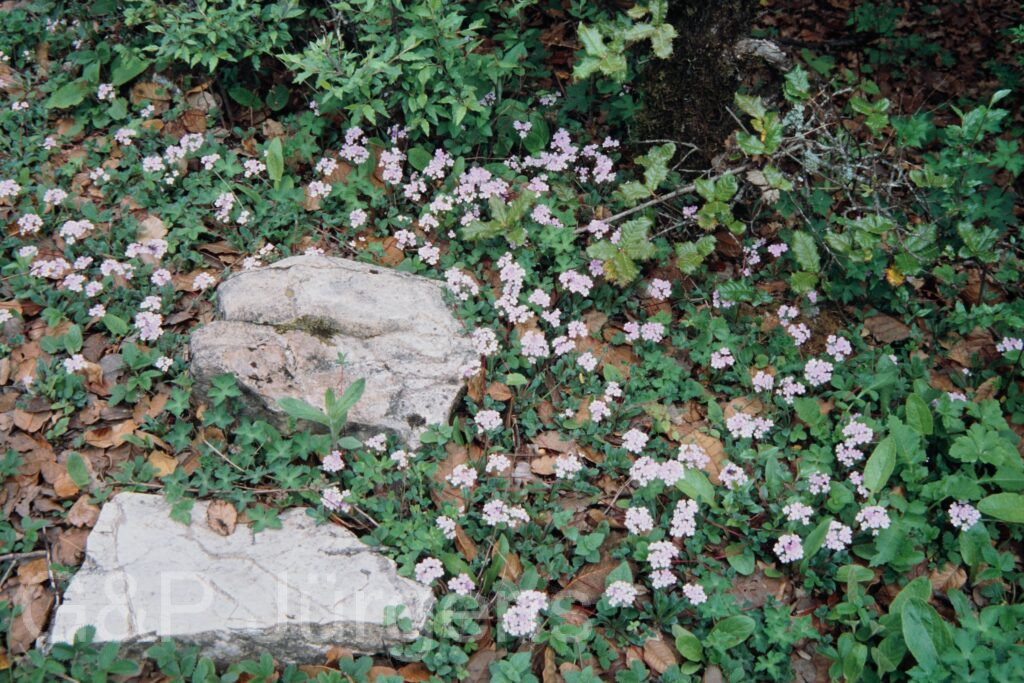
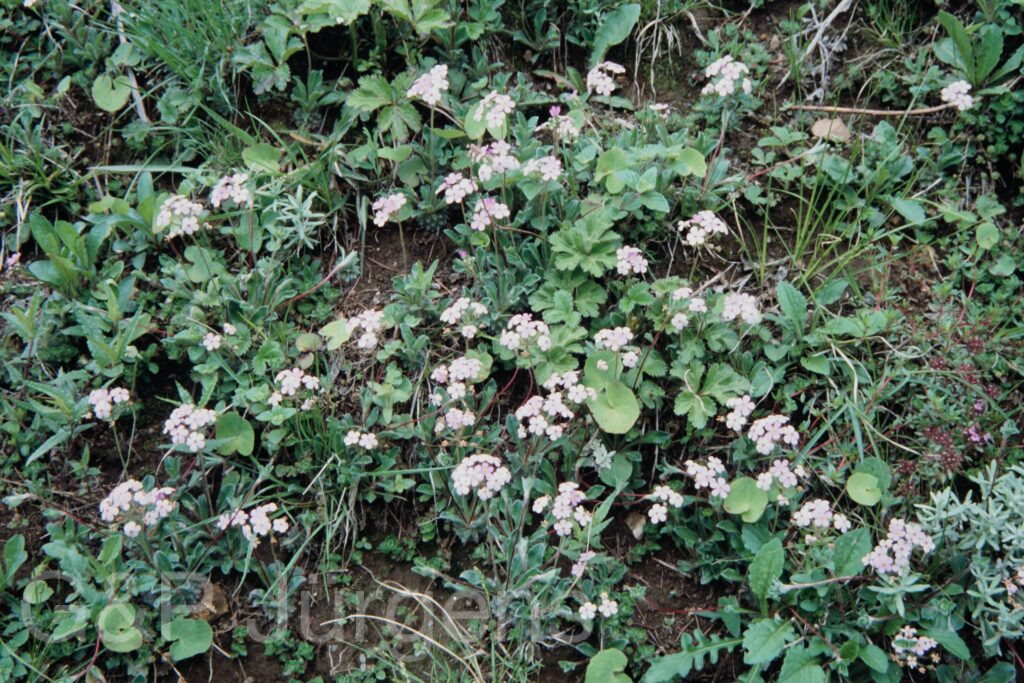
Androsace sarmentosa subsp. primuloides is a mat-forming rock-jasmine of the western and central Himalaya, recorded from India, China, Nepal and Pakistan, with about 122 occurrences in GBIF. It grows on open rocky slopes, ledges, stony pastures and the margins of alpine meadows, mainly in the subalpine and lower alpine zones between roughly 2500 and 4000 m, favouring well-drained, sunny sites. The photographs from Chanta in West Nepal at about 2700 m in June and from the Valley of Flowers in Garhwal at about 3250 m in September capture the plant across its altitudinal range from early summer flowering to late-season fruiting in the high meadows.

The plant forms loose mats by means of slender, leafy stolons or runners (hence sarmentosa) that root at the nodes to produce new rosettes. Each rosette consists of oblong to spathulate leaves clothed, especially when young, in silky white or silvery hairs that give the cushions a downy appearance. From the rosettes arise short, hairy scapes bearing an umbel of several flowers subtended by a whorl of bracts; the flowers have a five-lobed, salver-shaped corolla, rose-pink with a yellow or orange eye and a constricted throat, recalling a small primrose, as the epithet primuloides suggests. The fruit is a small capsule with few seeds.

Androsace belongs to the Primulaceae and is closely allied to Primula, distinguished by its smaller flowers with a constricted corolla throat; the stoloniferous, mat-building habit of this taxon contrasts with the tight cushions of many high-alpine relatives. Long popular in alpine and rock gardening for its free-flowering pink umbels, it propagates readily from its rooting runners. Widely distributed and locally abundant, the subspecies is not of conservation concern.

Author: (Duby) Govaerts · Sources: POWO (Kew), GBIF, Flora of Pakistan, Annotated Checklist of the Flowering Plants of Nepal, Smith and Lowe's monograph of Androsace, Richards' Primula and its allies

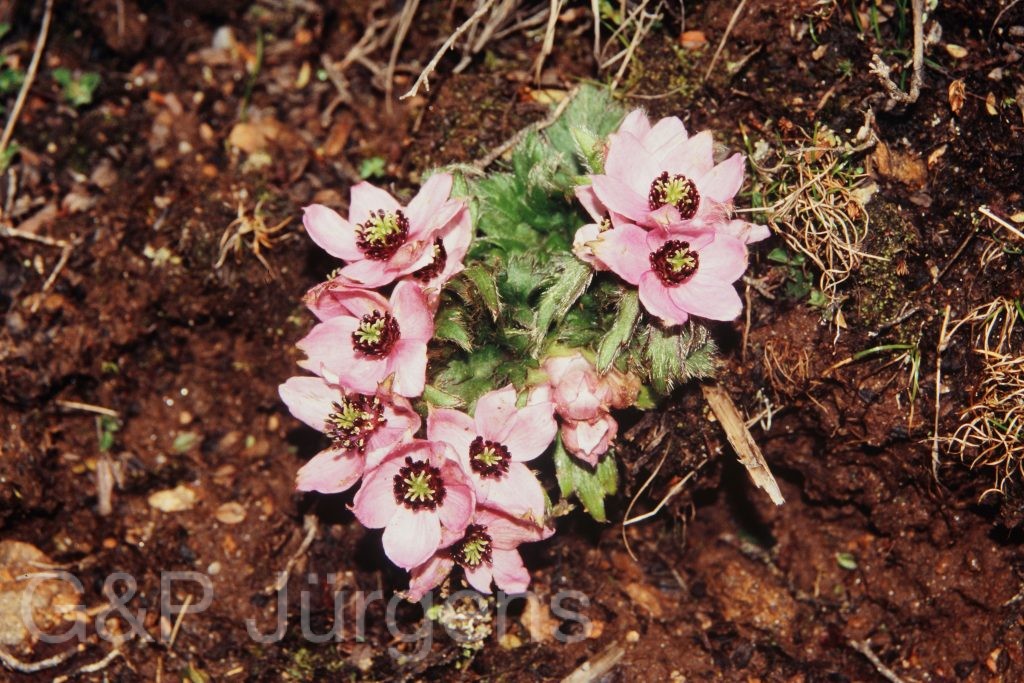
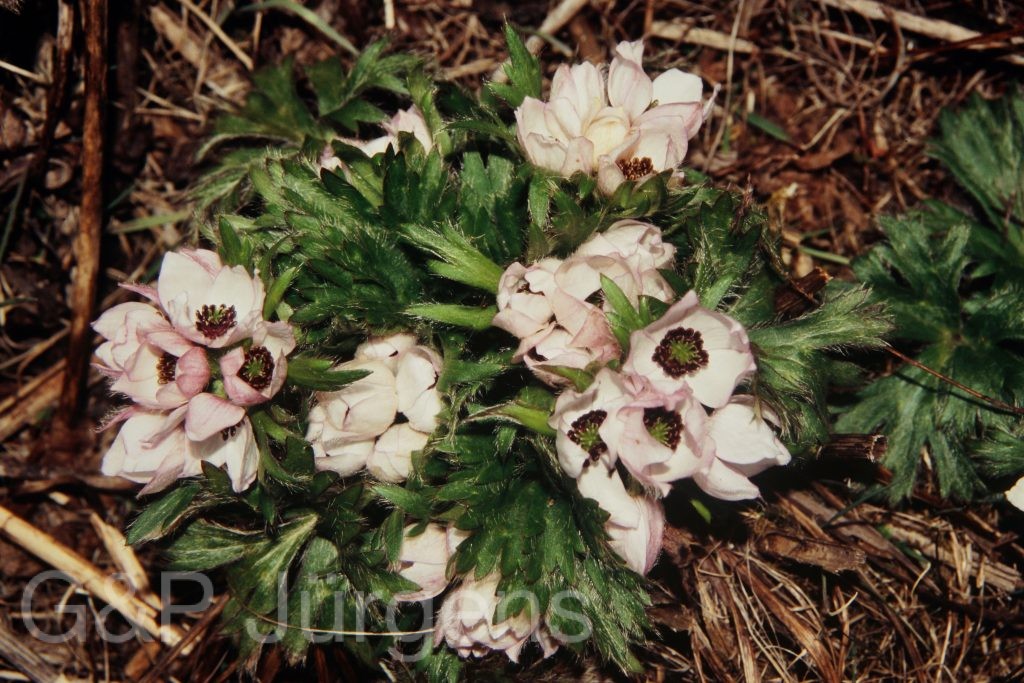
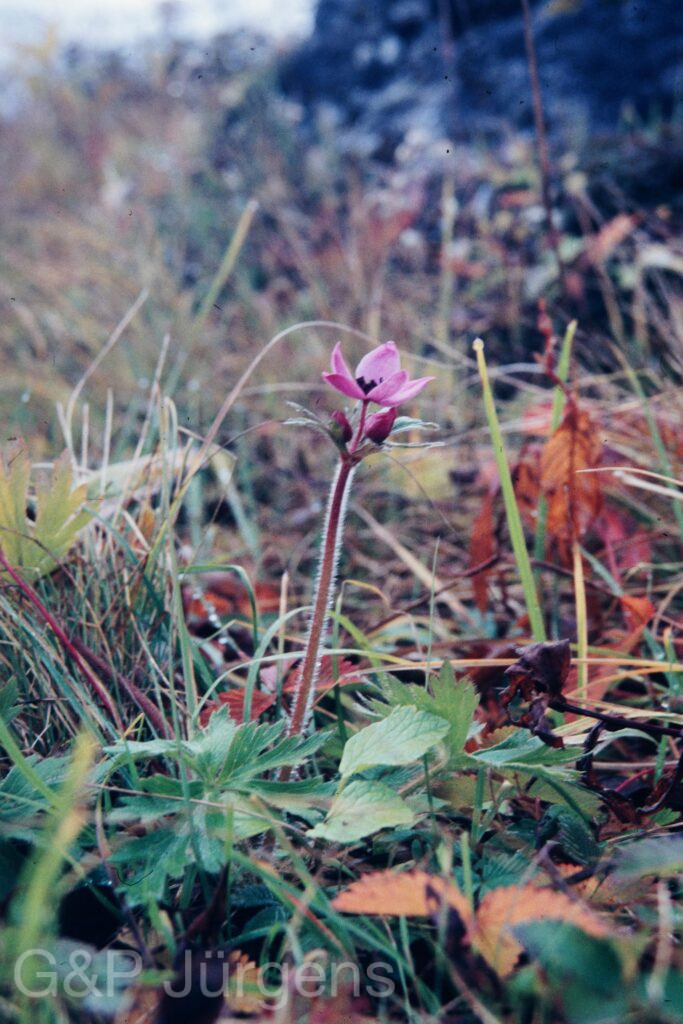
(Hook.f. & Thomson) Holub

Bh09 114 G203
Bhutan Chele-La, 3500m June
Bh09 159 G282
Bhutan Chele-La, 4000m June
Nepal 95 173 P282 ergebnis
Nepal Rupien La 3850m October
Bhutan2012 273
Bhutan Dochu-La 3500m, September

Description

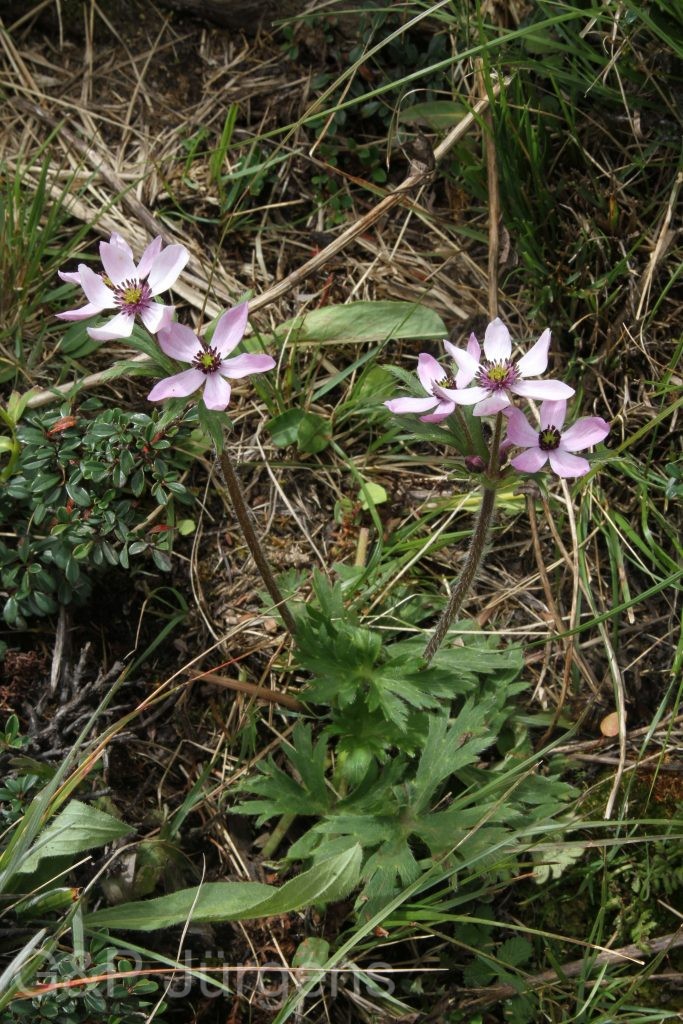
An alpine anemone of the Himalaya and the Tibetan Plateau, recorded from China, Myanmar, Nepal, Bhutan, India and Pakistan, with around 1600 GBIF occurrences. It is a plant of open alpine meadows, grassy slopes, rocky pastures and scrub margins, generally between about 3000 and 4500 m. The featured collections come from several high passes, including Bhutan's Chele-La at 3500 to 4000 m in June, the Dochu-La at 3500 m in September, and Nepal's Rupien La at 3850 m in October, illustrating a long flowering and fruiting season across windswept high-elevation habitats.

The species is a tufted perennial arising from a stout, often woody rootstock crowned with fibrous leaf remnants. The basal leaves are long-petiolate and palmately three- to five-divided, the segments further lobed and toothed and clothed, like the petioles, in spreading hairs. The scape bears a whorl of stalked, leaf-like involucral bracts beneath the inflorescence, which carries one to several flowers. Each flower lacks true petals; the showy perianth consists of five or more white, sometimes bluish- or pinkish-tinged tepals surrounding numerous stamens and a head of many free, hairy carpels. The fruit is an aggregate of compressed, beaked achenes adapted to wind and animal dispersal.

Formerly placed in Anemone, the species is now referred to the segregate genus Anemonastrum, accepted by POWO and GBIF, reflecting molecular and morphological re-circumscription of the windflowers; the basionym honours Hooker and Thomson. Ecologically it is a conspicuous element of summer-flowering alpine turf, offering pollen and nectar to high-altitude insects. Widespread and often locally abundant throughout the Himalaya, it is not of conservation concern, though its grassland habitats are subject to grazing and climatic shifts.

Author: (Hook.f. & Thomson) Holub · Sources: POWO (Kew), GBIF, Flora of Bhutan, Flora of China, Ziman et al. revision of Anemonastrum

Wall. ex Meisn.

Bhutan2012 1173
Bhutan Tashiyangtse 2000m, October

Description

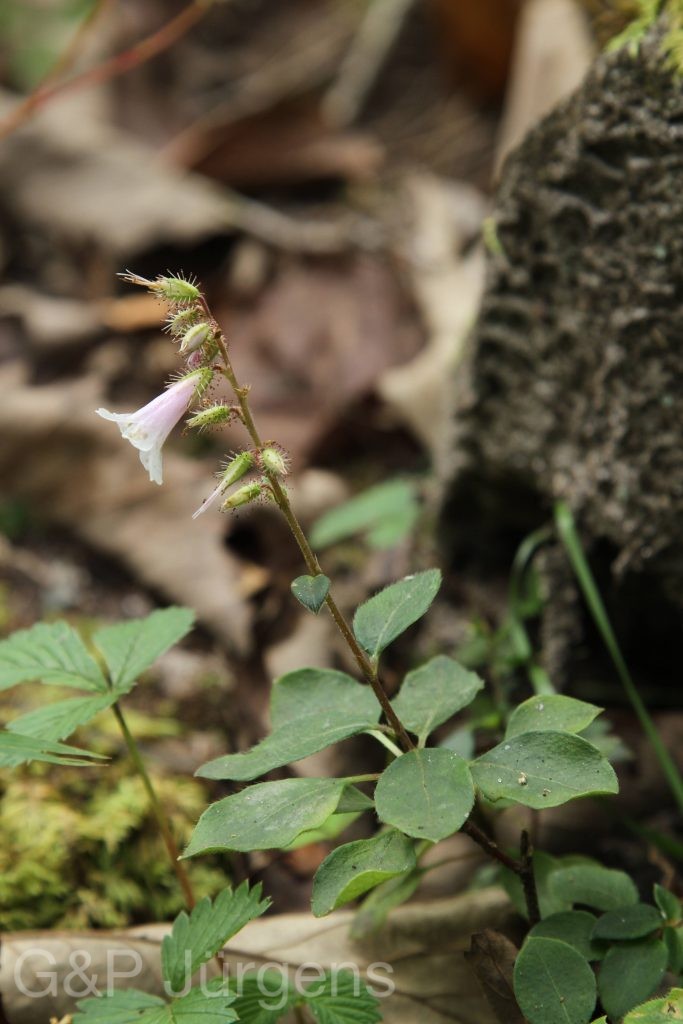
Anisadenia saxatilis is a slender herb of the eastern Himalaya and adjacent Southeast Asia, distributed from Nepal through NE India, Bhutan and southern China to Myanmar, Thailand, Bangladesh and Malaysia, with 69 GBIF occurrences reflecting its rather localised, forest-dwelling habit. It grows in shaded, humid broad-leaved and mixed forest, on mossy banks, rock ledges and along streamsides in the temperate to warm-temperate zone. The Bhutanese collection from Tashiyangtse at about 2,000 m in October corresponds to its autumn flowering in cool, moist montane forest understorey.

It is a perennial herb with a slender rootstock and erect, wiry stems. The leaves are mostly clustered or subrosulate toward the base and along the lower stem, ovate to elliptic, with prominent parallel-converging venation and crenate to serrate margins, the upper leaves much reduced and bract-like. The flowers are borne in a slender, lax, terminal spike-like raceme; each small flower has five sepals (the outer often glandular-fringed), five pink to pale purple petals, and a characteristic androecium with unequal or appendaged (anisadenous) staminal glands, from which the genus takes its name. The fruit is a small dry capsule.

Anisadenia is a small Asian genus of two or three species, here correctly placed in Linaceae though distinctive within the family for its spicate inflorescence and herbaceous habit. GBIF treats the name as accepted. As a shade- and humidity-dependent forest herb of limited occurrence, it is sensitive to forest clearance; it is not formally assessed but its narrow ecological amplitude merits attention.

Author: Wall. ex Meisn. · Sources: POWO (Kew), Flora of China Vol. 11, Flora of Bhutan Vol. 1, GBIF, Robson: Linaceae in Flora Zambesiaca and comparative studies (1963)

Anisomeles indica

by GP Jürgens

(L.) Kuntze

Bhutan2012 1023
Bhutan Trithangebe 920m, October

Description

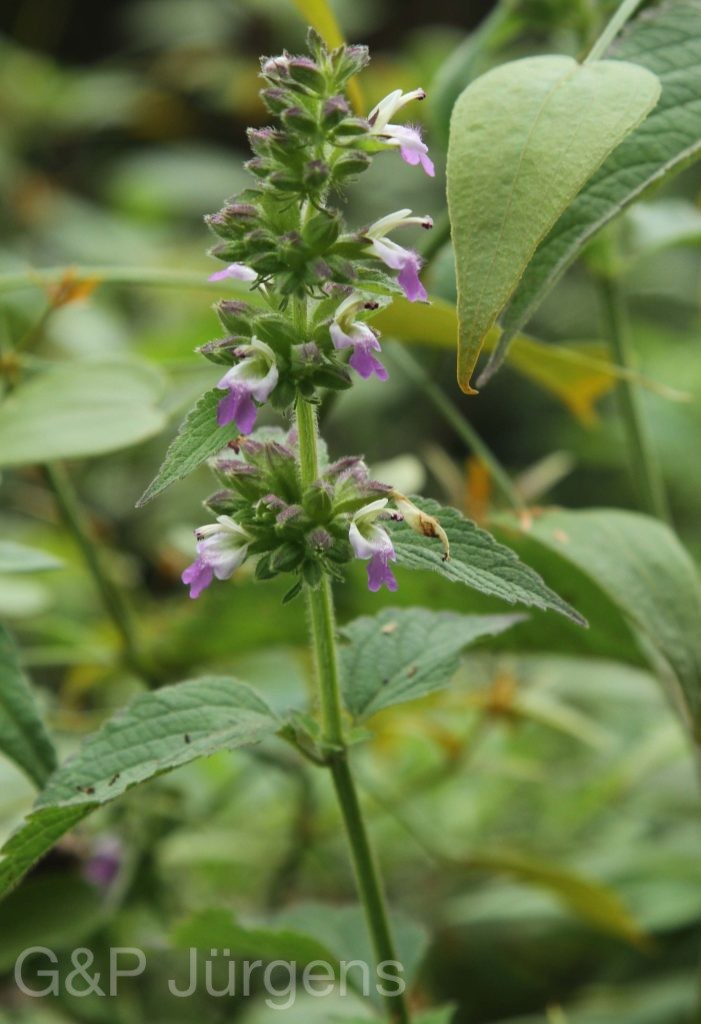
Anisomeles indica is a wide-ranging Asian mint extending from the Himalaya and the Indian subcontinent across China, Taiwan, Japan, mainland and insular Southeast Asia to the Pacific, with introduced or adventive records reaching the Caribbean; GBIF documents over 3000 occurrences across this large area. It is a plant of warm to subtropical lowlands and lower hills, characteristic of disturbed ground, roadsides, forest margins, fallow fields and waste places generally below about 1500 m. The photographed material from Trithangebe in southern Bhutan at 920 m, flowering in October, reflects its affinity for the lower, warmer reaches of the Himalayan foothills, where it behaves as a vigorous, sun-loving ruderal flowering into the autumn.

It is a coarse, aromatic annual or short-lived perennial herb, often a metre or more tall, with erect, quadrangular, densely pubescent stems. The leaves are opposite, ovate, crenate-serrate, acute, and softly hairy on both surfaces. The inflorescence consists of dense axillary cymes aggregated into elongate, leafy terminal panicles. Each flower has a tubular, ten-veined, five-toothed calyx and a two-lipped corolla coloured pale pinkish to pale purple, the short upper lip erect and the larger lower lip three-lobed; the four didynamous stamens are exserted and ascend beneath the upper lip. The fruit comprises four smooth, ovoid nutlets enclosed by the persistent calyx.

The species was described in Nepeta by Linnaeus and transferred to Anisomeles by Kuntze, the small Old World tropical genus being placed in subfamily Lamioideae. It is rich in essential oils and diterpenoids and is widely used in traditional medicine across its range for fevers, digestive and inflammatory complaints, which has prompted considerable phytochemical study. Far from threatened, its weedy, colonising habit and broad ecological tolerance make it a successful and locally abundant component of human-modified landscapes throughout tropical and subtropical Asia.

Author: (L.) Kuntze · Sources: POWO (Kew), GBIF, Flora of China, Flora of Bhutan, Flora of British India, Harley et al. Labiatae account in 'The Families and Genera of Vascular Plants'

Wall.

Bhutan2012 473
Bhutan Wangdi 2500m, September
Bhutan2012 474
Bhutan Wangdi 2500m, September

Description

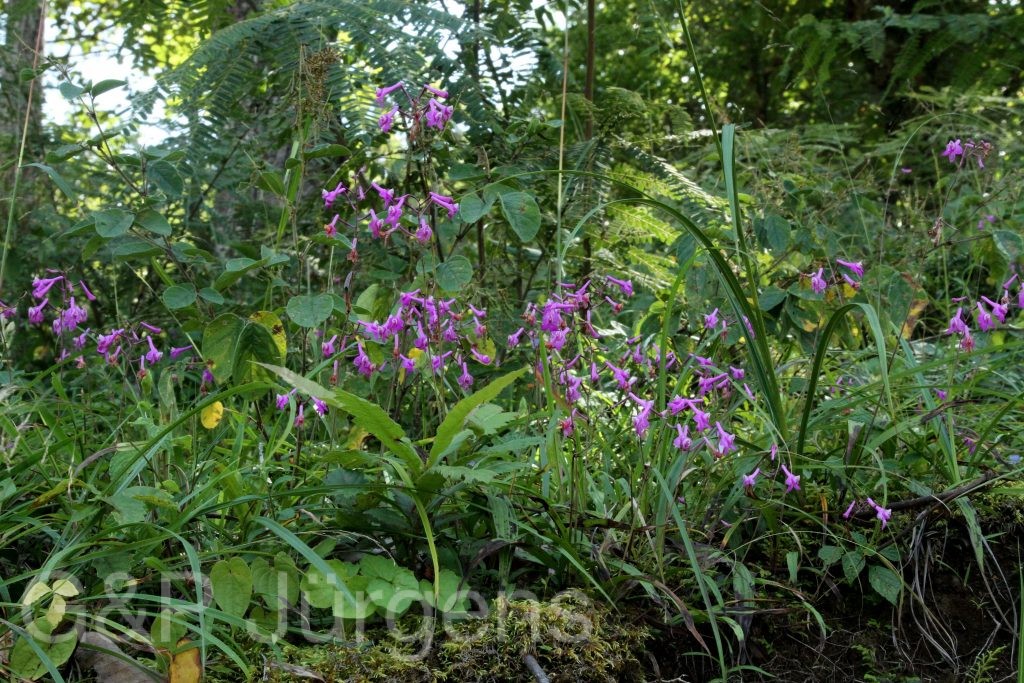
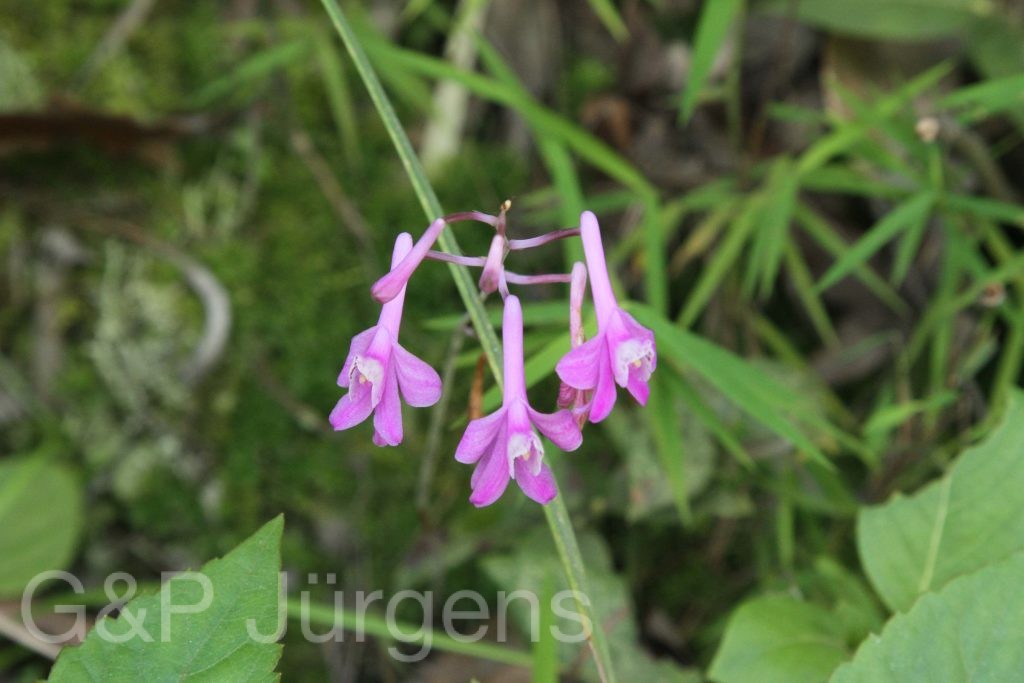
Anthogonium gracile is a terrestrial orchid and the sole species in the monotypic genus Anthogonium. It is distributed from Nepal through northeast India (Sikkim, Darjeeling, Assam, Arunachal Pradesh), Bhutan, and Myanmar into Thailand, Indochina, and southwest China (Yunnan, Guangxi). The species occurs in open, grassy hillsides, pine forests, and degraded forest margins at elevations of 1,000–3,000 m, often in seasonally moist grassland.

The plant produces slender, reed-like stems 30–80 cm tall from underground tubers, with narrow, plicate, grass-like leaves arranged along the upper portion of the stem. The inflorescence is a lax, terminal raceme bearing 5–15 flowers that open successively. Flowers are 3–4 cm across, typically rose-pink to magenta, with a broad, spreading lip that is darker pink with a yellow callus of parallel lamellae. The column is slender and gently curved. Flowering in the Himalayas occurs from August to October.

Anthogonium gracile is taxonomically isolated within the Orchidaceae, though molecular phylogenetic analyses place it close to Calanthe and Phaius. Its preference for open, fire-maintained habitats suggests adaptation to seasonal burning regimes characteristic of Himalayan montane grasslands.

Author: Wall. · Sources: POWO (Kew), Flora of Bhutan Vol. 3, GBIF, Pearce & Cribb: The Orchids of Bhutan (2002)

Apios carnea

by GP Jürgens

(Wall.) Benth.

Bhutan2012 990
Bhutan Trithangebe, 1100m October
Bhutan2012 991
Bhutan Trithangebe, 1100m October
Bh09 242 P405
Bhutan Wangdi, 2000m June

Description

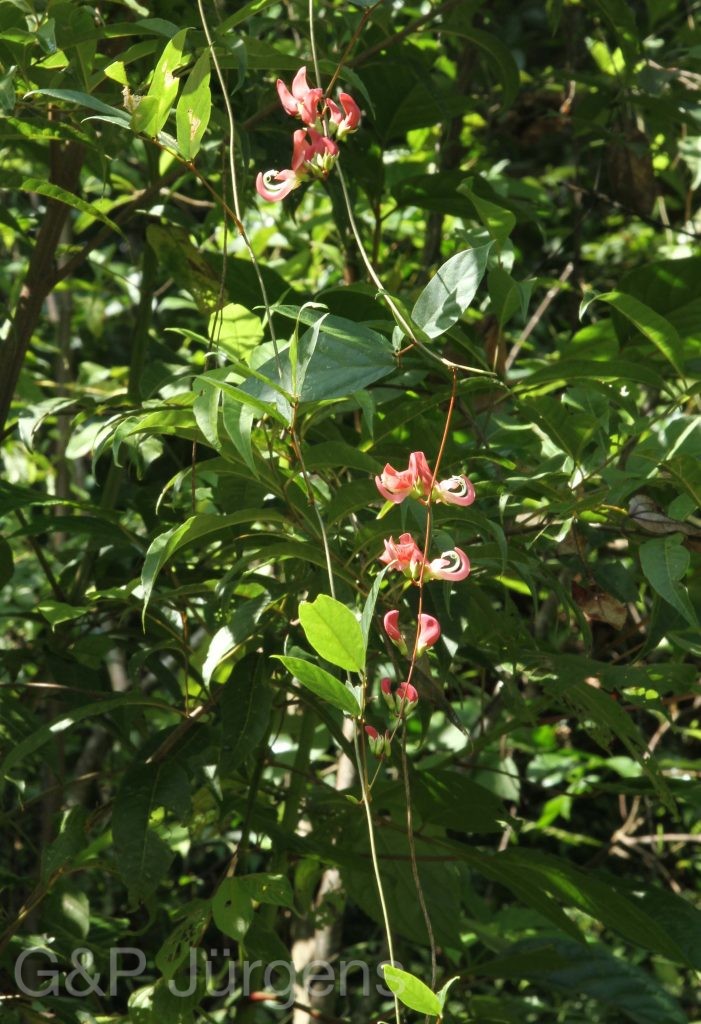
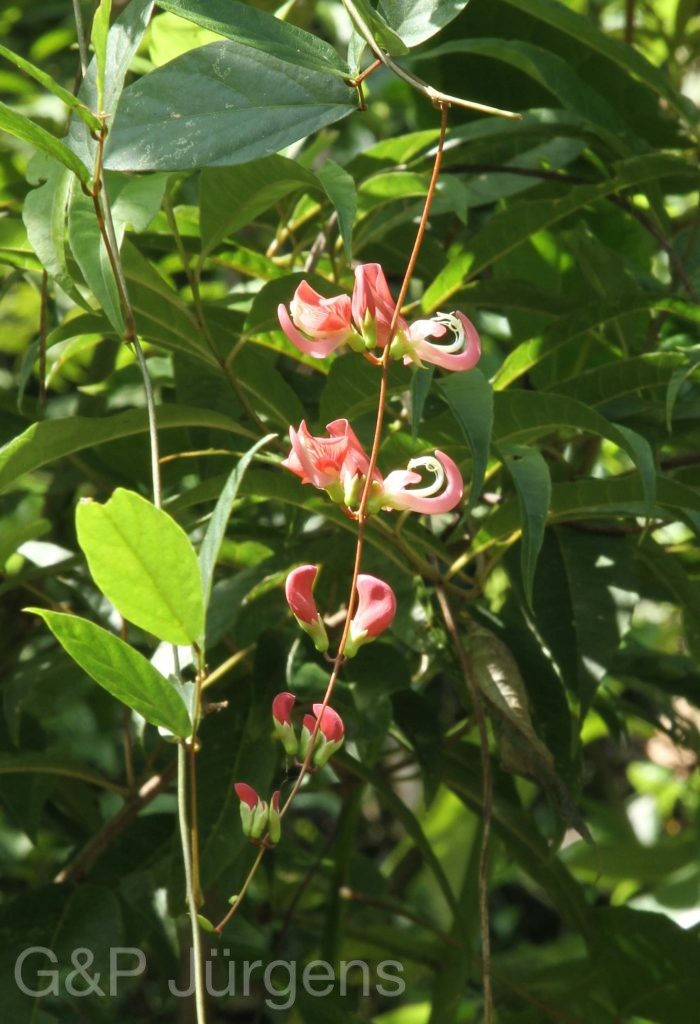
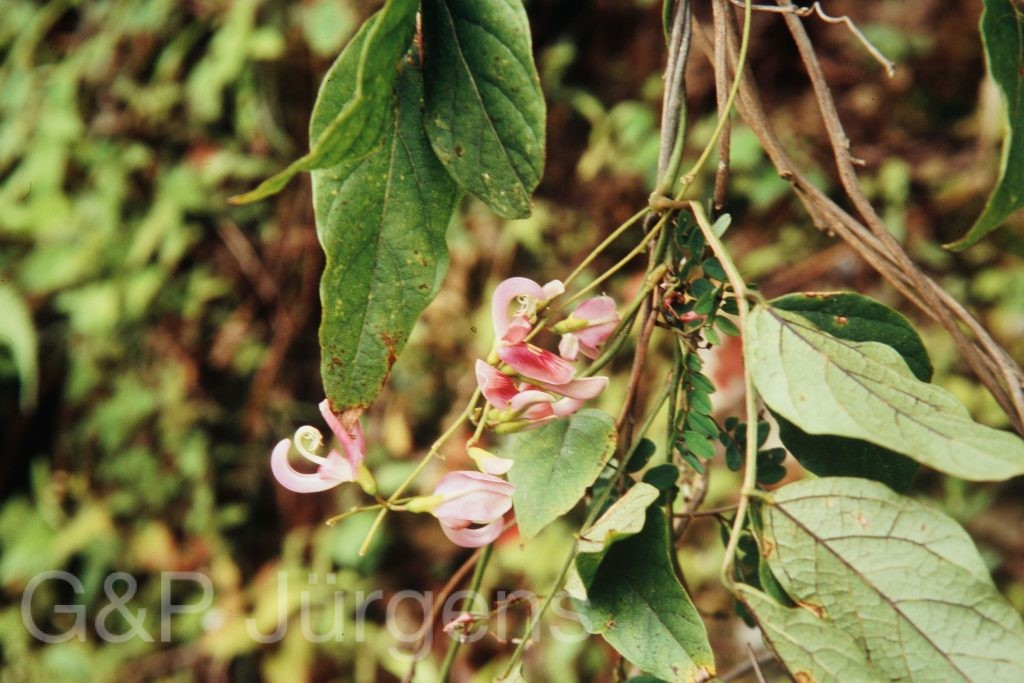
Apios carnea is widely distributed through the Himalaya and into south-east and east Asia, recorded from Nepal, north-east India, Bhutan, Myanmar, China, Thailand, Laos, Vietnam, Malaysia, Korea and Japan among its 887 georeferenced occurrences. It is a climbing herb of forest margins, thickets, streamsides and clearings in warm-temperate to subtropical settings, scrambling over shrubs and into the lower canopy. The Bhutan records at Trithangebe (1100 m, October) and Wangdi (2000 m, June) illustrate a broad altitudinal tolerance from about 1000 to 2400 m, flowering through the warm wet season.

It is a perennial twining vine arising from a tuberous, fleshy rootstock, with slender, herbaceous, somewhat woody-based stems. The leaves are pinnately compound (imparipinnate) with usually five to seven ovate-lanceolate, acuminate leaflets. The flowers are borne in dense axillary racemes and are typical papilionate legumes, flesh-pink to dull reddish or salmon, with a broad standard, incurved keel and the characteristic coiled keel-and-style of the genus. The fruit is a slender, elongate, dehiscent legume containing several seeds.

The genus Apios belongs to tribe Phaseoleae of subfamily Faboideae, allied to climbing beans, and the twisted keel enclosing the spirally coiled style and stamens is a notable floral specialisation promoting cross-pollination by bees. As a nitrogen-fixing legume it contributes to soil enrichment, and its tubers have been used locally as food. Common and widespread across its range, it is of no conservation concern, though it is regionally valued both as an ornamental climber and a wild food plant.

Author: (Wall.) Benth. · Sources: POWO (Kew), GBIF, Flora of Bhutan, Flora of China, Flora of Nepal, Lackey Phaseoleae revision (Advances in Legume Systematics)

J.Wen, Lowry & Esser

Bhutan2015 646
Bhutan Mo-Chu 1600m, October

Description

Aralia kingdon-wardii is a narrowly distributed eastern Himalayan and southwest Chinese species known from China, Myanmar, Bhutan and northeastern India, with GBIF recording only about 45 occurrences, reflecting its rarity and restricted range. It is a plant of warm-temperate to subtropical broadleaf forest, the photographed material coming from the Mo-Chu valley in western Bhutan at 1600 m in October. It occupies humid forest interiors, ravine slopes, clearings and stream banks on rich, moist soils in the lower montane belt, where it grows as a tall coarse herb or soft-wooded shrub in shaded to semi-open situations.

The species is a robust, often prickly perennial with stout stems and very large, two- to three-pinnately compound leaves, the numerous ovate to ovate-lanceolate leaflets serrate along the margins and acuminate at the apex. The small, five-merous, greenish-white flowers have an inferior ovary and are borne in numerous umbellules aggregated into a very large, much-branched terminal panicle, the typical inflorescence architecture of Aralia. The fruit is a small, dark, more or less globose, ribbed drupe containing several flattened pyrenes, ripening to purple-black and dispersed by birds.

Named for the plant collector Frank Kingdon-Ward, the species was described by J. Wen, Lowry and Esser as part of modern revisionary work clarifying Asian Aralia and the segregation of related Araliaceae genera. Given its limited known range and low number of records, A. kingdon-wardii is of potential conservation interest, dependent on the persistence of intact eastern Himalayan montane forest; its panicles of nectar-rich flowers and bird-dispersed drupes integrate it into forest pollinator and frugivore networks.

Author: J.Wen, Lowry & Esser · Sources: POWO (Kew), GBIF, Flora of China, Flora of Bhutan, Wen, Lowry & Esser studies in Asian Aralia (Araliaceae), Frodin & Govaerts World Checklist of Araliaceae