Tag:

Subtropical (<1500 m)

(Hornem.) Friis & Wilmot-Dear
Bhutan2012 730
Bhutan Galephu 500m, October

Description

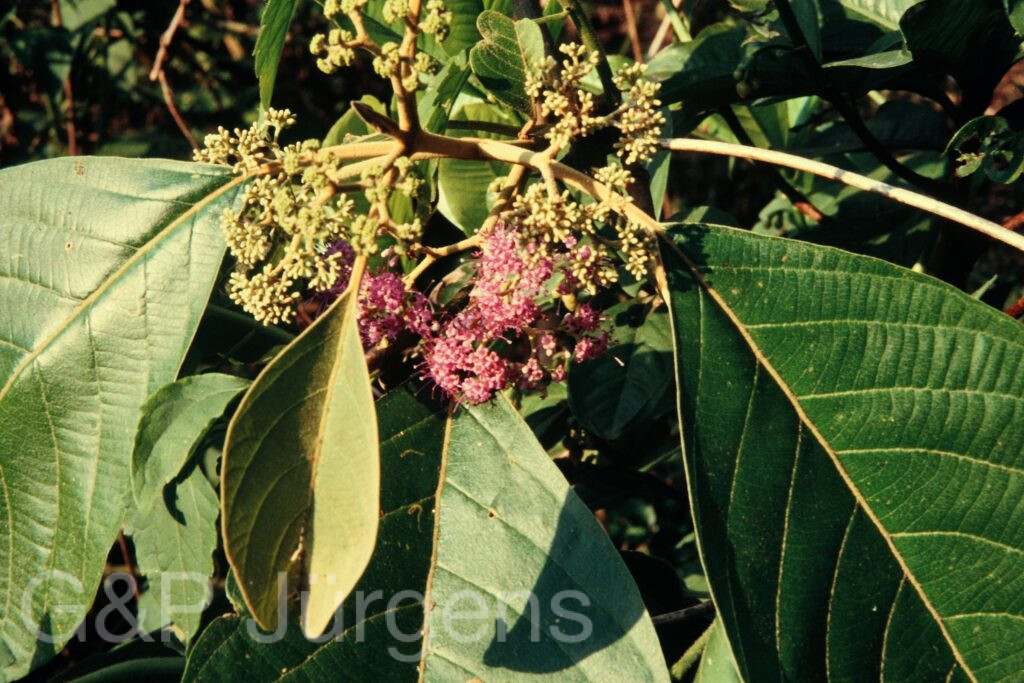
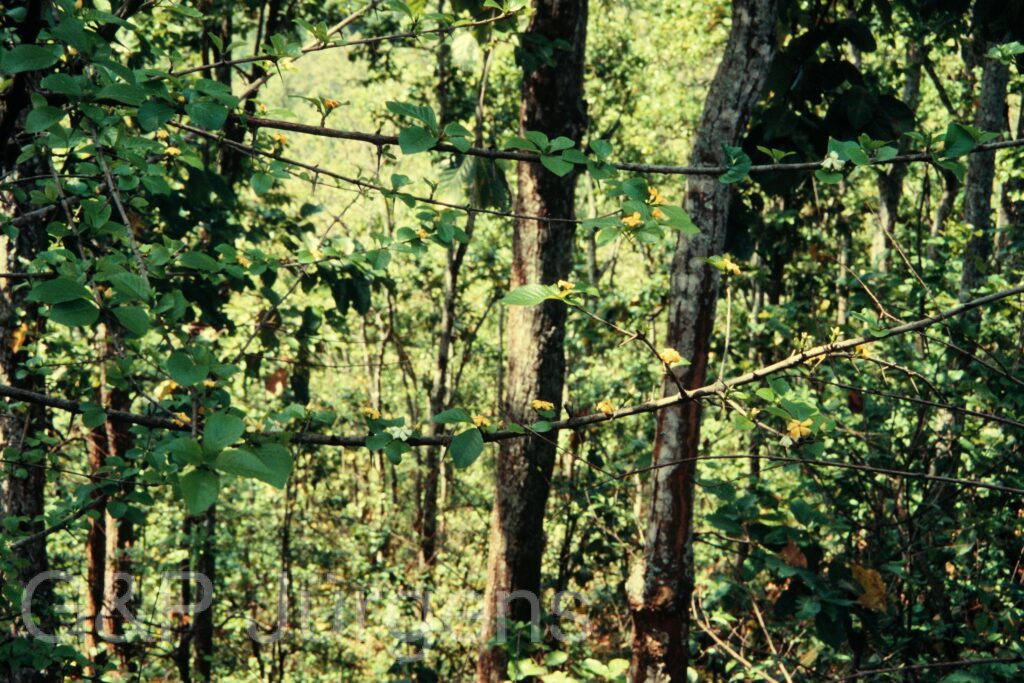
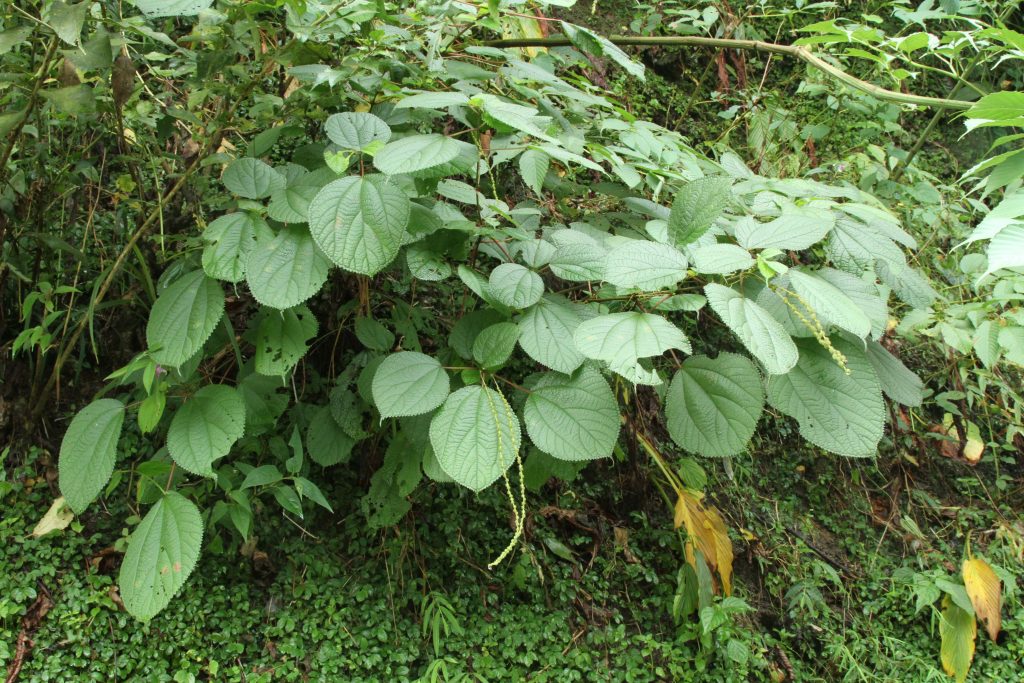
Boehmeria virgata subsp. macrophylla (Hornem.) Friis & Wilmot-Dear is a widespread paleotropical shrub of the nettle family, recorded by GBIF in over 2500 occurrences across an extraordinarily broad range that includes India (IN), Nepal (NP), China (CN), Thailand (TH) and Indonesia (ID), as well as much of tropical Africa (Tanzania, Cameroon, Gabon, Uganda, Angola), the Indian Ocean islands (Madagascar, Réunion, Mauritius, Comoros) and Australia (AU). It occupies forest margins, streambanks, clearings and disturbed secondary vegetation at low to mid elevations, and was photographed at Galephu in southern Bhutan at 500 m in October, in the warm subtropical foothills.

The plant is a shrub or coarse perennial herb with terete, often pubescent stems. The leaves are large, alternate or subopposite, broadly ovate to elliptic with a serrate margin, acuminate apex and three prominent basal veins, the lower surface frequently pale and softly hairy. As in all Boehmeria, the foliage lacks the stinging hairs found elsewhere in Urticaceae. The plant is monoecious, with minute unisexual flowers crowded into globose clusters arranged along slender, often elongate, interrupted spike-like inflorescences; female flowers have a tubular perianth enclosing a single ovule. The fruit is a small achene enclosed in the persistent, sometimes winged perianth.

This taxon belongs to a polymorphic complex that has been treated under various names including Boehmeria macrophylla, and the subspecific rank reflects Friis and Wilmot-Dear's revision integrating the Asian and African material. Wind pollination and the dust-like achenes account for its vast distribution. Stem fibres of Boehmeria species, notably ramie, are economically important, and the plant readily colonises disturbed ground, making it a frequent component of regenerating tropical and subtropical forest.

Author: (Hornem.) Friis & Wilmot-Dear · Sources: POWO (Kew), GBIF, Flora of Bhutan, Flora of China, Urticaceae revision (Friis & Wilmot-Dear)
Seem.

Bhutan2015 205
Bhutan Zhemgang 910m, October

Description

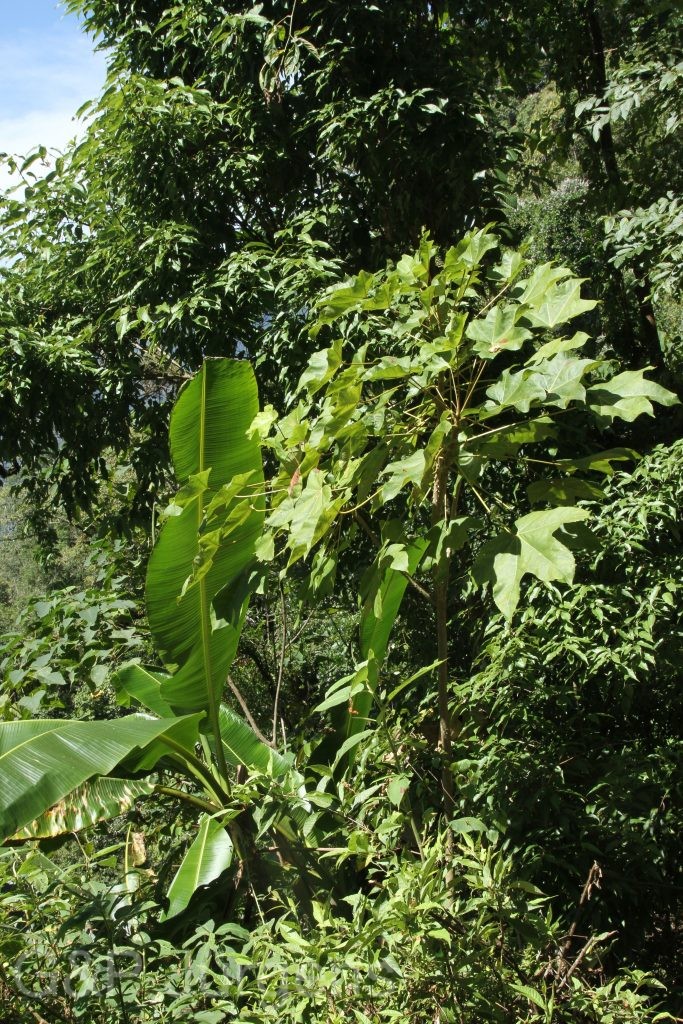
Brassaiopsis hainla is a small tree or treelet of the eastern Himalaya and adjacent Southeast Asia, distributed from northern India, Nepal and Bhutan through southern China into Myanmar, Thailand, Malaysia and Indonesia. GBIF records some 350 occurrences, the core in China, India, Nepal and Myanmar. It is a plant of subtropical to warm-temperate broad-leaved forest, growing along streamsides, ravine slopes, forest margins and secondary woodland, broadly from the foothills up to around 1500–2000 m. The individual shown was photographed in Bhutan at Zhemgang at 910 m in October, in humid hill forest characteristic of its lower-montane habitat.

The plant is a sparingly branched small tree with stout, often prickly stems and large, palmately lobed or palmately compound leaves clustered toward the branch tips on long petioles; the lobes are oblong-lanceolate, acuminate and serrate, and young growth is frequently armed with scattered prickles. The minute, greenish-white flowers are five-merous and borne in umbels arranged into large terminal, paniculate or racemose compound inflorescences. Each flower has a reduced calyx, free petals and an inferior ovary crowned by a stylar column. The fruit is a small, globose to slightly flattened drupe-like berry, ripening dark, containing several flattened pyrenes.

Brassaiopsis is a genus of the Araliaceae centred on the Sino-Himalaya and Indochina, allied to Aralia and Schefflera and distinguished by its armed stems, palmate leaves and umbellate inflorescences. The young shoots and leaves of B. hainla are eaten as a vegetable in parts of the Himalaya, and the species has local ethnobotanical use. It is reasonably widespread across its montane forest range and is not regarded as globally threatened, though it depends on the persistence of intact broad-leaved forest.

Author: Seem. · Sources: POWO (Kew), GBIF, Flora of China, Flora of Bhutan, An Annotated Checklist of the Flowering Plants of Nepal, A Systematic Revision of the Genus Brassaiopsis (Araliaceae)

Benth.

Bh2008 26 P45
Bhutan Doch-La, 1400m April
Bh2008 27 G47
Bhutan Doch-La, 1400m April

Description

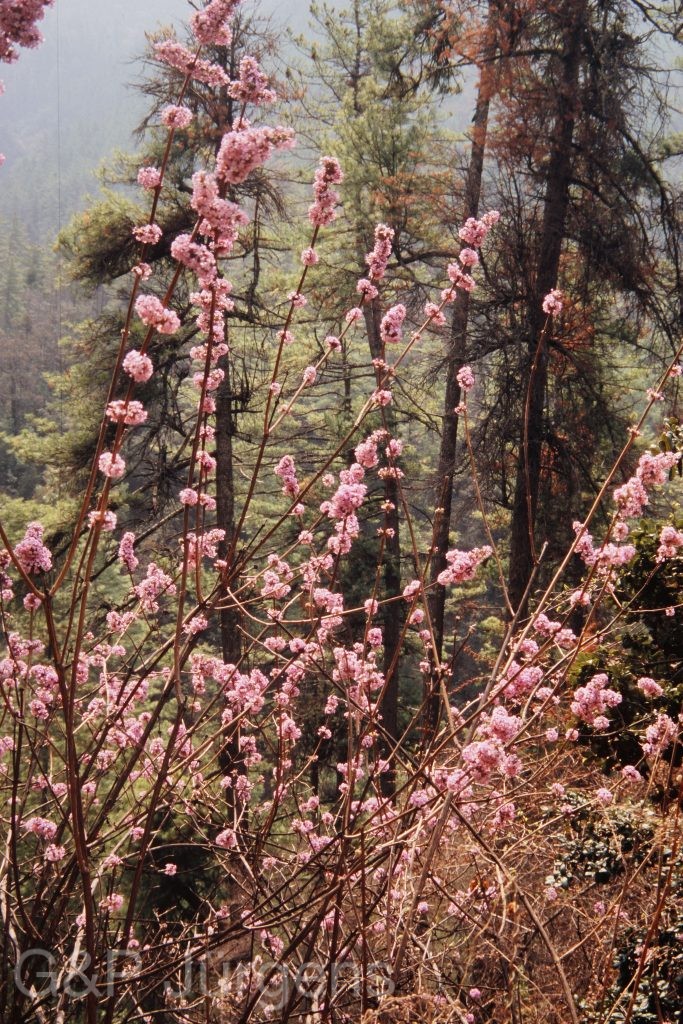
Buddleja crispa is a shrub of the dry inner valleys and warm temperate slopes of the Himalaya and adjacent mountains, distributed through China, Pakistan, India, Nepal, Afghanistan and Bhutan, with close to 1100 occurrences in GBIF. It favours open, sunny, often rocky and somewhat arid sites: cliff ledges, river gravels, dry hillsides, roadside banks and the margins of cultivation, generally between about 1000 and 3000 m. The plant photographed at the Doch La in Bhutan at 1400 m in April, flowering in spring on a warm montane pass, is typical of its early-season bloom on exposed, well-drained slopes where its grey-felted foliage withstands strong insolation and seasonal drought.

The species is a much-branched, deciduous to semi-evergreen shrub reaching 1–4 m, densely clothed throughout in white to greyish stellate and woolly tomentum that gives it a markedly silvery appearance. The leaves are opposite, ovate to lanceolate, with crisped, crenate or dentate, often undulate margins (the source of the epithet), and a thick indumentum, particularly beneath. The fragrant flowers are borne in dense, terminal and axillary panicles; each has a tubular corolla that is lilac to pale purple with an orange or yellow throat, the four-lobed limb spreading. The fruit is a small, two-valved septicidal capsule containing numerous minute seeds.

Buddleja, formerly placed in its own family Buddlejaceae or in Loganiaceae, is now treated within an expanded Scrophulariaceae, as on the source page. B. crispa is a variable species across its wide range and has given rise to several named varieties and to horticultural selections valued for their scented, early flowers and tolerance of dry, sunny conditions. The flowers attract butterflies and other insects. The species is widespread, often pioneering on disturbed ground, and is not of conservation concern.

Author: Benth. · Sources: POWO (Kew), GBIF, Flora of China Vol. 15, Flora of Bhutan Vol. 2, Flora of Pakistan, A Revision of the Asiatic Species of Buddleja (Scrophulariaceae)

Rchb.f.

Bhutan2012 1351
Bhutan Yankel 400m, October

Description

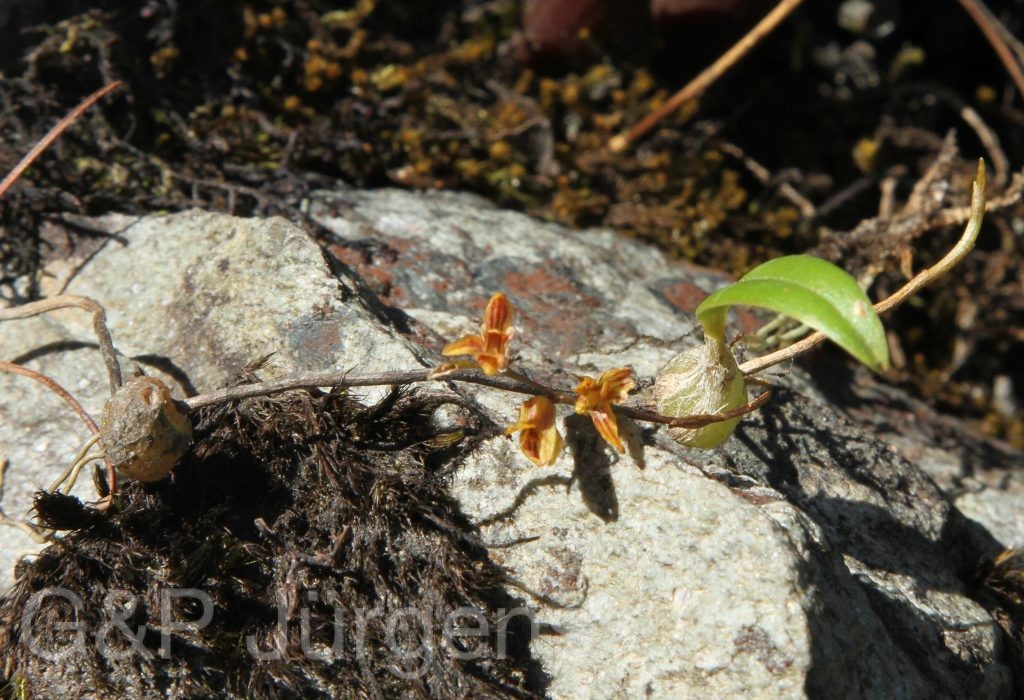
Bulbophyllum striatum is an epiphytic orchid confined to the eastern Himalayas and adjacent regions, with documented occurrences in northeast India (Sikkim, Assam, Meghalaya), Bhutan, Nepal, Bangladesh, and southwest China (Yunnan). It inhabits warm, humid subtropical and tropical forests at low to moderate elevations of 200–1,500 m — among the lower-altitude Bulbophyllum species in the Himalayan flora.

The pseudobulbs are ovoid, 2–3 cm tall, set at intervals on a stout, creeping rhizome. Each bears a single, oblong-lanceolate, coriaceous leaf 10–18 cm long. The inflorescence is an arching to pendent, laxly few-flowered raceme, 8–15 cm long, producing 3–8 flowers. The specific epithet 'striatum' (striped) refers to the conspicuous reddish-brown longitudinal striations on the sepals: flowers are 1.5–2 cm across, yellowish-green with prominent dark reddish-brown veining. The lip is dark purple, fleshy, curved, and mobile on the column foot. Flowering occurs from September to November.

The relatively low-altitude habitat of B. striatum at Yankel (400 m) in southern Bhutan reflects the warm, subtropical character of the Mo-Chu and lower Punatsangchu valleys, which harbour a distinct orchid flora adapted to high humidity and temperatures atypical for most of Bhutan.

Author: Rchb.f. · Sources: POWO (Kew), Flora of Bhutan Vol. 3, GBIF, Pearce & Cribb: The Orchids of Bhutan (2002)

Lindl.

Bhutan2012 689
Bhutan Galephu 850m, September

Description

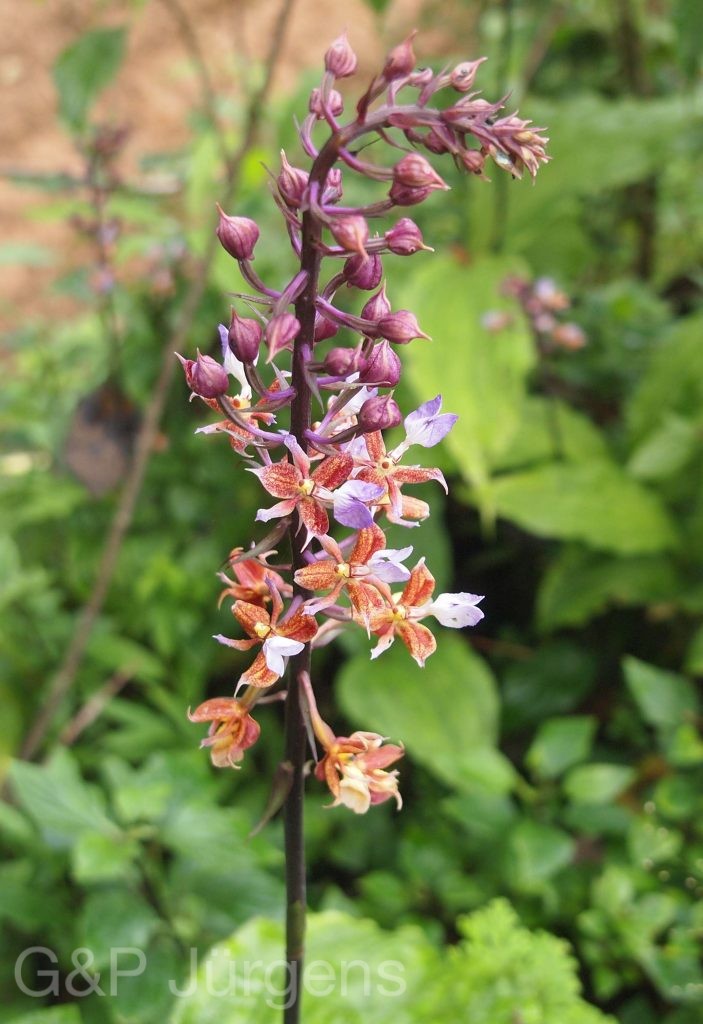
Calanthe biloba is a terrestrial orchid native to the eastern Himalayas and adjacent regions, occurring in northeast India (Sikkim, Assam, Meghalaya), Bhutan, Nepal, southwest China (Yunnan), and northern Vietnam. It grows in the understory of warm, humid broadleaved forests and along shaded stream banks at 500–1,500 m elevation, in well-drained, humus-rich soils.

The plant produces prominent, conical pseudobulbs partially enclosed by the persistent leaf bases. The leaves are large, 30–50 cm long, broadly elliptic to obovate, plicate (folded lengthwise), and deciduous in the dry season. The inflorescence is an erect, pubescent raceme 30–60 cm tall, bearing 10–20 flowers. Flowers are 2.5–3.5 cm across, white to pale yellow. The lip is conspicuously bilobed (as the specific epithet indicates), with two diverging apical lobes, and bears a yellow callus of raised lamellae. The spur is slender, 1.5–2 cm long. Flowering occurs from August to October.

Calanthe biloba belongs to the deciduous group of Calanthe (subgenus Preptanthe), which shed their leaves before or during flowering. The relatively low elevation of the collecting locality at Galephu (850 m) reflects southern Bhutan's subtropical climate, where several thermophilic orchid species reach their northern distributional limit.

Author: Lindl. · Sources: POWO (Kew), Flora of Bhutan Vol. 3, GBIF, Pearce & Cribb: The Orchids of Bhutan (2002)

Roxb.

Nepal 97 566 P1099
Nepal Sabha-Khola 550m May
Nepal 97 567 P1100
Nepal Sabha-Khola 550m May

Description

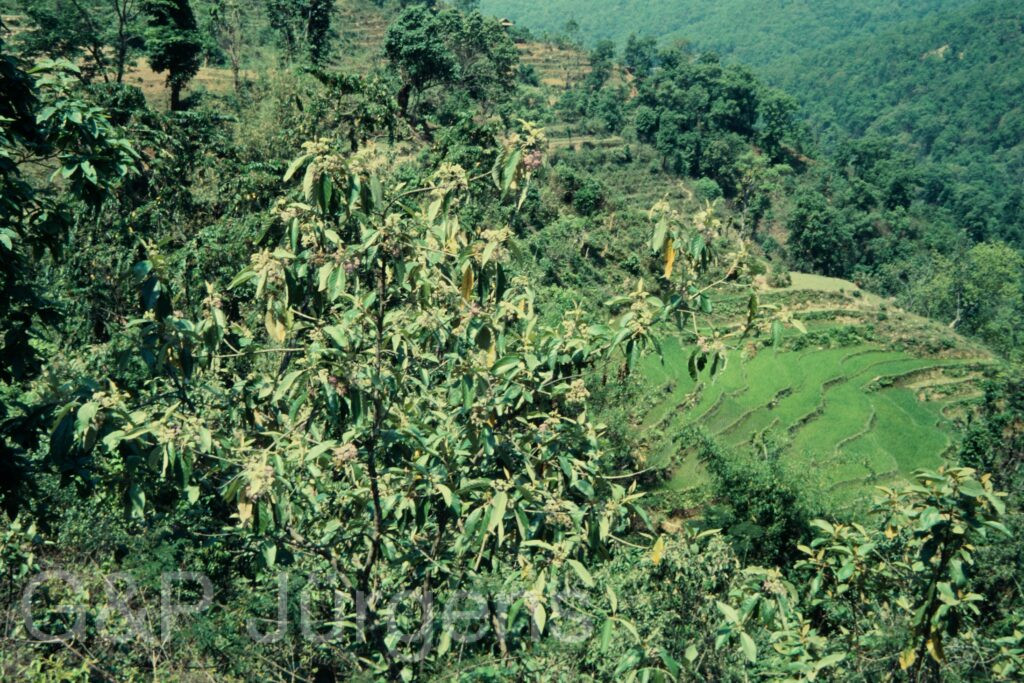
Callicarpa arborea is a tree of the Indo-Malesian tropics, distributed from the Himalayan foothills of Nepal, India, Bhutan and Bangladesh through Myanmar, Thailand, Indochina and southern China to the Malay Peninsula, the Indonesian archipelago, the Philippines and New Guinea; GBIF records nearly 1,200 occurrences. It is a characteristic component of secondary and disturbed lowland and lower-montane forest, forest margins and regrowth on cleared land, generally from near sea level to about 1,500 m. The plant photographed along the Sabha Khola in eastern Nepal at 550 m in May illustrates its occurrence in warm, humid subtropical foothill forest at the western limit of its range.

It is a small to medium-sized evergreen tree reaching 5-15 m, with young branchlets, petioles and inflorescences densely covered in a stellate, rusty- to grey-tomentose indumentum. The leaves are large, opposite, elliptic to oblong-lanceolate, 12-25 cm long, acuminate and entire, dark green and glabrescent above but conspicuously whitish- or brownish-tomentose beneath. The flowers are small and numerous, borne in dense, branched axillary cymes; the corolla is pinkish to purple, tubular with four short spreading lobes, and the four stamens are exserted. The fruit is a small globose drupe, ripening purplish to black and crowned by the persistent calyx, containing four pyrenes.

Callicarpa (now placed in Lamiaceae following the dismemberment of the traditional Verbenaceae) comprises some 140 species of pantropical and warm-temperate shrubs and trees, of which C. arborea is one of the largest and most arborescent. Its abundant insect-pollinated flowers and bird-dispersed drupes make it an effective coloniser of disturbed ground, and it is frequently encountered in successional forest. The tomentose foliage and bark have a long history of local medicinal and minor timber use across South and Southeast Asia. Widespread, common and ecologically adaptable, it is not regarded as threatened.

Author: Roxb. · Sources: POWO (Kew), GBIF, Flora of China, Flora of Bhutan, Annotated Checklist of the Flowering Plants of Nepal, revision of Callicarpa (Lamiaceae)

Caryota urens

by GP Jürgens

L.

Bhutan2015 261
Bhutan Zhemgang 1000m, October

Description

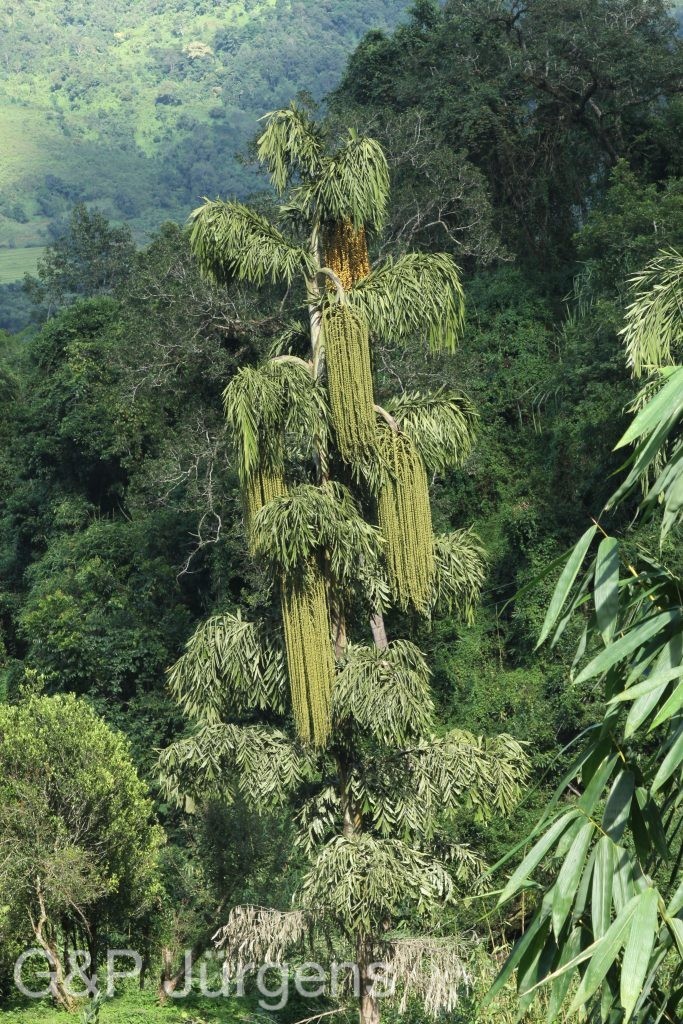
Caryota urens, the fishtail or jaggery palm, is a solitary tropical palm native to the Indian subcontinent, Sri Lanka, Myanmar and South-East Asia, with around 5517 occurrence records spanning both its native range and many countries where it is widely cultivated. It grows in moist tropical and subtropical forest, secondary woodland, river valleys and around villages, predominantly in the lowland to lower-montane zone. The photographed plant from Zhemgang in southern Bhutan at 1000 m, recorded in October, sits at the upper-elevation edge of its warm, humid habitat.

It is a tall, single-stemmed palm with a stout, ringed grey trunk reaching well over ten metres. The leaves are very large, bipinnate—unusual among palms—with the ultimate segments wedge-shaped and jaggedly toothed at the apex, resembling a fish's tail and giving the common name. The plant is monocarpic and hapaxanthic: after years of vegetative growth it flowers once, producing a sequence of massive pendulous inflorescences from the upper nodes downward, bearing cream to purplish unisexual flowers. The fruit is a globose red to purplish-black berry containing irritant calcium-oxalate raphides, whence the epithet urens ("stinging").

Despite the source labelling it Fabaceae, Caryota urens belongs to the palm family, Arecaceae, subfamily Coryphoideae, tribe Caryoteae. It is of considerable economic value: the sugary sap tapped from the inflorescences yields jaggery, palm wine and vinegar, while the trunk furnishes sago-like starch and the leaf sheaths a strong fibre (kittul). Widely planted and broadly distributed, it is not considered threatened.

Author: L. · Sources: POWO (Kew), GBIF, Flora of China (Arecaceae), Flora of Bhutan, Genera Palmarum (Dransfield et al.), Govaerts & Dransfield World Checklist of Palms

Castanopsis indica

by GP Jürgens

(Roxb. ex Lindl.) A.DC.

Bhutan2015 191
Bhutan Mo-Chu 1400m, October
Bhutan2015 192
Bhutan Mo-Chu 1400m, October
Bhutan2015 649 scaled
Bhutan Mo-Chu 1400m, October

Description

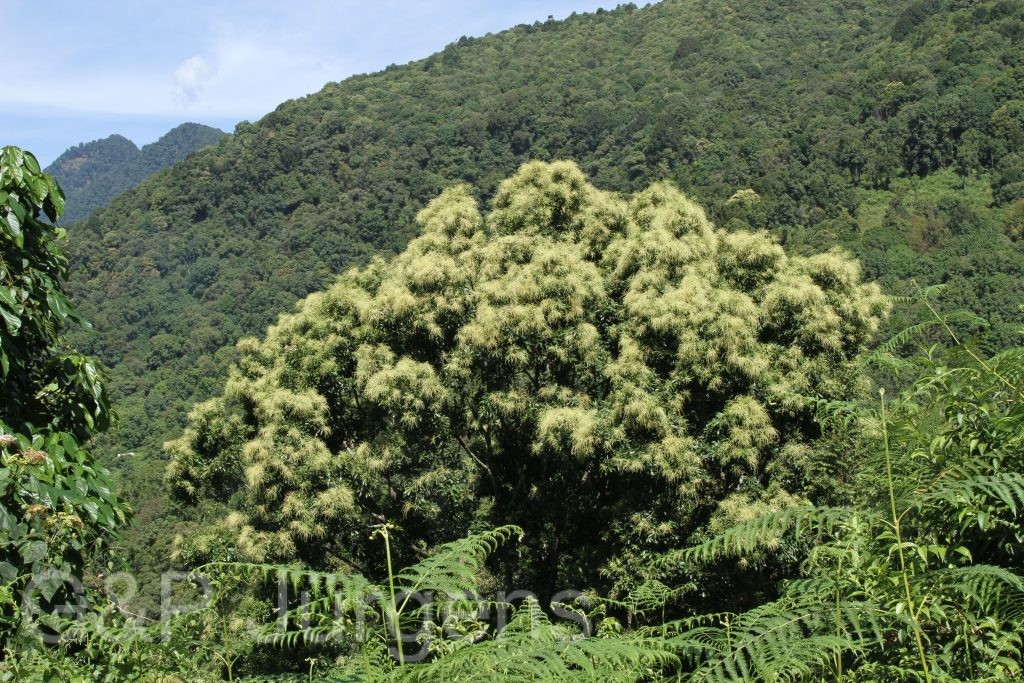
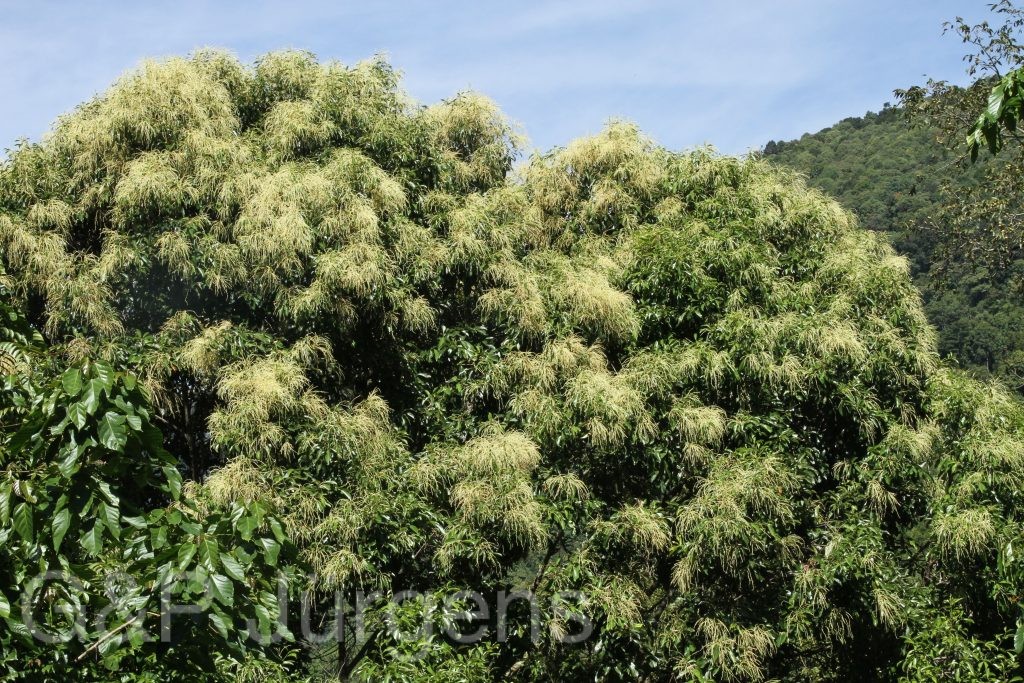
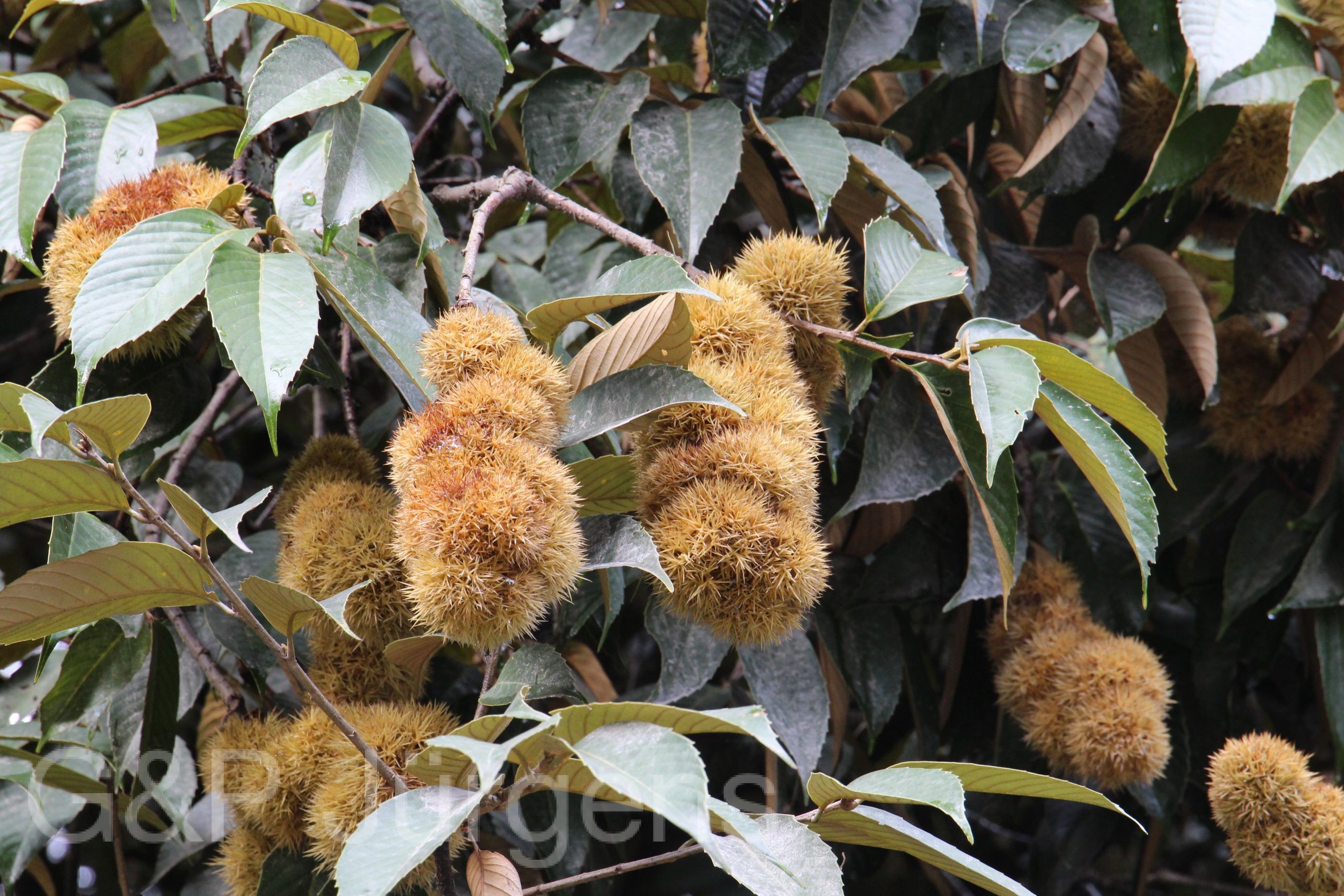
Castanopsis indica is a large evergreen tree of the subtropical and lower temperate forests of the Himalaya and Southeast Asia, abundantly recorded with around 1680 GBIF occurrences across India, China, Myanmar, Vietnam, Laos, Thailand, Nepal, Bhutan and Bangladesh. The photographed tree was found along the Mo-Chu in Bhutan at 1400 m in October. The species is a dominant or co-dominant canopy element of mid-elevation broad-leaved forest, typically between 800 and 2000 m, often forming Castanopsis-Schima associations on humid, well-drained hill slopes.

It is a stout tree with a broad crown and greyish, somewhat fissured bark. The leaves are alternate, leathery, oblong to elliptic-lanceolate, with a coarsely serrate margin bearing spinose-tipped teeth, glabrous and dark green above. Like other chestnut relatives the flowers are unisexual, the males borne in erect catkin-like spikes and the females clustered at their base, producing a strong scent at anthesis. The fruit is a hard nut wholly enclosed in a globose cupule densely armed with branched, spiny processes; the cupules split irregularly to release the edible nuts.

The genus Castanopsis (chinquapins) belongs to the Fagaceae and is a keystone group in Asian evergreen oak forests. The nutritious nuts are eaten locally and dispersed by rodents and birds, while the timber is valued for construction and the trees provide important habitat structure. Although the species is widespread and not globally threatened, the Castanopsis-dominated forests it characterises are under pressure from logging, fuelwood collection and agricultural conversion.

Author: (Roxb. ex Lindl.) A.DC. · Sources: POWO (Kew), GBIF, Flora of China, Flora of Bhutan, Flora of Nepal, Camus – Les Chenes: Monographie du genre Castanopsis

A.DC.

Bhutan2014 87
Bhutan Trashigang 1400m, May
Bhutan2014 167
Bhutan Trashigang 1400m, May
Bhutan2014 165
Bhutan Trashigang 1400m, May

Description

Castanopsis tribuloides is an evergreen chinquapin widely distributed across the eastern Himalaya and Indo-Burma into southern China and Japan, recorded from Nepal, Bhutan, north-eastern India, Bangladesh, Myanmar, Thailand, Indochina and the Sino-Japanese region. GBIF aggregates some 766 occurrences, concentrated in the montane forests of the eastern Himalaya and South-East Asia. It is a canopy or sub-canopy tree of subtropical and warm-temperate evergreen broad-leaved forest, often in mixed oak-laurel associations on hill slopes, typically between about 1000 and 2500 m. The tree photographed near Trashigang in eastern Bhutan (1400 m, May) reflects its place in the moist mid-elevation forests of the eastern Himalayan belt, flowering in the pre-monsoon season.

The species is a medium-sized tree with greyish bark and slender twigs. The leaves are simple, alternate, coriaceous, lanceolate to oblong-lanceolate, entire or finely serrate toward the apex, glabrous and glossy above and often thinly scaly or coppery beneath when young. The flowers are unisexual, borne in erect catkin-like spikes, the staminate inflorescences slender and the pistillate flowers in few-flowered clusters. The diagnostic fruit is a small nut enclosed in a globose cupule densely covered with slender, spreading, often branched spines, recalling a Tribulus burr and giving the epithet; the spiny involucres are borne in dense infructescences and dehisce to release the nut.

Castanopsis is a large genus of Asian Fagaceae distinguished from Castanea and Lithocarpus by its evergreen habit and persistently spiny cupules. C. tribuloides, described by Alphonse de Candolle, is variable in leaf form and cupule spininess, and is closely allied to other Himalayan chinquapins with which it can intergrade. As a widespread, often common forest dominant it is not threatened, while being ecologically valuable as wildlife mast and locally used for timber and fuelwood.

Author: A.DC. · Sources: POWO (Kew), GBIF, Flora of China, Flora of Bhutan, Flora of Thailand, Annotated Checklist of the Flowering Plants of Nepal, monograph of Asian Fagaceae (Camus)

(Link) Tirveng.

Nepal 97 542 G1061
Nepal Dhoban 740m April

Description

Catunaregam longispina is a spiny shrub or small tree of tropical and subtropical Asia, distributed from India and Nepal through Bhutan, Myanmar, Thailand, Cambodia and Vietnam. GBIF records about 165 occurrences across this range, concentrated in the Indian subcontinent and mainland South-East Asia. It is a plant of dry deciduous and mixed forest, thorn scrub, open hillsides and disturbed ground at low elevations, typically in the warm subtropical foothill and plains zone. The population imaged at Dhoban in Nepal (740 m, April) is characteristic of its habitat in the warm, seasonally dry hill country of the lower Himalayan foreland, flowering in spring before the monsoon.

The plant is a much-branched, often armed shrub bearing stout, straight, axillary thorns from which the epithet derives. The leaves are opposite or fascicled on short shoots, obovate to elliptic, entire, often clustered at the nodes, with interpetiolar stipules. The flowers are solitary or few at the shoot tips, fragrant, with a campanulate calyx and a salver- to funnel-shaped corolla that opens white or cream and frequently ages to yellow, the five lobes spreading and contorted in bud. Five stamens are inserted in the corolla throat and the ovary is inferior. The fruit is a leathery to woody, globose berry crowned by the persistent calyx and containing numerous seeds embedded in pulp.

Catunaregam (tribe Gardenieae) was segregated from the broadly defined Randia, and this species, transferred by Tirvengadum, has circulated under several synonyms in the Randia/Xeromphis complex; care is needed in distinguishing it from related thorny gardenioid shrubs. As a widespread and adaptable species of secondary and dry forest it is not of conservation concern, and its fruit and bark have local ethnobotanical uses, including as a fish poison and in folk medicine.

Author: (Link) Tirveng. · Sources: POWO (Kew), GBIF, Flora of British India, Flora of Bhutan, Flora of Thailand, Annotated Checklist of the Flowering Plants of Nepal, revision of Catunaregam and allied Gardenieae (Tirvengadum)