
Roxb.
Description
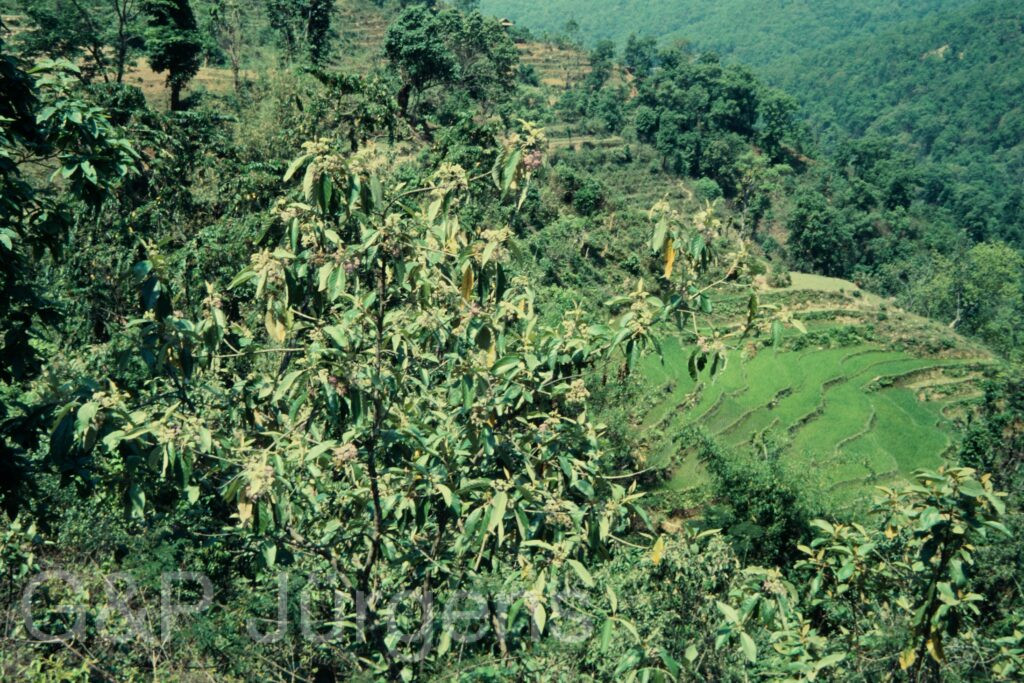
Callicarpa arborea is a tree of the Indo-Malesian tropics, distributed from the Himalayan foothills of Nepal, India, Bhutan and Bangladesh through Myanmar, Thailand, Indochina and southern China to the Malay Peninsula, the Indonesian archipelago, the Philippines and New Guinea; GBIF records nearly 1,200 occurrences. It is a characteristic component of secondary and disturbed lowland and lower-montane forest, forest margins and regrowth on cleared land, generally from near sea level to about 1,500 m. The plant photographed along the Sabha Khola in eastern Nepal at 550 m in May illustrates its occurrence in warm, humid subtropical foothill forest at the western limit of its range.
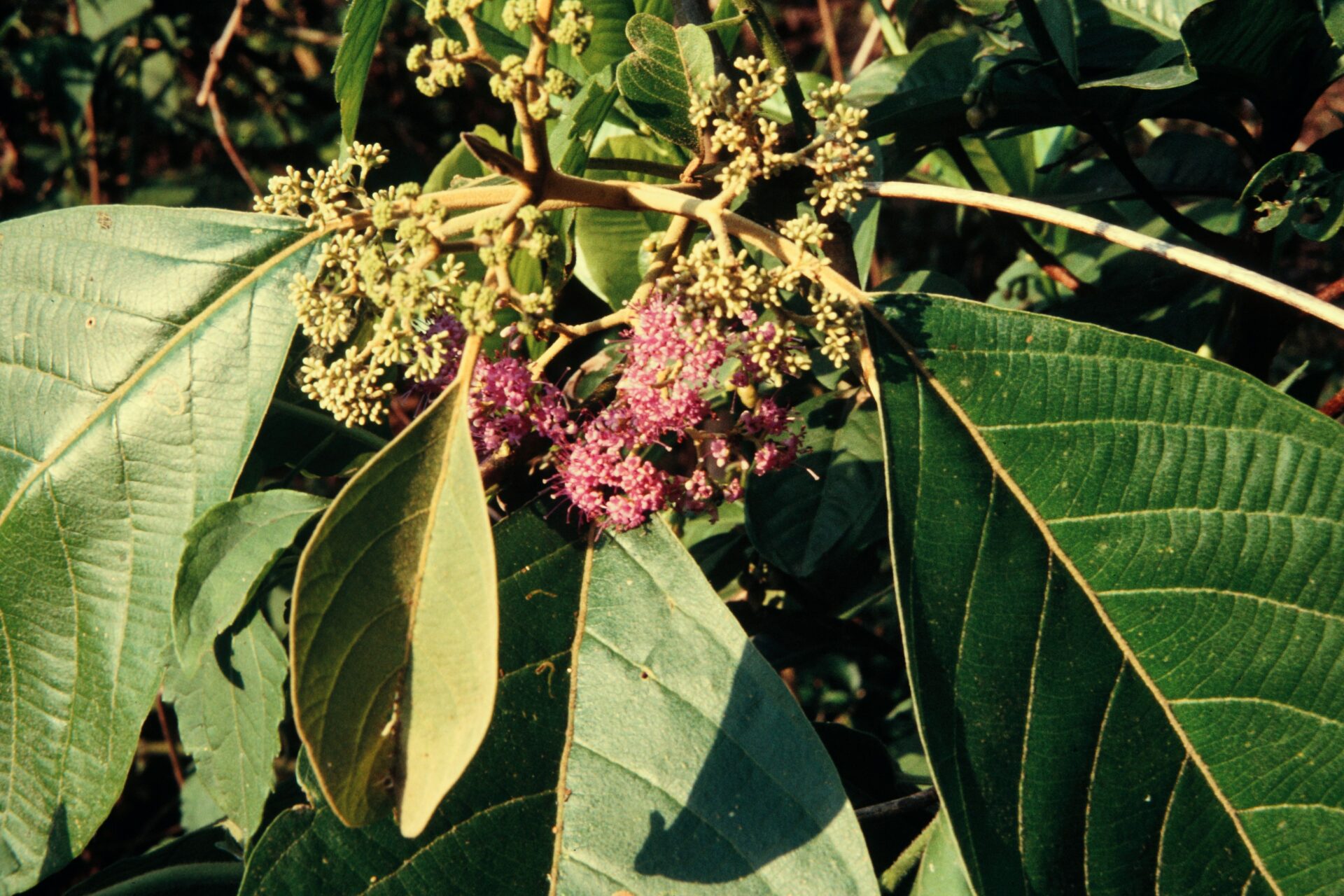
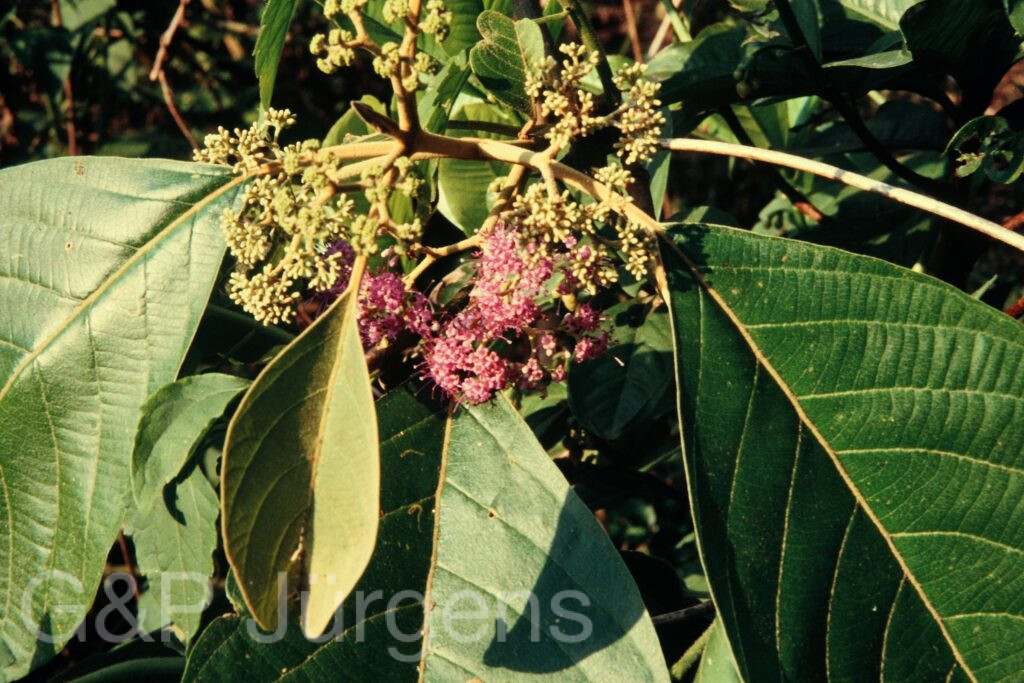
It is a small to medium-sized evergreen tree reaching 5-15 m, with young branchlets, petioles and inflorescences densely covered in a stellate, rusty- to grey-tomentose indumentum. The leaves are large, opposite, elliptic to oblong-lanceolate, 12-25 cm long, acuminate and entire, dark green and glabrescent above but conspicuously whitish- or brownish-tomentose beneath. The flowers are small and numerous, borne in dense, branched axillary cymes; the corolla is pinkish to purple, tubular with four short spreading lobes, and the four stamens are exserted. The fruit is a small globose drupe, ripening purplish to black and crowned by the persistent calyx, containing four pyrenes.
Callicarpa (now placed in Lamiaceae following the dismemberment of the traditional Verbenaceae) comprises some 140 species of pantropical and warm-temperate shrubs and trees, of which C. arborea is one of the largest and most arborescent. Its abundant insect-pollinated flowers and bird-dispersed drupes make it an effective coloniser of disturbed ground, and it is frequently encountered in successional forest. The tomentose foliage and bark have a long history of local medicinal and minor timber use across South and Southeast Asia. Widespread, common and ecologically adaptable, it is not regarded as threatened.
Author: Roxb. · Sources: POWO (Kew), GBIF, Flora of China, Flora of Bhutan, Annotated Checklist of the Flowering Plants of Nepal, revision of Callicarpa (Lamiaceae)