
(Benth.) Murata

Description
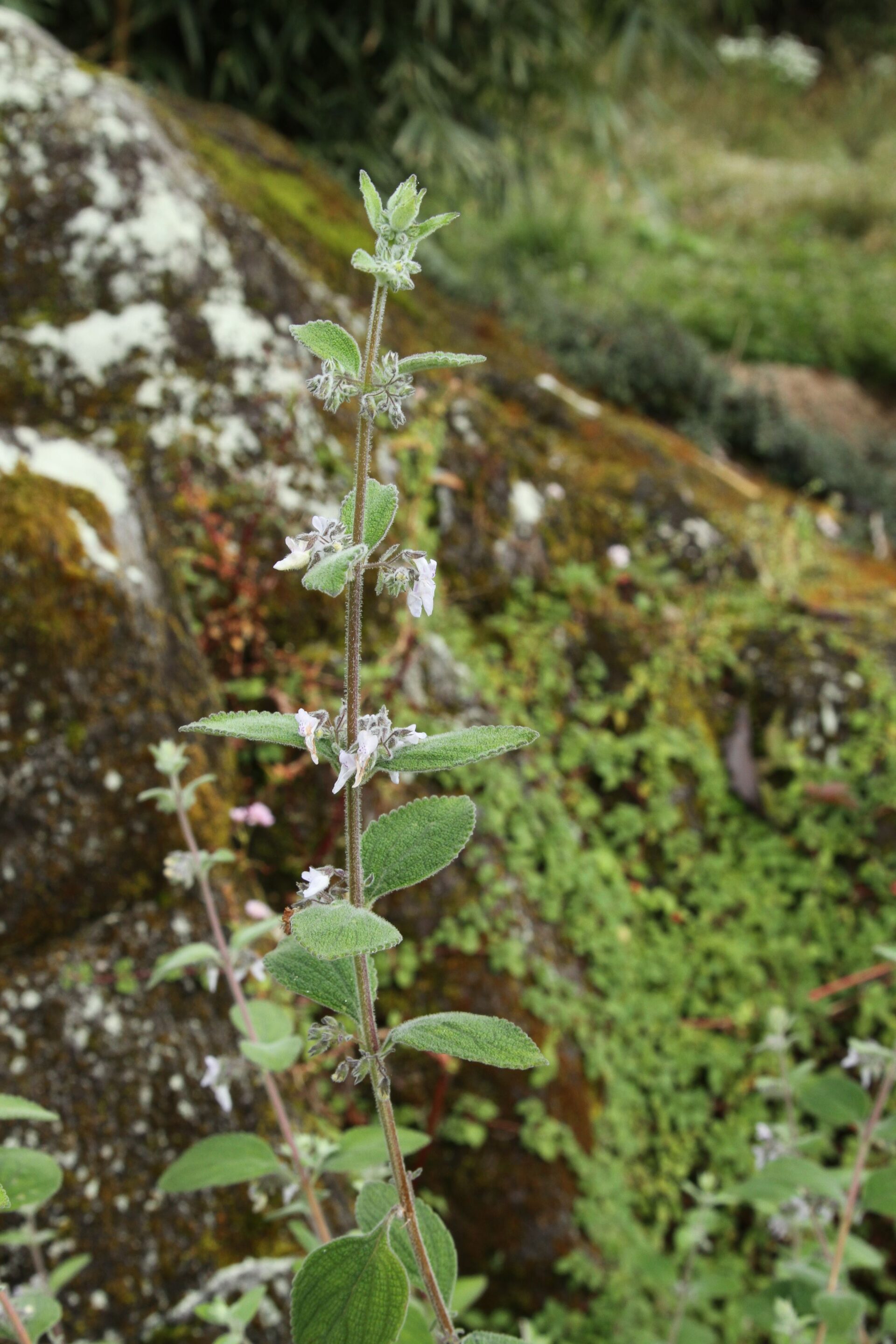
Isodon hispidus (Benth.) Murata is a perennial herb of the mint family distributed across the eastern Himalaya and the mountains of southern China and mainland Southeast Asia. GBIF records confirm its presence in Bhutan, India, China, Myanmar, Laos, Vietnam, Thailand and Korea, with an outlying record from Tanzania likely representing a cultivated or misidentified collection. It favours moist forest margins, shrubby clearings and open slopes in the temperate and subalpine zones, typically between 1,500 and 3,000 m. The photographed plant at the Dochu-La in Bhutan, at 2,800 m and flowering in October, exemplifies its preference for cool, humid montane habitats where autumn blooms persist after the monsoon.
The species forms an erect, branched herb 0.5–1.5 m tall arising from a woody rootstock, with quadrangular stems that are densely hispid with spreading hairs. The opposite leaves are ovate to broadly ovate, acuminate, with a coarsely serrate margin and a rugose, pubescent surface, narrowing to a winged petiole. The inflorescence is a lax terminal panicle composed of numerous cymes; the small flowers have a campanulate, two-lipped calyx and a pale violet to purplish corolla with the characteristic declinate lower lip of the genus, enclosing four exserted stamens. The fruit comprises four smooth, ovoid nutlets.
Isodon hispidus belongs to a large and taxonomically intricate genus (formerly placed in Rabdosia and Plectranthus) noted for diterpenoid chemistry of pharmacological interest. Several congeners are used in traditional Asian medicine, and the genus is a focus of phytochemical research into ent-kaurene diterpenoids. The species is widespread and not considered threatened across its broad range.
Author: (Benth.) Murata · Sources: POWO (Kew), GBIF, Flora of China Vol. 17, Flora of Bhutan Vol. 2, Murata: Revision of Asian Isodon (Lamiaceae)