Tag:

Subtropical (<1500 m)

Roxb.

Nepal 97 458 P882
Nepal Arun-Valley 900m May

Description

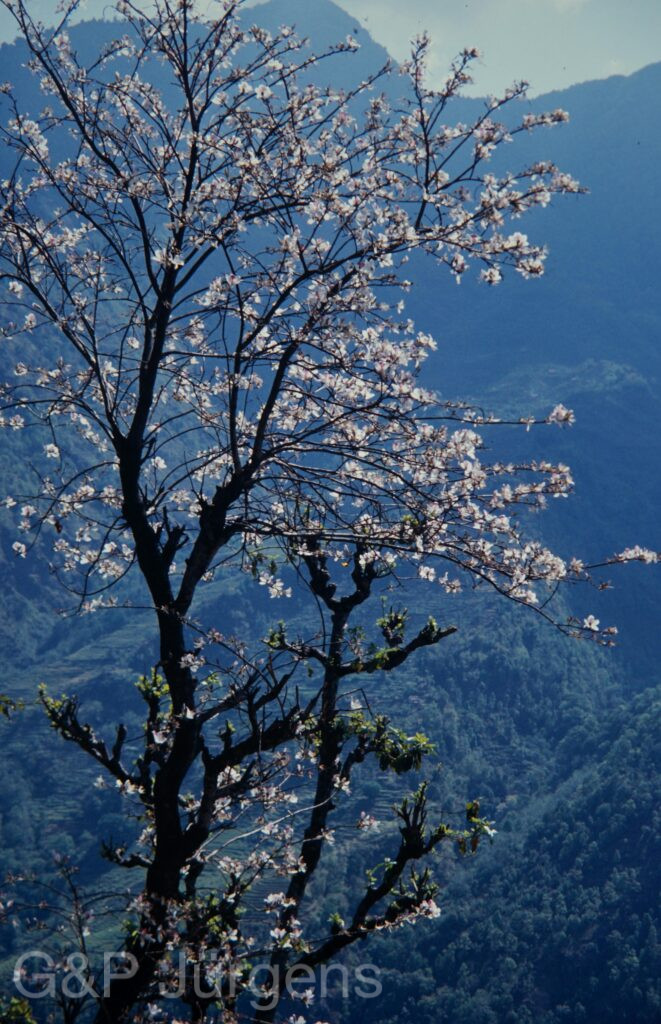
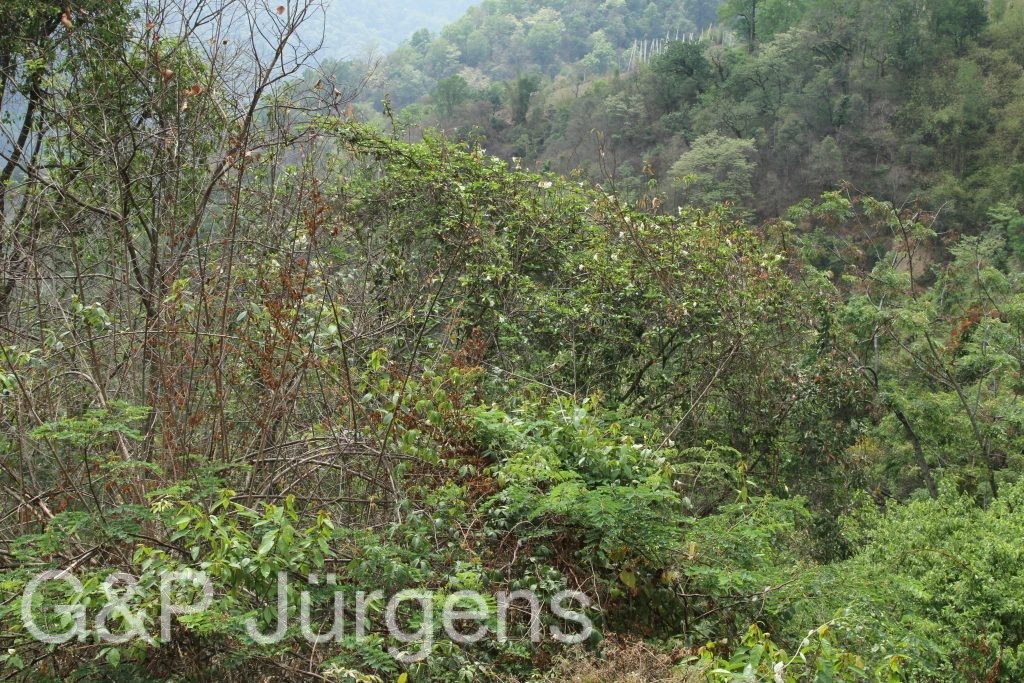
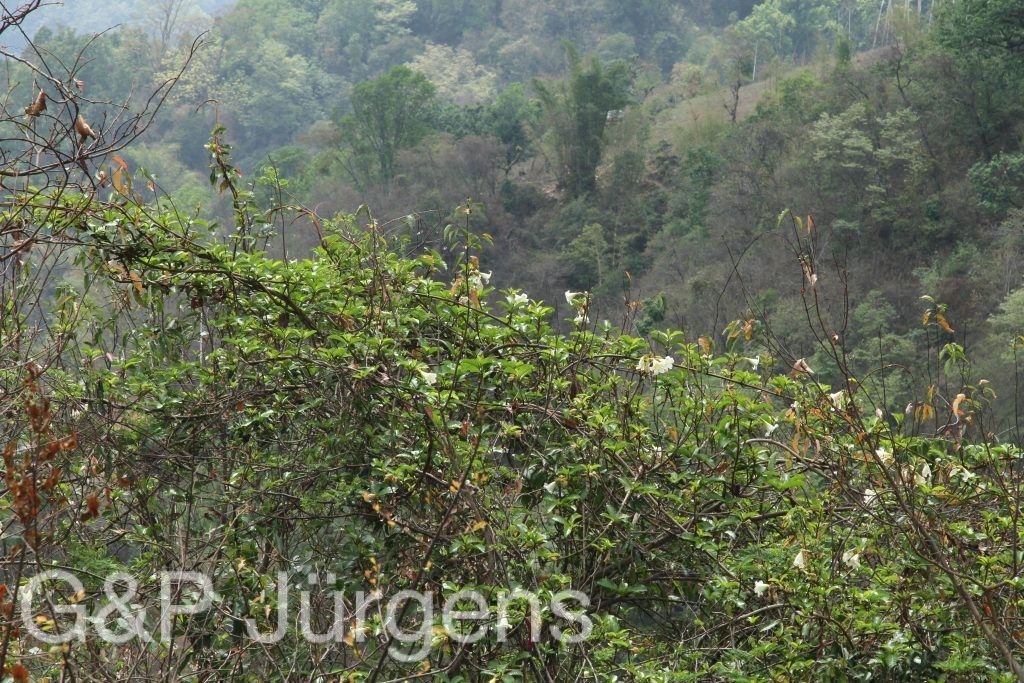
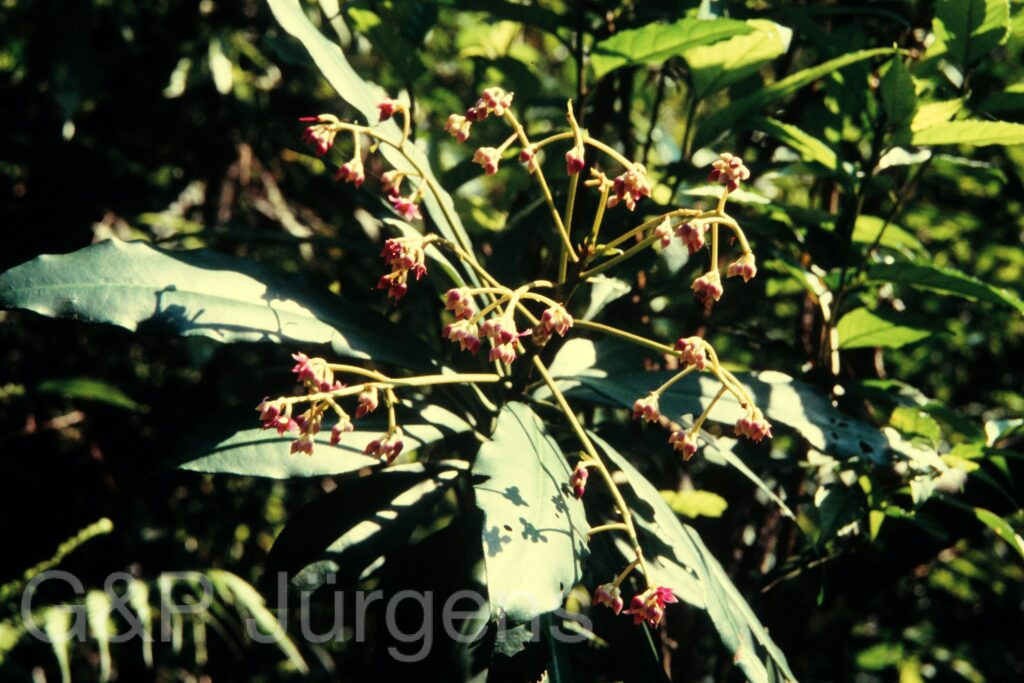
Ardisia solanacea is a widespread tropical and subtropical shrub of South and Southeast Asia, recorded from India, Nepal, China, Bangladesh, Myanmar, Thailand, Sri Lanka, Malaysia and Indonesia, and naturalised or cultivated more widely; its 865 GBIF records make it one of the better-documented species in this group. It occupies lowland and lower-hill forest, forest margins, secondary thickets and roadside scrub, generally below about 1500 m. The plant photographed in the Arun Valley of eastern Nepal at 900 m, flowering in May, typifies its preference for warm, humid lower-montane settings.

It is an evergreen shrub or small tree with glabrous, terete branchlets. The leaves are alternate, elliptic to obovate-oblong, leathery, entire and obscurely gland-dotted, tapering to a short petiole. The inflorescences are lateral, umbellate to corymbose racemes borne on short specialised branchlets; the flowers are pinkish to rose-purple, with five reflexed, often punctate corolla lobes and prominent connivent anthers forming a cone, in the characteristic Ardisia fashion. The fruit is a depressed-globose, single-seeded drupe that ripens from red to glossy purplish-black.

In GBIF the name carries a synonym flag, but Ardisia solanacea Roxb. is the accepted name for this taxon. The species sits within Ardisia (Myrsinoideae of Primulaceae, formerly Myrsinaceae), a large pantropical genus distinguished by glandular punctations and drupaceous fruits. It is common, weedy in places, and of no conservation concern; its fruits are eaten by birds and the plant is used locally in traditional medicine.

Author: Roxb. · Sources: POWO (Kew), GBIF, Flora of China, Flora of Nepal, Pipoly & Chen revision of Asian Ardisia
Mart.

Bhutan2014 32
Bhutan, Trashigang 1300m, May
Nepal 97 432 G839
Nepal Tashigaon 3100m May
Nepal 1994 269 ergebnis
Ost-Nepal Milka-Danda 3200m May 
Nepal1992 184 P270 ergebnis
Nepal Banyang 1900m March 

Description

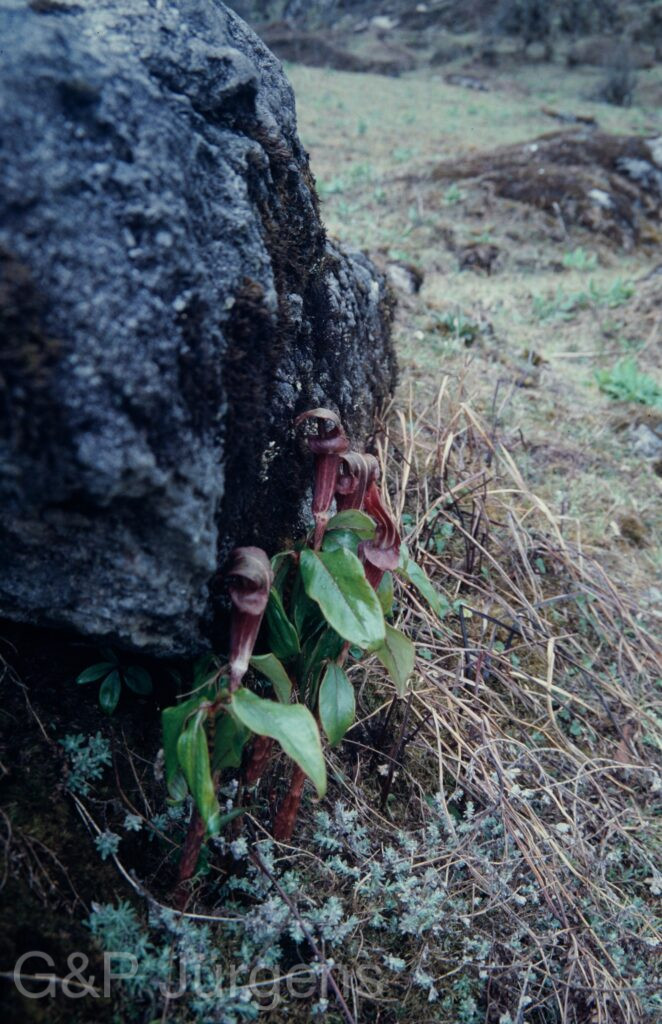
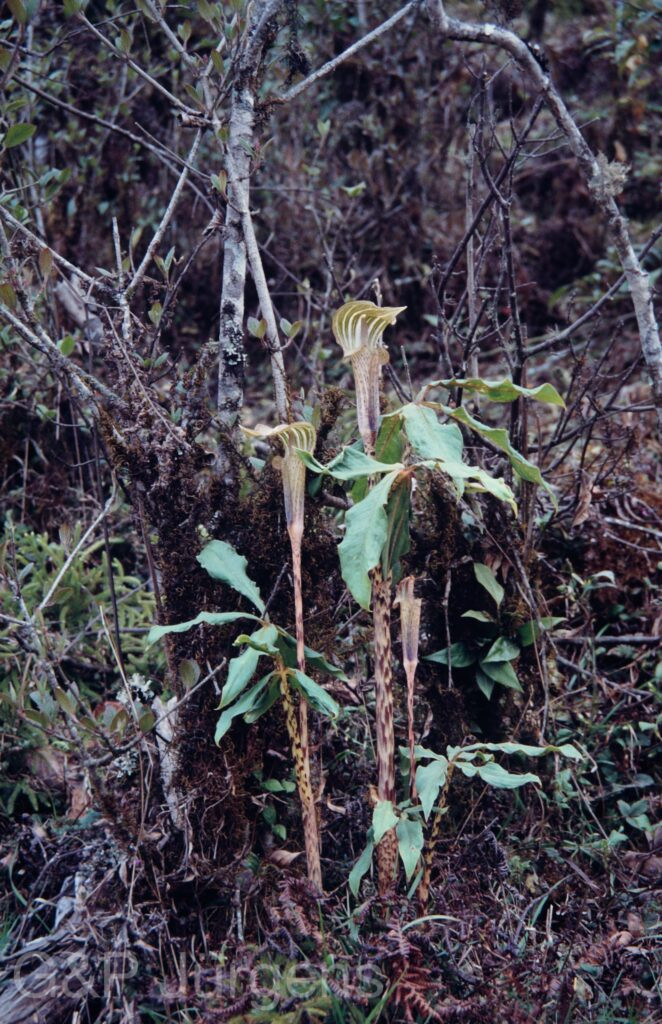
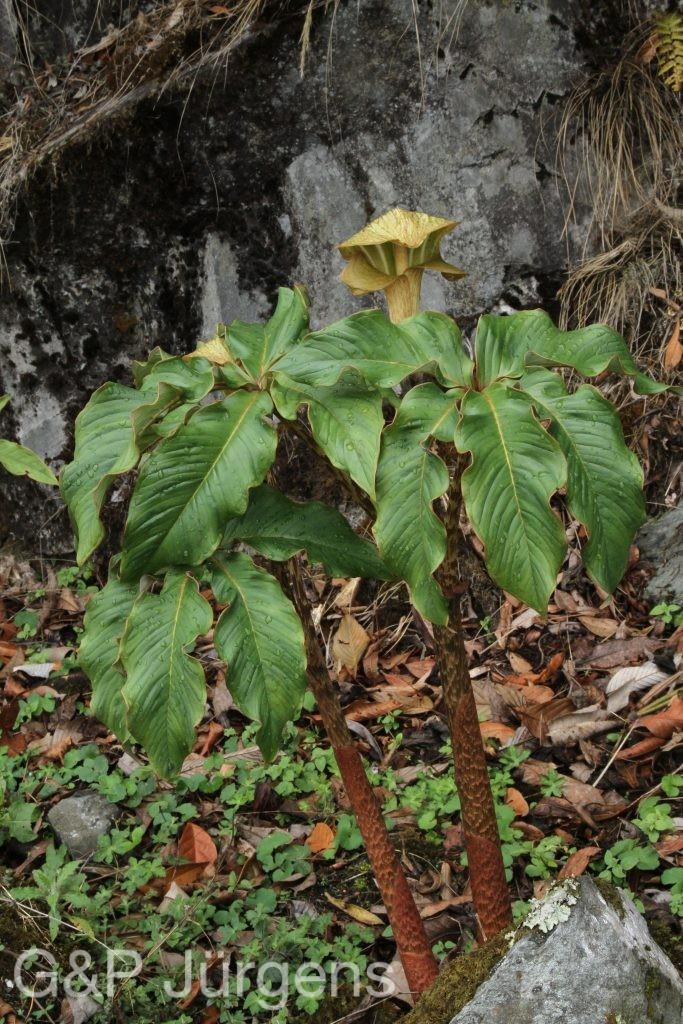
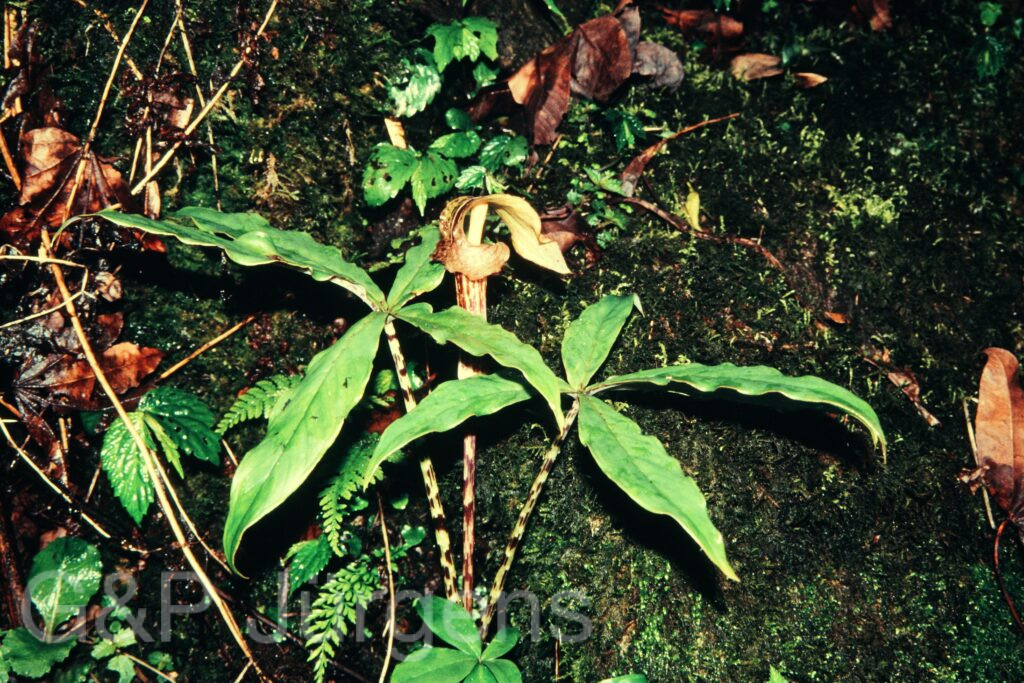
Arisaema nepenthoides is a Himalayan cobra lily distributed from Nepal eastward through Sikkim, Bhutan and north-east India to Myanmar and south-western China, with about 322 GBIF occurrences reflecting its montane range. It is a herb of cool temperate to subalpine forest, growing in moist broad-leaved and conifer-Rhododendron forest, shady banks and forest margins, broadly from 1,900 to 3,600 m. The localities recorded for the photographed plants span this range, from Trashigang in eastern Bhutan at 1,300 m and Banyang in Nepal at 1,900 m to Tashigaon at 3,100 m and Milka Danda at 3,200 m, flowering between March and May as the snows recede.

It is a tuberous perennial arising from a depressed corm, producing a stout, conspicuously mottled pseudostem patterned with brownish-purple and pale markings reminiscent of a snake's skin. Usually two leaves are produced, each pedately divided into several elliptic to oblanceolate leaflets. The inflorescence is a spadix enclosed in a spathe whose tube is greenish and prominently striped, opening into a hooded, incurved limb that recalls the pitcher of a Nepenthes, hence the epithet nepenthoides. The species is dioecious, with the sexes distinguished by the spadix appendage; pollinated female plants develop a dense head of orange-red berries, each with few seeds.

Arisaema is a large genus centred on the Sino-Himalayan region, and A. nepenthoides belongs to a group recognised by its mottled pseudostem and distinctive hooded spathe. Like many relatives it shows sequential gender change, individuals functioning as male when small and as female once the tuber attains sufficient size, an adaptation to resource availability. Pollination is effected by fungus gnats and small flies attracted into the spathe chamber. The conspicuous spathe makes it a sought-after ornamental, but it remains widespread and locally common across the eastern Himalaya and is not considered threatened.

Author: Mart. · Sources: POWO (Kew), GBIF, Flora of China, Flora of Bhutan, The Genus Arisaema (Gusman & Gusman), Araceae of the Himalaya

Lam.

Nepal 97 561 P1094
Nepal Sabha-Khola 550m May
Nepal 97 563 P1096
Nepal Sabha-Khola 550m May
Nepal 97 562 P1095
Nepal Sabha-Khola 550m, May
Nepal 1994 44 ergebnis
Ost-Nepal Simbhuwa Kola 
1250m, April

Description

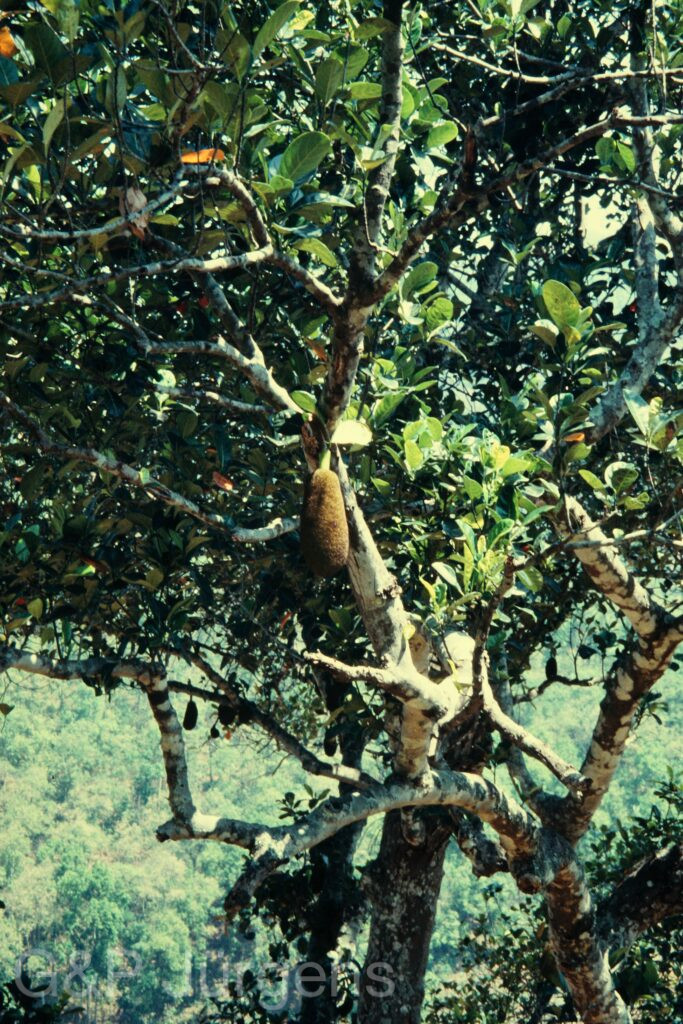
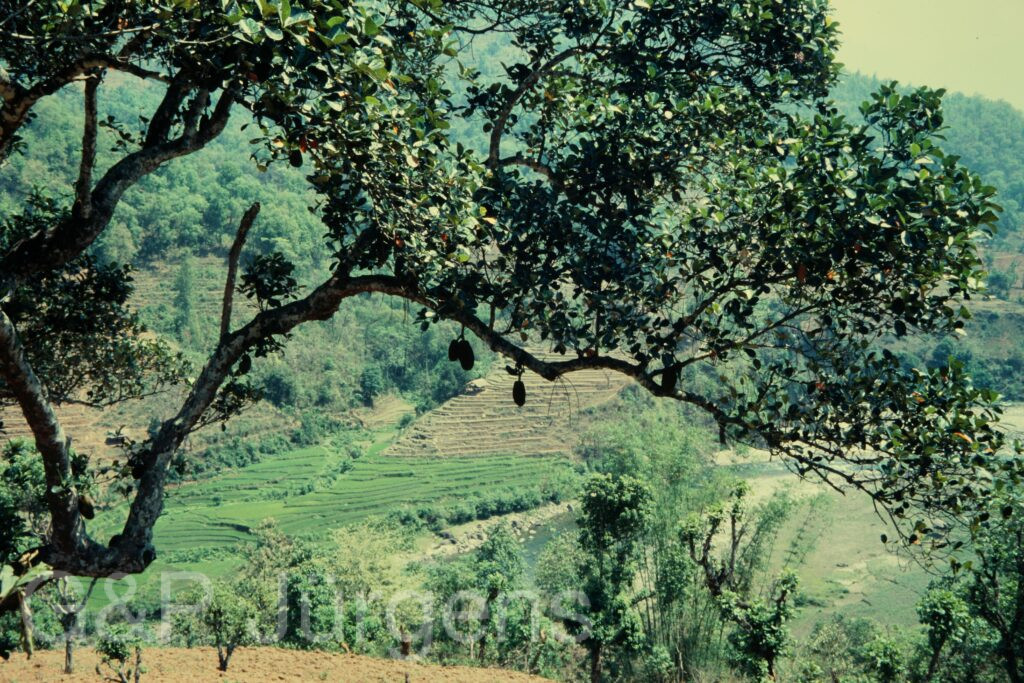
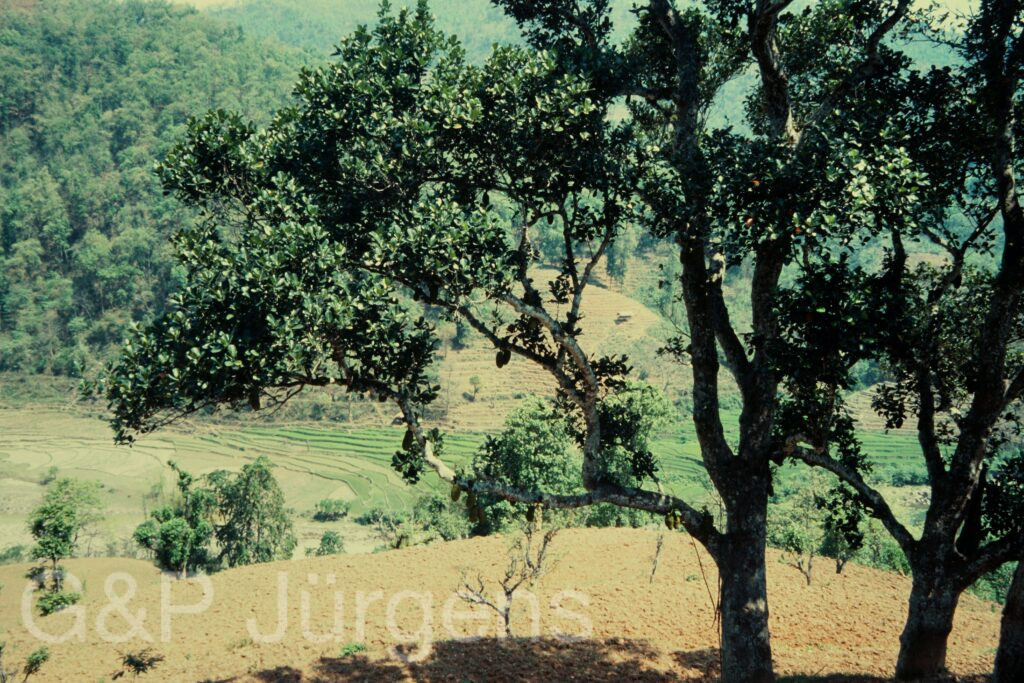
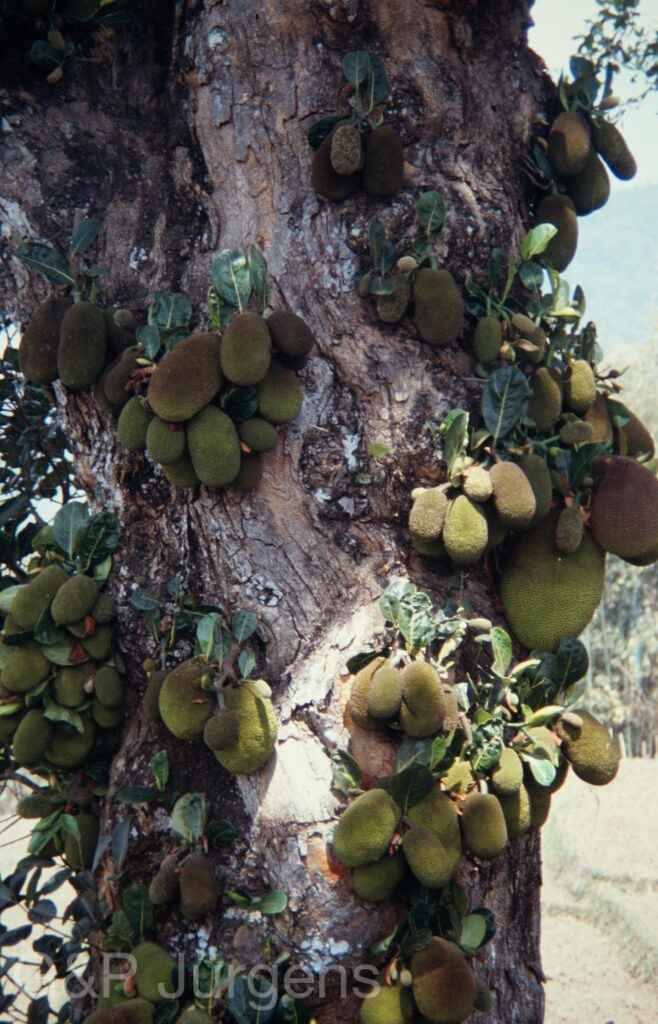
Artocarpus heterophyllus Lam., the jackfruit, is a large evergreen tree believed to be native to the Western Ghats and rainforests of the Indian subcontinent, now cultivated and naturalised throughout the tropics. The extensive GBIF record spans India, Sri Lanka, Bangladesh, China, much of Southeast Asia and Malesia, as well as tropical Africa, the Mascarenes, Brazil and the Pacific, reflecting its pantropical cultivation. In the Himalayan foothills it is grown in warm, humid lowland and lower hill country; the records from the Sabha Khola in Nepal at 550 m in May and the Simbhuwa Khola in east Nepal at 1,250 m in April document its cultivation in subtropical river valleys near the upper limit of its tolerance.

The tree reaches 10–25 m, with a dense, spreading crown and copious white latex in all parts. The alternate, leathery, glossy leaves are obovate to elliptic and entire in adult foliage, although juvenile and coppice leaves may be lobed, accounting for the epithet heterophyllus. The species is monoecious, with minute flowers densely aggregated on separate male and female inflorescences. After pollination the female heads develop into the immense, syncarpous compound fruit, the largest borne by any tree, which may exceed 30 kg; it is oblong, green, covered in conical, hexagonal protuberances, and contains numerous seeds embedded in sweet, aromatic, edible perianth flesh and surrounded by fibrous tissue, the whole borne cauliflorously on the trunk and main branches.

A member of Moraceae, the breadfruit and fig family, jackfruit is among the most important food trees of the humid tropics, the fruit eaten ripe or as a vegetable and the seeds cooked, while the durable, yellow timber and a dye from the heartwood are also valued. As an ancient cultigen of long human domestication it has no conservation concern, but its biogeography illustrates the role of human dispersal in shaping pantropical crop distributions.

Author: Lam. · Sources: POWO (Kew), GBIF, Flora of China Vol. 5, Flora of Nepal, Jarrett: Studies in Artocarpus and Allied Genera (Journal of the Arnold Arboretum)

(D.Don) Hochr.

Bhutan2012 523
Bhutan Wangdi Phodrang 2400m, September
Bhutan2015 247
Bhutan Zhemgang 1000m, October

Description

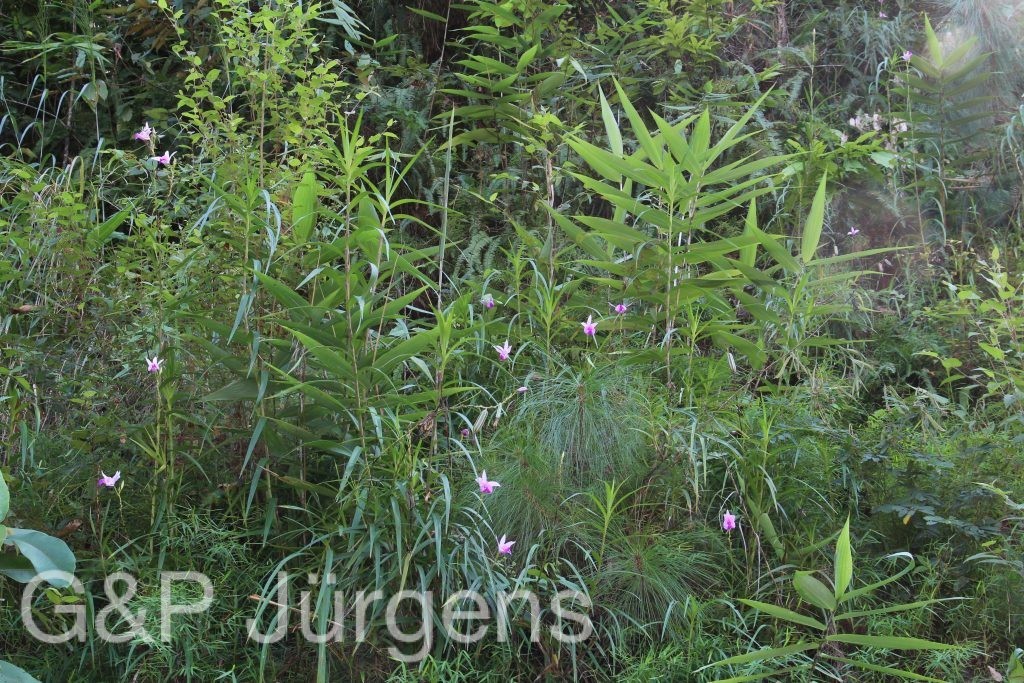
Arundina graminifolia, commonly known as the bamboo orchid, is a robust terrestrial species with a remarkably wide distribution from the Himalayas (Nepal, India, Bhutan) through Southeast Asia to southern China, the Malay Archipelago, and the Pacific Islands. It has become naturalised in parts of tropical America, Hawaii, and the Caribbean. In the Himalayas, it grows on exposed banks, road cuttings, landslide scars, and open grasslands at 200–2,800 m elevation, favoring well-drained, acidic soils with good light exposure.

The plant forms dense clumps of erect, reed-like stems 60–150 cm tall, bearing linear-lanceolate, grass-like leaves 10–20 cm long that are arranged distichously. Flowers are produced terminally, 5–8 cm across, resembling small Cattleya blooms: the sepals and petals are white to pale pink, while the lip is deep rose-purple with a tubular base and a broad, ruffled apical lobe. Flowers open successively over an extended period, with individual blooms lasting only 2–3 days. In the eastern Himalayas, flowering peaks from August to November.

Arundina graminifolia is one of very few orchids that thrives as a pioneer species on disturbed ground. Its wide ecological amplitude and capacity for rapid colonisation are facilitated by its production of numerous wind-dispersed seeds. The species exhibits considerable morphological variation across its vast range, and several subspecific taxa have been proposed.

Author: (D.Don) Hochr. · Sources: POWO (Kew), Flora of Bhutan Vol. 3, GBIF, Seidenfaden: The Orchids of Indochina (1992)

L.

Bhutan2014 65
Bhutan Trashigang 1300m, May
Bhutan2014 66
Bhutan Trashigang 1300m, May

Description

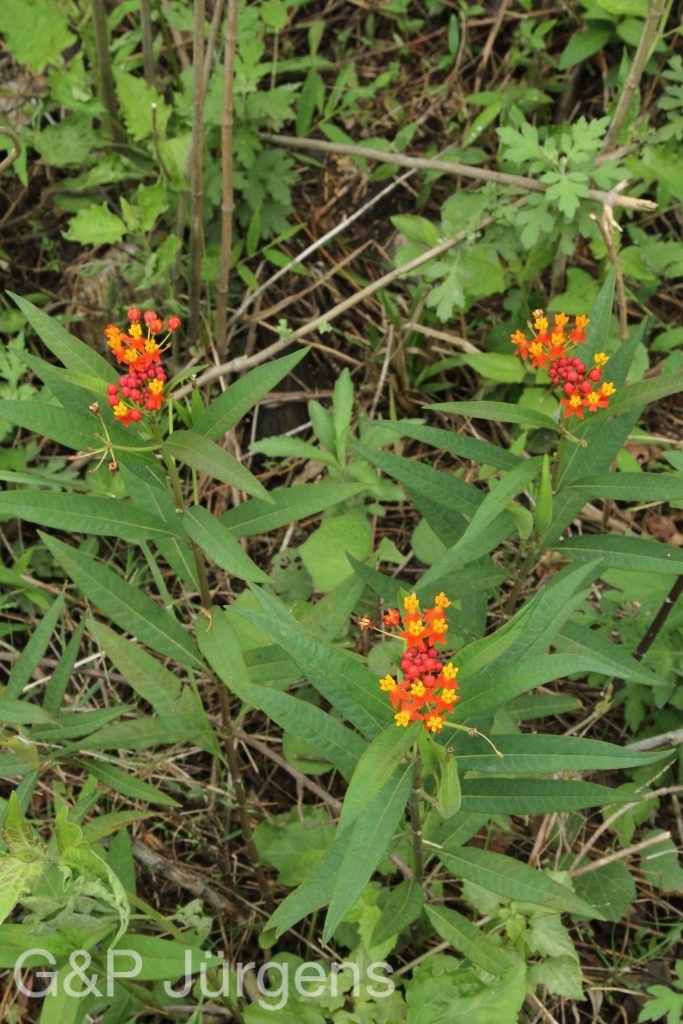
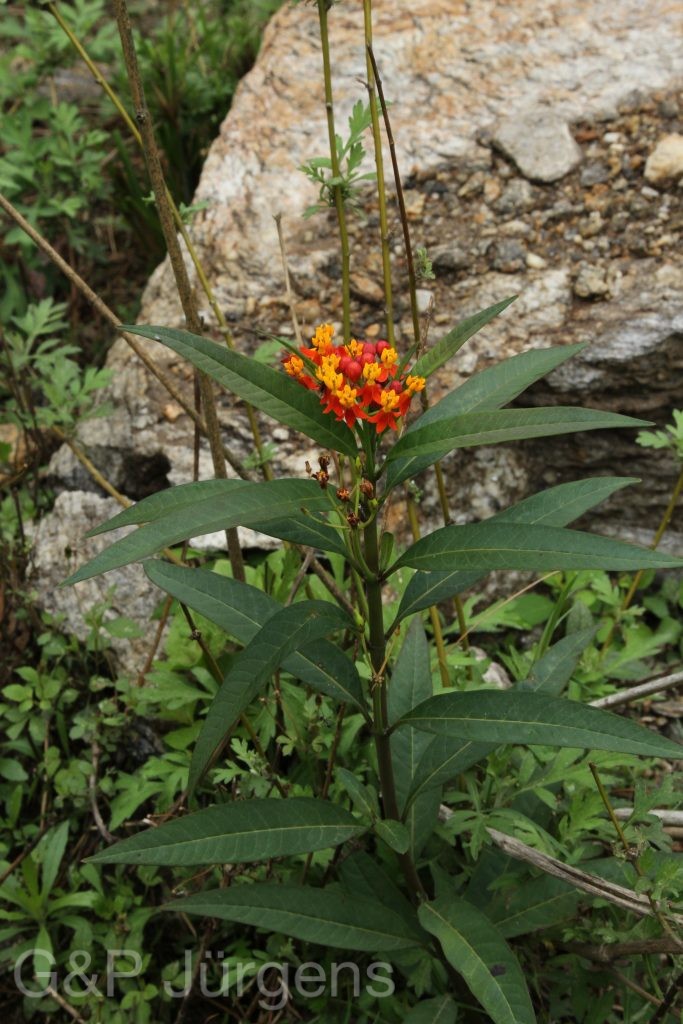
Asclepias curassavica, the scarlet or tropical milkweed, is native to tropical America but is now a pantropical weed of cultivation and waste ground, reflected in its more than 40,000 GBIF occurrences spanning Mexico, the United States, Central America and the Caribbean, Brazil and Andean South America, and introduced populations across China, Taiwan, India and Australia. In the Himalayan region it is naturalised at lower warm elevations along roadsides, field margins and disturbed slopes, as shown by the Bhutanese record from Trashigang at 1300 m in May, well within its preferred frost-free montane-foothill zone.

It is an erect perennial herb or subshrub 0.5-1 m tall with slender, sparingly branched stems exuding milky latex when cut. The leaves are opposite, lanceolate to narrowly elliptic, short-petioled and acuminate. The flowers are borne in terminal and axillary umbel-like cymes; each has five reflexed red to orange-red corolla lobes and a contrasting yellow to orange central corona (gynostegial hoods with incurved horns), the whole forming the characteristic asclepiad pollinarium-bearing structure. The fruit is a slender erect follicle splitting to release numerous flat seeds bearing a silky coma for wind dispersal.

A member of the milkweed subfamily Asclepiadoideae (now placed in Apocynaceae), it is rich in cardenolide toxins and serves as a host for monarch and other danaine butterflies. Widely grown ornamentally and for traditional medicine, it spreads readily and behaves as an invasive in many warm regions; it is of no conservation concern and is instead frequently managed as a weed.

Author: L. · Sources: POWO (Kew), GBIF, Flora of China, Flora of Bhutan, Flora of North America, Woodson monograph of Asclepias

Müll.Arg.

Bhutan2012 684
Bhutan Tserang 850m, September

Description

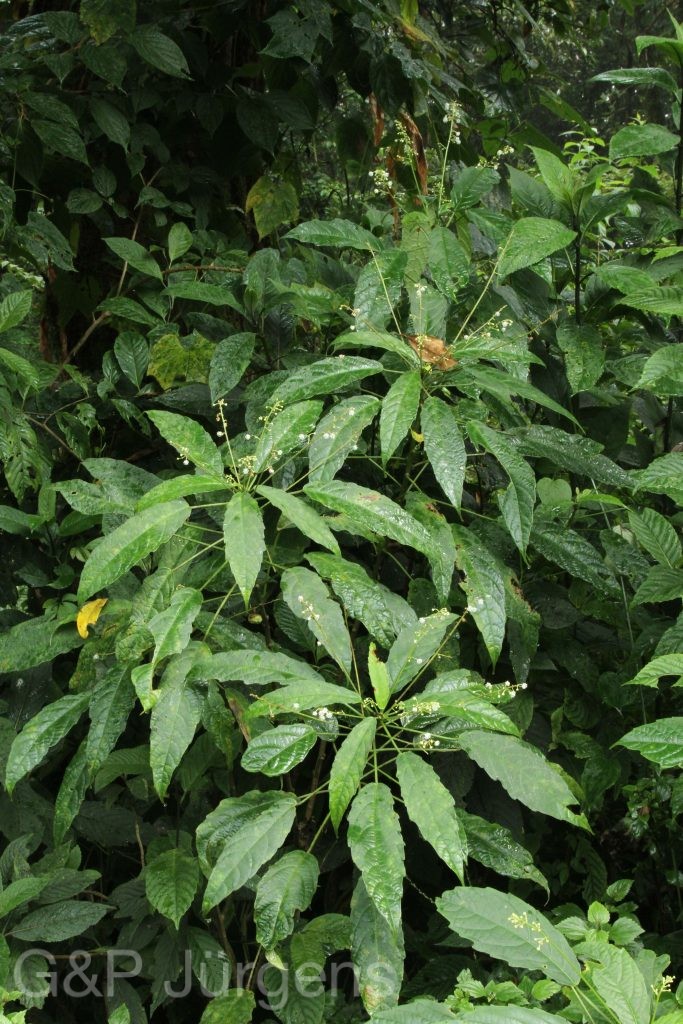
Baliospermum calycinum is a broadly distributed spurge of the Indo-Himalayan and Southeast Asian region, with more than 550 georeferenced occurrences across China, Thailand, India, Myanmar, Nepal, Vietnam, Bhutan, Laos and Bangladesh. It is a plant of warm, subtropical forest margins, scrub, ravines and disturbed ground at low to moderate elevations. The specimen recorded near Tsirang (Tserang) in southern Bhutan at about 850 m in September reflects its typical lowland habitat, fruiting toward the end of the monsoon on moist, fertile soils in partly shaded settings.

It is a monoecious, somewhat woody undershrub or robust herb exuding a watery to milky sap typical of the Euphorbiaceae. The leaves are alternate, large, the lower ones often broadly ovate and palmately lobed while the upper become narrower and merely toothed, with glandular teeth and a serrate margin. The small, apetalous unisexual flowers are borne in axillary racemiform inflorescences, with female flowers below and numerous male flowers above; the species is distinguished by its conspicuously developed, persistent calyx. The fruit is a three-lobed schizocarpic capsule splitting into three two-valved cocci that eject the smooth, mottled seeds.

Within Euphorbiaceae the genus Baliospermum comprises a small number of Asian species long valued in traditional medicine for the purgative and irritant properties of the seed oil. Taxonomic confusion with related taxa such as B. montanum has historically obscured its limits, and modern treatments rely on calyx, leaf-lobing and capsule characters for separation. Common and weedy across its wide range, it is of least conservation concern.

Author: Müll.Arg. · Sources: POWO (Kew), GBIF, Flora of Bhutan, Flora of China, Flora of British India, Radcliffe-Smith's account of Euphorbiaceae

L.

Bhutan2012 1062
Bhutan Koma-Chu-Valley 800m, September
Bhutan2015 173 scaled
Bhutan Zhemgang 910m, October

Description

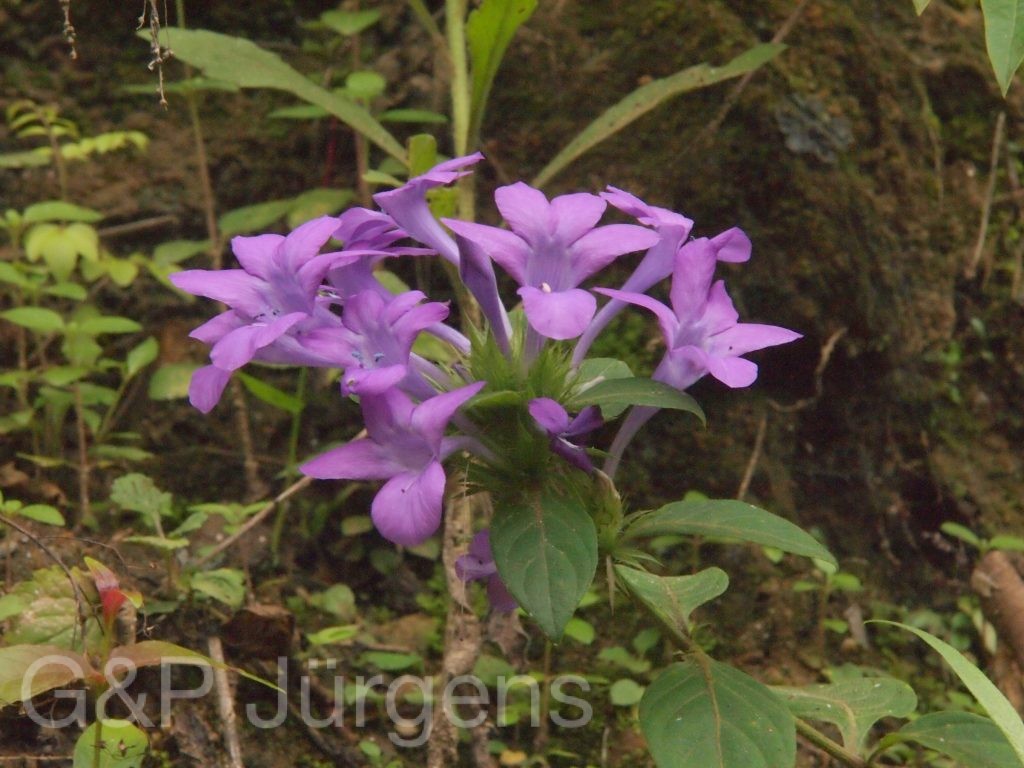
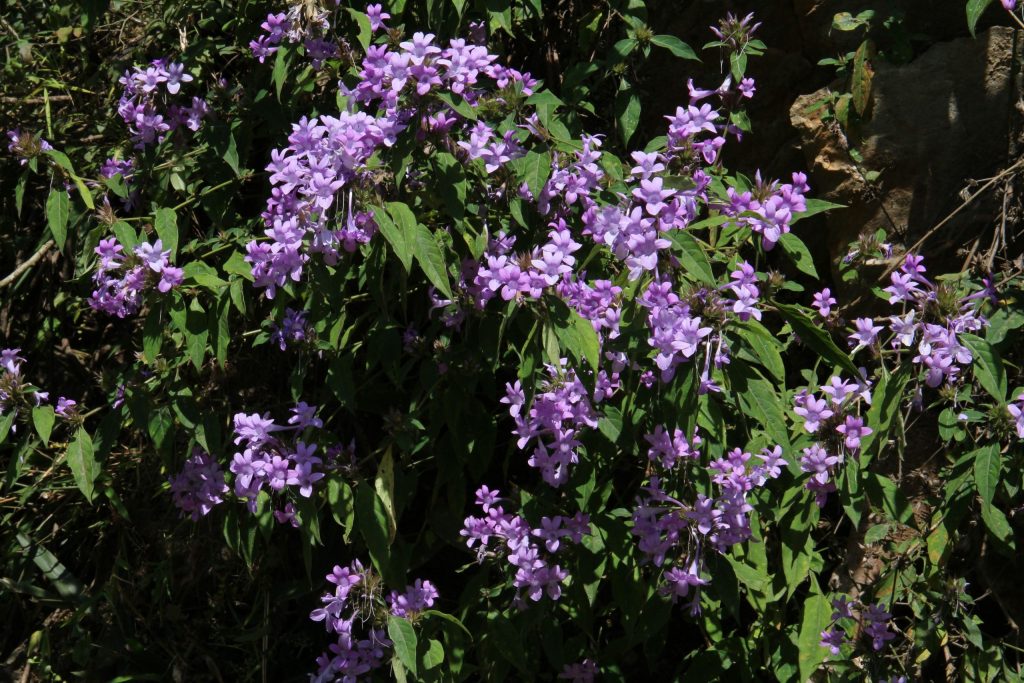
Barleria cristata is a widespread species distributed from the Indian subcontinent through Southeast Asia to southern China, occurring in India, Nepal, Bhutan, Pakistan, Myanmar, Thailand, and Laos. It has also become naturalized in parts of the tropics worldwide, including Australia, Brazil, and the Philippines. The species inhabits open and disturbed forests, rocky slopes, stream banks, and forest margins at elevations from near sea level to approximately 1,800 m. In Bhutan, it is found in the warm broadleaved forests of the southern foothills, as documented from the Koma-Chu Valley at 800 m and near Zhemgang at 910 m, where it flowers from September to October.
The plant is an erect to spreading shrub or subshrub, 0.5–1.5 m tall, with quadrangular stems that are pubescent when young. Leaves are opposite, ovate to elliptic, 5–12 cm long, with an acuminate apex and entire margins, bearing scattered hairs on both surfaces. The inflorescence is a dense, terminal or axillary spike, subtended by conspicuous, ovate, spinose-tipped bracts that give the species its epithet "cristata" (crested). Flowers are bilabiate, 3–4 cm long, typically violet to pale blue or occasionally white. The calyx is deeply four-lobed with two larger outer lobes and two smaller inner ones. The fruit is an oblong capsule containing two to four flattened, hygroscopic seeds that are explosively dehiscent when wetted.
Barleria is a large pantropical genus of approximately 300 species, with its centre of diversity in Africa and Asia. B. cristata is among the most commonly cultivated ornamental species in the genus and has escaped cultivation in numerous tropical regions, raising concerns about its invasive potential in some areas. Ecologically, it provides nectar resources for butterflies and long-tongued pollinators. The species exhibits considerable variation in flower colour across its range, which has led to the description of several infraspecific taxa, though most are not currently recognized.

Author: L. · Sources: POWO (Kew), GBIF, Flora of Bhutan Vol. 2, Flora of China Vol. 19

Bauhinia purpurea

by GP Jürgens

L.

Bhutan2015 551
Bhutan Punaka 1400m, October
Nepal 95 20 P29 ergebnis
Nepal Gorkha 1200m, Octobre

Description

Bauhinia purpurea is a tropical and subtropical tree native to South and Southeast Asia, with a centre of diversity across India, Nepal, Bhutan, southern China, Thailand, Malaysia and the Philippines. Through widespread cultivation as an ornamental and street tree it has become naturalised across the tropics, and the more than 11,500 GBIF records include numerous occurrences in the Americas (Brazil, Colombia, Mexico, Costa Rica, the Caribbean) and elsewhere. In its native Himalayan foothill range it occupies warm broad-leaved forest, scrub and cultivated margins at low to mid elevations; the Bhutanese tree at Punakha (1400 m) and the Nepalese population near Gorkha (1200 m), both flowering in October, mark its autumn blooming in the eastern Himalaya.

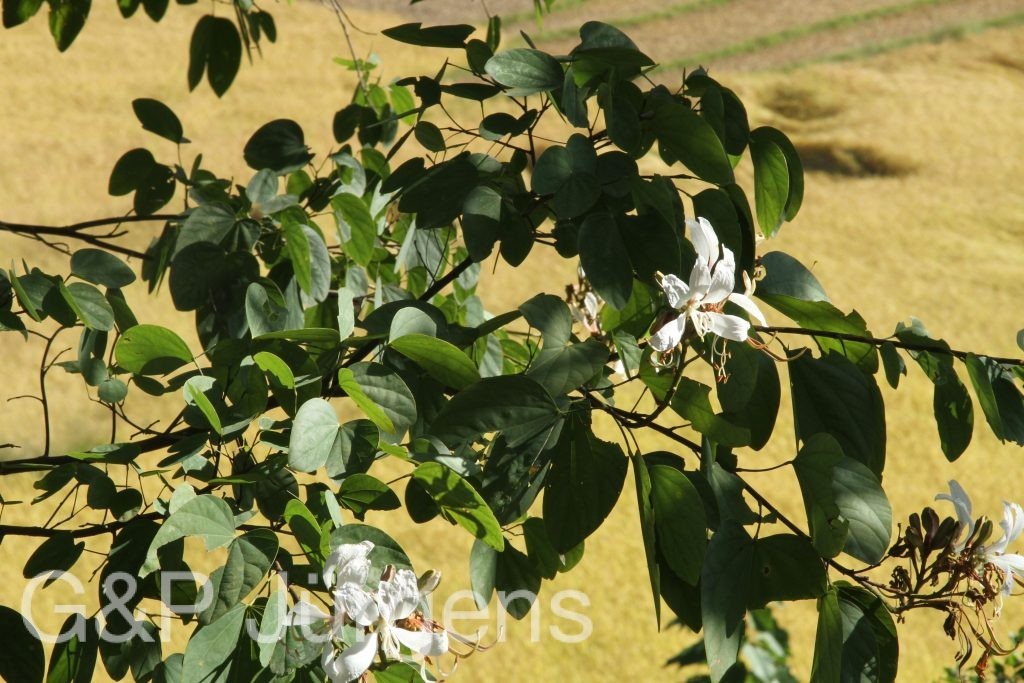
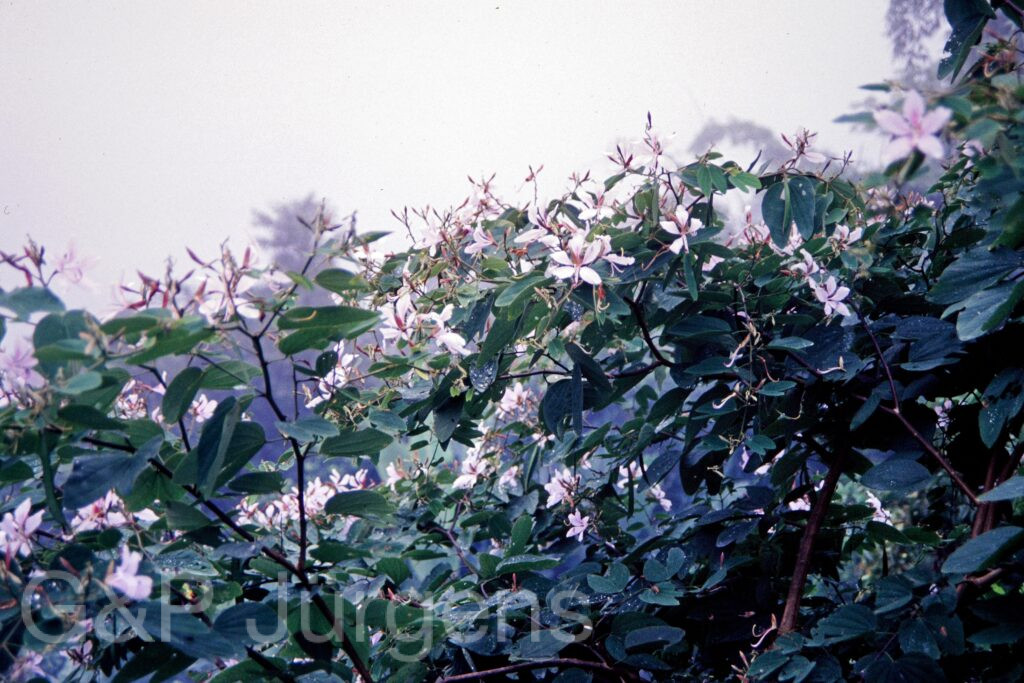
It is a small to medium-sized deciduous tree with a spreading crown. The leaves are distinctive and diagnostic of the genus: broadly ovate to orbicular, cleft at the apex into two rounded lobes for up to one-third to one-half their length, giving the characteristic bilobed "camel-foot" outline, with several palmate veins. The fragrant flowers are borne in short racemes and have five free, narrow, clawed petals coloured rose-purple to magenta, with usually three fertile stamens. The fruit is a flattened, linear-oblong, woody legume that dehisces elastically to scatter several seeds.

Bauhinia purpurea is often confused with the closely allied B. variegata, from which it differs in its narrower petals, reduced number of fertile stamens and later flowering season. The species is economically and culturally significant, valued for shade, ornament, edible flower buds, fibre and traditional medicine. It is common and widely planted, of no conservation concern, but its readiness to naturalise has led to its being treated as locally invasive in some introduced tropical regions.

Author: L. · Sources: POWO (Kew), GBIF, Flora of China, Flora of Bhutan, Annotated Checklist of the Flowering Plants of Nepal, Larsen & Larsen revision of Asian Bauhinia (monograph)

Bauhinia variegata

by GP Jürgens

L.

Bhutan2014 45
Bhutan Trashigang 1200m, May
Bhutan2014 46
Bhutan Trashigang 1200m, May
Nepal 1994 170 ergebnis
Ost-Nepal Mewa-Khola
1850m April

Description

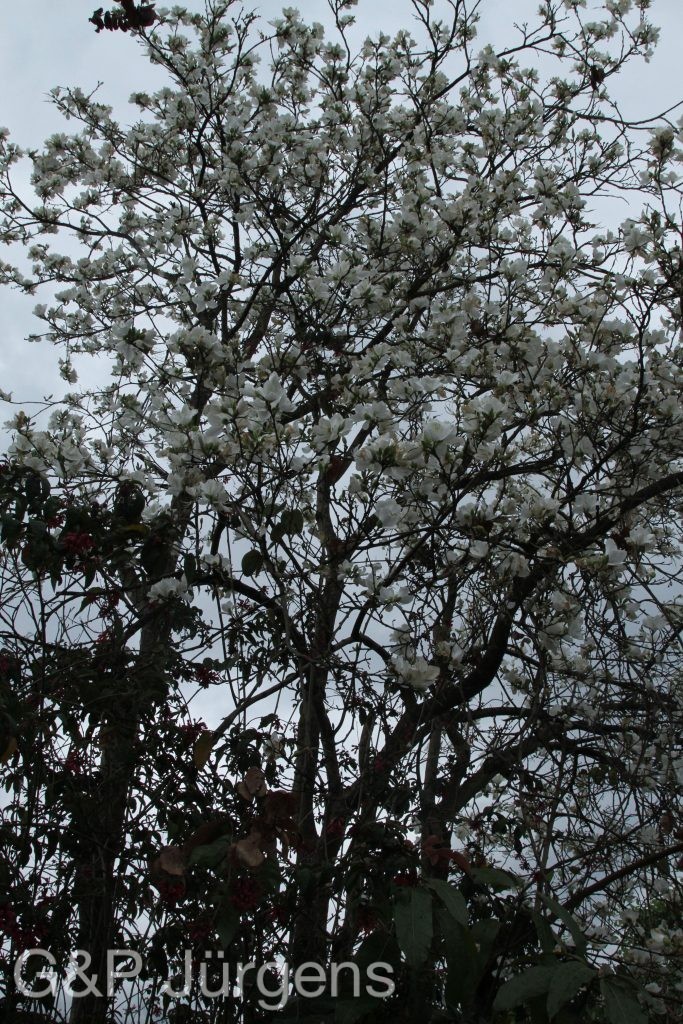
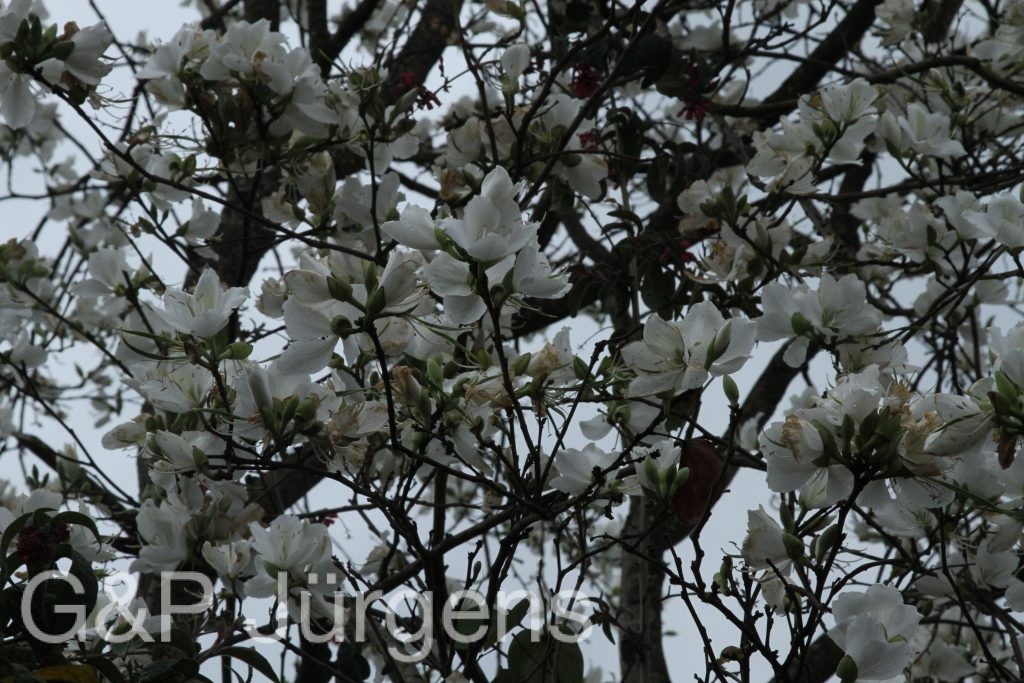
Bauhinia variegata, the orchid tree or kachnar, is a deciduous tree native to tropical and subtropical Asia and now pantropically naturalised, reflected in GBIF's nearly 5000 occurrences spanning India, Nepal, China, Myanmar, Thailand and Pakistan as well as introduced ranges in Brazil, the United States, Mexico, South Africa, Australia and Spain. In the Himalayan foothills it occupies warm, seasonally dry broadleaf forest, riverine slopes and disturbed ground from the plains to about 1900 m. The photographed trees from Trashigang in eastern Bhutan at 1200 m in May and from the Mewa-Khola in eastern Nepal at 1850 m in April illustrate its lower-montane habitat, where it flushes conspicuous blossoms in the dry pre-monsoon months on largely leafless branches.

It is a small to medium tree with grey-brown bark and a spreading crown. The alternate leaves are broadly ovate-cordate, bilobed for up to one-third their length into two rounded lobes giving the characteristic camel-footprint outline, with palmate venation. The showy, fragrant flowers are borne in short axillary or terminal racemes; each has five obovate, clawed petals ranging from white through pink to mauve-purple, the uppermost broader and streaked with deeper veining, and typically three to five fertile stamens. The fruit is a flat, dehiscent, woody legume up to 30 cm long containing several compressed seeds.

A member of Fabaceae (Caesalpinioideae), Bauhinia is the type genus of the diagnostically bilobed-leaved tribe Cercideae. The species is extensively cultivated as an ornamental and avenue tree, while its flower buds, bark and young pods are used as vegetables and in traditional medicine. Widespread, weedy and able to fix little nitrogen yet tolerant of poor soils, it is of Least Concern and locally invasive beyond its native range.

Author: L. · Sources: POWO (Kew), GBIF, Flora of Bhutan, Flora of China, Annotated Checklist of the Flowering Plants of Nepal, Larsen & Larsen revision of Bauhinia

Wall.

Bhutan2014 270
Bhutan Trithangebe near a farmhouse 700m, May
Bhutan2014 271
Bhutan Trithangebe near a farmhouse 700m, May

Description

Beaumontia grandiflora is a large woody climber native to the eastern Himalaya and Indo-Chinese region, with native occurrences in India, China, Nepal, Bhutan, Thailand and Vietnam; the long list of additional countries among its roughly 602 records, spanning the Americas, Africa, the Caribbean and Oceania, reflects its extensive use as an ornamental in tropical and subtropical gardens worldwide. In the wild it is a plant of warm, humid lowland to lower-montane forest, scrambling over trees at forest margins and along streams. The photographed plant near a farmhouse at Trithangebe in Bhutan, at about 700 m and flowering in May, is consistent with its subtropical foothill habitat and its spring flowering, and hints at its frequent cultivation around dwellings.

It is a vigorous, large liana with stout woody stems exuding milky latex when cut. The leaves are opposite, simple, large, obovate to elliptic, leathery and glossy above with prominent venation and often rusty-pubescent beneath. The flowers, among the showiest in the family, are large, fragrant and trumpet-shaped, borne in terminal cymes; the corolla is broadly funnelform to campanulate, white, with five spreading lobes and a conspicuously expanded green-veined throat, giving rise to its garden name of Herald's-trumpet or Easter-lily vine. The five stamens have arrow-shaped anthers connivent around the stigma, and the fruit is a pair of large, woody, divergent follicles releasing numerous flat seeds, each with a tuft of silky hairs for wind dispersal.

Beaumontia belongs to the subfamily Apocynoideae of Apocynaceae, a family characterised by latex, contorted corolla aestivation and a specialised gynostegial pollination apparatus; the genus is allied to other tropical Asian lianas of the tribe Apocyneae. The plumed seeds and large insect-pollinated flowers fit a strategy of conspicuous floral display and wind-borne dispersal. Though valued and widely planted as a spectacular flowering vine, in its native Himalayan and Indo-Chinese range it is a natural component of subtropical forest and is not regarded as threatened.

Author: Wall. · Sources: POWO (Kew), GBIF, Flora of Bhutan, Flora of China, Flora of British India, Middleton's revisionary studies of Asian Apocynaceae