
L.
Description
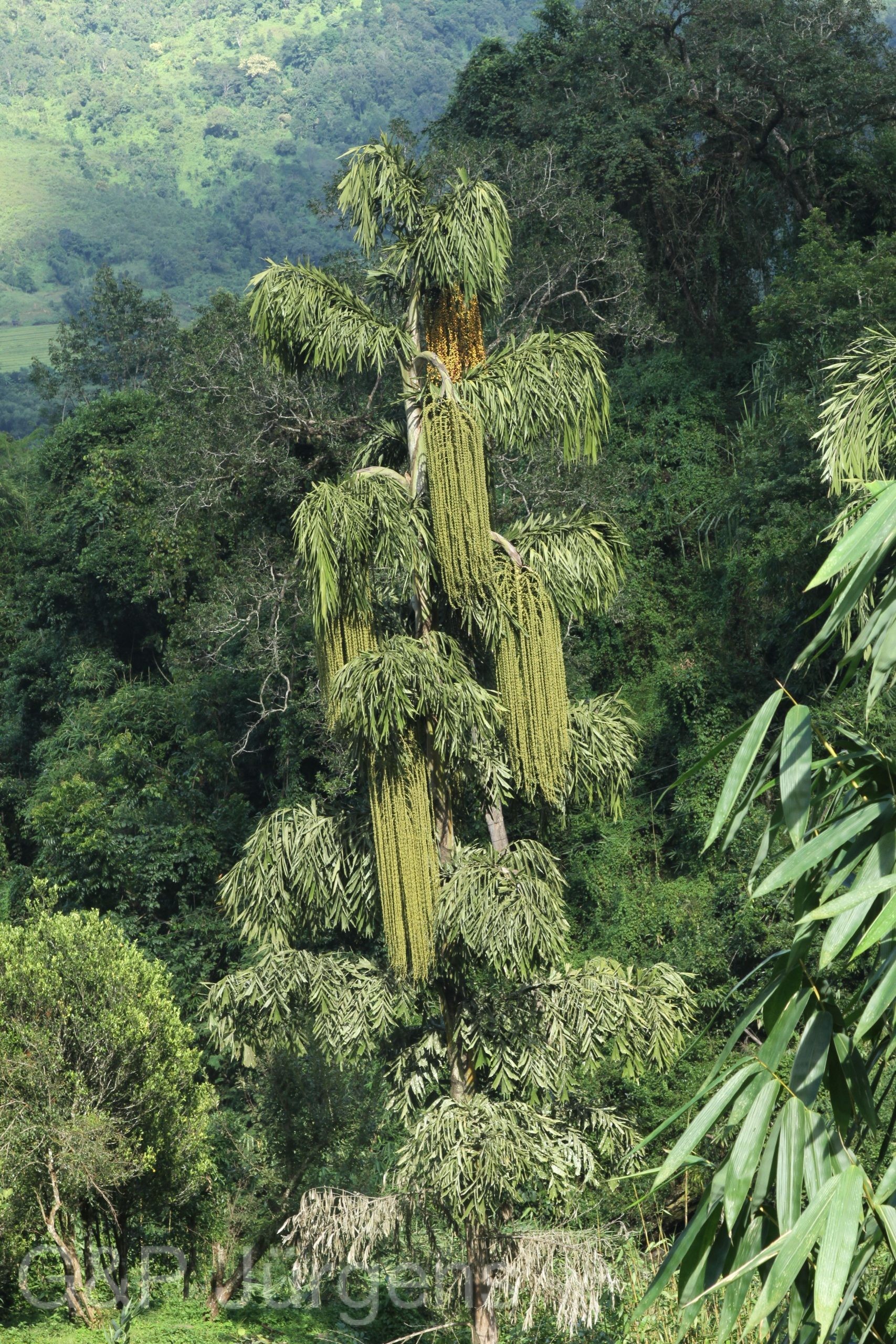
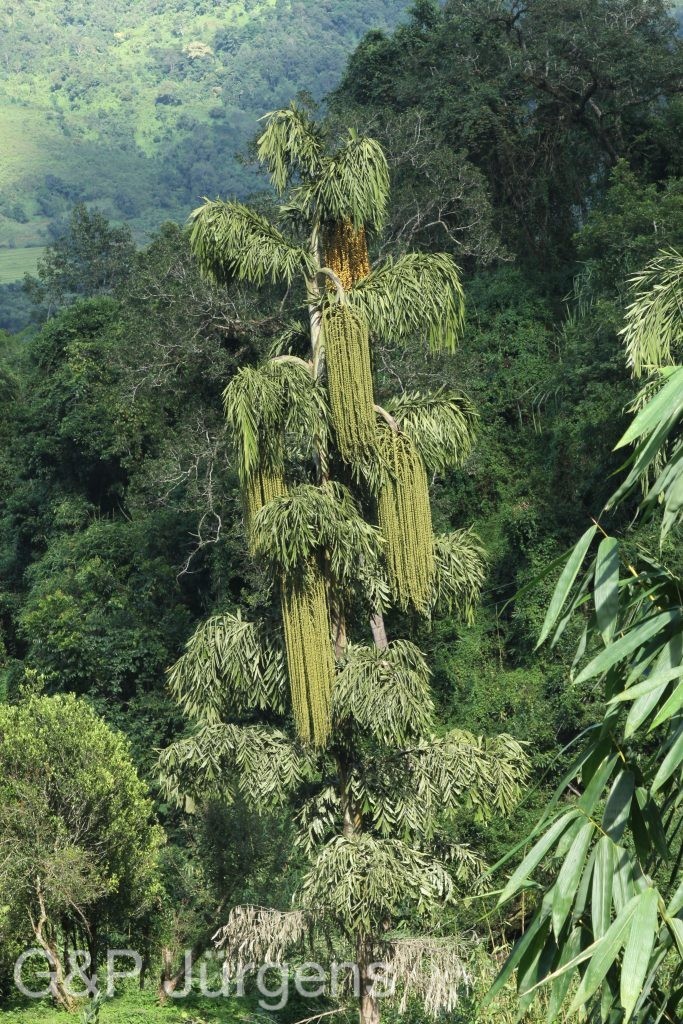
Caryota urens, the fishtail or jaggery palm, is a solitary tropical palm native to the Indian subcontinent, Sri Lanka, Myanmar and South-East Asia, with around 5517 occurrence records spanning both its native range and many countries where it is widely cultivated. It grows in moist tropical and subtropical forest, secondary woodland, river valleys and around villages, predominantly in the lowland to lower-montane zone. The photographed plant from Zhemgang in southern Bhutan at 1000 m, recorded in October, sits at the upper-elevation edge of its warm, humid habitat.
It is a tall, single-stemmed palm with a stout, ringed grey trunk reaching well over ten metres. The leaves are very large, bipinnate—unusual among palms—with the ultimate segments wedge-shaped and jaggedly toothed at the apex, resembling a fish's tail and giving the common name. The plant is monocarpic and hapaxanthic: after years of vegetative growth it flowers once, producing a sequence of massive pendulous inflorescences from the upper nodes downward, bearing cream to purplish unisexual flowers. The fruit is a globose red to purplish-black berry containing irritant calcium-oxalate raphides, whence the epithet urens ("stinging").
Despite the source labelling it Fabaceae, Caryota urens belongs to the palm family, Arecaceae, subfamily Coryphoideae, tribe Caryoteae. It is of considerable economic value: the sugary sap tapped from the inflorescences yields jaggery, palm wine and vinegar, while the trunk furnishes sago-like starch and the leaf sheaths a strong fibre (kittul). Widely planted and broadly distributed, it is not considered threatened.
Author: L. · Sources: POWO (Kew), GBIF, Flora of China (Arecaceae), Flora of Bhutan, Genera Palmarum (Dransfield et al.), Govaerts & Dransfield World Checklist of Palms