
Hook.f.
Description
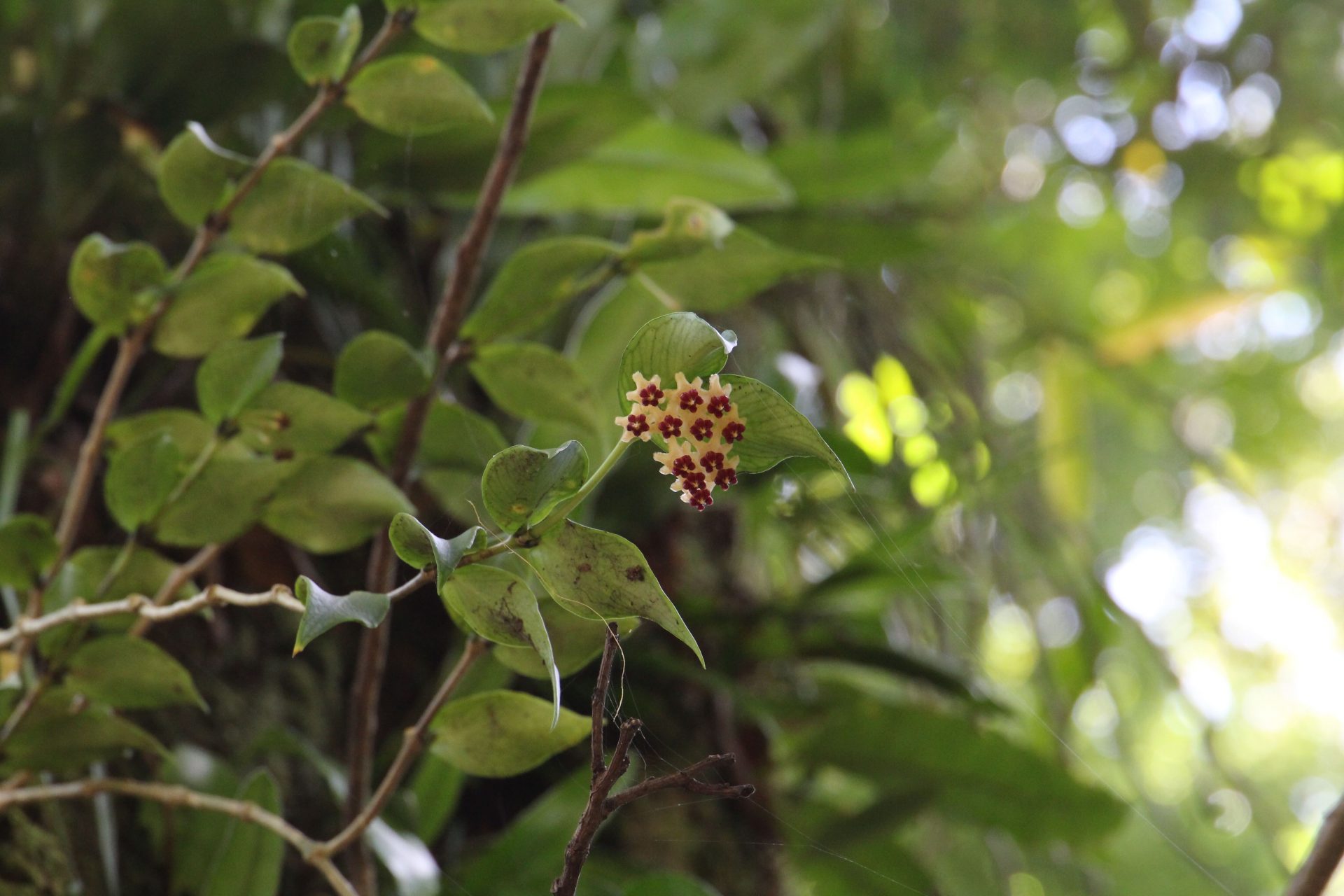
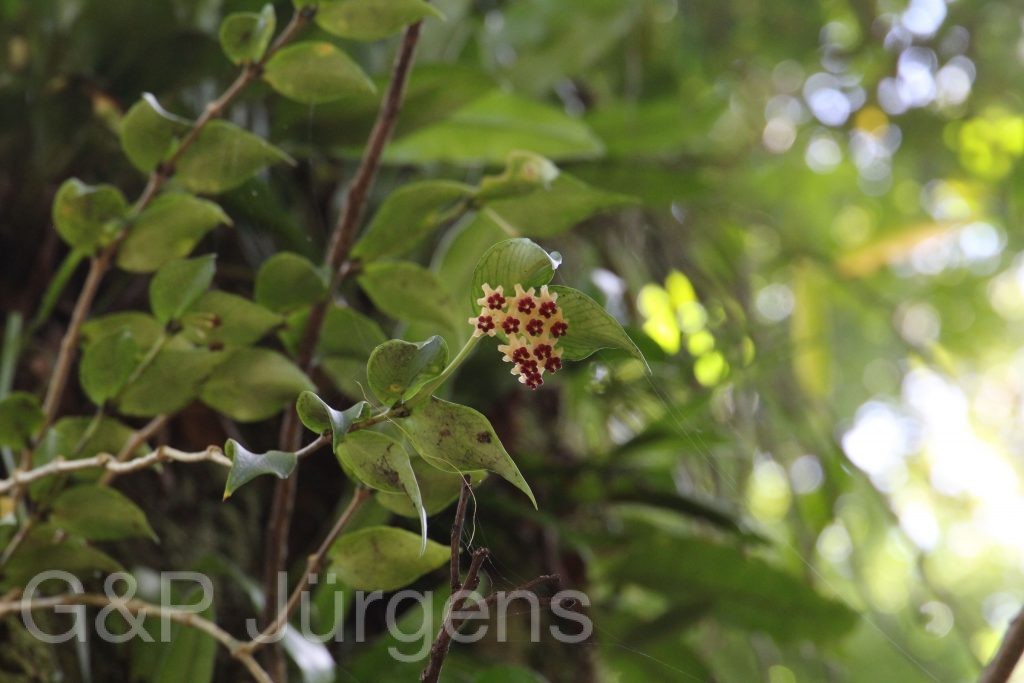
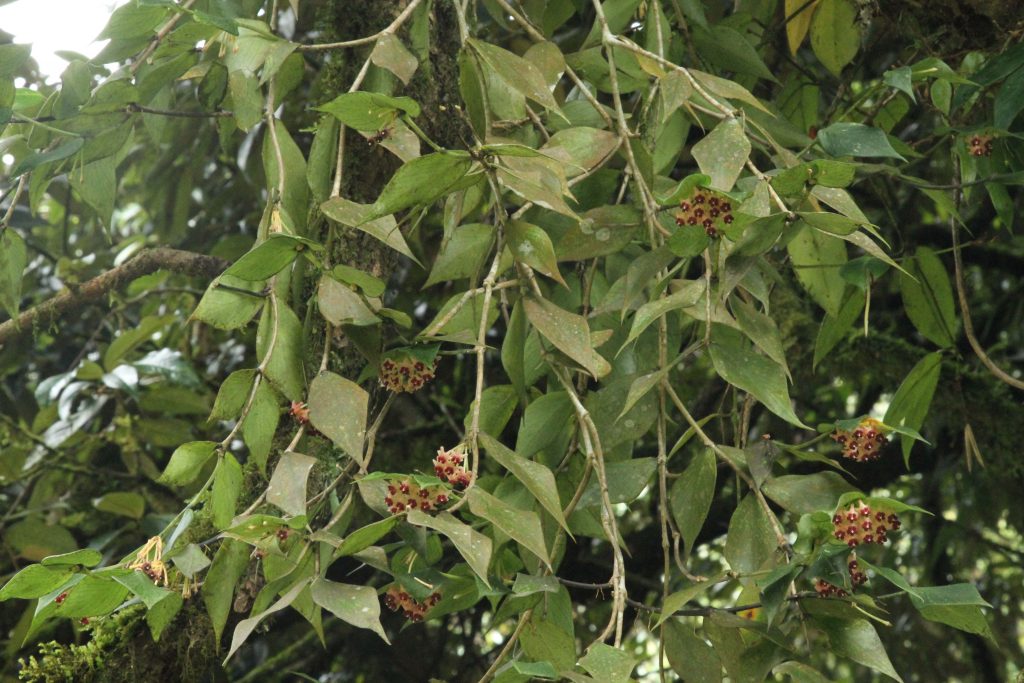
Hoya polyneura Hook.f. is an epiphytic vine of the eastern Himalaya and adjoining ranges, recorded from India, Bhutan, Nepal and China, with disjunct material from Japan; the GBIF total of about 59 occurrences reflects its scattered, locally frequent presence in humid mid-montane forest. It grows as an epiphyte or lithophyte on mossy trunks and damp rock faces in subtropical to warm-temperate broad-leaved evergreen forest, broadly between 800 and 2000 m. The photographed plants from Zhemgang in central Bhutan at about 1000 and 1400 m, flowering in October, illustrate its occurrence in the moist, shaded forest interior of the southern Bhutanese foothills.
The species is a slender, twining to pendent epiphytic subshrub with thin, flexible stems rooting at the nodes and exuding milky latex when cut. The leaves are opposite, distinctly thin-textured and elliptic to ovate, with a prominent, fish-bone-like venation of fine, parallel lateral nerves arching to the margin — the feature giving the epithet polyneura. The inflorescence is an axillary, umbelliform cyme of few to several flowers; each has a fleshy, reflexed, five-pointed corolla, cream to yellowish often marked with red, surmounted by the waxy, star-shaped, glistening staminal corona typical of the genus. Pollen is aggregated into paired pollinia, and the fruit is a slender paired follicle releasing comose seeds.
Hoya (Apocynaceae, subfamily Asclepiadoideae) is a large palaeotropical genus distinguished by its waxy, coronate flowers and pollinarial pollination. H. polyneura is among the most distinctive Himalayan species owing to its conspicuously veined, almost translucent leaves, a prized character in cultivation where it is grown as the "fishtail Hoya." As a forest-dependent epiphyte it is sensitive to deforestation and over-collection for the ornamental trade, though formally unassessed and locally not uncommon within intact montane forest.
Author: Hook.f. · Sources: POWO (Kew), GBIF, Flora of China, Flora of Bhutan, Flora of British India, Surveswaran et al. — Phylogeny and revision of Hoya