
Hardw.
Description
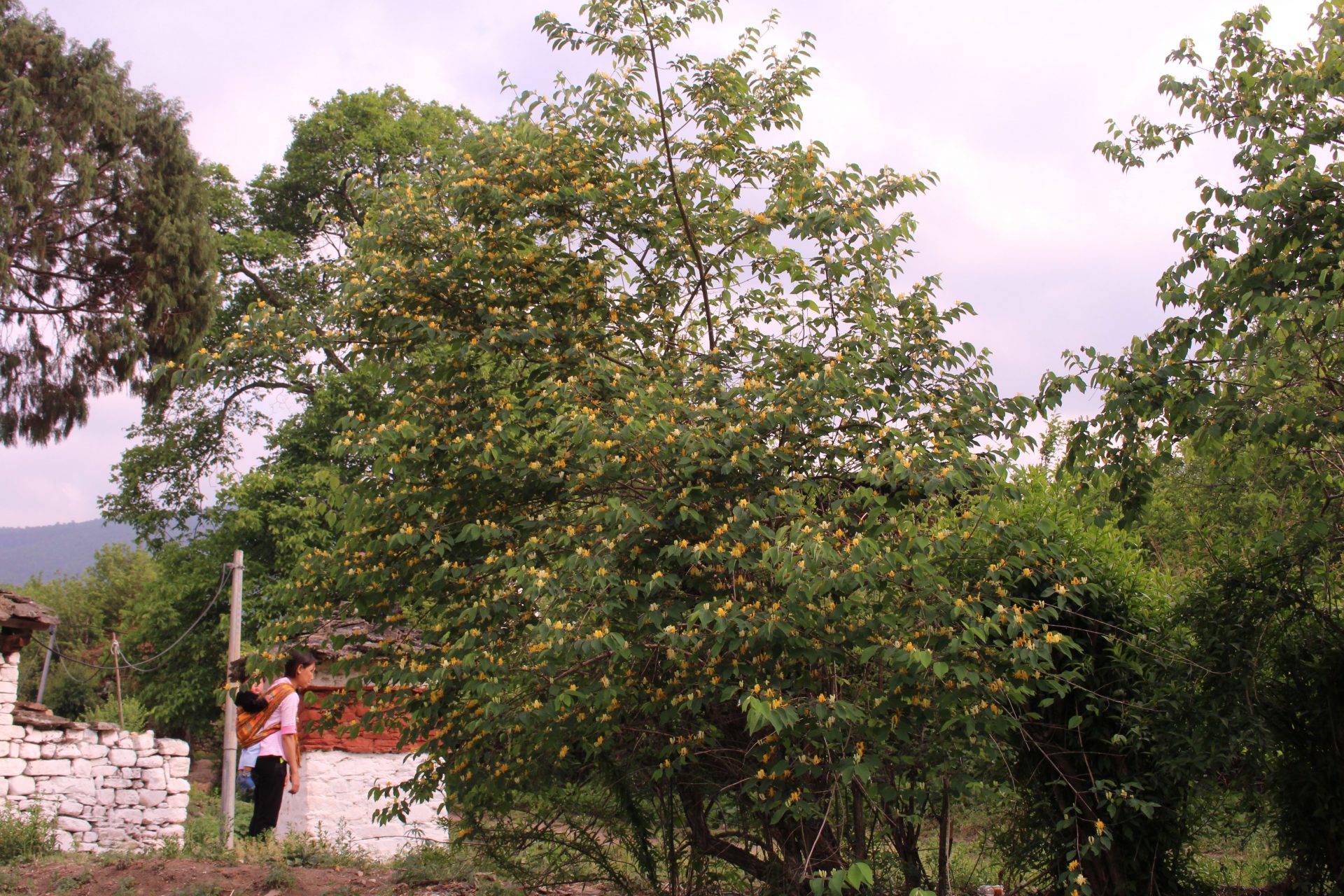
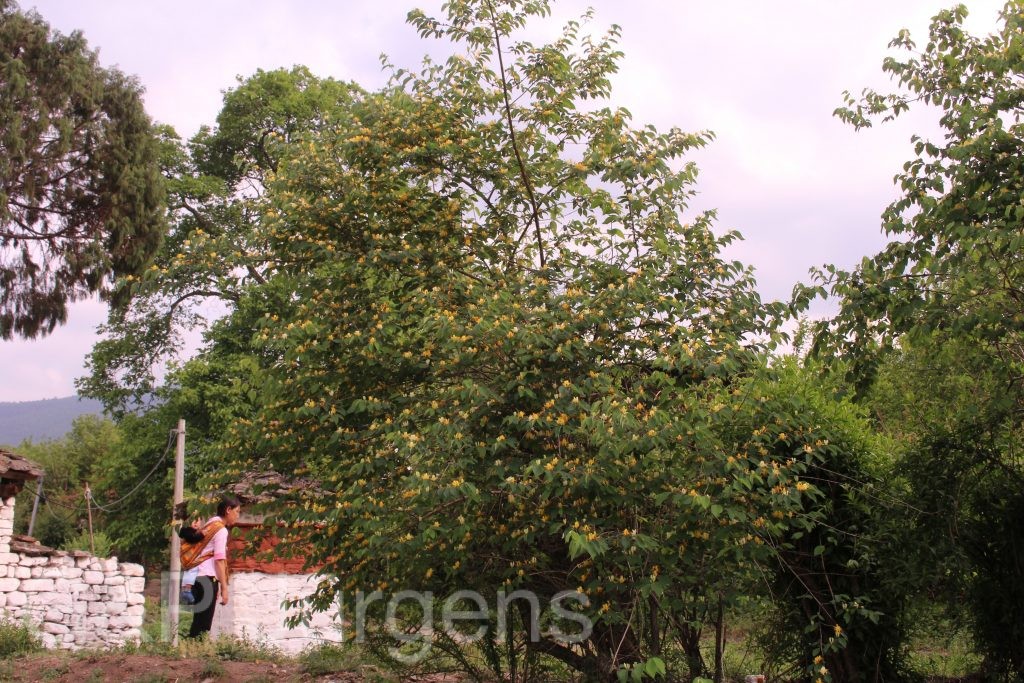
Lonicera quinquelocularis is a deciduous shrub of the Himalayan and Sino-Himalayan temperate zone, ranging from Afghanistan and Pakistan eastward through India, Nepal and Bhutan into south-western China; with some 873 georeferenced records it is among the better-documented honeysuckles of the region (European and North American records reflect cultivation). It grows in open forest, scrub, forest margins, riverine thickets and rocky hillsides, chiefly between 1500 and 3000 m. The illustrated plant from Paro in western Bhutan at 2000 m, flowering in May, typifies its occurrence in the temperate broadleaf and conifer zone where it forms part of the understorey and forest-edge shrub community.
It is a much-branched shrub 2-5 m tall with greyish, peeling bark and ovate to elliptic, entire leaves that are softly pubescent, often greyish beneath, arranged in opposite pairs. The flowers are borne in axillary pairs on a common peduncle; each is two-lipped and creamy-white, ageing to yellow, fragrant, with a short tube. The bracts and bracteoles subtend the paired ovaries. A diagnostic feature reflected in the epithet is the five-locular ovary. The most striking character is the fruit: the two berries of each pair fuse and ripen translucent, the seeds visible within, turning purple-black, giving rise to the English name "translucent-berry honeysuckle."
Described by Hardwicke (as Hardw.), the species belongs to Lonicera section Coeloxylosteum of the Caprifoliaceae. The conspicuous semi-transparent berries are dispersed by birds, while the nectar-rich flowers attract bees and other insects. The species is widespread and locally common, used as fuel and hedging and occasionally cultivated as an ornamental; it is not considered threatened.
Author: Hardw. · Sources: POWO (Kew), GBIF, Flora of Bhutan, Flora of Pakistan, Flora of China, Rehder's monograph of Lonicera (Caprifoliaceae)