Caprifoliaceae

Wall. ex DC.

Sikkim2003 372 G521
Sikkim Tista valley 3500m August
Nepal 99 84 ergebnis
West-Nepal Bhulbhule 3200m, June
Garw 2005 36 ergebnis ergebnis
India Garhwal Valley of flowers 3100m, September

Description

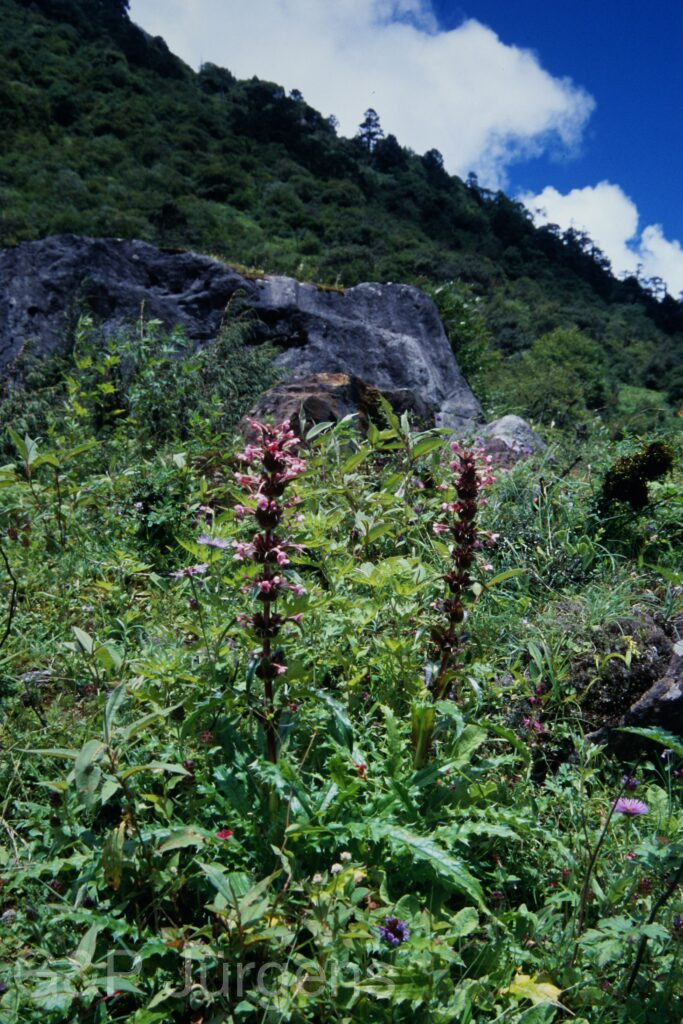
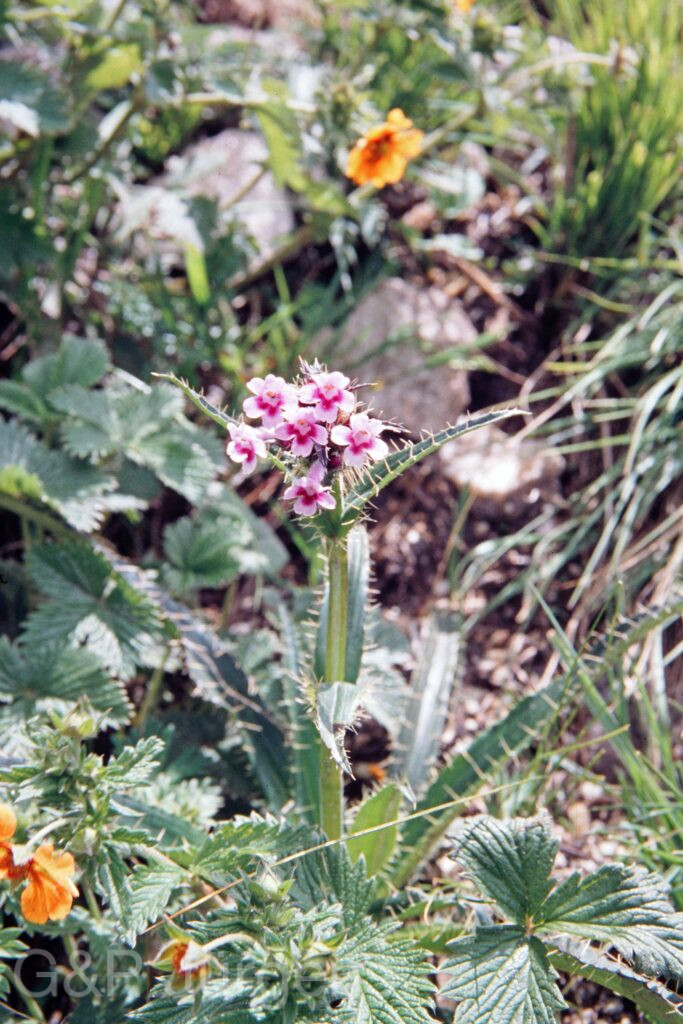
Morina longifolia, the Himalayan whorlflower, is native to the Himalaya across Pakistan, India, Nepal and Bhutan, with naturalised and cultivated records in Europe and North America (Norway, Germany, Denmark, Sweden, the United States) reflected among its roughly 125 GBIF occurrences. It grows on open alpine and subalpine slopes, in stony meadows, grassy clearings and among low scrub on well-drained soils above the forest. The cited localities, the Tista valley in Sikkim at 3500 m in August, Bhulbhule in western Nepal at 3200 m in June, and the Valley of Flowers in Garhwal at 3100 m in September, span its range of roughly 3000-4000 m, where it flowers through the summer monsoon.

It is a robust, erect perennial herb forming a basal rosette of long, narrow, linear-lanceolate leaves whose margins are conspicuously spiny-toothed, giving a thistle-like appearance, the whole plant aromatic when crushed. The flowering stem rises stoutly and bears the flowers in well-separated, spiny-bracted whorls (verticillasters) up the upper axis. Each flower has a tubular, curved, two-lipped corolla that opens white and ages through pink to deep crimson, so flowers of several colours appear together in one whorl. Two stamens are fertile, the slender style is exserted, and the inferior ovary develops into a small one-seeded achene enclosed within the persistent involucel.

The genus Morina, with its spiny leaves and whorled bicoloured flowers, has been placed variously in its own family Morinaceae or within Dipsacaceae, and is treated by current systems within an enlarged Caprifoliaceae; molecular work confirms its position near the teasels and valerians in the Dipsacales. The long-tubed flowers are pollinated by long-tongued insects, and the species is widely grown as an ornamental, accounting for its scattered occurrences far beyond its native range.

Author: Wall. ex DC. · Sources: POWO (Kew), GBIF, Flora of Pakistan, Flora of Bhutan, Cannon revision of Morina, Bell Dipsacales phylogeny
D. Don

Nepal 99 277 ergebnis
West-Nepal Kalomura 3900m, June
Nepal 99 276 ergebnis
West-Nepal Kalomura 3900m, June

Description

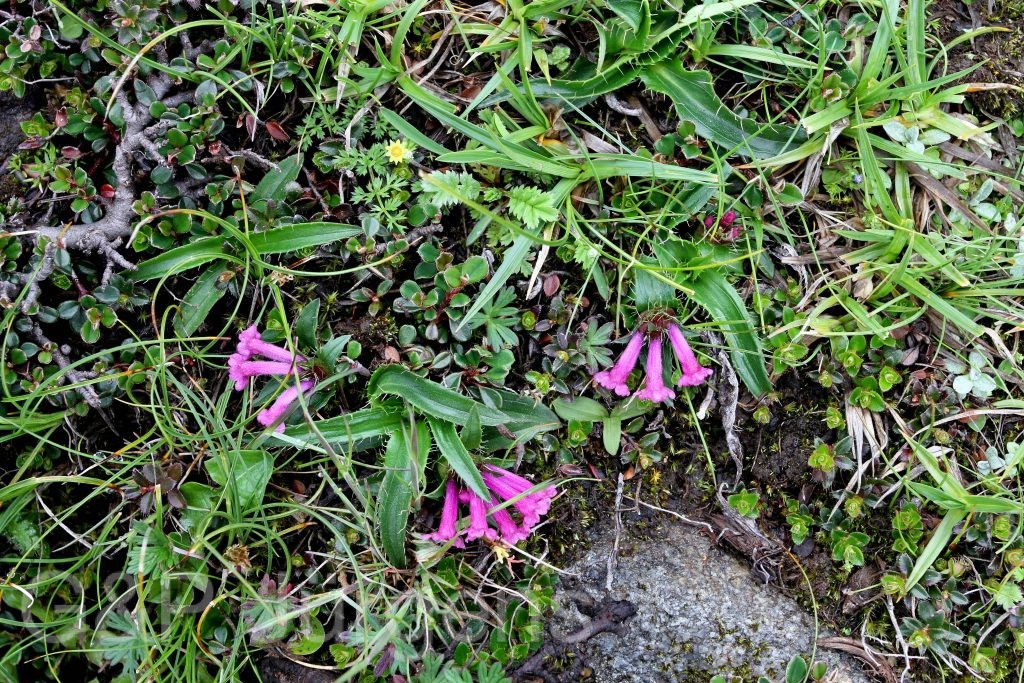
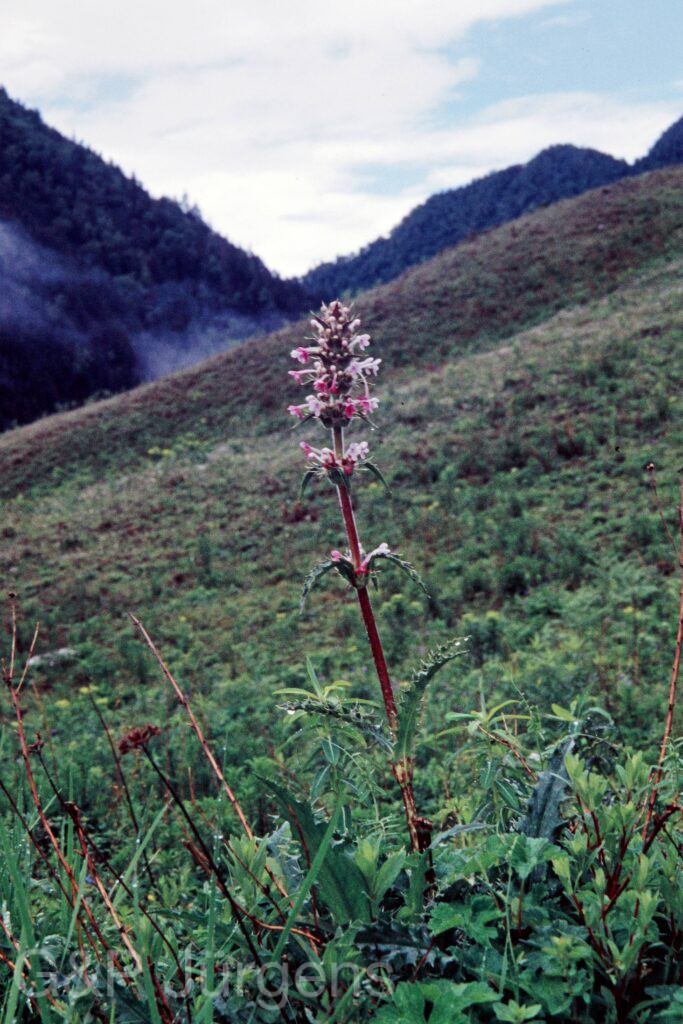
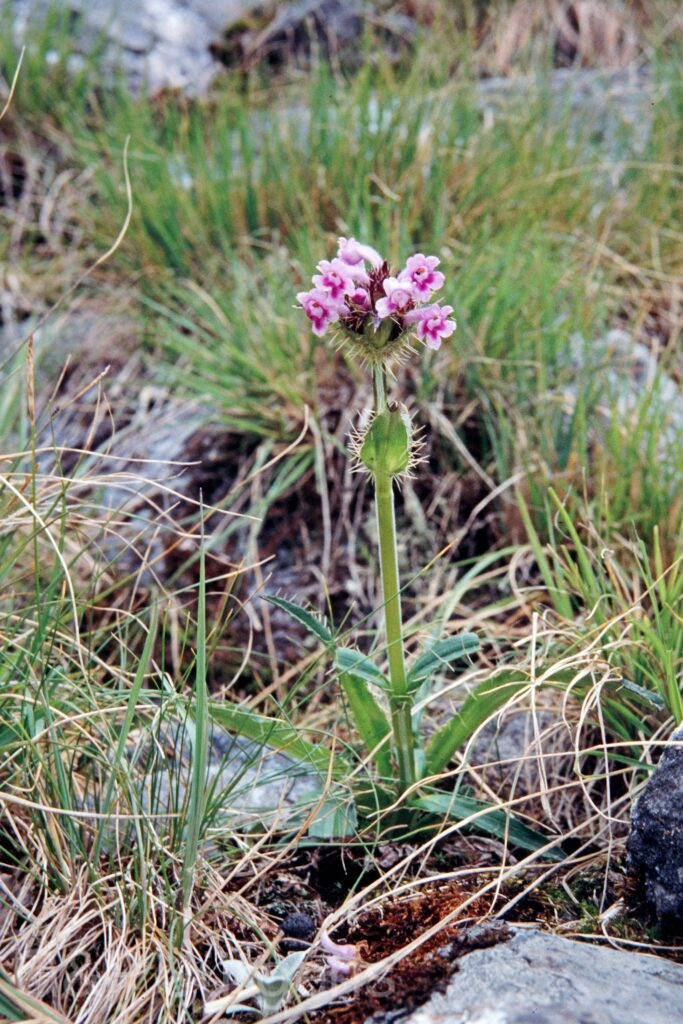
Morina nepalensis is a high-mountain perennial of the Sino-Himalayan region, ranging through China, Nepal, India, Bhutan and Pakistan, with GBIF recording 239 occurrences across this arc. It inhabits open alpine pastures, grassy slopes, rocky meadows and shrubby hollows above the treeline, typically between about 3000 and 4500 m. The illustrated plants were photographed in West Nepal at Kalomura at 3900 m and in Bhutan on the Ludlow-Sherriff Trail near Warrtlang-La at 4450 m, both in June, exemplifying the subalpine to alpine turf where the species is most frequent during the early summer flush.

The plant forms a stout rosette from a thick taproot, the basal leaves narrowly oblong to lanceolate, sessile or amplexicaul and conspicuously armed along the margins with stiff spinose teeth. The flowering stem is erect, terminating in interrupted whorls of flowers subtended by spiny pinnatifid bracts. Each flower sits within a tubular involucel and a two-lipped calyx; the corolla is gamopetalous, curved and white to pink, often deepening to rose with age, with a slender tube and five spreading lobes. There are two fertile stamens and a single inferior ovary maturing into an achene enclosed by the persistent involucel.

Long placed in the segregate family Morinaceae, the genus Morina is now subsumed within an expanded Caprifoliaceae, consistent with the input family. POWO and GBIF treat M. nepalensis as the accepted name. The colour change of the corolla after pollination is a notable floral signal, and the species contributes to the showy alpine herbfields grazed by Himalayan livestock.

Author: D. Don · Sources: POWO (Kew), GBIF, Flora of China, Flora of Bhutan, Annotated Checklist of the Flowering Plants of Nepal, Revision of Morinaceae (Dipsacales monograph)

Wall. ex DC.

Nepal 99 354 ergebnis
West-Nepal Kalmura 3800m, June
Nepal 99 355 ergebnis
West-Nepal Kalmura 3800m, June
Sikkim2003 371 P520
Sikkim Lachen Tista valley 3600m August

Description

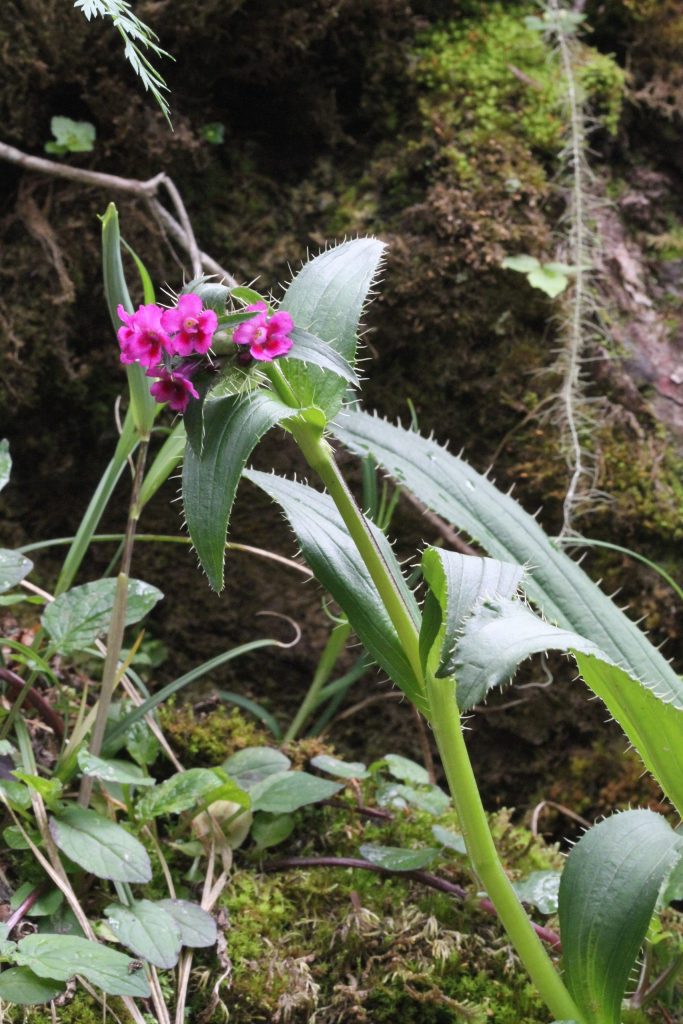
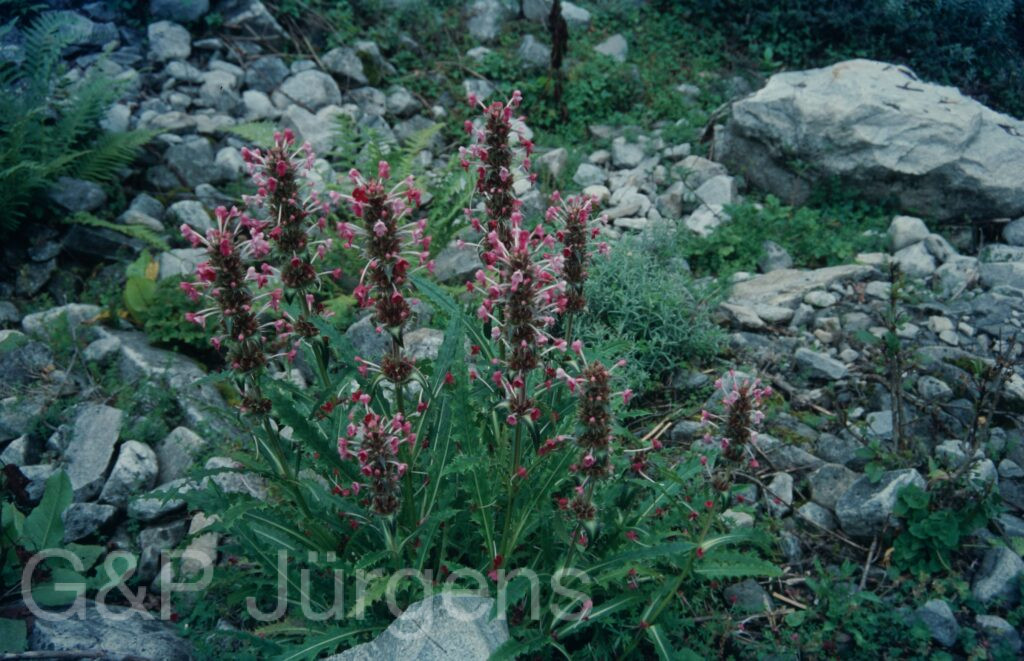
Morina polyphylla is a Himalayan high-altitude herb recorded from Nepal, northern India and Bhutan, with roughly 54 documented occurrences. It inhabits open subalpine to alpine meadows, rocky slopes and grazed pasture, generally between about 3300 and 4200 m. The collections illustrated here, from Kalmura in West Nepal at 3800 m in June and from the Tista valley above Lachen in Sikkim at 3600 m in August, span the early and late monsoon flowering periods and typify its preference for moist, well-drained turf and stony ground in full sun above the treeline.

It is a stout perennial forming a basal rosette of numerous narrowly oblong to lanceolate leaves whose margins are pinnately lobed and armed with stiff spinescent teeth, the texture rigid and the surfaces often shining. The erect flowering stem bears whorls of flowers subtended by spiny floral bracts arranged in interrupted verticillasters. Each flower has a tubular, oblique calyx and a slender-tubed, curved corolla that is two-lipped, typically pale to deep pink or whitish, the long tube adapted to long-tongued pollinators. There are usually two fertile stamens; the inferior ovary ripens into a single-seeded achene enclosed by the persistent involucel.

GBIF treats the name as a synonym, with Morina polyphylla retained as the accepted name; the species belongs to the Morinoideae, now placed within an expanded Caprifoliaceae. Its spiny, thistle-like architecture deters grazing in heavily pastured alpine zones, and the protandrous, long-tubed flowers favour cross-pollination by bumblebees and lepidopterans. The species remains widespread across its montane range with no recognised conservation threat.

Author: Wall. ex DC. · Sources: POWO (Kew), GBIF, Flora of Bhutan Vol. 2, Flora of Nepal, Flora of China Vol. 19, A Taxonomic Revision of the Morinaceae

(D.Don) DC.

BhutanPG2011 707 01 01
Bhutan Chele-La, 3850m July
Sikkim2003 195 P273
Sikkim Dzongri 4000m 08.2003
Nepal 99 283 ergebnis
Nepal Loccu 3155m, May
Nepal 99 366 ergebnis
Nepal Loccu 3155m, May
Nepal 99 822 ergebnis
West-Nepal Baga-La-Phedi 4200m, July

Description

Nardostachys jatamansi, the source of the aromatic drug spikenard, is an alpine herb of the high Himalaya and the Tibetan plateau margins. GBIF records confirm its native distribution across China, Nepal, India, Bhutan and Myanmar, with cultivated or processed material recorded from several other countries, totalling around 1110 occurrences. It grows on open alpine meadows, rocky slopes, grassy ledges and stable scree, generally between about 3000 and 5000 m, in the cool, summer-moist conditions of the high mountains. The photographed collections span its range and altitude well, from the Chele-La in Bhutan at 3850 m and Dzongri in Sikkim at 4000 m to Loccu in Nepal at 3155 m and the Baga-La-Phedi in West Nepal at 4200 m, recorded from May to August during the alpine flowering season.

It is a small, erect perennial herb arising from a stout, woody, aromatic rhizome densely clothed in the fibrous remains of old leaf-bases. The leaves are mostly basal, elongate-spathulate to oblong, entire and somewhat fleshy. The flowering stem bears a compact terminal cyme or head of small flowers; each has a campanulate, pink to pale rose corolla with five lobes, four stamens and an inferior ovary. The fruit is a small, one-seeded achene crowned by the persistent calyx.

Nardostachys is here placed in the Caprifoliaceae, into which the former valerian family Valerianaceae is now subsumed. The species is of great economic and cultural importance, its fragrant rhizome being the jatamansi or spikenard of ancient commerce, still harvested for essential oils, perfumery and traditional medicine. Intensive wild collection coupled with its restricted alpine habitat has led to serious population decline, and the species is assessed as Critically Endangered and listed under CITES Appendix II.

Author: (D.Don) DC. · Sources: POWO (Kew), GBIF, Flora of Nepal, Flora of China (Valerianaceae/Caprifoliaceae), Medicinal Plants of the Himalaya (Polunin & Stainton)

Wall.

Bh09 321 G527
Bhutan Jakar 3200m, June
Sikkim2003 377 G529
Sikkim Tista valley 3400m August

Description

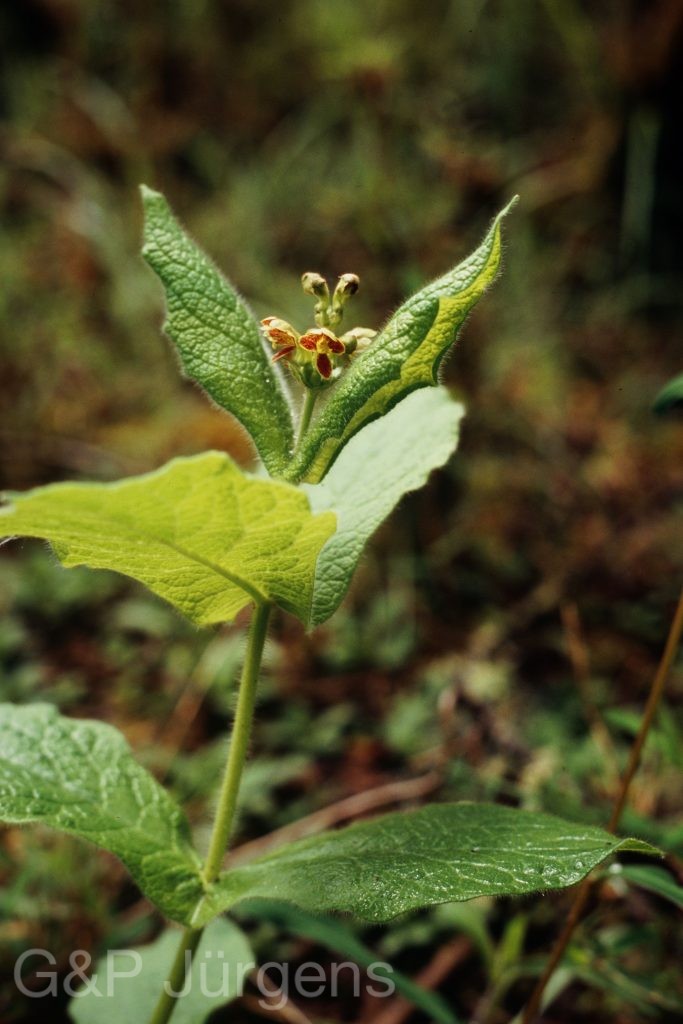
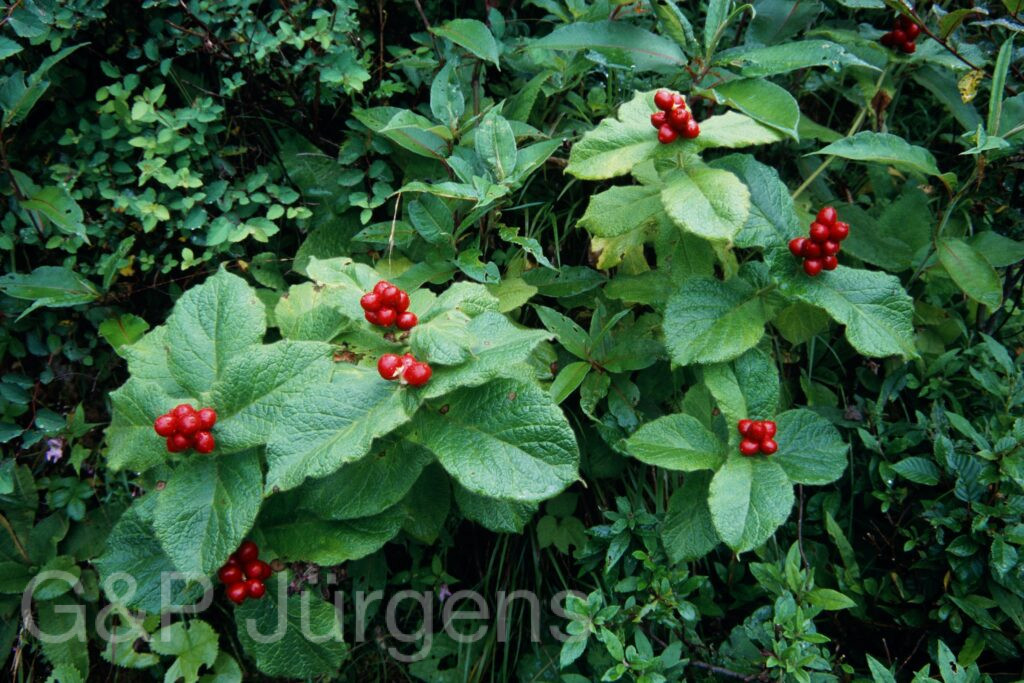
Triosteum himalayanum is a Sino-Himalayan perennial herb distributed across China, Nepal, Bhutan, Sikkim and northern India, with GBIF aggregating around 990 occurrences. It is characteristic of the upper temperate to subalpine forest belt, recorded here from Jakar in Bhutan at 3200 m in June and the Tista valley in Sikkim at 3400 m in August. The species grows in moist shaded forest, woodland margins, scrub and tall-herb communities along streams and on cool, humus-rich slopes, typically between roughly 2500 and 4000 m, where it forms part of the shade-tolerant understorey flora.

It is an erect, softly hairy herbaceous perennial 0.4-1 m tall arising from a stout rhizome, the stems unbranched and glandular-pubescent. The leaves are opposite, large, broadly obovate to elliptic, often shortly connate at the base around the stem (perfoliate to subconnate), entire to shallowly lobed and softly hairy on both surfaces. Small tubular flowers are clustered in dense axillary and terminal verticels; the corolla is dull purplish to greenish-yellow, weakly two-lipped, and the calyx bears persistent, leafy, ciliate lobes. The most conspicuous feature is the fruit, a fleshy, bright red, bristly-hairy drupe crowned by the persistent calyx and containing three bony pyrenes.

Triosteum (horse-gentian) is a small, disjunct genus of about six species in eastern Asia and North America, now placed within an enlarged Caprifoliaceae; this striking amphi-Pacific distribution makes it a classic example of the eastern-Asian-North-American biogeographic link. T. himalayanum is widespread and locally common within its montane range and is not of conservation concern; its showy red drupes are dispersed by birds, and the rhizome has a place in regional herbal traditions.

Author: Wall. · Sources: POWO (Kew), GBIF, Flora of China, Flora of Bhutan, Flora of British India (Hooker), Gould & Donoghue revision of Triosteum (Caprifoliaceae)

Wall. ex DC.

Bhutan2015 26
Bhutan Dochu-La 3100m, October

Description

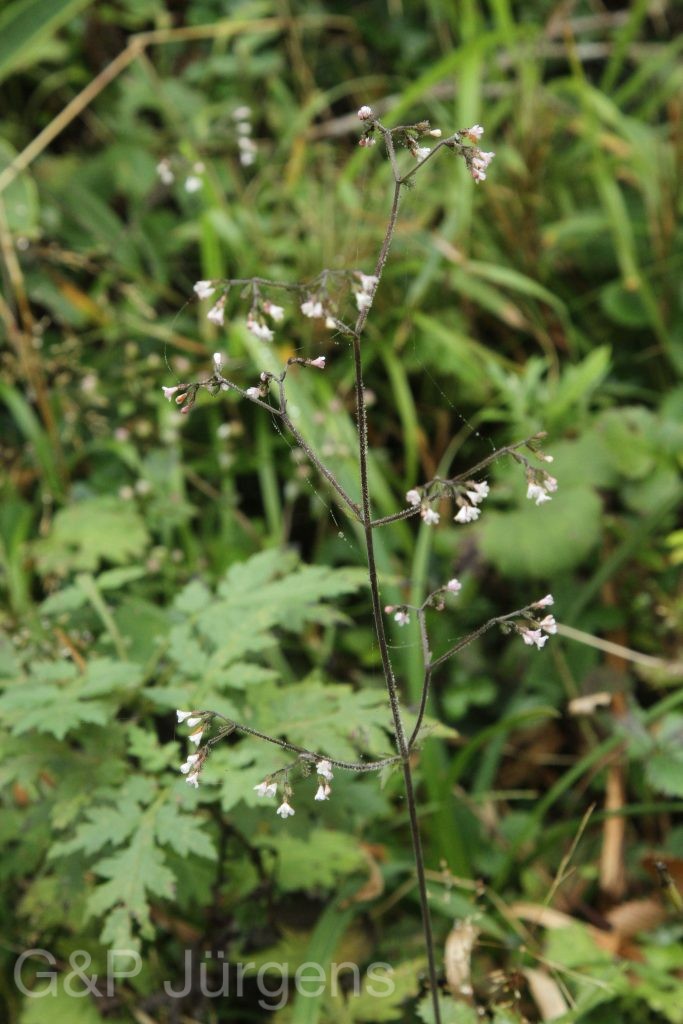
Triplostegia glandulifera is a slender montane herb broadly distributed through the Sino-Himalaya and into Malesia, ranging from Nepal, northern India and Bhutan eastward across China and Taiwan to Myanmar, Malaysia, Indonesia and New Guinea, with outliers in Japan. GBIF documents over 1500 occurrences, concentrated in China, Taiwan and the Himalayan countries. It grows in moist temperate forest, on shaded grassy banks, in clearings and along forest margins on humus-rich soils, broadly between about 2000 and 3500 m. The plant illustrated was photographed in Bhutan at the Dochu-La at 3100 m in October, in cool, misty broad-leaved and conifer forest typical of its autumn fruiting.

The plant is a delicate, erect perennial herb with slender, four-angled stems that are glandular-pubescent above. The leaves are opposite, the lower ones often lyrate-pinnatifid and the upper smaller and less divided, with toothed segments. The inflorescence is a lax, dichotomously branched cyme bearing small, regular, five-lobed white to pinkish flowers. Diagnostically, each ovary is enclosed in a double involucel of bracteoles densely covered with stalked, hooked glandular hairs, which persists around the single-seeded fruit and aids epizoochorous dispersal.

The genus Triplostegia comprises only a couple of species and has had an unsettled placement, treated variously within Dipsacaceae, Valerianaceae or its own family Triplostegiaceae; molecular phylogenetics now situates it within an enlarged Caprifoliaceae (the dipsacalean clade), as a sister lineage to the teasels and valerians. Its glandular double involucel is a key character linking it to that alliance. The species is widespread and ecologically unremarkable in distribution, and is not considered of conservation concern.

Author: Wall. ex DC. · Sources: POWO (Kew), GBIF, Flora of China, Flora of Bhutan, An Annotated Checklist of the Flowering Plants of Nepal, Phylogeny and Classification of Dipsacales (Caprifoliaceae s.l.)

  • 1
  • 2