
L.
Description
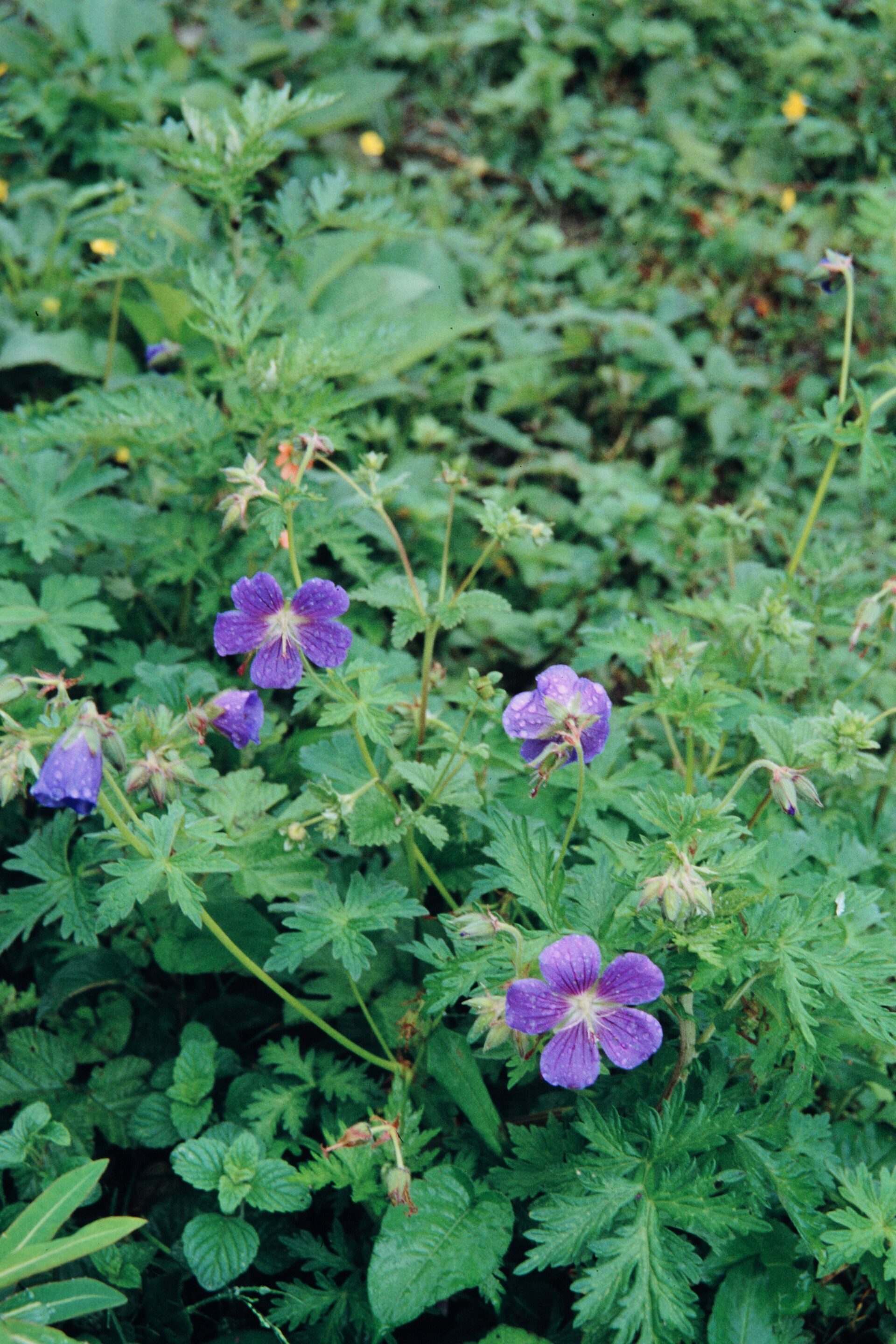
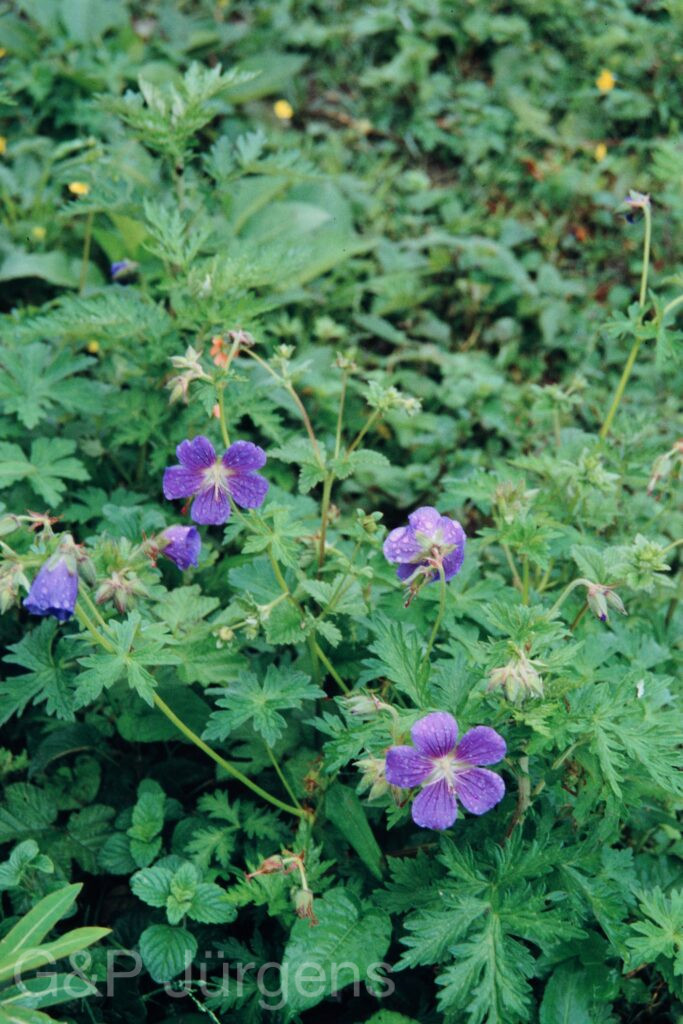
Geranium pratense, the meadow cranesbill, is a widespread perennial of temperate Eurasia. With over 190,000 GBIF occurrences it is abundantly documented across Britain, Germany, France, the Nordic and Baltic states, the Low Countries, central Europe and Russia, extending through Central Asia to the Himalaya. It grows in moist meadows, grassy slopes, streamsides and open woodland margins. In the high Himalaya it ascends to subalpine pastures; the illustrated plant was photographed at Bhulbhule in western Nepal at about 3,500 m, flowering in June, where it is a characteristic component of moist alpine-meadow turf during the early monsoon.
The plant forms a stout, branched rootstock bearing erect, glandular-pubescent stems 30–80 cm tall. The leaves are deeply palmately 5–7-lobed, the lobes themselves pinnatifid and sharply toothed, the basal leaves long-petiolate. The flowers are large and showy, 2.5–4 cm across, borne in pairs on long peduncles; the five petals are violet-blue with fine darker veins. The fruit is the characteristic geraniaceous schizocarp with an elongate beak that springs apart explosively at maturity, ejecting the five mericarps.
Geranium pratense is taxonomically variable across its vast range, with several recognised subspecies and forms; Himalayan populations have at times been segregated but are generally treated within the broad species. It is of least conservation concern, being common and adaptable, and is widely grown ornamentally with numerous cultivars. Its presence links the Himalayan flora biogeographically to the temperate grasslands of the western Palaearctic.
Author: L. · Sources: POWO (Kew), Flora of Nepal, Flora of Pakistan, GBIF, Yeo: Hardy Geraniums (2002)