
Wedd.
Description
Pilea insolens is a Sino-Himalayan herbaceous species distributed from central Nepal through Sikkim, Bhutan, and northeast India (Darjeeling, Arunachal Pradesh) to Bangladesh, Myanmar, southern China, Japan, and Indonesia. GBIF records 94 occurrences across this range. The species inhabits damp, shaded habitats in subtropical and warm-temperate forests at elevations of 800–2,400 m, where it colonises moist rocks, stream banks, tree bases, and old walls in areas of high humidity. It is most abundant in the eastern Himalayan valleys that receive heavy monsoon precipitation.
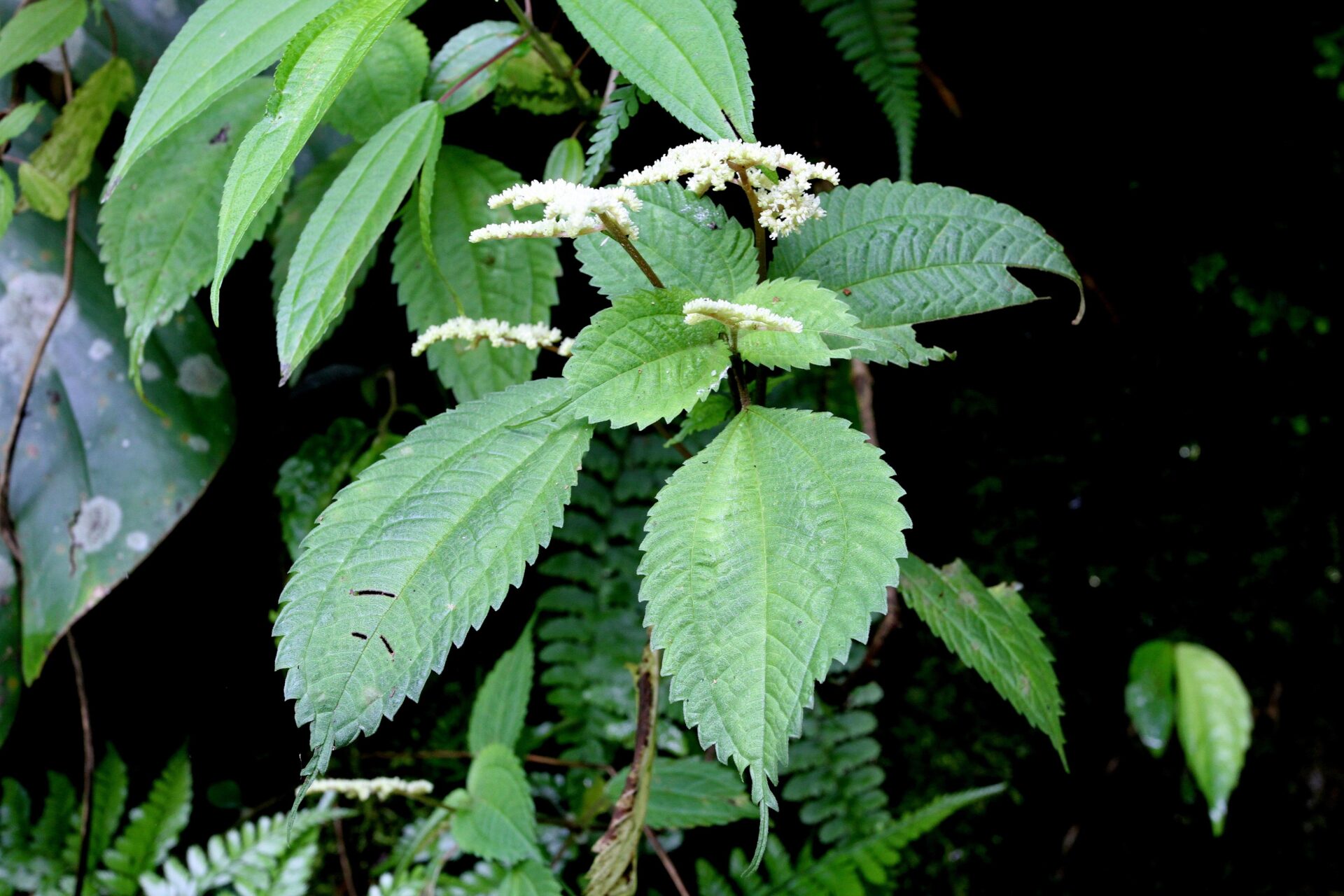
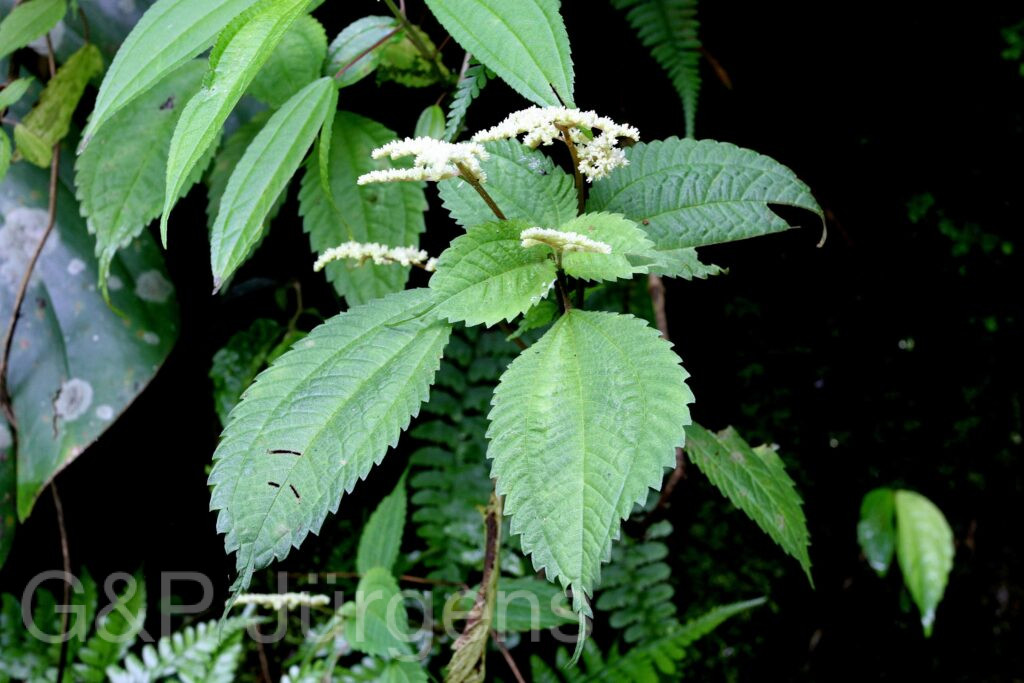
Pilea insolens is a succulent, erect to ascending, monoecious perennial herb, 15–40 cm tall. Stems are fleshy, translucent, glabrous, and often reddish-brown at the base. Leaves are opposite, markedly anisophyllous — a characteristic feature, with the larger leaf of each pair broadly ovate to suborbicular, 3–8 cm long, and the smaller leaf often reduced to a stipule-like scale or small blade less than 1 cm. The larger leaf surface is dark green, often with a cystolith-dotted texture visible as pale streaks, with crenate to serrate margins and three prominent basal veins. Stipules are small, membranous, and soon deciduous. Male and female flowers are borne in separate axillary cymes on the same plant; the male flowers are minute with four perianth segments, while the female flowers are even smaller, with an achene enclosed by persistent perianth lobes.
The photographed specimen from the Tista valley in Bhutan at 1,900 m in October represents a typical occurrence in the humid, deeply incised river valleys of the eastern Himalayas. Pilea insolens is distinguished from other Himalayan congeners by its pronounced leaf anisophylly combined with the broadly ovate, crenate larger leaf. The genus Pilea is enormous, with over 700 species globally, and the eastern Himalayan region is a centre of diversity with numerous narrowly distributed endemics. The species' extension from the Himalayas into Japan and Indonesia reflects a shared subtropical element across the monsoon-influenced forests of East and Southeast Asia. Its reliance on humid, undisturbed forest microsites makes it sensitive to deforestation and stream-channel modification.
Author: Wedd. · Sources: POWO (Kew), GBIF, Flora of China Vol. 5, Flora of Bhutan Vol. 1, Grierson & Long (1983), Chen (1982) — Revision of Chinese Pilea