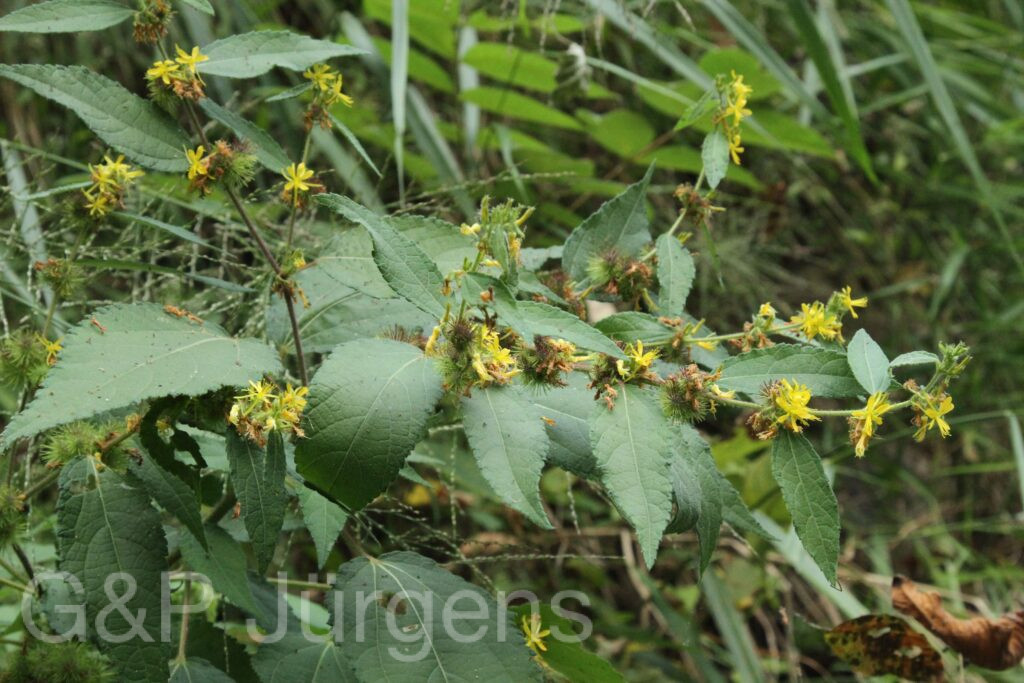
Malvaceae

L.

Bhutan2015 280
Bhutan Zhemgang 1000m, October

Description

Triumfetta annua L. is a widespread herb of the Old World tropics and subtropics, with a pantropical distribution that GBIF records across tropical Africa (from Ethiopia and Tanzania to Angola, Zambia and South Africa), Madagascar, and southern and southeastern Asia, including China, Nepal, India, the Philippines, Indonesia, Malaysia and Papua New Guinea. In the Himalaya it is a plant of disturbed ground, forest clearings, roadsides, field margins and warm broad-leaved forest, ascending from the lowlands to around 1,500–2,000 m. The October record from Zhemgang in central Bhutan at 1,000 m typifies its occurrence as a seasonal weed of cultivated and ruderal subtropical habitats.

The species is an erect, branching annual herb up to about 1–1.5 m tall, with stems sparsely covered in stellate or simple hairs. The leaves are alternate, long-petiolate, ovate in outline and frequently three- to five-lobed, with serrate margins, an acuminate apex and palmate venation. Small yellow flowers are borne in leaf-opposed or axillary cymose clusters; each flower has five sepals, five petals, numerous stamens and a superior ovary. The diagnostic fruit is a globose, indehiscent capsule densely covered with hooked, glochidiate spines, a burr adapted for epizoochorous dispersal by adhering to animal fur and clothing.

Formerly placed in Tiliaceae, Triumfetta is now treated within an enlarged Malvaceae (subfamily Grewioideae). Its hooked fruits make it an effective colonist and an occasional agricultural weed across continents, while the bark yields a serviceable bast fibre used locally. The genus is taxonomically complex, and its wide ecological amplitude renders T. annua a classic example of a successful tropical synanthropic species.

Author: L. · Sources: POWO (Kew), GBIF, Flora of China Vol. 12, Flora of Bhutan Vol. 2, Bayer & Kubitzki: The Families and Genera of Vascular Plants Vol. V (Malvaceae)
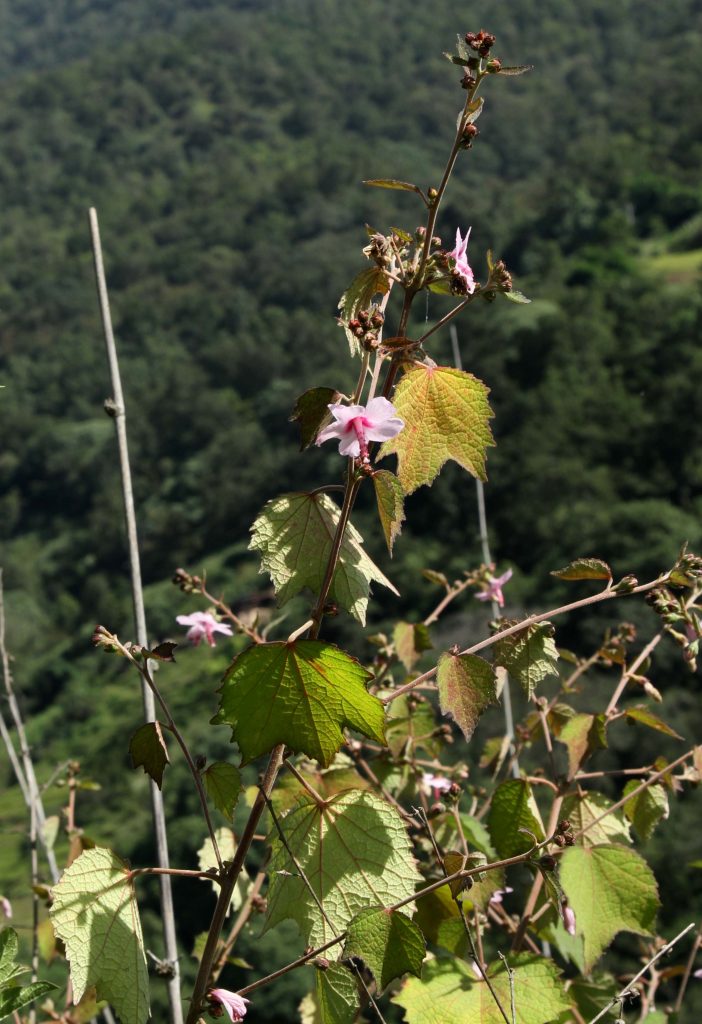
Urena lobata

by GP Jürgens

L.

Bhutan2012 458
Bhutan Zhemgang 1200m, October

Description

Urena lobata is a pantropical subshrub of remarkably wide distribution, with GBIF recording over 31000 occurrences spanning the Americas, Africa, Asia and Australasia, including the United States, Brazil, China, Australia, India, Indonesia, Madagascar, the Philippines and many other countries. A vigorous colonist of open, disturbed and seasonally moist ground, it grows along roadsides, in waste places, fallow fields, forest margins and grassland, mostly at low to middle elevations. The plant photographed at Zhemgang in southern Bhutan at about 1200 m, in October, occupies the warm subtropical foothill habitat where it is a common weed of cleared and cultivated land.

The plant is an erect, woody-based perennial herb or subshrub clothed throughout in stellate, often stinging-rough hairs. The leaves are alternate, variable, the lower ones rounded and shallowly three- to five-lobed or angled, the upper narrower, with toothed margins and conspicuous nectaries on the principal veins beneath. The flowers are solitary or clustered in the leaf axils, with an epicalyx of five bracteoles, five free pink to rose petals, and the stamens united into a staminal column typical of the Malvaceae. The fruit is a depressed schizocarp splitting into five indehiscent mericarps, each densely covered in glochidiate (hooked) spines that cling to fur and clothing, ensuring epizoochorous dispersal.

Urena lobata is economically significant as a bast-fibre plant, cultivated and gathered as "Congo jute" or "aramina", and the hooked fruits make it both an effective long-distance disperser and an aggressive weed in many warm regions, where it is sometimes regarded as invasive. Its enormous global range and tolerance of disturbance place it well outside any conservation concern. The species exemplifies a successful pantropical weed whose burr-like fruits have carried it, often with human aid, across the tropics and subtropics of both hemispheres.

Author: L. · Sources: POWO (Kew), GBIF, Flora of China, Flora of Bhutan, Flora of Tropical East Africa (Malvaceae), Borssum Waalkes revision of Malesian Malvaceae

  • 1
  • 2