
Prain
Description
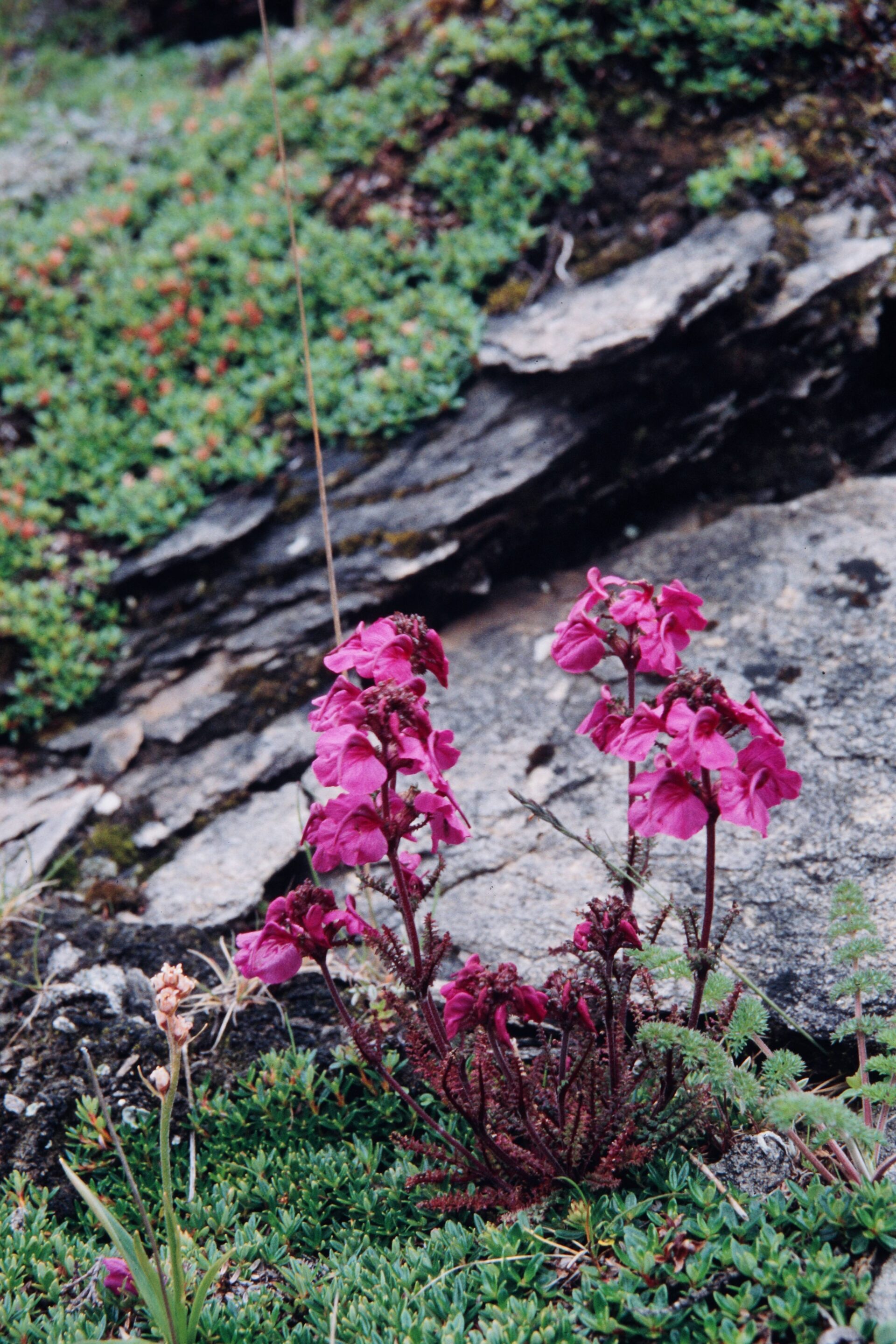
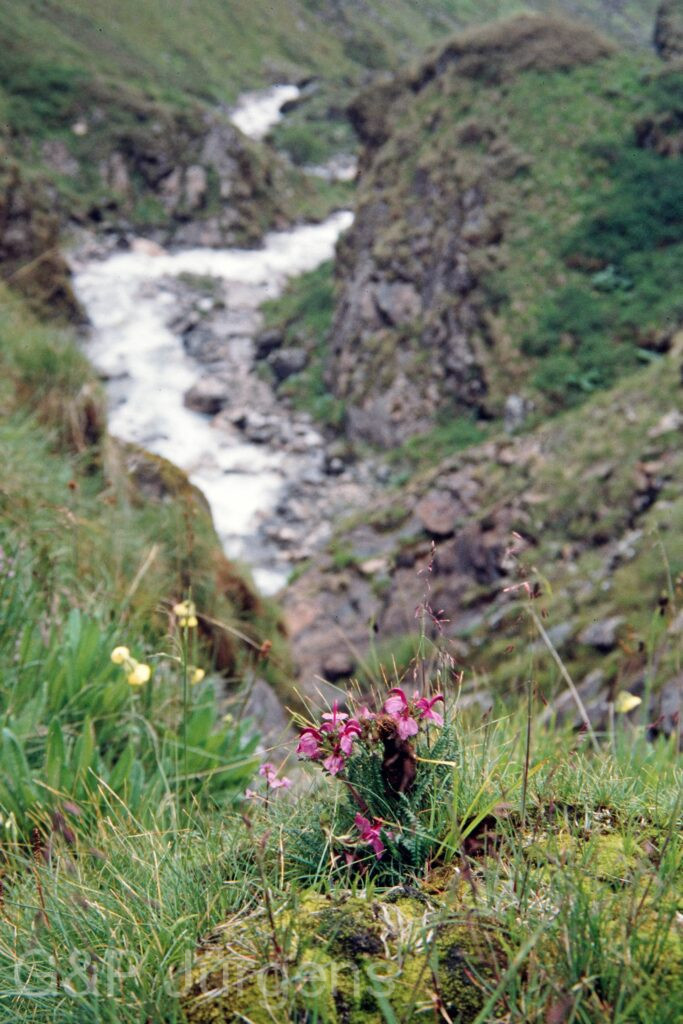
Pedicularis confertiflora is a hemiparasitic herb of the high Himalaya and Tibetan borderlands, documented by GBIF from China, Nepal, Bhutan, India, Mongolia and Korea, with around 378 occurrences concentrated in the central and eastern alpine zone. It grows in open alpine meadows, moist turf, rocky slopes and the margins of grazed pastures, where it taps the roots of surrounding herbs and grasses. The illustrated population grows in West Nepal at Churta-Khola at about 3800 m, flowering in June; the species generally occupies the 3500-4500 m belt where short-statured alpine vegetation prevails.
The plant forms low, often clustered stems from a slender rootstock, bearing pinnatisect leaves whose narrow segments are deeply incised and toothed, sometimes tinged purple. As the epithet confertiflora implies, the flowers are crowded into a dense, capitate to short-spicate inflorescence near the stem apex, each subtended by a pinnatifid bract. The calyx is tubular and lobed, while the bilabiate corolla, in shades of pink to purplish-red, bears a galeate, often beaked upper lip and a spreading three-lobed lower lip. The capsule is oblique and laterally compressed, releasing few flattened seeds.
The Himalayan species of Pedicularis exhibit remarkable corolla diversity, with beak length and curvature finely adapted to bumblebee pollinators that partition resources among co-flowering taxa; the dense, beaked flowers of P. confertiflora fit this syndrome. As an alpine hemiparasite it can suppress competitive grasses and so shape meadow diversity. No formal threat assessment exists, but its specialised high-elevation habitat is sensitive to climate warming and heavy grazing.
Author: Prain · Sources: POWO (Kew), GBIF, Flora of Nepal, Flora of China, Pedicularis monograph (Tsoong)