
Hook. f.
Description
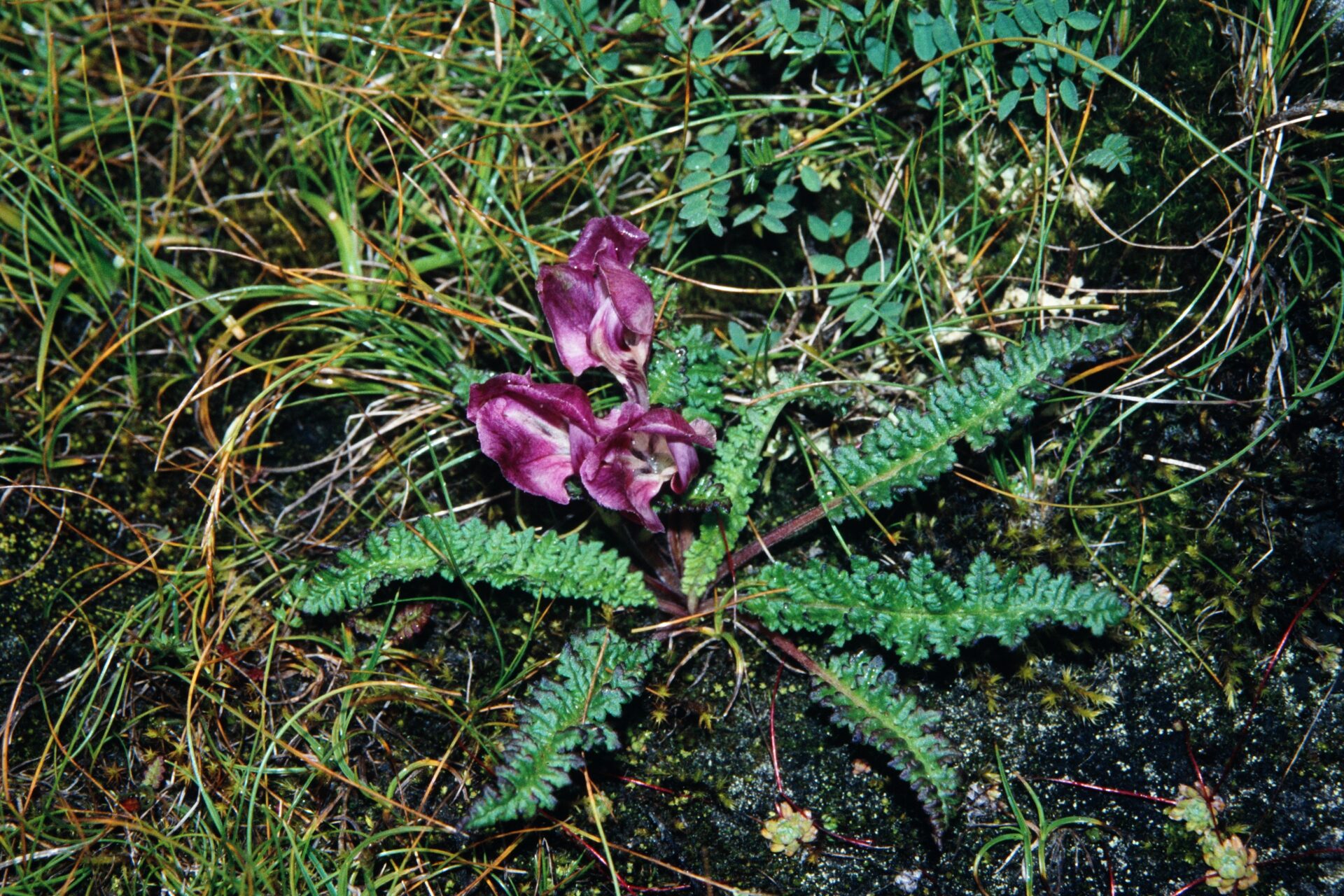
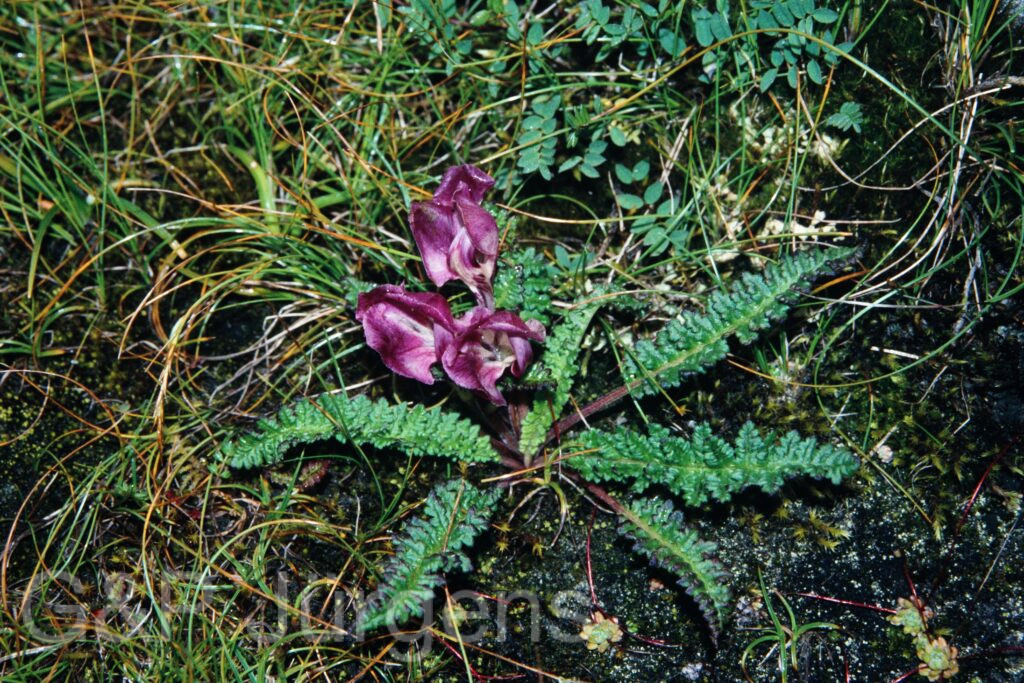
Pedicularis elwesii is a hemiparasitic herb of the eastern Himalaya and adjacent high mountains of southwestern China, with a distribution spanning China, Nepal, India, Bhutan and Myanmar and some 532 georeferenced records compiled by GBIF. It is a plant of the alpine zone, characteristically inhabiting moist meadows, open turf, streamsides and stony slopes above the treeline, generally between about 3500 and 4500 m. The photographed material from Sikkim, on the Dzongri ridge at 4300 m in August, typifies its preferred habitat among short alpine grassland during the summer flowering peak that follows snowmelt and coincides with the monsoon.
It is a perennial forming a tuft of erect to ascending stems from a stout rootstock, with chiefly basal and cauline pinnatisect to pinnatipartite leaves whose oblong segments are toothed and crenate. The showy inflorescence is a dense terminal spike subtended by leaf-like bracts. As in many Himalayan louseworts the corolla is strongly two-lipped: a hooded galea formed by the upper lip, here often produced into a slender beak, encloses the anthers, while the broad three-lobed lower lip serves as a landing platform. Flowers are typically rose-pink to purplish; the fruit is an oblique, beaked loculicidal capsule.
The species belongs to the large, taxonomically intricate genus Pedicularis, exceptionally diversified in the Sino-Himalayan region where floral specialisation reflects coevolution with long-tongued bumblebee pollinators. Like its congeners it is a root hemiparasite, drawing water and nutrients through haustorial connections to neighbouring alpine plants while retaining functional chlorophyll. No major conservation concern is recognised given its wide range, though its meadows are sensitive to grazing and climatic shifts.
Author: Hook. f. · Sources: POWO (Kew), GBIF, Flora of China, Flora of Bhutan, Pedicularis monograph (Tsoong / Prain)