
Craib

Description
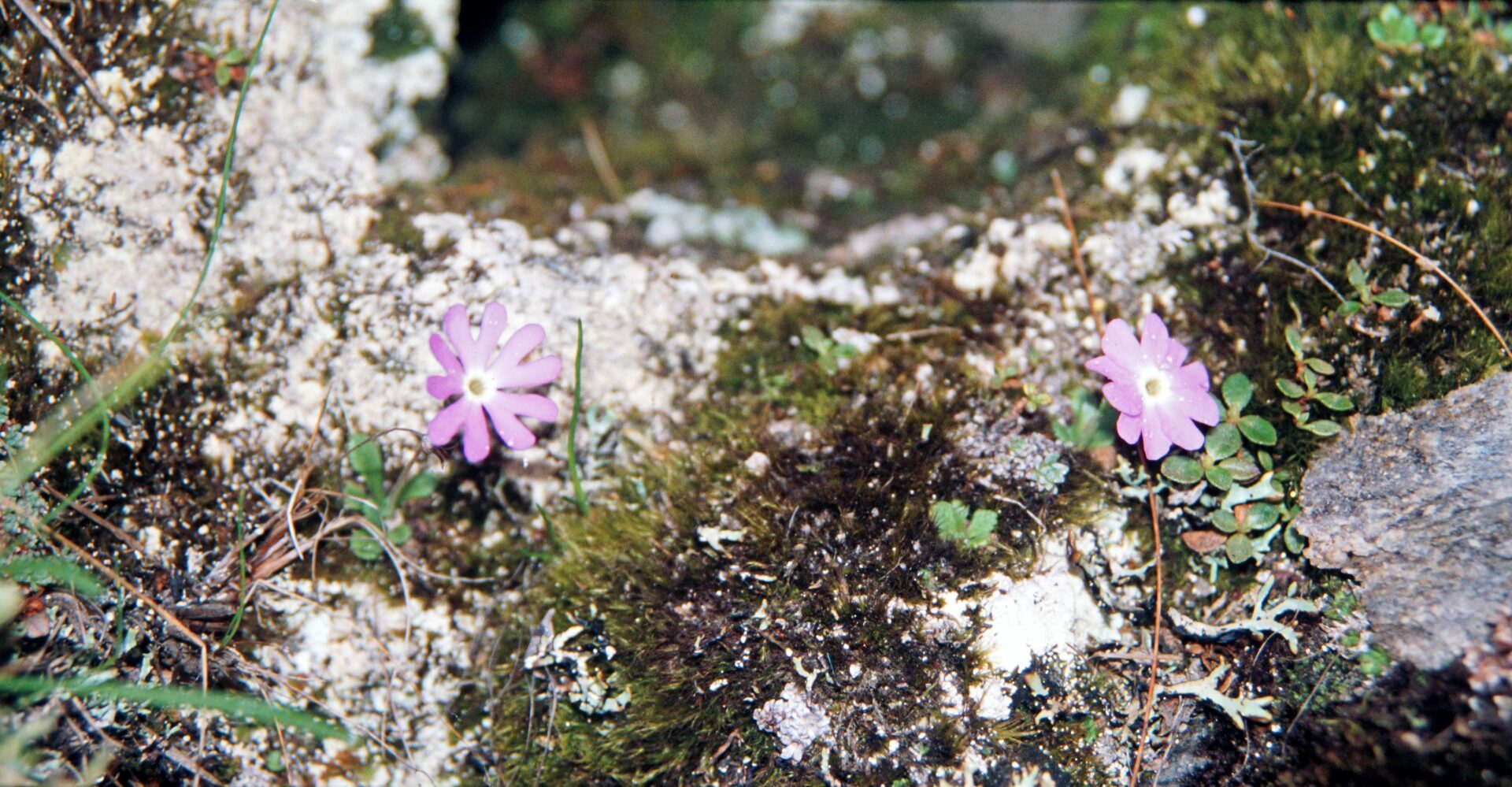
Primula spathulifolia Craib is a high-alpine herb of the central and eastern Himalaya, recorded from India, Nepal and Bhutan (IN, NP, BT), with GBIF documenting some 25 occurrences across this restricted range. It grows in the upper alpine and subnival belt, typically between about 4000 and 5000 m on damp gravelly slopes and snow-melt flushes. The material from the Kagmara-La in Nepal at 4800 m in July shows its flowering shortly after snow-melt, when the brief alpine summer permits rapid growth and anthesis.
The species forms a small, neat rosette arising from a short rootstock, the leaves spathulate to narrowly oblanceolate as the epithet indicates, with a tapering base, an entire to obscurely toothed margin and an efarinose to lightly farinose surface. The scape is short, bearing one to several flowers in a terminal umbel. The corolla is rose-purple to violet with a paler or yellowish eye, the limb divided into obcordate, emarginate lobes spreading from a slender tube; the calyx is campanulate and the flowers heterostylous in the typical primuloid manner. The fruit is a small capsule releasing numerous minute seeds dispersed by wind and water.
Within Primula, P. spathulifolia belongs among the small-statured rosette-forming alpines, part of a complex of dwarf Sino-Himalayan species adapted to extreme altitudes. Its narrow distribution makes it of biogeographic interest as a Himalayan endemic of high passes, and although no formal threat assessment is widely cited, its dependence on stable snow-melt habitats renders it potentially sensitive to shifts in snowpack and grazing. Pollination is presumed to involve small bees and flies active in the brief alpine window.
Author: Craib · Sources: POWO (Kew), GBIF, Flora of Nepal, Flora of Bhutan Vol. 2, Flora of China Vol. 15, Smith & Fletcher monograph of the genus Primula