
L. (Aiton)
Description
Jasminum sambac, the Arabian jasmine, is believed to be native to a broad region extending from the Indian subcontinent through Southeast Asia, though its precise original range is obscured by millennia of cultivation. It is now widely grown and naturalized throughout the tropics and subtropics, with GBIF records from over 40 countries including India, China, Indonesia, the Philippines, Thailand, and numerous Pacific islands. The species typically occurs at low to moderate elevations in warm, humid climates, though it has been documented at Trijugi Narayan in the Garhwal Himalaya of Uttarakhand at 2,250 m in June, likely in a cultivated or semi-naturalized context near this important pilgrimage site, representing an unusually high-elevation occurrence.
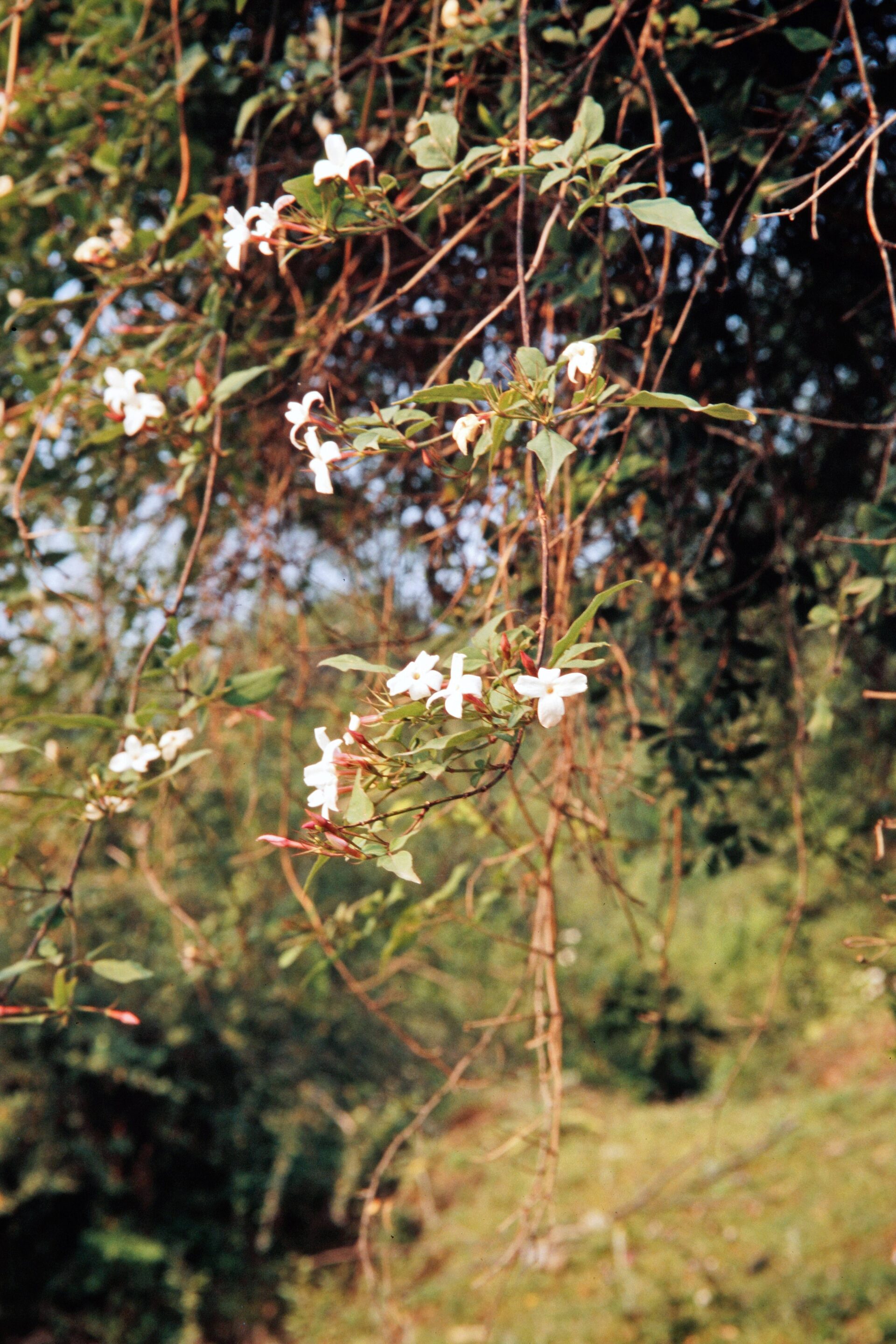
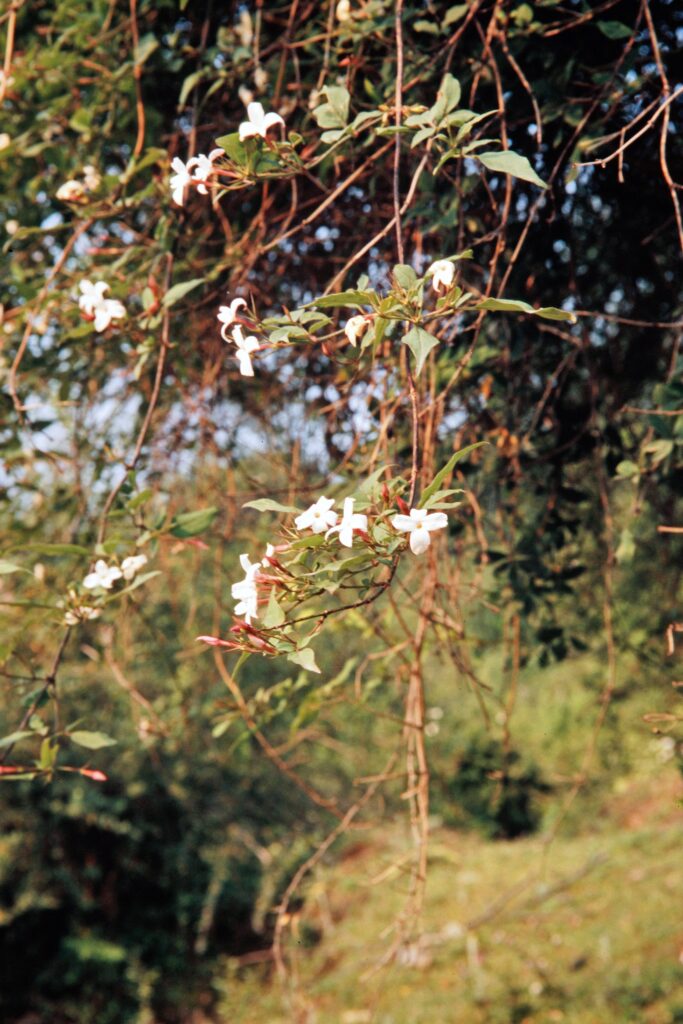
Jasminum sambac is an evergreen or semi-deciduous scandent shrub or vine, 0.5–3 m tall, with terete, pubescent young branches. Leaves are opposite, simple (unusual in Jasminum, where most species have compound leaves), broadly ovate to elliptic, 4–12 cm long and 2–7 cm wide, with an obtuse to rounded apex, entire margins, and a glossy, dark green upper surface. The inflorescence is a terminal or axillary cyme bearing three to twelve flowers. Flowers are highly fragrant, with a tubular calyx bearing eight to ten linear lobes and a salverform corolla with a slender tube 10–15 mm long and typically eight to nine oblong, spreading, pure white lobes. In cultivated double-flowered forms, the petals are greatly multiplied. The fruit is a globose, two-lobed berry approximately 8 mm in diameter, black when ripe, though fruiting is rare in cultivated plants.
Jasminum sambac holds profound cultural, religious, and economic significance across Asia. It is the national flower of the Philippines (sampaguita) and one of three national flowers of Indonesia (melati putih), used extensively in religious ceremonies, garlands, and traditional medicine throughout South and Southeast Asia. The flowers are a major source of jasmine absolute and essential oil used in the perfume industry and are the traditional scenting agent for jasmine tea in China. Taxonomically, J. sambac is placed in Jasminum section Unifoliolata, reflecting its simple (unifoliolate) leaves. The species was first described by Linnaeus as Nyctanthes sambac and later transferred to Jasminum by Aiton in 1789.
Author: L. (Aiton) · Sources: POWO (Kew), GBIF, Flora of China Vol. 15, Green: A Revision of Jasminum in Asia and Australia (2003), Mabberley: Mabberley's Plant-Book (2017)