
(Roxb.) Rehder


Description
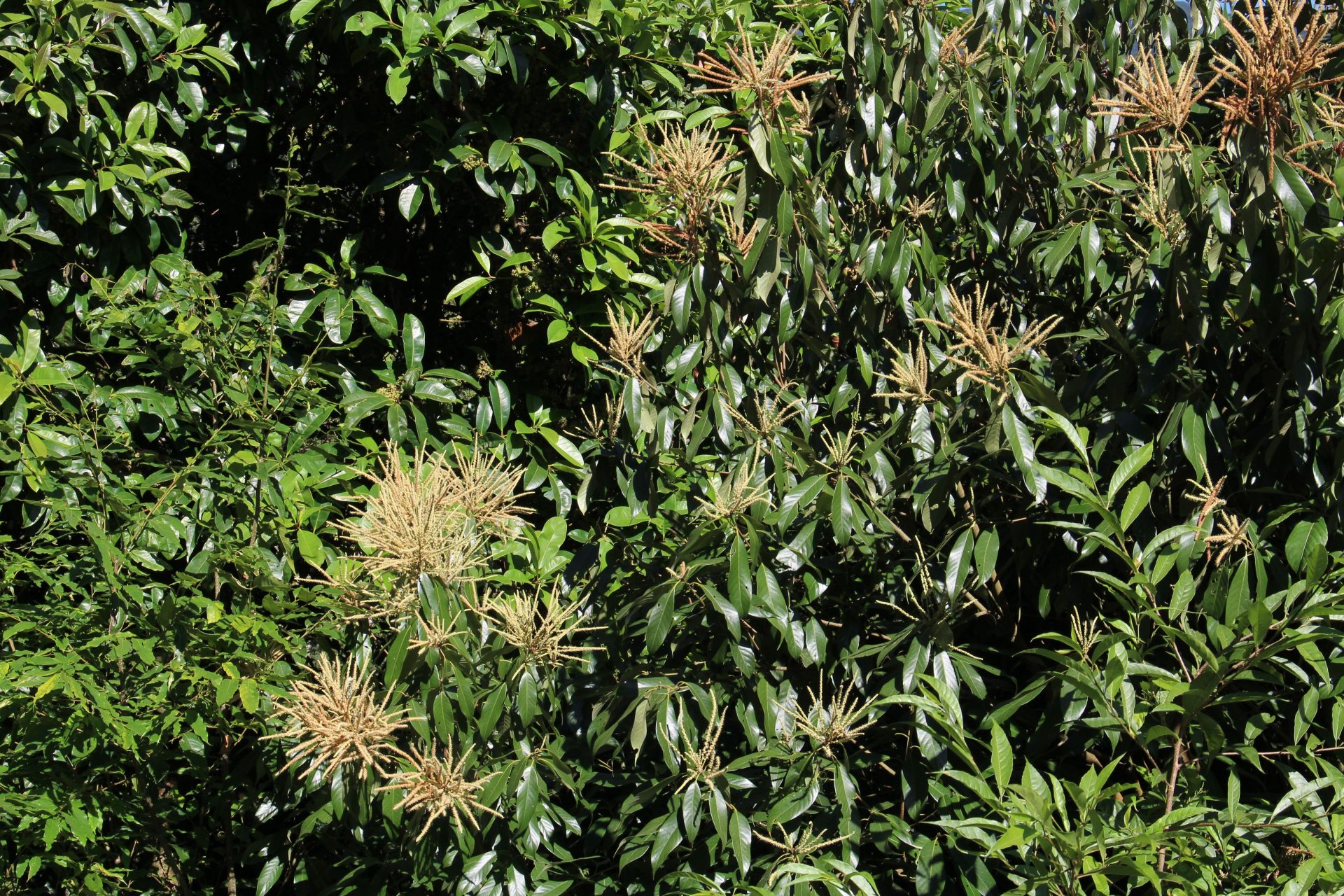
Lithocarpus fenestratus is an evergreen stone-oak widely distributed across the eastern Himalaya and Indo-Burma, ranging from Nepal, Bhutan and north-eastern India through Bangladesh, Myanmar, Thailand, Laos, Vietnam and Cambodia into southern China and Taiwan. GBIF aggregates over 1080 occurrences, concentrated in the montane forests of South-East Asia and the Sino-Himalayan borderlands. It is a canopy or sub-canopy tree of subtropical and warm-temperate evergreen broad-leaved forest, often in mixed laurel-oak associations on hill slopes, generally from the lowlands up to around 2000 m. The tree photographed in Bhutan near Wangdue/Gelephu (800 m, October) reflects its presence in the warm foothill forests of the southern Bhutanese duars.
The species is a medium to large tree with greyish, fissured bark and stout twigs. The leaves are simple, alternate, coriaceous, elliptic to oblong-elliptic, entire and pinnately veined, glabrous and lustrous above and often glaucous or thinly tomentose beneath. The flowers are unisexual, borne in erect catkin-like spikes, the male inflorescences elongate and the female flowers seated singly or in clusters at the base of mixed spikes. The diagnostic fruit is the acorn: a hard nut wholly or largely enclosed by a woody cupule covered in concentric, often lamellate rings, maturing over more than one season and dispersed by gravity and rodents.
Lithocarpus is a large Asian genus distinguished from Quercus by its erect (rather than pendulous) male catkins and its frequently enclosing, ringed cupules. L. fenestratus, transferred to the genus by Rehder, has a broad range and considerable foliar variation, and several infraspecific taxa have been recognised regionally. As a widespread, often dominant forest tree it is not globally threatened, though locally exploited for timber and important as mast for forest wildlife.
Author: (Roxb.) Rehder · Sources: POWO (Kew), GBIF, Flora of China, Flora of Bhutan, Flora of Thailand, Annotated Checklist of the Flowering Plants of Nepal, monograph of Asian Lithocarpus (Camus)