
Sm.


Description
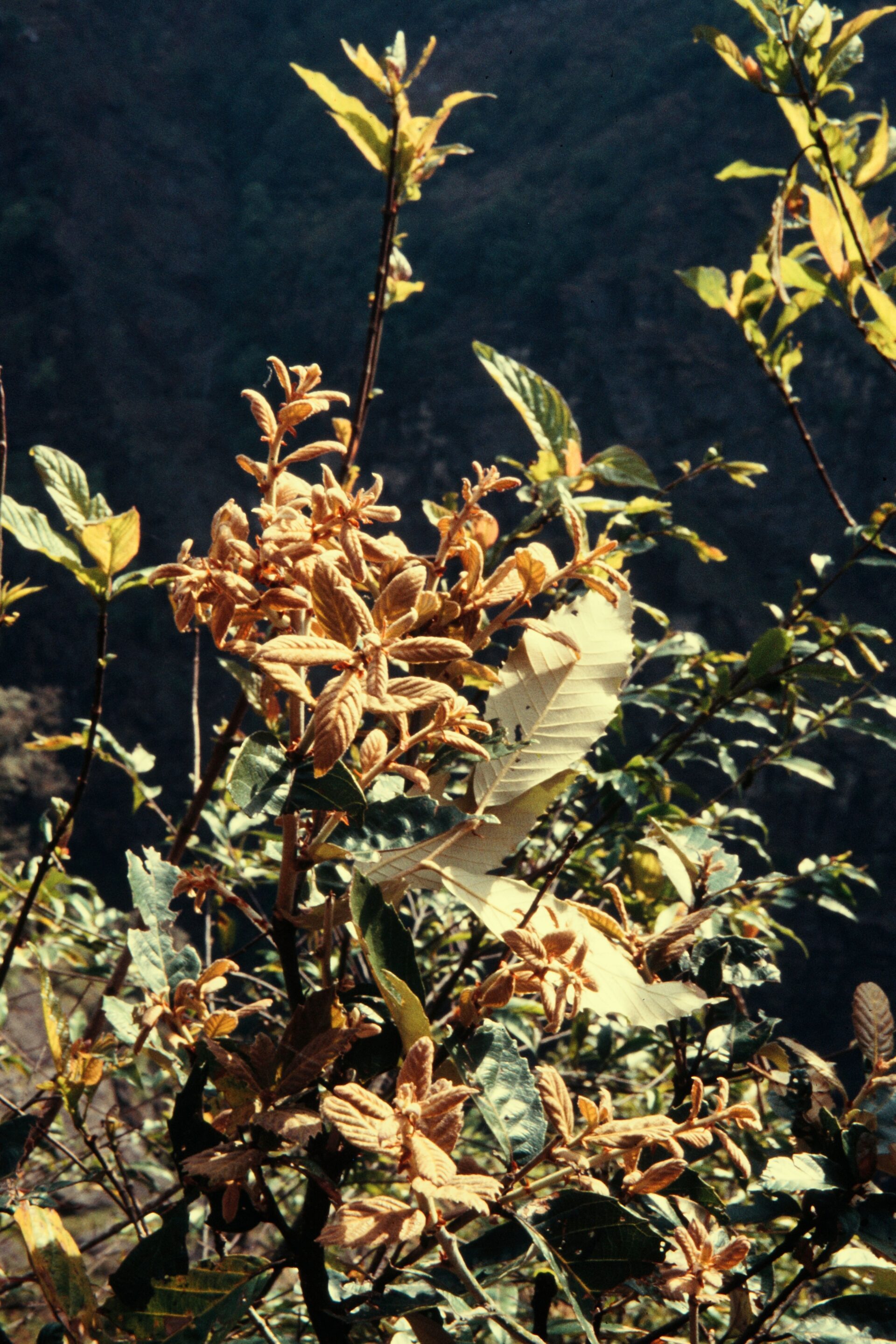
Quercus lanata is an evergreen oak of the Himalaya and adjacent uplands, documented in 317 GBIF occurrences across Nepal, Bhutan, India, Pakistan, China, Myanmar, Thailand and Vietnam. It is a characteristic tree of subtropical to lower temperate broad-leaved forest, occurring on hill slopes and ridges, often in association with other evergreen oaks, rhododendrons and laurels, generally between about 1000 and 2400 m. The tree photographed at Tankhu in Nepal at 2100 m in April occupies the mid-montane oak belt, flowering in spring before or with the flush of new foliage on warm, well-drained slopes.
The species forms a small to medium-sized evergreen tree with a rounded crown and bark that is grey and fissured. The leaves are alternate, simple, coriaceous, ovate-lanceolate to elliptic, with serrate or crenate-dentate margins, the lower surface densely covered in a persistent greyish to tawny wool from which the epithet lanata derives. The flowers are unisexual and monoecious, the staminate borne in slender pendulous catkins and the pistillate few, in short spikes. The fruit is an acorn, ovoid, seated in a shallow, scaly cupule, maturing over one season.
Quercus lanata belongs to subgenus Cerris, section Cyclobalanopsis or the ring-cupped oak alliance recognised in older treatments, and has historically been confused with Q. leucotrichophora and other woolly-leaved Himalayan oaks. It is an important component of mid-elevation watershed forests, providing fuelwood, fodder and leaf litter, and is locally subject to pressure from lopping and forest clearance, though it remains widespread and not globally threatened.
Author: Sm. · Sources: POWO (Kew), GBIF, Flora of China Vol. 4, Flora of Bhutan Vol. 1, Flora of Nepal, Flora of Pakistan, Menitsky's Oaks of Asia