
Chatterjee
Description
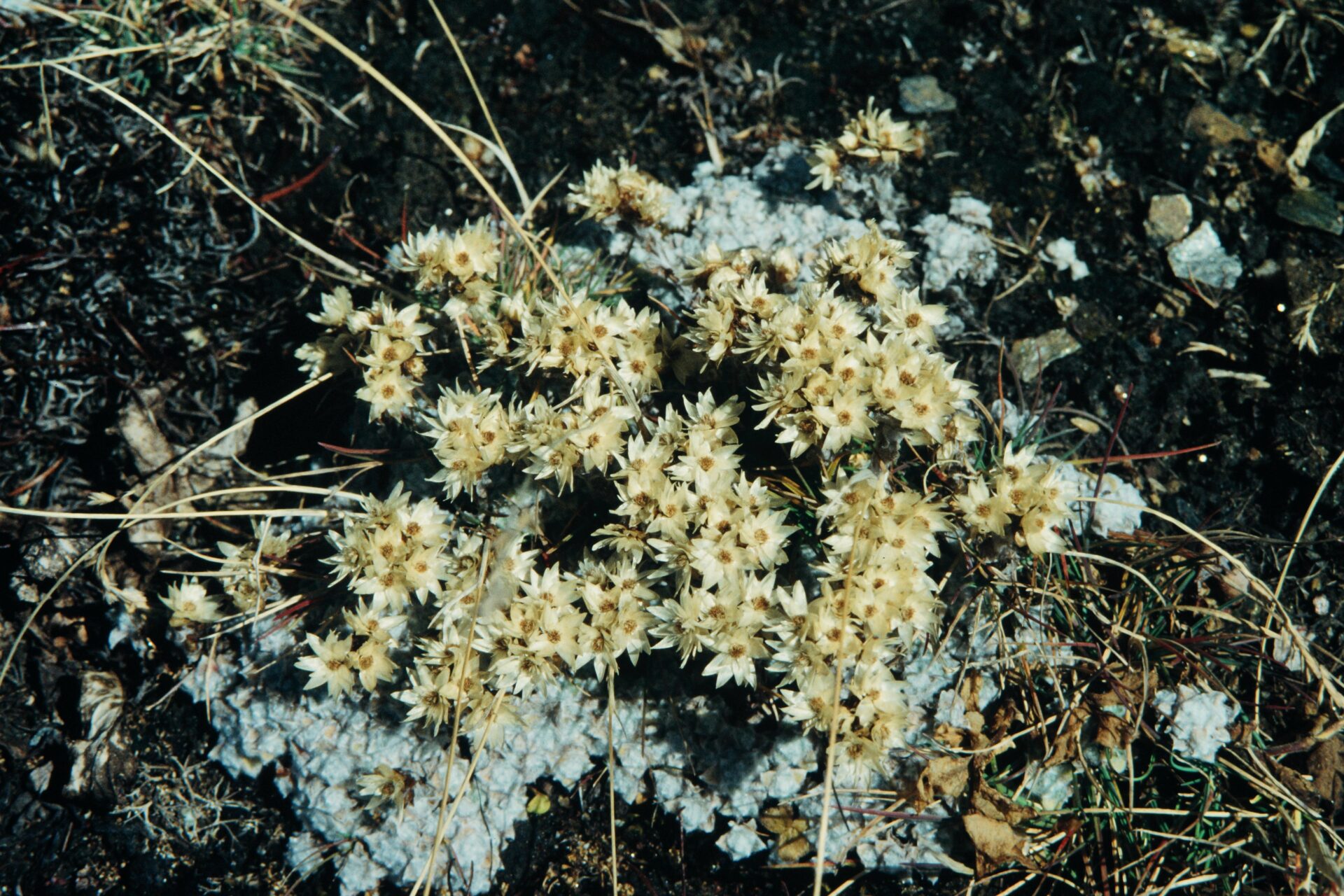
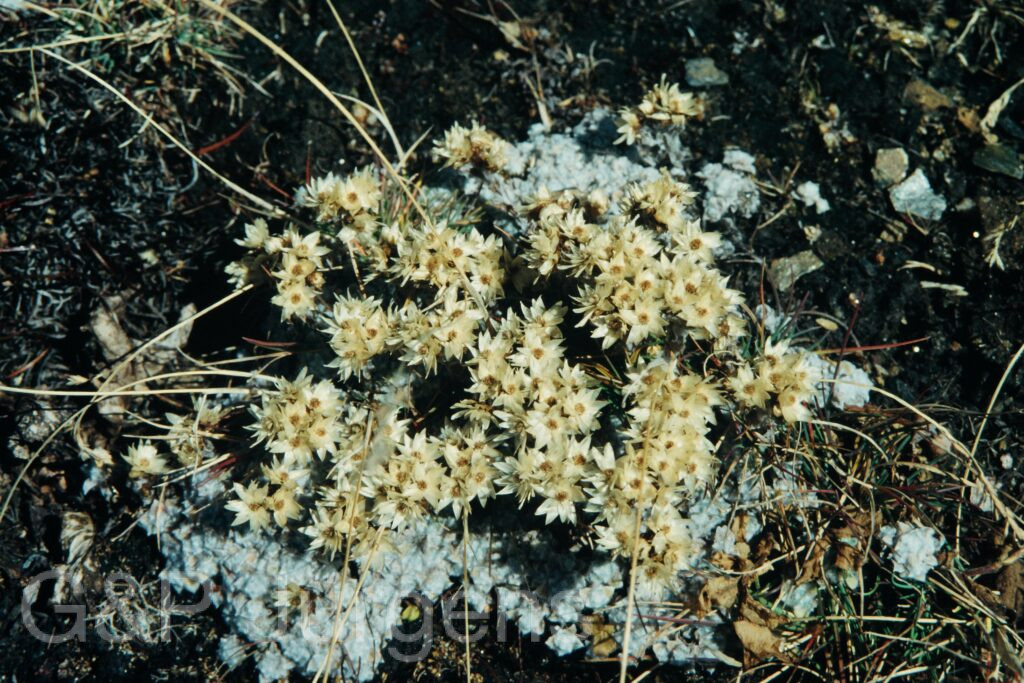
Anaphalis cavei is a Himalayan high-alpine species recorded from Nepal, northern India, Bhutan and southwestern China, with around 91 occurrences concentrated along the main Himalayan axis. It is a plant of the upper alpine zone, the accompanying image documenting it at Jaisuli Kund in Nepal at about 4200 m in October, as the brief autumn growing season closes. It inhabits open stony slopes, alpine meadow turf, moraine and rocky ground near and above the treeline, growing in well-drained, often gravelly substrates exposed to intense insolation and cold, where its dense indumentum mitigates desiccation and ultraviolet stress.
It is a small, perennial, white-woolly herb forming low tufts or mats from a branched, somewhat woody caudex. The stems and leaves are densely covered in appressed lanate-tomentose hairs giving a silvery-grey aspect; the leaves are narrowly oblanceolate to spathulate, often with margins revolute and bases decurrent or semi-amplexicaul. The capitula are aggregated into a compact terminal corymb; each head is surrounded by several rows of dry, papery, pearly-white involucral bracts characteristic of the genus. The plants are functionally dioecious, with female and male florets borne predominantly on separate heads, and the cypselae are small, glabrous and crowned by a deciduous capillary pappus.
The species, described by Chatterjee, belongs to tribe Gnaphalieae, the genus Anaphalis being a taxonomically intricate group of "everlasting" daisies whose papery bracts persist long after flowering. Its restricted high-elevation range, dense wool and cushion-like habit are adaptations to the harsh alpine environment, and seed dispersal is anemochorous via the pappus. Owing to its narrow, remote montane distribution it has not been formally assessed, but it appears locally frequent within suitable alpine habitat.
Author: Chatterjee · Sources: POWO (Kew), GBIF, Flora of China, Annotated Checklist of the Flowering Plants of Nepal, Gnaphalieae monograph (Asteraceae)