
Turcz.
Description
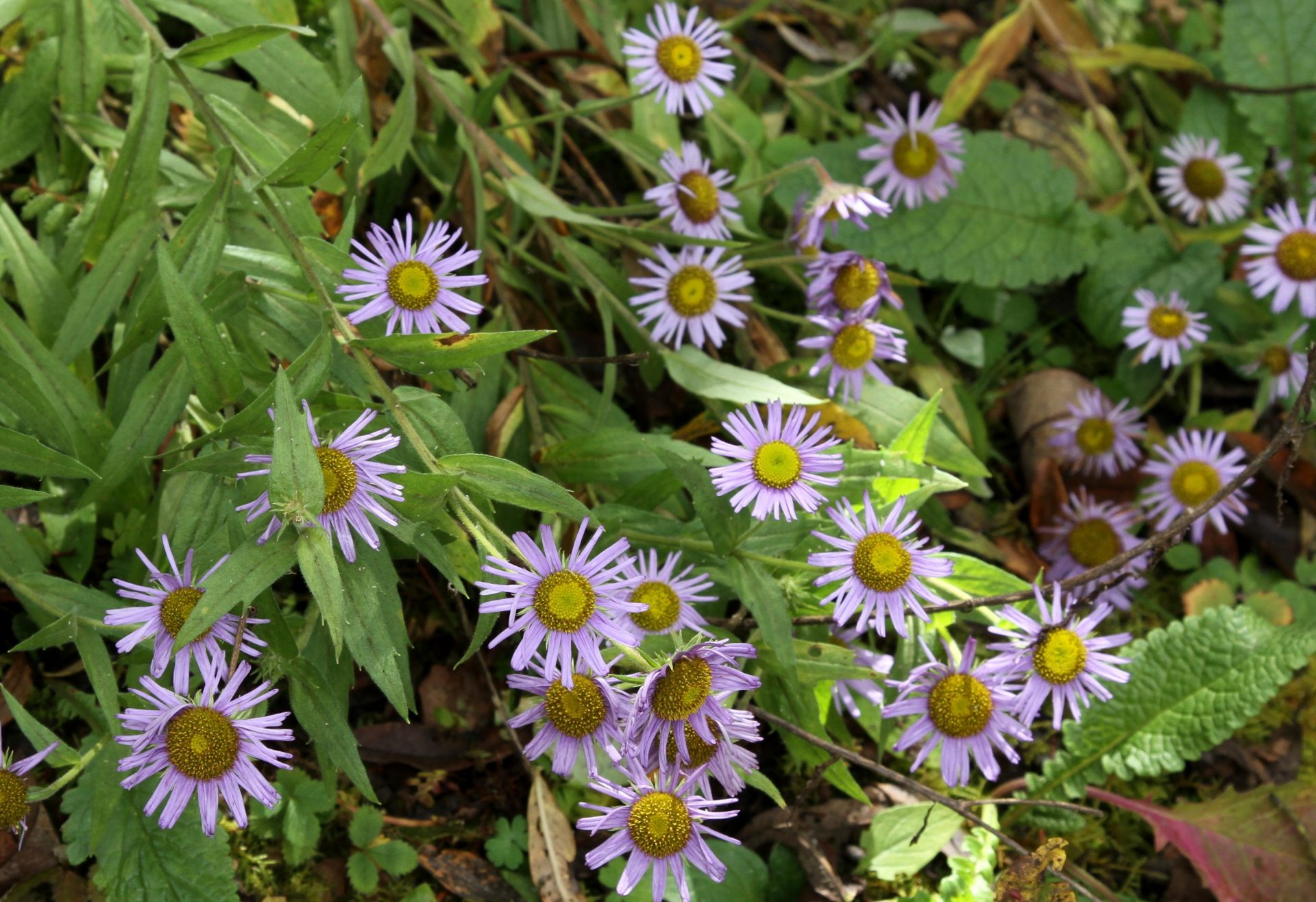
Aster ageratoides Turcz. is a widespread and variable East Asian aster ranging through China, Japan, Korea, Taiwan, Russia, Vietnam, Thailand, Nepal, India and Bhutan, with more than 14,000 georeferenced occurrences in GBIF and an increasing presence as an introduction in parts of Europe and North America. It occupies forest margins, grassy slopes, thickets, streamsides and roadside banks across a broad altitudinal range. The plant recorded at Jakar at 2200 m in October is typical of its late-season flowering in the mid-elevation temperate zone of the Bhutan Himalaya.
It is a rhizomatous perennial herb with erect, often branched stems that are scabrid to pubescent. The leaves are alternate, ovate-lanceolate to elliptic, with a serrate to coarsely toothed margin, three more or less prominent main veins, and a rough surface; the lower leaves are petiolate and the upper ones become sessile. The capitula are arranged in a lax corymbose array; each radiate head has an involucre of imbricate, graduated phyllaries, a single series of white to pale violet or purplish ray florets, and numerous yellow disc florets. The fruit is a compressed, hairy cypsela crowned by a pappus of reddish bristles.
A.ageratoides is notoriously polymorphic, and numerous subspecies, varieties and forms have been described across its range based on leaf shape, indumentum and head size. Modern molecular systematics has reorganised the broad genus Aster, but this Asian species is retained in Aster sensu stricto. Common and ecologically flexible, it is of no conservation concern.
Author: Turcz. · Sources: POWO (Kew), GBIF, Flora of China, Flora of Bhutan, Nesom systematic studies of Astereae