DC.
Description
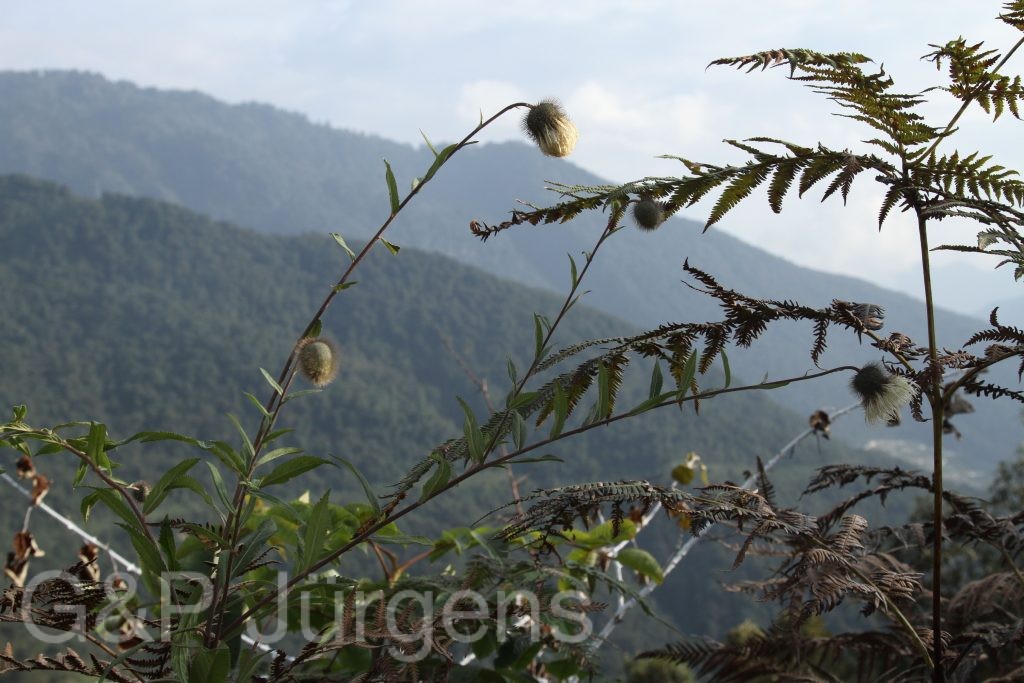
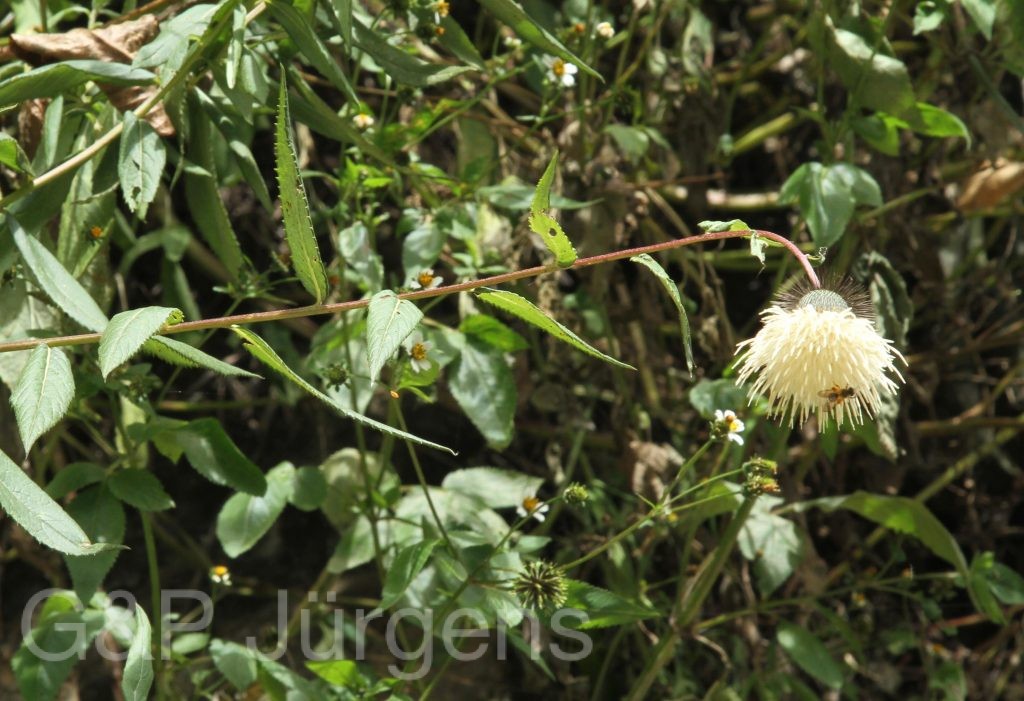
Tricholepis furcata is a thistle-like composite of the Himalaya and adjacent regions, recorded from India, Nepal, Bhutan, Pakistan and China, with 148 georeferenced occurrences. It is a plant of open, sunny, often dry situations, occupying grassy hill slopes, scrub, rocky banks, roadsides and disturbed ground in the subtropical to lower temperate zone, typically between about 1000 and 2500 m. It was photographed near Trongsa at 2100 m and Pemagatse at 1900 m in Bhutan in October, flowering at the close of the monsoon when many montane composites reach their peak on warm, well-drained slopes.
It is an erect, branched perennial or biennial herb, the slender striate stems often forking (furcate) above and bearing alternate, narrow, entire to pinnately divided leaves that are roughly hairy and frequently decurrent on the stem. The flower heads are solitary or few at the branch tips, with an ovoid involucre of many imbricate bracts whose tips are characteristically fringed or laciniate, a diagnostic feature of the genus Tricholepis. All florets are tubular (discoid) and pink to purple, the corolla deeply five-lobed. The fruit is a small obovoid cypsela crowned by a pappus of barbellate or plumose bristles.
The genus Tricholepis belongs to tribe Cardueae (the thistle tribe) and is centred on the Indian subcontinent and Iran, allied to Centaurea and Saussurea. The fimbriate phyllary tips that give the genus its name ("hairy scale") separate it from related cardueoid genera. Ecologically the species is a coloniser of open and disturbed slopes and contributes to autumn-flowering grassland communities. It is widespread and common, of no conservation concern.
Author: DC. · Sources: POWO (Kew), GBIF, Flora of Bhutan, Flora of Pakistan, Compositae monograph (Cardueae, in The Families and Genera of Vascular Plants)