Author

G & P Jürgens

I.M. Johnst.

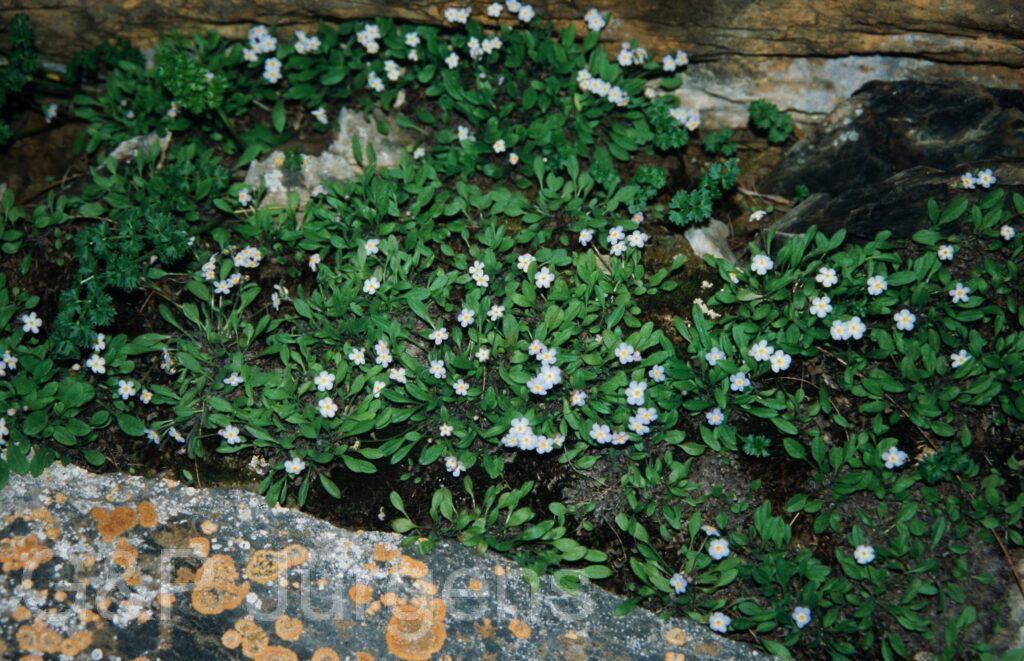
Nepal 99 812 ergebnis
West-Nepal, Baga-La-Phedi 4300m, July
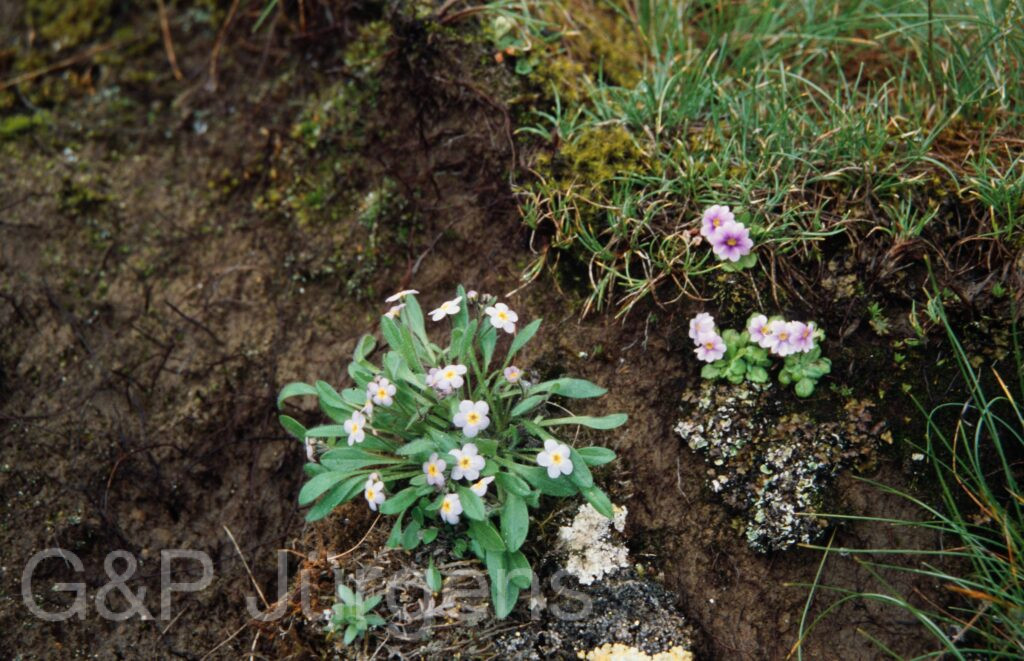
Nepal 99 813 ergebnis
West-Nepal, Baga-La-Phedi 4300m, July

Description

Trigonotis tibetica is a small alpine forget-me-not relative distributed across the Tibetan Plateau and the high Himalaya, recorded from China, India, Nepal, Bhutan and Pakistan, and reasonably well collected (c. 278 records in GBIF) across this broad arc. It inhabits open alpine turf, gravelly slopes, stabilised screes and the margins of meadows, typically between about 3500 and 5000 m, where snowmelt provides moisture through the brief summer. The photographed plant from West Nepal at Baga-La-Phedi (4300 m, July) is typical of the species in mid-summer flower in this cold, well-drained high-elevation setting.

The plant is a low, often tufted perennial herb with a slender taproot and prostrate to ascending stems, the whole frequently appressed-strigose or hispid. The leaves are small, spathulate to oblong-elliptic, entire, and crowded toward the base. The inflorescence is a short, ebracteate or basally bracteate cyme that elongates in fruit; the flowers are small and gamopetalous, with a blue (occasionally white) rotate to shallowly campanulate corolla bearing five vaulted faucal scales at the throat. The androecium has five included stamens; the gynoecium develops into the characteristic four nutlets, which in Trigonotis are conspicuously trigonous and tetrahedral, often borne on short gynobasic stalks.

The genus Trigonotis (tribe Trigonotideae) is distinguished from Myosotis and allied forget-me-nots chiefly by these sharply angled, pyramidal nutlets. Note that this taxon has historically been treated under Microula, and the source links accordingly to a Microula tibetica page; current nomenclature places the accepted name in Trigonotis. As a widespread plateau and Himalayan alpine, the species is not considered threatened.

Author: I.M. Johnst. · Sources: POWO (Kew), GBIF, Flora of China (Boraginaceae), Flora of Nepal, Flora of Pakistan, Monograph of Trigonotis (I.M. Johnston)
Wall. ex D.Don

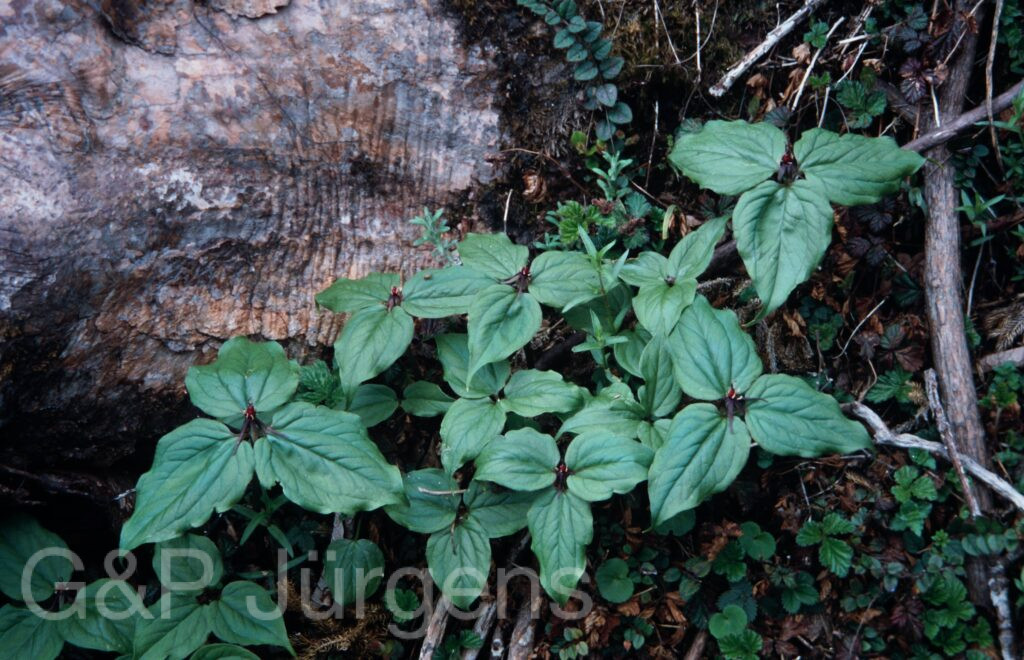
Nepal 99 141 ergebnis
West-Nepal South of Rara-Lake 3800m, June
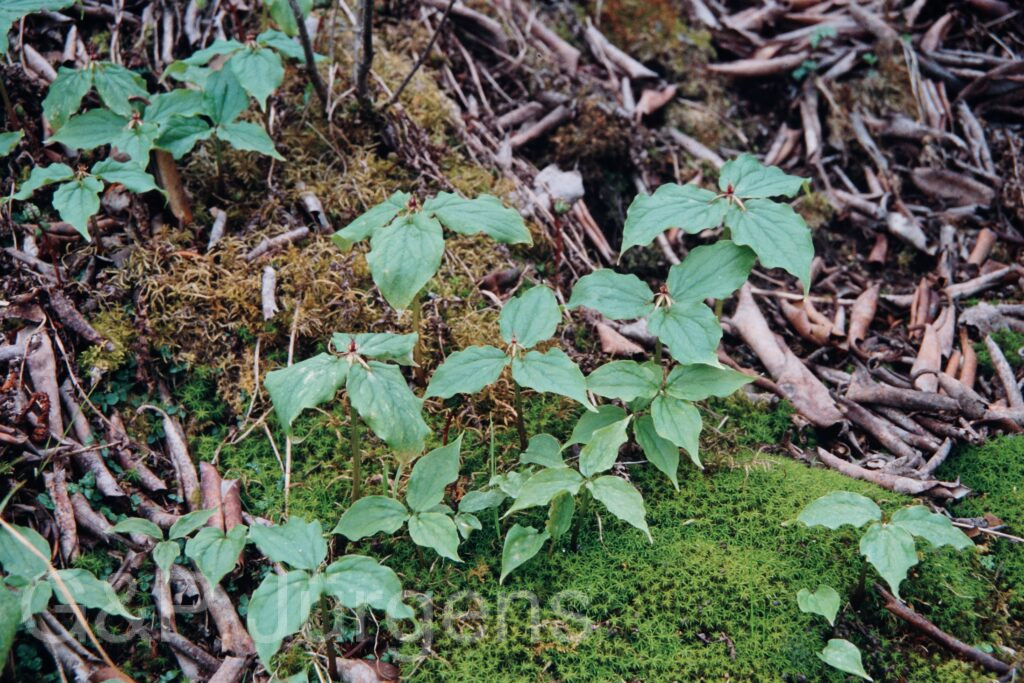
Nepal 2001 308 ergebnis ergebnis
Nepal (Gorkha) Kharka 3100m, May

Description

Trillium govanianum is a rhizomatous perennial herb of the family Melanthiaceae and the sole representative of the otherwise North American and East Asian genus Trillium in the Himalaya. GBIF data confirm a core distribution through Pakistan, India and Nepal, extending into Bhutan and the western fringe of China. It is a plant of moist, shaded temperate and subalpine forest, growing on humus-rich soils beneath Abies, Betula and rhododendron, and in damp alpine scrub and meadow margins, typically between about 2,800 and 4,000 m. The collections illustrated from south of Rara Lake in west Nepal at 3,800 m in June and from Kharka in Gorkha at 3,100 m in May are characteristic of this shaded, high-montane habitat.

The species arises from a short, thick, creeping rhizome and produces a single erect stem 10–30 cm tall bearing the diagnostic whorl of three broadly ovate, net-veined, sessile leaves at its summit. From the centre of this whorl a solitary, sessile or shortly stalked flower is borne; it is small and dark, with three narrow green sepals and three slender petals that are deep maroon to purplish-brown, accompanied by six stamens and a three-loculed ovary. The fruit is a fleshy, reddish berry-like capsule containing several seeds, in contrast to the dry capsules of many congeners.

The presence of a single Trillium in the Himalaya is of considerable biogeographic interest, representing a disjunct outlier of a genus otherwise centred on temperate North America and Japan. The species, locally known as nag chhatri, has become the focus of intense and unsustainable harvesting for its rhizome, which is traded for purported steroidal saponin content. This pressure, combined with slow growth and a narrow ecological niche, has raised serious conservation concern, and the plant is now regarded as threatened across much of its range.

Author: Wall. ex D.Don · Sources: POWO (Kew), GBIF, Flora of Nepal, Flora of Pakistan, Annotated Checklist of the Flowering Plants of Nepal, Farmer & Schilling: Phylogenetics of Trillium

L.

Bhutan2015 280
Bhutan Zhemgang 1000m, October

Description

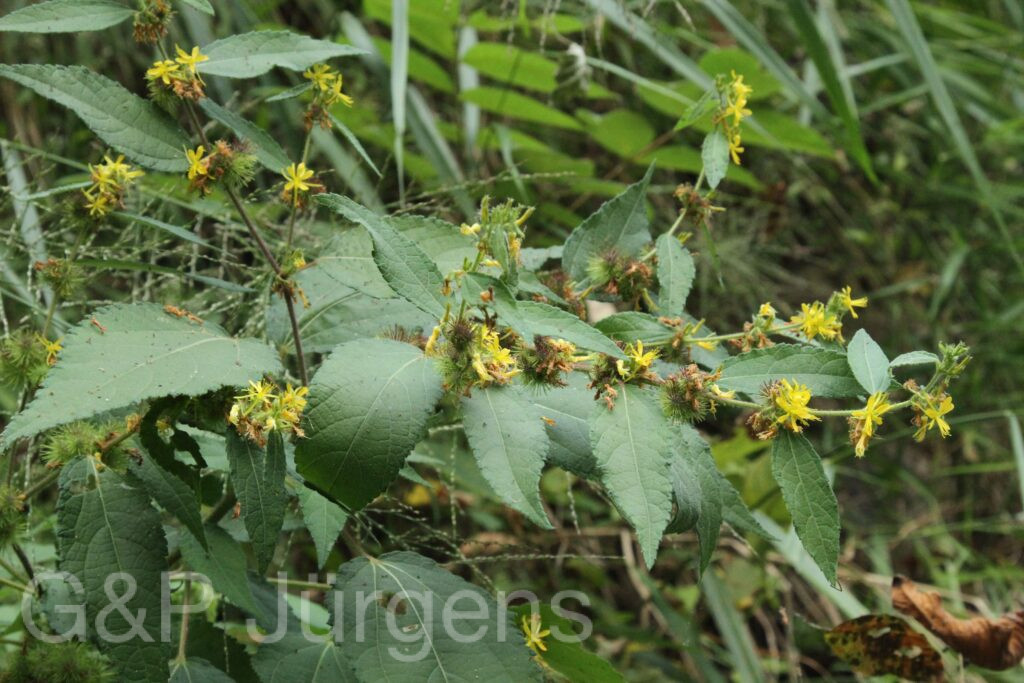
Triumfetta annua L. is a widespread herb of the Old World tropics and subtropics, with a pantropical distribution that GBIF records across tropical Africa (from Ethiopia and Tanzania to Angola, Zambia and South Africa), Madagascar, and southern and southeastern Asia, including China, Nepal, India, the Philippines, Indonesia, Malaysia and Papua New Guinea. In the Himalaya it is a plant of disturbed ground, forest clearings, roadsides, field margins and warm broad-leaved forest, ascending from the lowlands to around 1,500–2,000 m. The October record from Zhemgang in central Bhutan at 1,000 m typifies its occurrence as a seasonal weed of cultivated and ruderal subtropical habitats.

The species is an erect, branching annual herb up to about 1–1.5 m tall, with stems sparsely covered in stellate or simple hairs. The leaves are alternate, long-petiolate, ovate in outline and frequently three- to five-lobed, with serrate margins, an acuminate apex and palmate venation. Small yellow flowers are borne in leaf-opposed or axillary cymose clusters; each flower has five sepals, five petals, numerous stamens and a superior ovary. The diagnostic fruit is a globose, indehiscent capsule densely covered with hooked, glochidiate spines, a burr adapted for epizoochorous dispersal by adhering to animal fur and clothing.

Formerly placed in Tiliaceae, Triumfetta is now treated within an enlarged Malvaceae (subfamily Grewioideae). Its hooked fruits make it an effective colonist and an occasional agricultural weed across continents, while the bark yields a serviceable bast fibre used locally. The genus is taxonomically complex, and its wide ecological amplitude renders T. annua a classic example of a successful tropical synanthropic species.

Author: L. · Sources: POWO (Kew), GBIF, Flora of China Vol. 12, Flora of Bhutan Vol. 2, Bayer & Kubitzki: The Families and Genera of Vascular Plants Vol. V (Malvaceae)

Lindl.

Description

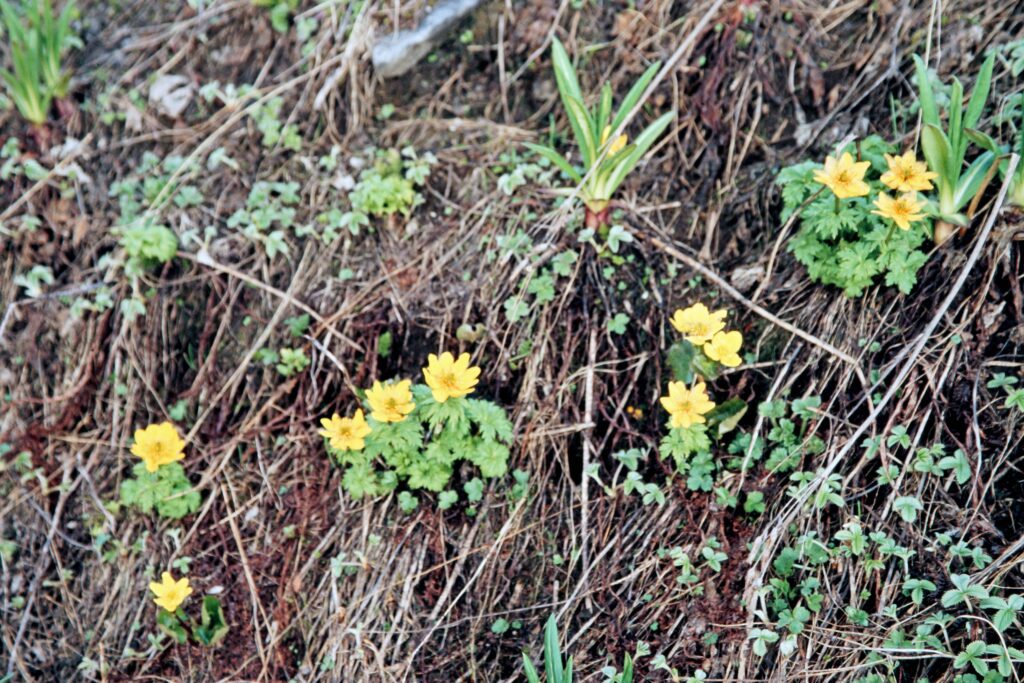
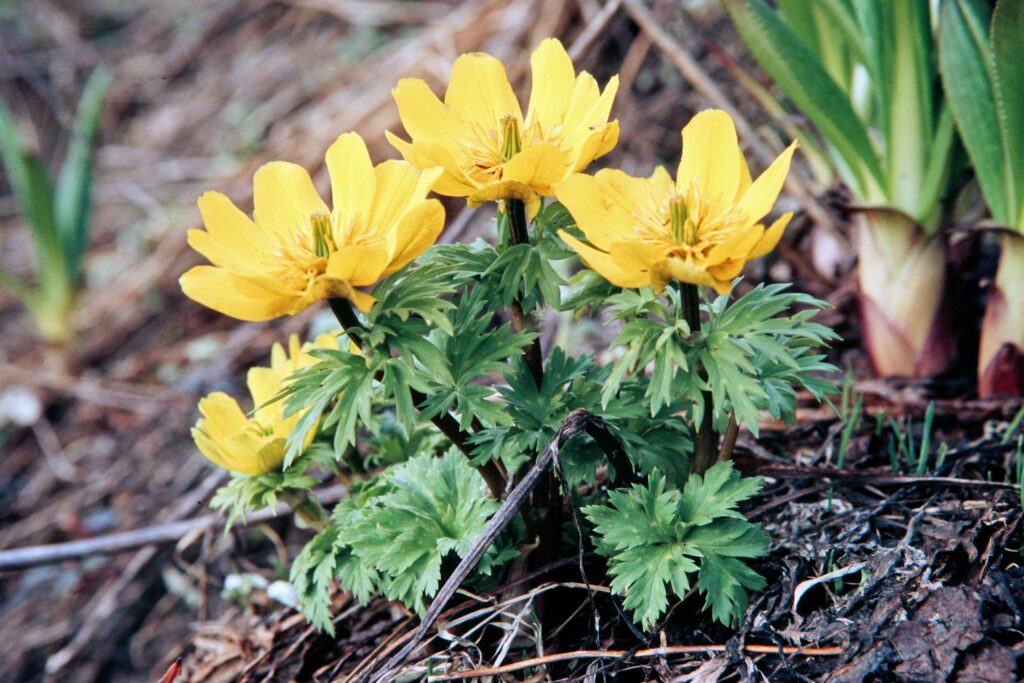
Trollius acaulis is a dwarf perennial of the high Himalaya, ranging along the alpine belt from Afghanistan and Pakistan through the western and central Himalaya into Nepal, Uttarakhand and Himachal Pradesh, and the western Tibetan Plateau in China. GBIF aggregates 188 georeferenced records, the species being strongest in the north-west. It grows in open alpine turf, moist grassy slopes, screes and snow-melt flushes, typically between 3000 and 4500 m. The plant photographed at Khiar Kutti in Garhwal at 3900 m in June is characteristic, flowering as the snow recedes.

It forms a compact, almost stemless herb arising from a short fibrous-rooted rhizome, the flowering stem reduced so the bloom appears to rest on the foliage (hence acaulis). The basal leaves are long-petiolate and palmately divided into deeply incised, toothed segments, glabrous and somewhat fleshy. The solitary flower is large, broadly cup-shaped and golden-yellow, the petaloid sepals enclosing numerous narrow nectariferous petals and a dense boss of stamens. The fruit is a head of many sessile, longitudinally veined follicles, each beaked and dehiscing ventrally to shed small angular seeds.

Within Ranunculaceae, Trollius (the globeflowers) is allied to Anemone and Ranunculus but set apart by its persistent petaloid sepals and clustered follicles. T. acaulis is among the most reduced, high-altitude members of the genus, its acaulescent habit an adaptation to short seasons, intense insolation and wind exposure. Like its congeners it yields acrid protoanemonin and is unpalatable to stock. Not assessed as threatened, it is nonetheless sensitive to overgrazing and the upward shift of climatic belts.

Author: Lindl. · Sources: POWO (Kew), GBIF, Flora of China Vol. 6, Flora of Pakistan, Flora of Bhutan Vol. 1, Annotated Checklist of the Flowering Plants of Nepal, Doroszewska monograph of the genus Trollius

Decne.

Garh 07 119 ergebnis
India Garhwal Meggu Kichatti 3400m, June

Description

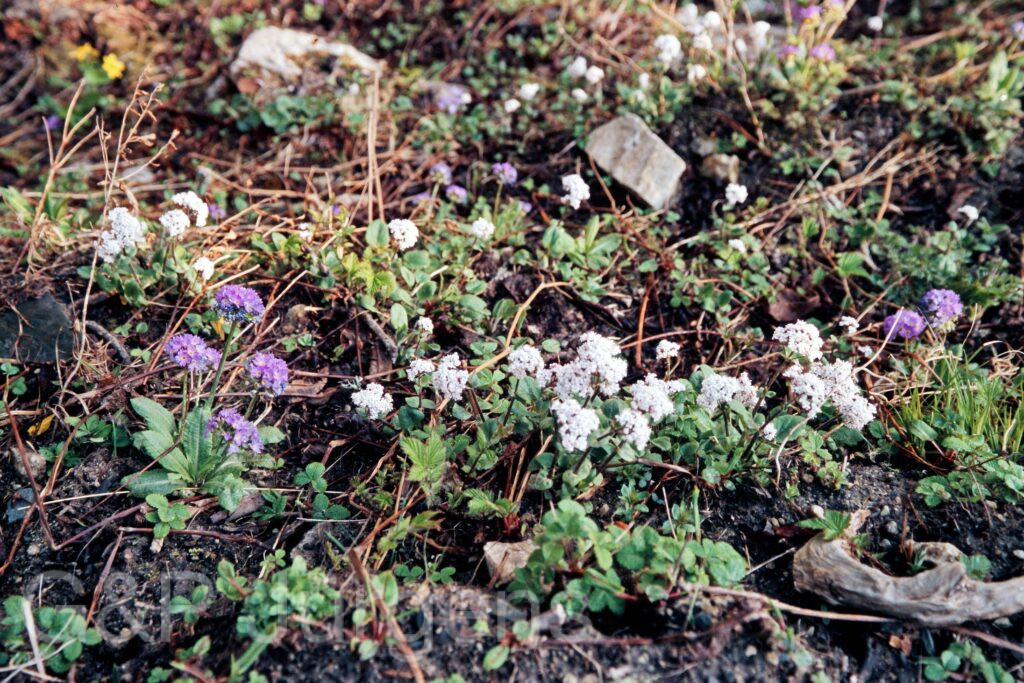
Valeriana pyrolifolia is a western Himalayan valerian distributed from Pakistan (northern areas, Azad Kashmir) through northwestern India (Kashmir, Himachal Pradesh, Uttarakhand). GBIF records 100 occurrences, predominantly from India and Pakistan. The species grows in subalpine meadows, grassy slopes, open scrub, and forest clearings at elevations of 2,800–4,200 m. The photograph from Meggu Kichatti in the Garhwal Himalaya at 3,400 m, taken in June, documents the species at a typical mid-range elevation during its early summer flowering period.
The plant is a perennial herb, 15–40 cm tall, arising from a stout, aromatic rhizome. Basal leaves are distinctive and diagnostic: simple, broadly ovate to orbicular, 3–7 cm long, with entire or obscurely crenate margins, glabrous, somewhat coriaceous, resembling the leaves of Pyrola — hence the specific epithet pyrolifolia. The basal leaves are long-petiolate, forming a conspicuous rosette. Cauline leaves are few, reduced, sessile, and sometimes pinnately lobed with 1–2 pairs of small lateral segments. The inflorescence is a compact, terminal, corymbose cyme that expands in fruit. Flowers are small, 3–5 mm long, funnel-shaped, white to pale pink, with three stamens and an inferior, unilocular ovary. The fruit is a small achene, 2–3 mm long, crowned by a feathery, plumose pappus derived from the accrescent calyx, aiding wind dispersal.
Valeriana pyrolifolia is readily distinguished from other Himalayan valerians by its entire, pyrola-like basal leaves, in contrast to the pinnately divided foliage typical of most congeners. The genus Valeriana, now placed in Caprifoliaceae following APG classifications (formerly Valerianaceae), is represented by numerous species in the Himalayan alpine zone. V. pyrolifolia is not currently considered threatened, though its relatively restricted western Himalayan range and dependence on subalpine grassland habitats merit monitoring in the context of climate change.

Author: Decne. · Sources: POWO (Kew), GBIF, Flora of Pakistan Vol. 150, Duthie: Flora of the Upper Gangetic Plain, Naithani: Flora of Chamoli Vol. 1

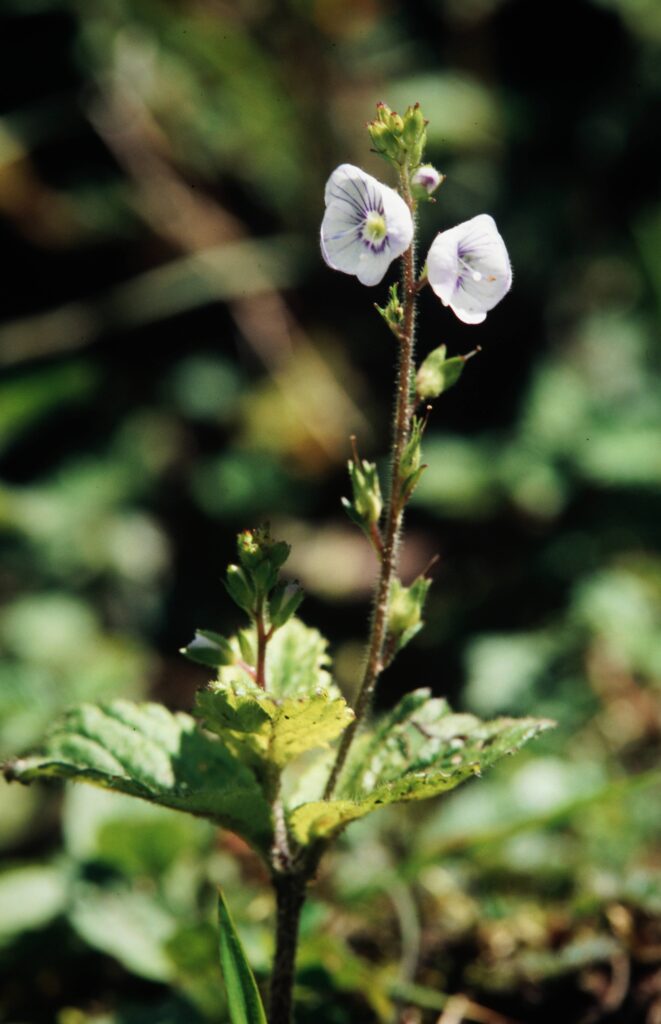
Wall. ex Benth.

Sikkim 2006 333 ergebnis
India West-Bengal, Tolung 2450m, May

Description

Veronica cana is a Himalayan speedwell distributed from Pakistan and northern India (Kashmir to Arunachal Pradesh) through Nepal, Bhutan, and Myanmar to southwestern China (Xizang, Yunnan) and Japan. It occurs in open forest clearings, grassy slopes, rocky banks, and montane scrub at elevations of 1,500–3,500 m. The species has been recorded from the Tolung area in West Bengal at 2,450 m, where it flowers in May during the pre-monsoon season. It favours well-drained, often stony soils in areas receiving moderate to high rainfall.
Veronica cana is an erect to ascending perennial herb, 15–40 cm tall, arising from a slender, creeping rhizome. The stems are simple or sparingly branched, densely covered with short, grey-white, appressed hairs that give the plant a characteristically canescent appearance — hence the epithet "cana" (grey-haired). Leaves are opposite, sessile or subsessile, ovate to lanceolate, 2–5 cm long and 1–2 cm wide, with a crenate to serrate margin and dense, soft pubescence on both surfaces. The inflorescence is a terminal raceme, 5–15 cm long, bearing numerous flowers on short, erect pedicels. The corolla is rotate, four-lobed, 5–8 mm in diameter, pale blue to lilac with darker veins. Stamens are two, exserted. The fruit is an obcordate, compressed capsule 3–5 mm wide, emarginate at the apex, containing numerous minute seeds.
Veronica cana belongs to a complex of pubescent, racemose-flowered Himalayan speedwells that have been variously treated taxonomically. Molecular phylogenetic studies have confirmed that Veronica in the broad sense (including former Pseudolysimachion and Veronicastrum segregates) is monophyletic within Plantaginaceae. V. cana is distinguished from the related V. laxa by its denser canescent indumentum and more compact racemes. Ecologically, the species is a characteristic element of Himalayan montane grasslands and forest-edge communities, contributing to ground-layer diversity in habitats increasingly threatened by overgrazing and land-use intensification.

Author: Wall. ex Benth. · Sources: POWO (Kew), GBIF, Flora of China Vol. 18, Flora of Bhutan Vol. 2, Albach et al.: Phylogeny of Veronica (2004)

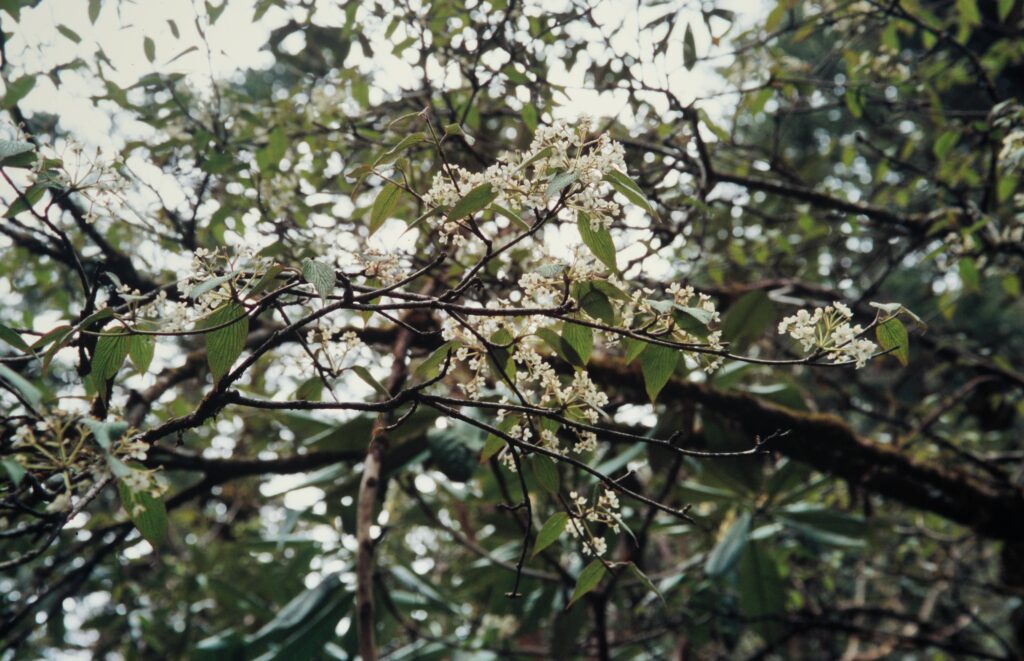
D.Don

Sikkim 2006 369 ergebnis
India West-Bengal, Tamrong 2800m, May

Description

Viburnum nervosum is a deciduous shrub or small tree of the temperate Himalaya and adjacent mountains, documented by GBIF (1437 occurrences) from China, Nepal, India, Bhutan, Myanmar and Taiwan, with further records reflecting cultivation elsewhere. It grows in moist temperate forest, forest margins, rhododendron thickets and open slopes, typically between about 2400 and 3600 m. The collection from Tamrong in West Bengal at 2800 m in May reflects its montane forest setting, where it is conspicuous in spring, often flowering on bare branches before or as the leaves expand in the cool, humid middle-mountain belt.

The plant is a shrub or small tree with stout twigs and prominent buds, the young growth and inflorescence somewhat stellate-pubescent. The leaves are opposite, broadly ovate to elliptic, cordate at the base, serrate, and strongly marked by deeply impressed, parallel lateral veins from which the epithet derives. The inflorescence is a rounded to flat-topped terminal cyme of small, fragrant, white to pinkish flowers, each with a short campanulate corolla of five lobes and five exserted stamens. The fruit is a small, ellipsoid drupe ripening from red to black, containing a single compressed stone.

Viburnum, long placed in Caprifoliaceae but here treated within Viburnaceae (Adoxaceae sensu lato), is distinguished by opposite simple leaves, cymose inflorescences and one-seeded drupes. The strongly nerved leaves and early-spring flowering readily characterise this species among Himalayan viburnums. Its fleshy fruits are dispersed by birds, and it regenerates well in forest gaps. Widespread and locally common, V. nervosum is of no conservation concern.

Author: D.Don · Sources: POWO (Kew), GBIF, Flora of China Vol. 19, Flora of Bhutan Vol. 2, Flora of Nepal, Kern & Hara Viburnum of the Himalaya (Flora of Eastern Himalaya)

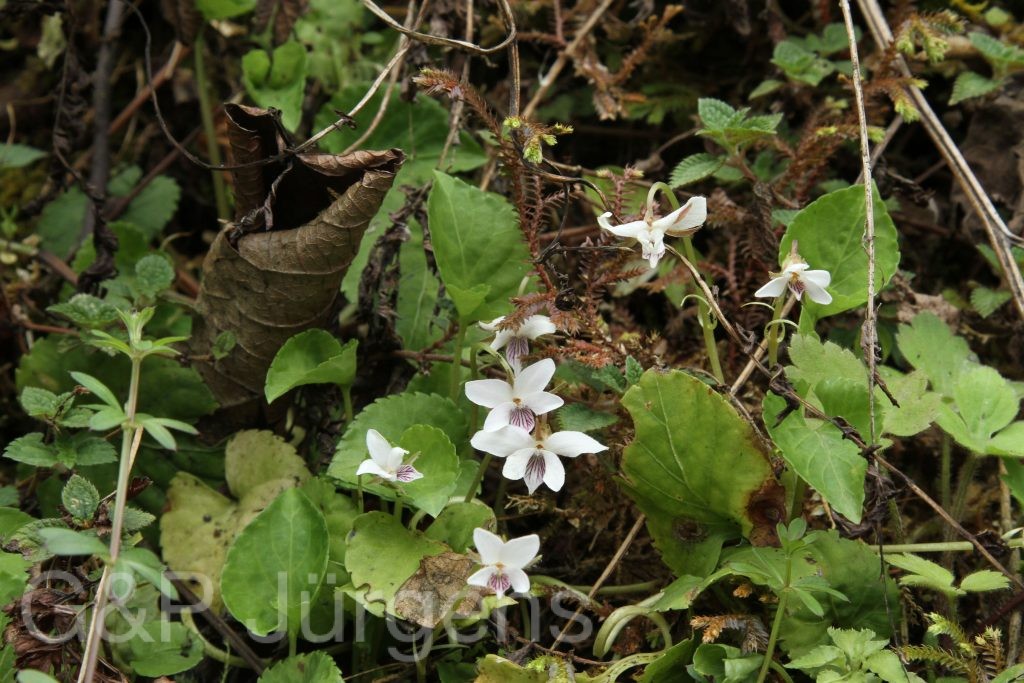
Hara

Bhutan2014 205
Bhutan Trashyangtse 2100m, May

Description

Viola bhutanica is a rare and range-restricted species endemic to Bhutan with marginal occurrence in adjacent parts of southern China. With only eight occurrences recorded in GBIF, it is among the least collected violets in the Himalayan region. The species inhabits moist, shaded forest floors in warm-temperate to subtropical broadleaved forests at elevations of 1,800–2,500 m, growing on humus-rich soils among mosses and leaf litter. The collection from Trashyangtse district in eastern Bhutan at 2,100 m typifies its preferred habitat in the moist valleys of the eastern Himalayan biodiversity hotspot.
Viola bhutanica is a perennial, acaulescent herb with a short, erect rhizome. Leaves are basal, long-petiolate, with ovate to broadly ovate blades 3–6 cm long, cordate at the base, crenate-serrate along the margins, and sparsely pubescent on both surfaces. Peduncles are slender, arising from the rootstock, exceeding the leaves, each bearing a single zygomorphic flower. Flowers are 1.5–2 cm across, with pale violet to lilac petals; the lateral petals are bearded, and the lowest petal bears a short, obtuse spur 3–5 mm long with darker violet veining that serves as a nectar guide. The fruit is an ellipsoid capsule dehiscing explosively by three valves, projecting seeds several centimetres from the parent plant.
Described by H. Hara in 1971, Viola bhutanica remains one of the most poorly known Himalayan violets. Its extreme rarity in herbarium collections and the very low number of GBIF records suggest either genuine scarcity or significant under-collection in its remote eastern Bhutanese habitats. The species belongs to the section Nomimium and is morphologically allied to V. pilosa, differing in its leaf indumentum and spur morphology. Given its highly restricted known range and the increasing pressures of land-use change in subtropical eastern Bhutan, V. bhutanica merits conservation assessment and targeted field surveys to clarify its population status.

Author: Hara · Sources: POWO (Kew), GBIF, Flora of Bhutan Vol. 1, Hara: Flora of Eastern Himalaya (1971), Noltie: Flora of Bhutan Vol. 3 (2000)

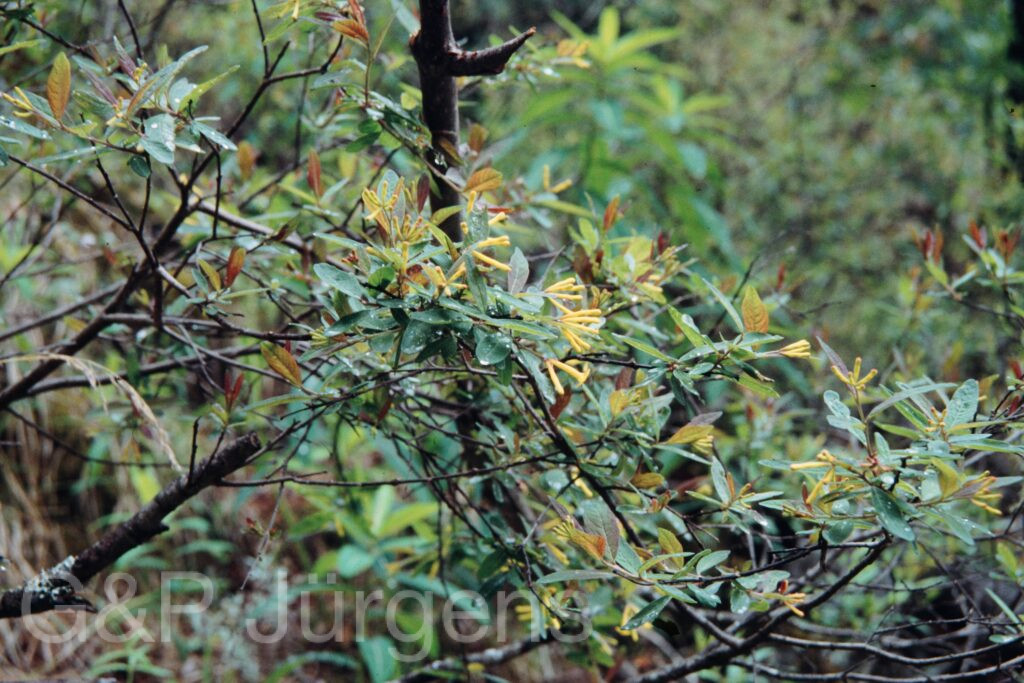
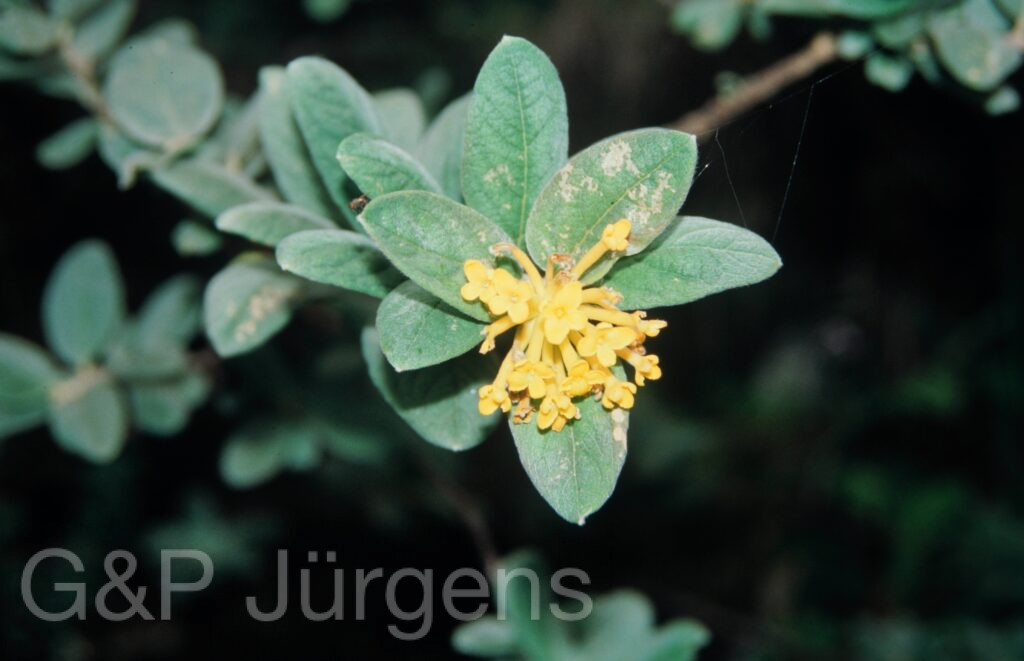
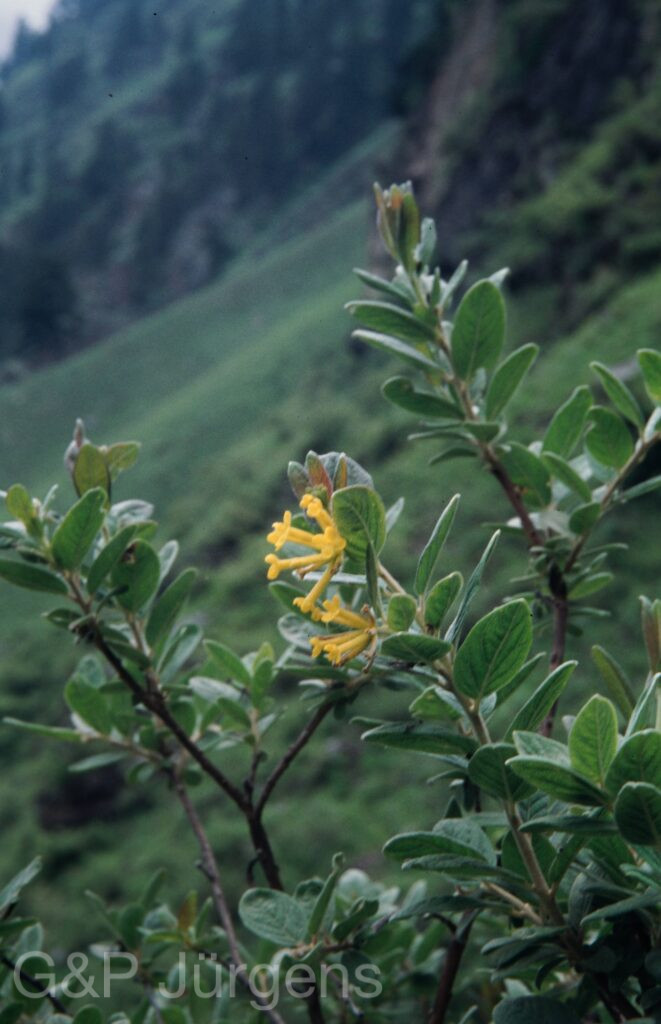
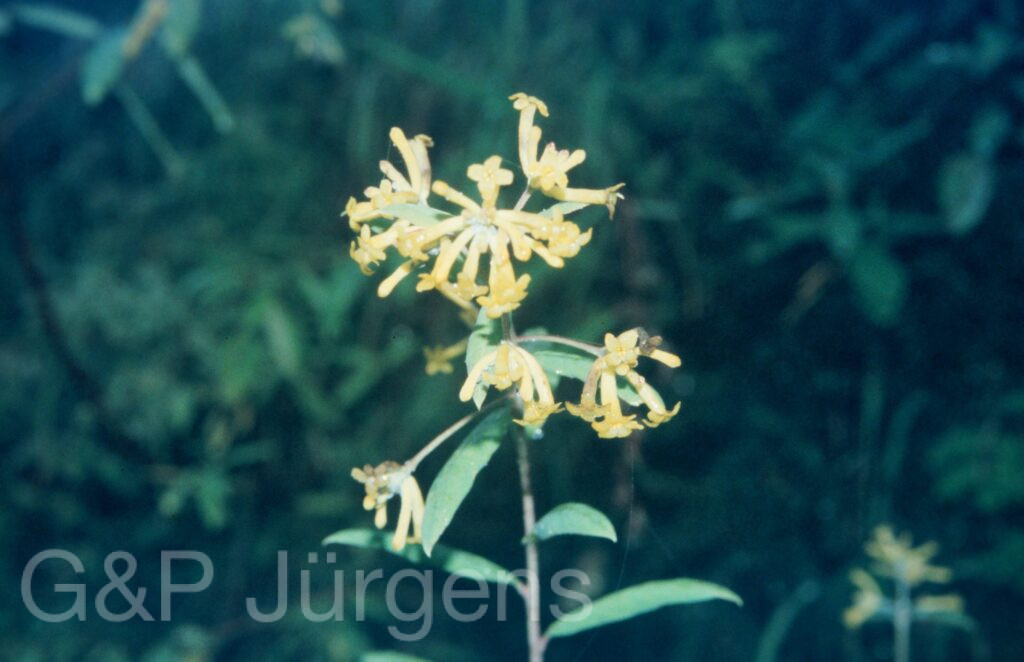
Meisn.

Nepal 99 57 ergebnis
West-Nepal Nyor Gaad 2700m, June
Nepal 99 935 ergebnis 1
West-Nepal Suli-Khola 2700m, July
Nepal 99 933 ergebnis
West-Nepal Ski-Khola 2700m, July
Garw 2005 236 ergebnis ergebnis
India Garhwal Guni 2350m, September

Description

Wikstroemia canescens (Meisn.) is a Himalayan to East Asian shrub of the family Thymelaeaceae, distributed from Pakistan and the northwest Himalaya through India, Nepal and Myanmar to China, Sri Lanka and Japan. The fewer than 600 GBIF records indicate a scattered but characteristically montane occurrence. It inhabits open slopes, forest margins, scrubland and rocky banks in the temperate zone, generally between 1,500 and 3,000 m. The several West Nepal localities at around 2,700 m, recorded from June through July, together with the Garhwal collection from Guni at 2,350 m in September, span its full flowering and fruiting season across the central and western Himalaya.

The plant is an erect, branching shrub up to about 2 m tall, with tough, fibrous bark and young branchlets covered in a fine greyish pubescence, hence the epithet canescens. The leaves are subopposite to alternate, shortly petiolate, elliptic to oblong-lanceolate, entire-margined and somewhat silky beneath. The small, tubular flowers lack petals and consist of a yellow to greenish-yellow, four-lobed calyx tube; they are clustered in short, terminal, head-like or umbellate inflorescences. The fruit is a small, dry to fleshy drupe.

Like many Thymelaeaceae, Wikstroemia canescens possesses an exceptionally strong inner bark rich in long fibres, and in the Himalaya it is used locally for cordage and in the traditional manufacture of hand-made paper, a use shared with the related Daphne species. The genus is closely allied to Daphne, the two differing chiefly in floral merosity and indumentum, and generic boundaries within the group remain debated. The species is widespread and not currently considered threatened.

Author: Meisn. · Sources: POWO (Kew), Flora of Nepal, GBIF, Flora of China Vol. 13, Halda: The Genus Daphne and allied Thymelaeaceae (2001)

(Lindl.) Herb.

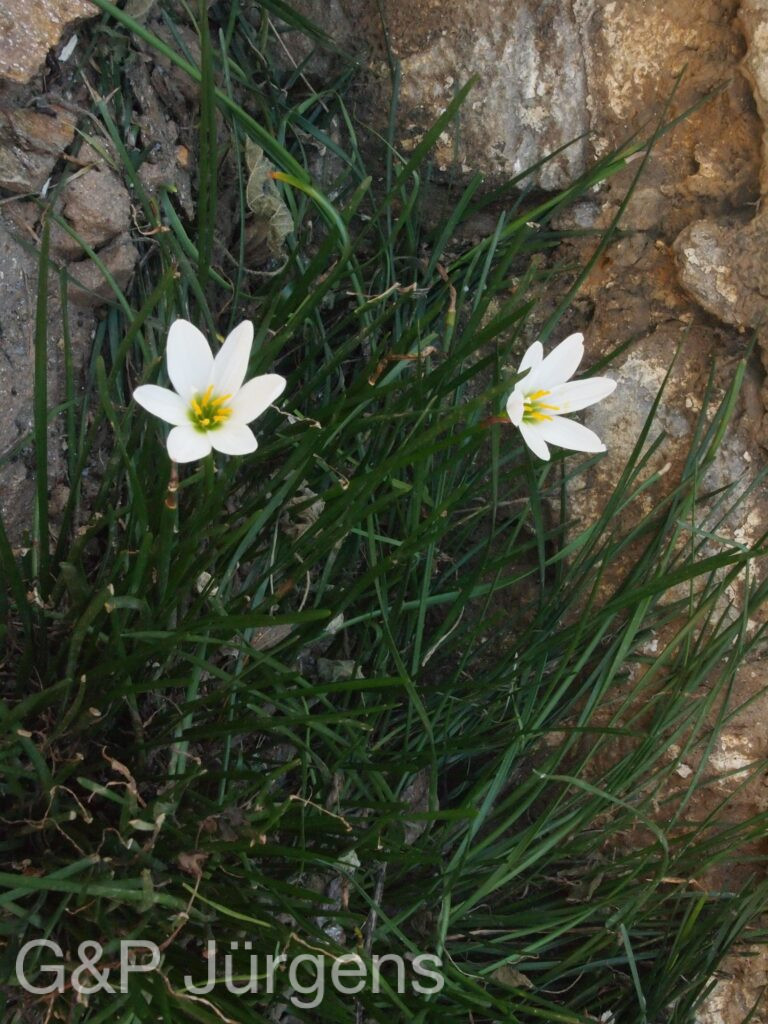
Bhutan2012 1104
Bhutan Khoma 950m, October

Description

Zephyranthes candida is native to the marshlands and riverbanks of the Río de la Plata region in Argentina and Uruguay, but has become one of the most widely naturalised bulbous plants in tropical and subtropical Asia, Africa, and Oceania. GBIF documents over 2,810 occurrences spanning more than 20 countries, with substantial records from the United States, Japan, India, China, and Australia. In the eastern Himalayas, it occurs as a naturalised garden escape in warm valleys and lowland settlements at elevations below 1,500 m. At Khoma in eastern Bhutan at 950 m, it grows along roadsides, field margins, and around homesteads, flowering abundantly in October during the late monsoon and post-monsoon period.
Zephyranthes candida is a bulbous perennial herb. The bulb is ovoid, 2–3 cm in diameter, with a dark brown tunic. Leaves are basal, linear, rushlike, 15–30 cm long and 2–4 mm wide, dark green, semi-erect, and persistent through much of the year. The scape is slender, hollow, 15–25 cm tall, bearing a single erect flower subtended by a tubular spathe. The flower is actinomorphic, crocus-like, 3–5 cm across, with six white tepals that are broadly elliptic and slightly tinged green at the base externally. Stamens are six, subequal, with yellow anthers. The ovary is inferior, trilocular; the fruit is a depressed-globose capsule containing flattened black seeds.
Despite its alien origin, Zephyranthes candida has become thoroughly established across warm regions of the Himalayan foothills and is now a familiar element of the naturalised flora of Bhutan, Nepal, and northeast India. Its rapid vegetative spread via daughter bulbs, tolerance of a wide range of soil moisture conditions, and prolific seed production contribute to its success as a coloniser of disturbed habitats. The species is taxonomically placed in Zephyranthes sensu lato; some recent molecular treatments have subsumed it within an expanded Habranthus, though most regional Floras retain the traditional placement.

Author: (Lindl.) Herb. · Sources: POWO (Kew), GBIF, Flora of China Vol. 24, Flora of Bhutan Vol. 3, Meerow & Snijman: Amaryllidaceae in Kubitzki: Families and Genera of Vascular Plants Vol. 3 (1998)