
Rendle

Description
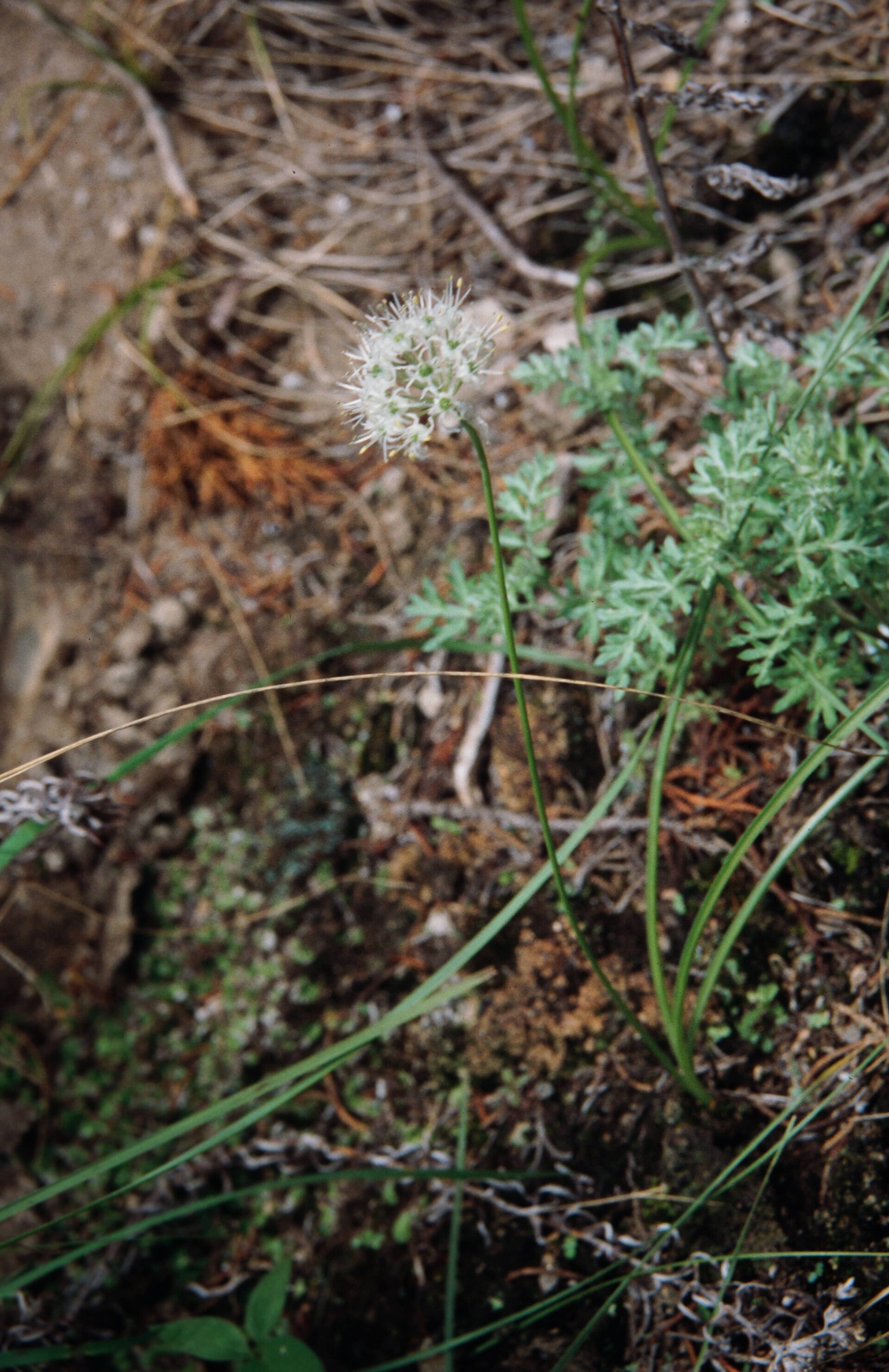
Allium fasciculatum is a Himalayan onion ranging across the central and eastern Himalaya into the south-eastern Tibetan plateau, with GBIF records from China, Nepal, India, Afghanistan and Bhutan and around 325 documented occurrences. It is a plant of open temperate to subalpine slopes, grassy meadows, rocky pastures and forest clearings, generally between about 2,400 and 3,600 m. The plant photographed at Suli Khola in West Nepal at 2,900 m, flowering in July, exemplifies its midsummer anthesis in the moist, monsoon-fed grasslands of the central Himalaya where it often grows among other alpine herbs.
The plant is a bulbous perennial with clustered, narrowly conical to cylindrical bulbs attached to a short rhizome, the outer tunics membranous to fibrous. The leaves are few, basal, linear and flat to channelled, usually shorter than the scape. The inflorescence is a terminal umbel of densely to loosely fascicled flowers borne on a slender solid scape and subtended by a membranous spathe; the small flowers have six free, white to pale pinkish or greenish tepals, exserted or included stamens, and a superior ovary. The fruit is a small loculicidal capsule producing black angular seeds.
The species belongs to Allium, now placed in an expanded Amaryllidaceae (subfamily Allioideae) following molecular systematic revisions that subsumed the former Alliaceae. Within the genus it falls among the Himalayan rhizomatous-bulbed alliums whose delimitation remains partly unresolved. Like many wild alliums it is gathered locally as a flavouring and pot-herb. It is not considered threatened, being widespread and tolerant of grazed montane grassland.
Author: Rendle · Sources: POWO (Kew), Flora of China Vol. 24, Flora of Bhutan Vol. 3, GBIF, Stearn: A Synopsis of the Asiatic species of Allium