Papaveraceae

Prain

Bhutan2012 925
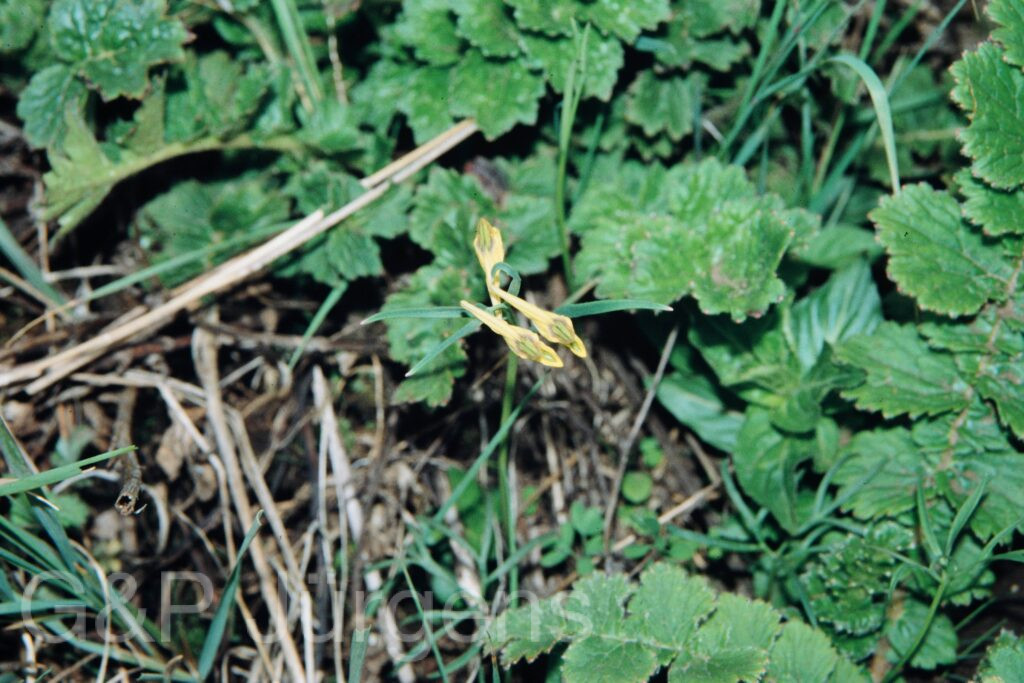
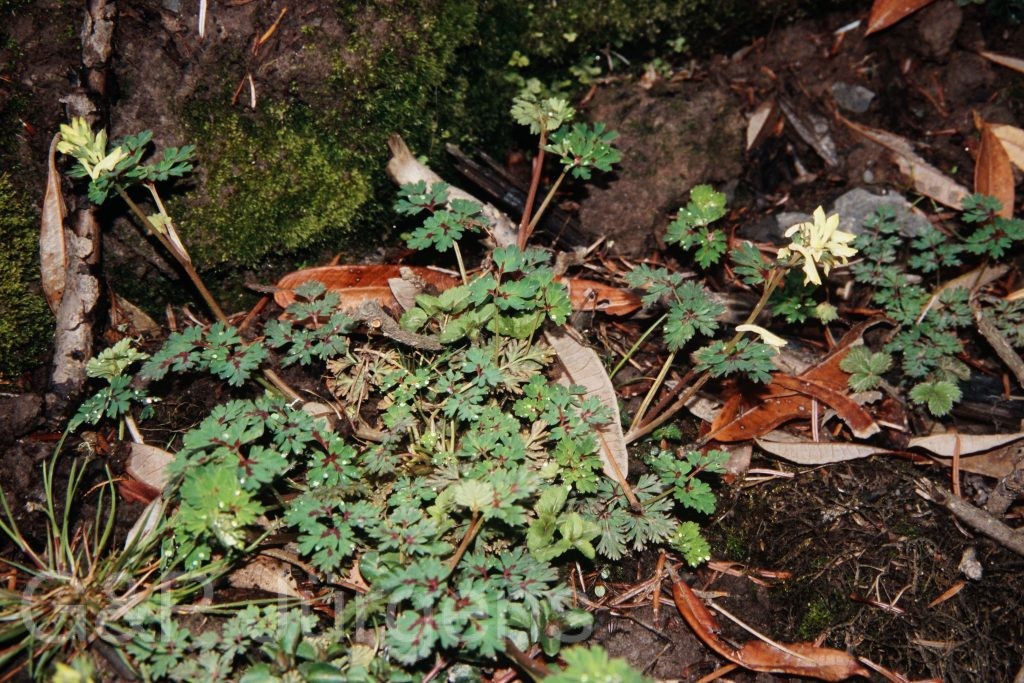
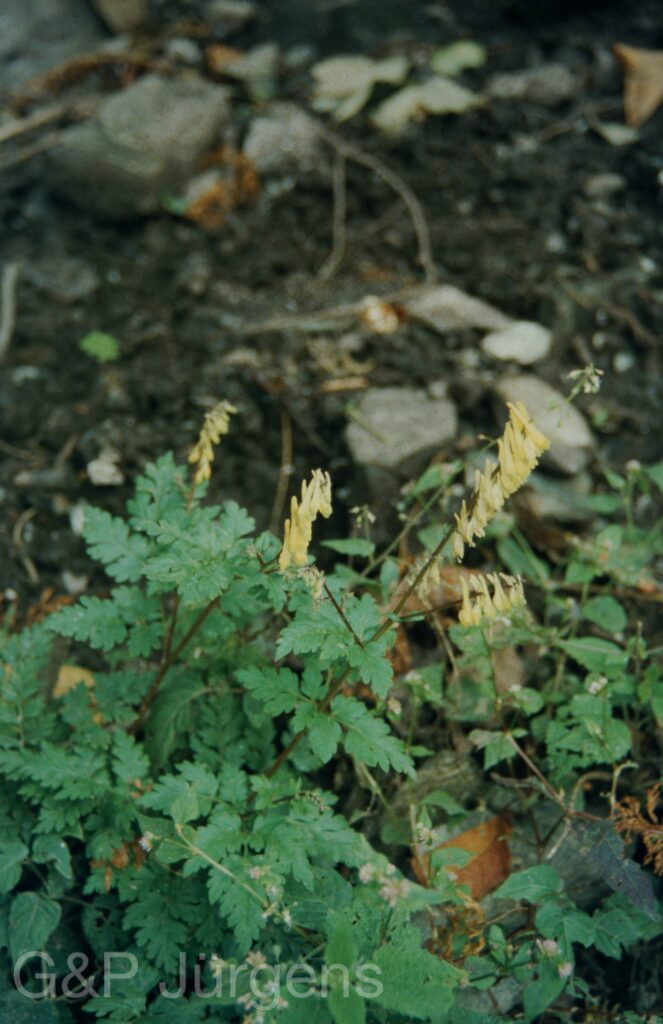
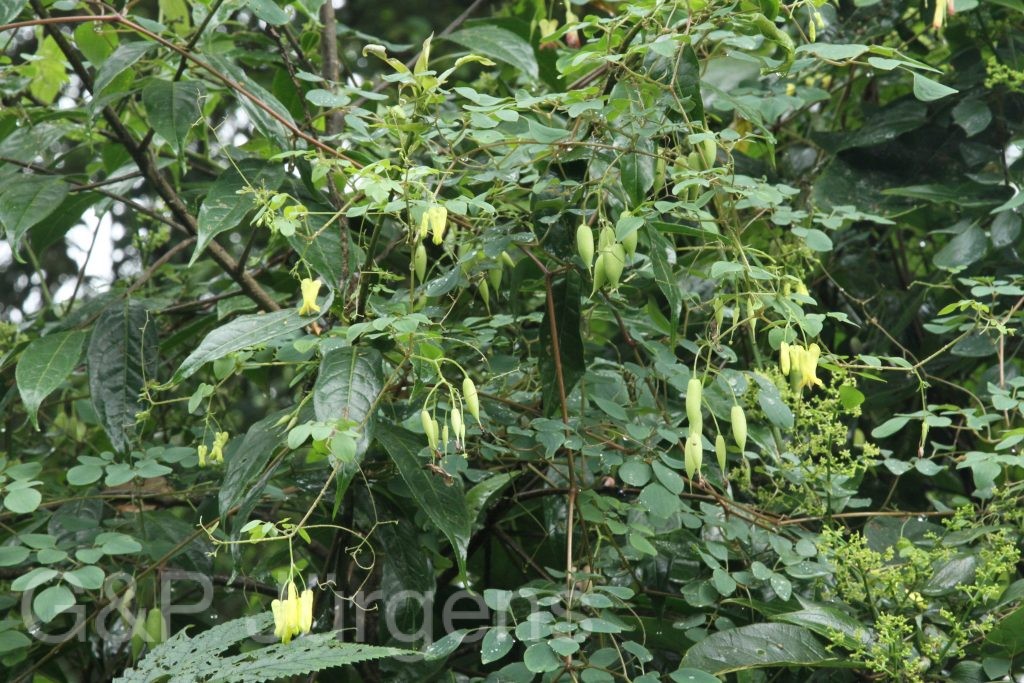
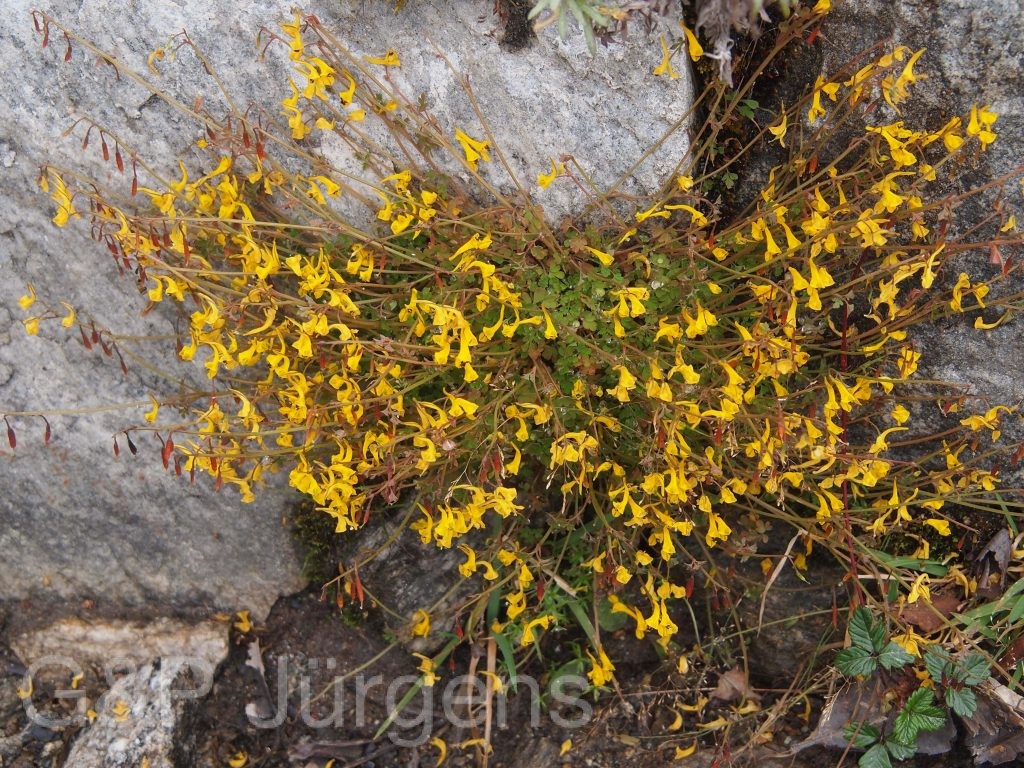
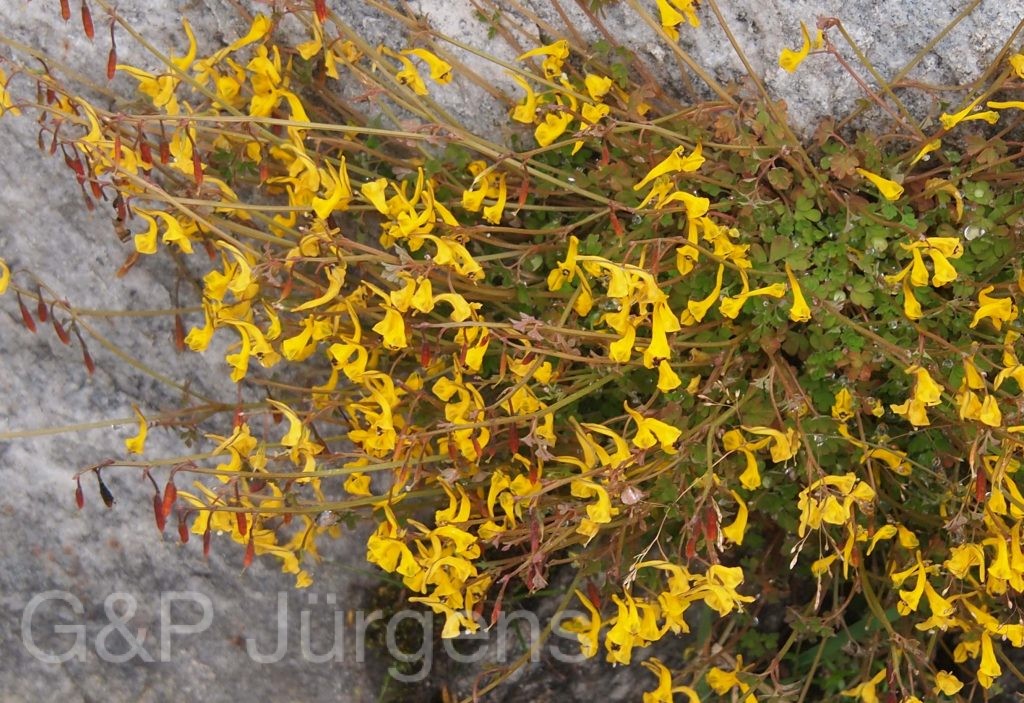
Bhutan Tumching-La 3800m, October
Bhutan2012 926

Description

Corydalis lathyroides Prain is an Eastern Himalayan species known from Nepal, Bhutan and northeastern India (gbif_countries: NP, BT, IN), represented by only 28 occurrences in GBIF, indicative of a narrow range and limited collection. It is a plant of high subalpine to alpine habitats, occurring on open slopes, scree margins, scrub and rocky meadows, with a documented occurrence at Tumching-La in Bhutan at 3800 m, where it was photographed in October. This late-autumn record reflects an extended flowering season at the upper forest-to-alpine transition of the monsoonal eastern ranges.

It is a glabrous, glaucous herb with brittle, somewhat fleshy stems and a deep root or tuberous rootstock. The leaves are alternate, pinnately or ternately divided into oblong to obovate segments, the epithet lathyroides alluding to a vetch-like (Lathyrus) aspect of the foliage. The flowers are borne in terminal racemes; each is strongly zygomorphic with four petals, the upper petal prolonged backward into a conspicuous nectar spur, the colour typically yellow to purplish. The fruit is a slender dehiscent capsule (siliquiform) containing several shining seeds, often with an oil-rich elaiosome.

Corydalis, placed in subfamily Fumarioideae of an expanded Papaveraceae, is an exceptionally large and taxonomically complex genus richly developed in the Sino-Himalaya. The spurred flowers are adapted to long-tongued bees, while elaiosome-bearing seeds promote ant dispersal (myrmecochory). Given its restricted distribution and sparse records, the species merits monitoring, though no formal conservation assessment has been published.

Author: Prain · Sources: POWO (Kew), GBIF, Flora of Bhutan, Annotated checklist of the flowering plants of Nepal, Lidén & Zetterlund monograph of Corydalis
Hook.f. & Thomson

Nepal 99 795 ergebnis
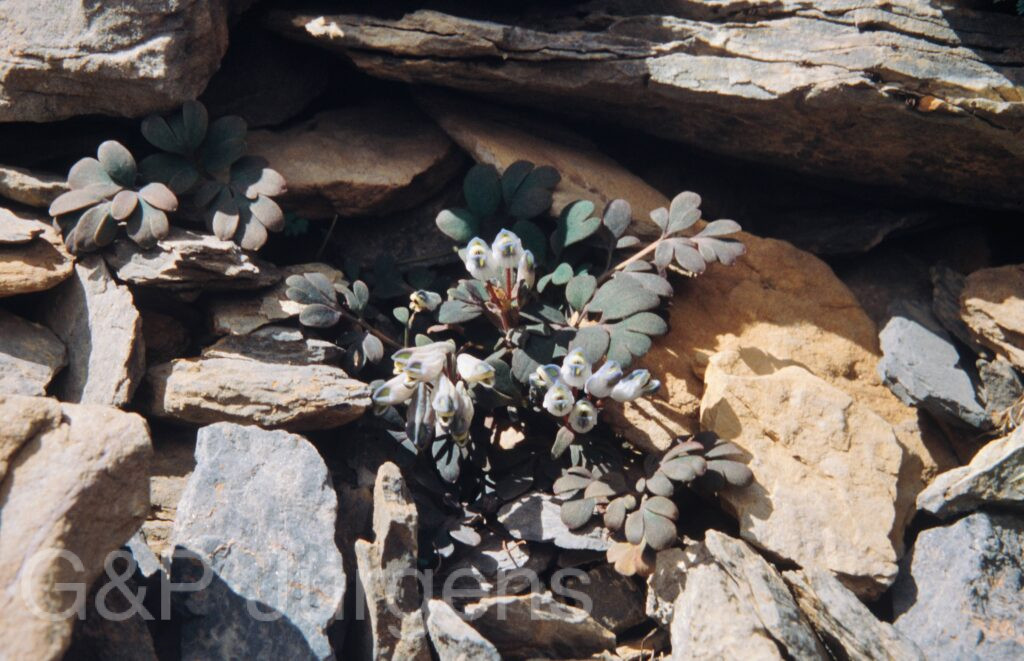
West-Nepal Baga-La-Phedi 4500m, July
Nepal 99 794 ergebnis
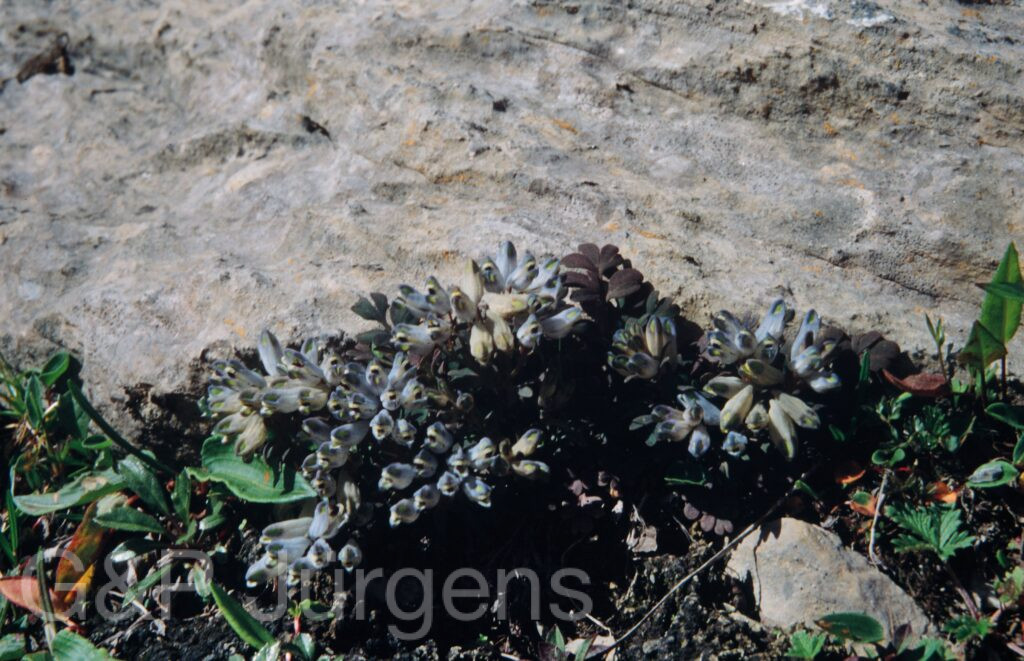
West-Nepal Baga-La-Phedi 4500m, July

Description

Corydalis latiflora is a high-alpine perennial herb of the central and western Himalaya, recorded from Nepal, northern India and Bhutan with some extension into south-western China, a comparatively narrow distribution reflected in around 78 occurrence records. It grows on open screes, moraines, rocky alpine slopes and gravelly flats, typically between about 4000 and 4800 m, well above the treeline. The specimen photographed at Baga-La-Phedi in west Nepal at 4500 m in July illustrates its flowering during the short summer growing season of the high alpine zone.

The plant is a low, often glaucous perennial arising from a slender rootstock or small tuber, with a tuft of finely dissected, several-times divided leaves bearing narrow ultimate segments. The flowering stems carry few-flowered racemes of zygomorphic flowers subtended by leafy or divided bracts; each flower has two small outer petals and two inner petals, the upper outer petal prolonged backwards into a conspicuous spur, the corolla broad and blue to purplish-blue as the epithet latiflora ("broad-flowered") suggests. The fruit is a slender, dehiscent capsule (siliqua-like) opening to scatter small, shining seeds often bearing an elaiosome.

Corydalis (Papaveraceae, subfamily Fumarioideae) is an exceptionally large and taxonomically intricate genus, with a great radiation of blue-flowered alpine species across the Himalaya and Hengduan mountains. C. latiflora belongs to this assemblage of high-elevation specialists. The spurred flowers are pollinated by bumblebees and other long-tongued insects, and the elaiosome-bearing seeds are frequently ant-dispersed (myrmecochory). As a narrow-range alpine endemic, it is of biogeographic interest and potentially sensitive to climatic warming of its high-mountain habitat.

Author: Hook.f. & Thomson · Sources: POWO (Kew), GBIF, Flora of China, Flora of Bhutan, Annotated Checklist of the Flowering Plants of Nepal, Lidén & Zetterlund monograph of Corydalis
Hook.f. & Thomson

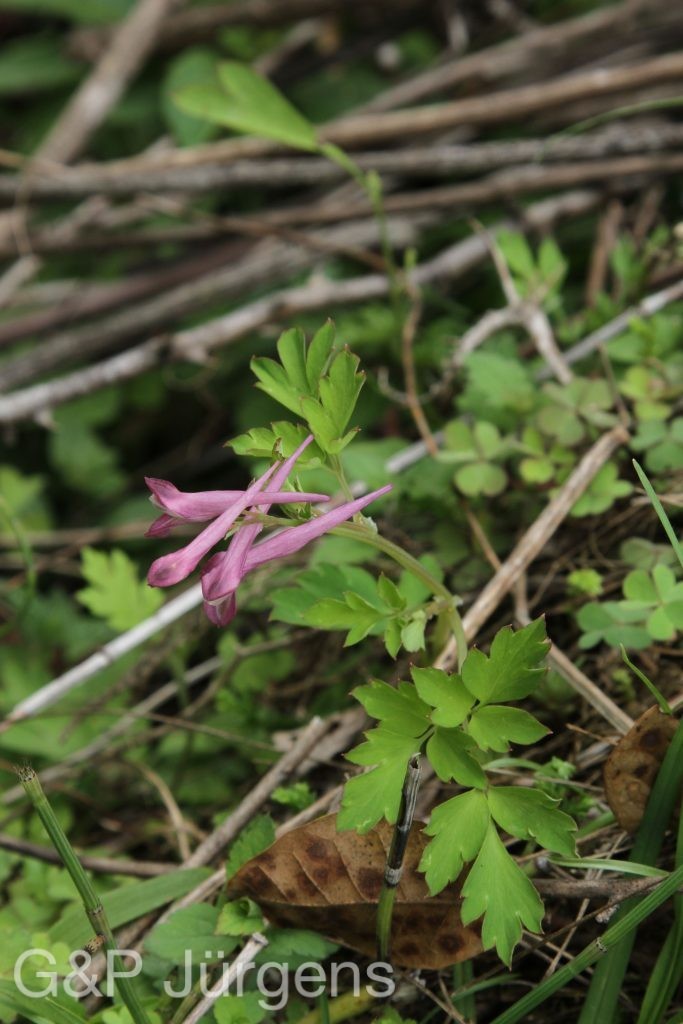
Bhutan2014 185
Bhutan Trachyangtse 2300m, May

Description

Corydalis leptocarpa is a Sino-Himalayan to East Asian fumitory recorded from China, Bhutan, India, Myanmar, Japan, Nepal, Thailand and Korea, with around 163 GBIF occurrences spanning this broad temperate range. It is a plant of shaded, humid forest, woodland margins, mossy banks and damp ravines, typically at montane elevations from roughly 1500 to 3000 m. The individual photographed near Trashiyangtse (Trachyangtse, eastern Bhutan) at about 2300 m in May illustrates its association with moist broad-leaved forest in spring, when the slender stems and pale flowers appear in the dappled understorey.

The species is a slender, erect to ascending annual or short-lived perennial herb with brittle, somewhat glaucous foliage. The leaves are bi- to triternately compound, the ultimate segments ovate and lobed, borne on delicate petioles. The inflorescence is a lax raceme of pale yellow, zygomorphic flowers; each has four petals, the upper outer one prolonged backward into a slender spur, enclosing two stamen bundles and an elongate ovary. The fruit, as the epithet leptocarpa ('slender-fruited') indicates, is a narrow, linear, pendulous capsule that dehisces elastically to scatter the shining black seeds, which often bear an oily elaiosome.

Corydalis is one of the largest genera of the Papaveraceae (subfamily Fumarioideae), exceptionally diverse in the Sino-Himalaya, where hundreds of species occupy habitats from forest floor to alpine scree. C. leptocarpa belongs to the yellow-flowered woodland element of the genus. Many Corydalis species rely on ant-mediated seed dispersal of their elaiosome-bearing seeds. With its wide East Asian range and tolerance of forest-edge habitats it is not considered threatened, though it remains tied to intact montane forest cover.

Author: Hook.f. & Thomson · Sources: POWO (Kew), GBIF, Flora of China, Flora of Bhutan, Annotated Checklist of the Flowering Plants of Nepal, Lidén & Zetterlund monograph of Corydalis
Ludlow & Stearn

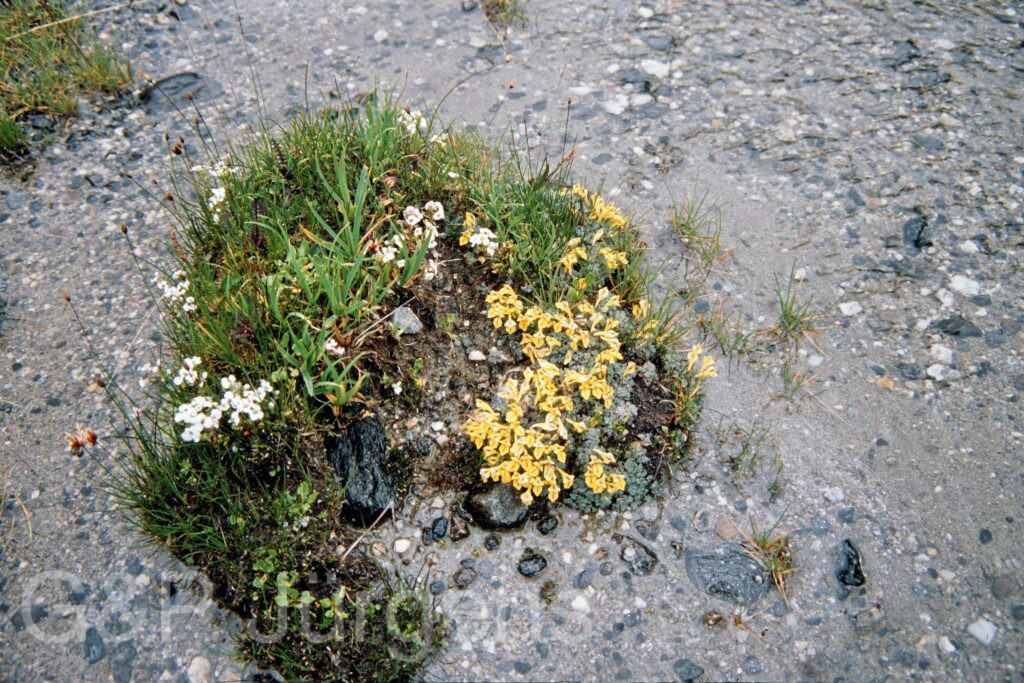
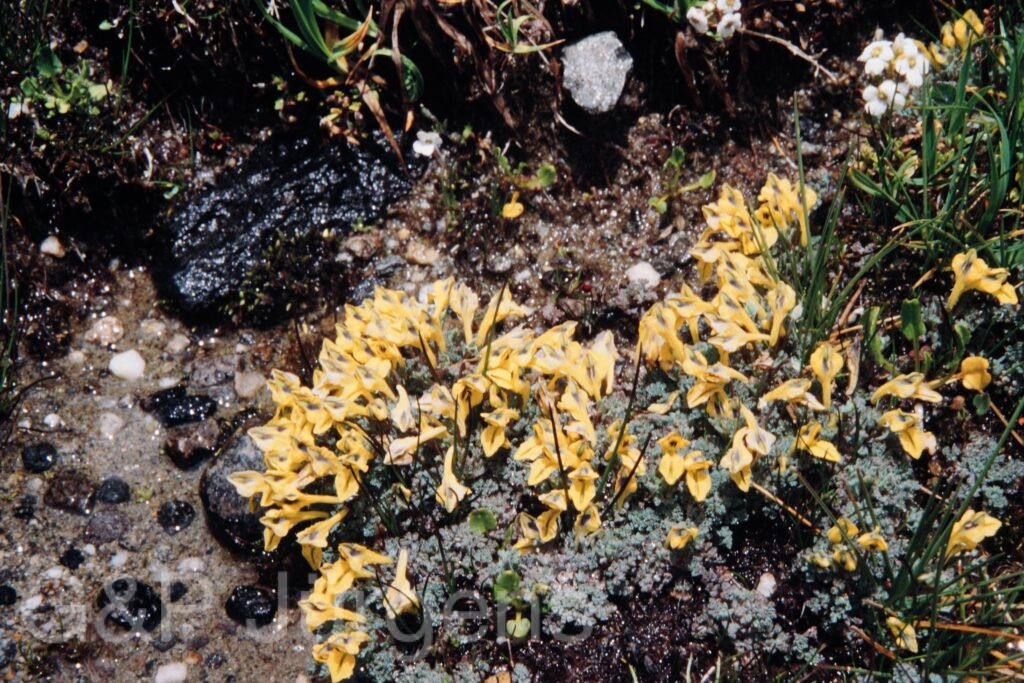
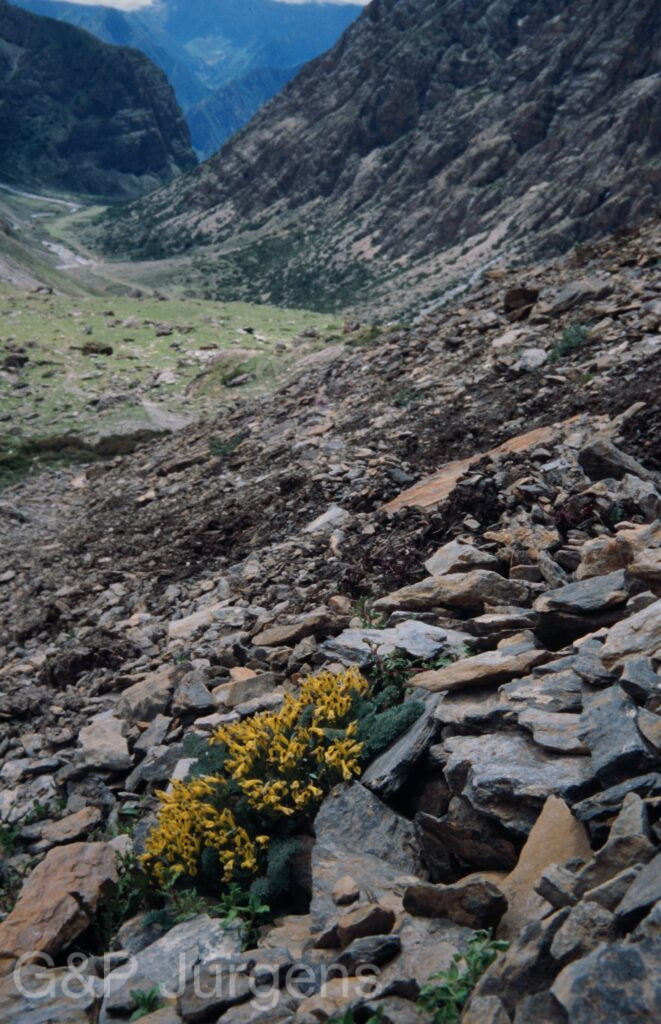
Nepal 99 518 ergebnis
West-Nepal Churta-Khola 3800m, June
Nepal 99 520 ergebnis
West-Nepal Churta-Khola 3800m, June
Nepal 99 788 ergebnis
West-Nepal Baga-La-Phedi 4400m, July

Description

Corydalis megacalyx Ludlow & Stearn is a narrowly distributed Himalayan endemic known with certainty only from Nepal, where GBIF records just 37 occurrences. It is a plant of the subalpine and alpine zones, growing on damp rocky slopes, screes, moraine debris and stream banks where moisture from snowmelt is reliable. The photographed populations in West Nepal, at Churta-Khola around 3800 m in June and at Baga-La-Phedi near 4400 m in July, indicate a habitat band roughly between 3800 and 4400 m and a flowering period coinciding with the early monsoon thaw of the western Nepalese high country.

The species is a glabrous, somewhat fleshy perennial herb arising from a slender rootstock. Stems are ascending to erect, bearing alternate, glaucous leaves that are divided into rather broad, lobed segments. The inflorescence is a few- to several-flowered terminal raceme; the flowers are strongly zygomorphic, with a conspicuously enlarged calyx that gives the species its epithet megacalyx. Each blue to purplish-blue flower bears a single posterior spur and the crested outer petals typical of the genus. The fruit is an elongate dehiscent capsule containing small black seeds furnished with elaiosomes.

Within Corydalis, this species belongs to the blue-flowered Himalayan alpine assemblage and is distinguished by its prominent persistent calyx, an unusual feature in a genus where sepals are usually small and caducous. Like its relatives, it is pollinated by long-tongued insects able to access the spur and is dispersed by ants. Its restricted known range and low occurrence count make it a species of biogeographic interest and potential conservation concern, though its remote high-altitude habitat affords some protection from direct human pressures.

Author: Ludlow & Stearn · Sources: POWO (Kew), GBIF, Flora of Nepal, Flora of China, Lidén & Zetterlund monograph of Corydalis, Stearn studies of Himalayan Corydalis

Wall.

Nepal 99 628 ergebnis
West-Nepal Kagmara-La 4950m, July

Description

Corydalis meifolia Wall. is a high-alpine herb distributed along the Himalaya and adjacent ranges, with GBIF documenting some 251 occurrences across India, Nepal, China, Bhutan and Pakistan, with outliers reaching Japan. It is a plant of the upper subalpine and alpine zones, typically growing between roughly 3500 and 5200 m on open, gravelly slopes, moraine flushes, screes and damp meadow margins where snowmelt persists. The photographed population at the Kagmara-La in West Nepal, at about 4950 m in July, exemplifies its preference for cold, well-drained substrates that thaw only briefly during the short montane summer.

The species is a glabrous, somewhat glaucous perennial arising from a slender taproot. Stems are erect to ascending, often several from the base, and the foliage is finely divided: the leaves are two- to three-pinnate with narrow, almost filiform ultimate segments, recalling the foliage of Meum (hence the epithet meifolia). The inflorescence is a dense terminal raceme of zygomorphic flowers; each flower is yellow, bearing the characteristic single posterior spur of the genus, with the outer petals expanded and crested. The fruit is a slender, dehiscent capsule containing small black seeds, typically each bearing an oil-rich elaiosome.

Within the large and taxonomically complex genus Corydalis, C. meifolia belongs to a Himalayan assemblage of yellow-flowered, finely dissected alpine species and is morphologically variable across its range, with several segregate taxa described. Like many high-elevation Papaveraceae it relies on insect pollination during the brief flowering window and on seed dispersal by ants attracted to the elaiosomes. The species remains locally frequent across its broad montane distribution and is not considered threatened, though populations are confined to the narrow, climatically sensitive alpine belt.

Author: Wall. · Sources: POWO (Kew), GBIF, Flora of China, Flora of Nepal, Flora of Bhutan, Lidén & Zetterlund monograph of Corydalis
Ludlow & Stearn

Bh2008 36 P59
Bhutan Dochu-La 2850m, April

Description

Corydalis oligantha is an apparently Bhutanese endemic, the only GBIF records (about 6) deriving from Bhutan and described from there by Ludlow and Stearn. It is a plant of moist, shaded temperate habitats, growing on humus-rich banks, forest floors, mossy rock crevices and damp clearings, around 2800 to 3000 m. The specimen illustrated from Dochu-La in western Bhutan at 2850 m in April, flowering early in spring as the snow recedes, exemplifies its preference for cool, moisture-retentive woodland margins and its brief vernal growing season.

It is a slender, often glaucous herb with watery sap and a fleshy rootstock or small tuber. The leaves are alternate and finely dissected, ternately or pinnately compound into narrow segments, giving the delicate, fern-like aspect typical of the genus. The flowers, comparatively few in the lax raceme as the epithet oligantha (few-flowered) implies, are strongly zygomorphic: each has four petals, the upper one prolonged backwards into a conspicuous nectar spur, the inner pair coherent over the stamens and stigma, the colour generally yellow to purplish. The fruit is a slender, two-valved dehiscent capsule releasing several shining seeds, often bearing an elaiosome.

Corydalis is an exceptionally large and taxonomically difficult genus that radiates spectacularly across the Sino-Himalaya, and narrow endemics such as C. oligantha contribute to Bhutan's distinctive alpine and temperate flora. The spurred, bilabiate flowers reflect specialised pollination by long-tongued bees, while seed elaiosomes promote ant dispersal. With an extremely restricted range and very few documented occurrences, this species is potentially of high conservation concern and would benefit from targeted survey and assessment.

Author: Ludlow & Stearn · Sources: POWO (Kew), GBIF, Flora of Bhutan, Ludlow & Stearn studies of Bhutan plants, Flora of China (Papaveraceae), Lidén & Zetterlund monograph of Corydalis
Ludlow & Stearn

Nepal 99 135 ergebnis
West-Nepal South of Rara-Lake 3800m, June

Description

Corydalis pseudojuncea is a poorly collected high-Himalayan herb known from a narrow range across Nepal, northern India and adjacent south-western China (Tibet), with only 14 GBIF records reflecting both its restricted distribution and the remoteness of its habitat. It occupies open alpine and subalpine ground – stony slopes, moraine flats and seasonally moist gravels – in the inner ranges. The cited gathering from south of Rara Lake in West Nepal at 3800 m in June places it in the early-summer flowering flush of the western Nepalese alpine zone, where snowmelt briefly supports such ephemeral fumitories.

It is a slender, glabrous and somewhat glaucous perennial herb arising from a small tuber or fleshy rootstock, the rush-like ("juncea") aspect alluded to in its epithet given by the few, narrow, much-reduced leaves and the wiry erect stems. The leaves are finely dissected into linear segments. The flowers are borne in a lax terminal raceme, zygomorphic and spurred in the manner of the genus, the outer two petals one of which bears a long backward-pointing nectar spur, the inner pair connate over the stigma; the corolla is pale yellow to bluish. The fruit is a slender dehiscent capsule releasing few shining seeds.

Corydalis is an exceptionally large genus with a Sino-Himalayan diversity centre, and C. pseudojuncea, described by Ludlow and Stearn, belongs among the narrow-leaved alpine species. Its spurred flowers indicate long-tongued bee pollination. Given its rarity in collections and limited known range it warrants monitoring, though insufficient data exist for a formal threat assessment.

Author: Ludlow & Stearn · Sources: POWO (Kew), GBIF, Flora of China, Annotated Checklist of the Flowering Plants of Nepal, Flora of Bhutan, Lidén & Zetterlund monograph of Corydalis
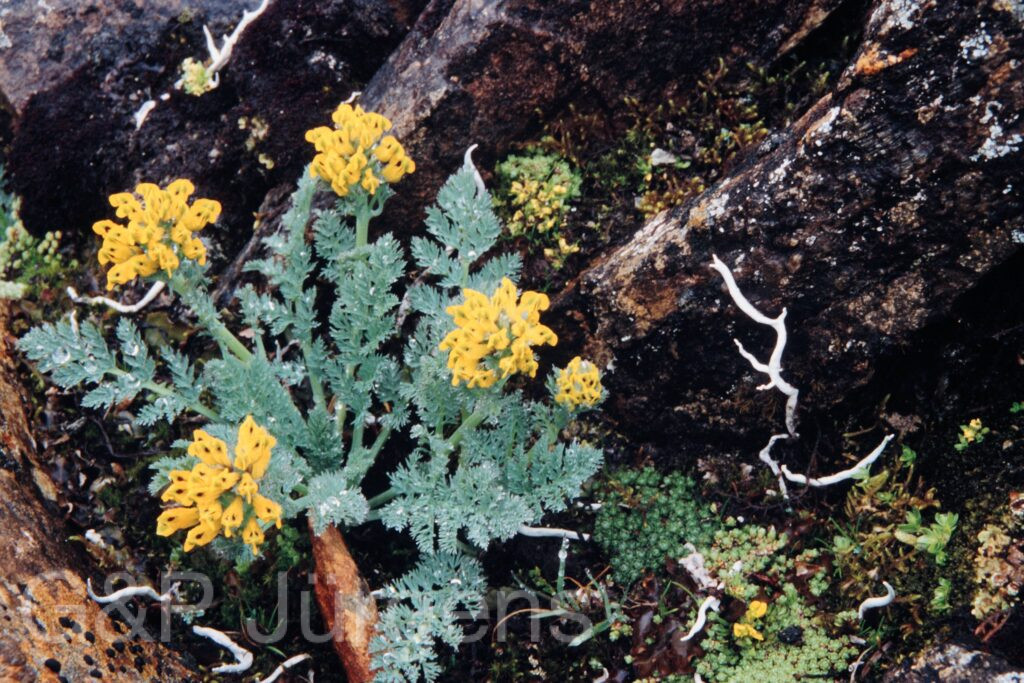
(Prain) Fedde

Bh2008 379 G589
Bhutan Gogona 3200m, May

Description

Corydalis sikkimensis is an Eastern Himalayan endemic distributed across the high mountains of Sikkim and adjacent India, eastern Nepal, Bhutan and southern Xizang (China), with GBIF documenting 18 georeferenced collections from these four countries (IN, NP, BT, CN). It occupies the subalpine to lower alpine belt, typically between 3000 and 4000 m, growing in moist shaded conifer and Rhododendron forest margins, on humus-rich banks, beside snow-melt rivulets and among damp rocks. The photographed plant from Gogona in central Bhutan at about 3200 m in May illustrates its phenology, flowering with the early summer monsoon when soils are saturated and light is filtered through the forest canopy.

It is a slender, glabrous, glaucous perennial herb arising from a small fibrous-rooted or shortly tuberous rootstock. The erect to ascending stems bear thin, several-times ternately or pinnately divided leaves, the ultimate segments ovate to obovate and often shallowly lobed, the lower leaves long-petiolate. Flowers are borne in lax terminal racemes subtended by small entire or toothed bracts; each zygomorphic flower comprises four petals, the upper petal produced into a slender, somewhat curved or decurved spur, the inner petals connate at the apex and crested. The corolla is typically blue to purplish-blue. The fruit is a narrow dehiscent capsule containing small black shining seeds.

A member of the large and taxonomically intricate genus Corydalis (Papaveraceae, subfamily Fumarioideae), the species belongs to the predominantly Sino-Himalayan radiation centred on the eastern Himalaya and Hengduan Shan. Like many congeners it is pollinated by long-tongued bumblebees attracted to the spurred corolla, and its alkaloid-rich tissues are characteristic of the family. Though restricted in range, it occurs in remote, little-disturbed high-elevation habitats and is not presently regarded as threatened, but its narrow endemism makes it sensitive to climate-driven shifts in the alpine zone.

Author: (Prain) Fedde · Sources: POWO (Kew), GBIF, Flora of China Vol. 7, Flora of Bhutan Vol. 1, Flora of Nepal, Monograph of the genus Corydalis (Lidén & Zetterlund)

Royle

Garw 2005 427 ergebnis
India Garhwal Didina 2470m, September

Description

Corydalis vaginans is a Sino-Himalayan herb of the western and central Himalaya, with georeferenced collections concentrated in India, Pakistan and Nepal; GBIF records some 164 occurrences. It is a plant of cool, humid temperate to subalpine zones, favouring shaded forest margins, moist rocky banks, stream sides and clearings within Quercus and Abies forest. The image, taken near Didina in Garhwal (India) at about 2470 m in September, illustrates its typical late-season flowering in this moist mid-montane belt, where it grows among ferns and tall herbs on humus-rich, well-drained slopes.

The plant is a slender, glaucous, glabrous annual or short-lived perennial arising from a slender taproot. Stems are erect to ascending, somewhat fleshy and ribbed, branched above. The leaves are alternate, the lower long-petiolate and conspicuously sheathing at the base (the epithet vaginans referring to these dilated sheaths), the blades two- to three-pinnately divided into ovate to cuneate, lobed segments. Flowers are borne in lax terminal and axillary racemes, zygomorphic and yellow, with two outer petals one of which is spurred and the inner petals connate and crested. The fruit is a slender, dehiscent siliquiform capsule containing several shining black seeds with an elaiosome.

Within the large, taxonomically intricate genus Corydalis, this species belongs to the predominantly Asian assemblage of mesophytic, sheathing-leaved annuals, distinct from the tuberous spring-flowering groups. Its ant-dispersed seeds (myrmecochory) and shade-tolerant habit allow colonisation of disturbed forest soils. Though not assessed as threatened, populations are localised and dependent on intact temperate forest cover, sensitive to deforestation and grazing in the western Himalaya.

Author: Royle · Sources: POWO (Kew), GBIF, Flora of Pakistan, Flowers of the Himalaya (Polunin & Stainton), Lidén & Zetterlund monograph of Corydalis
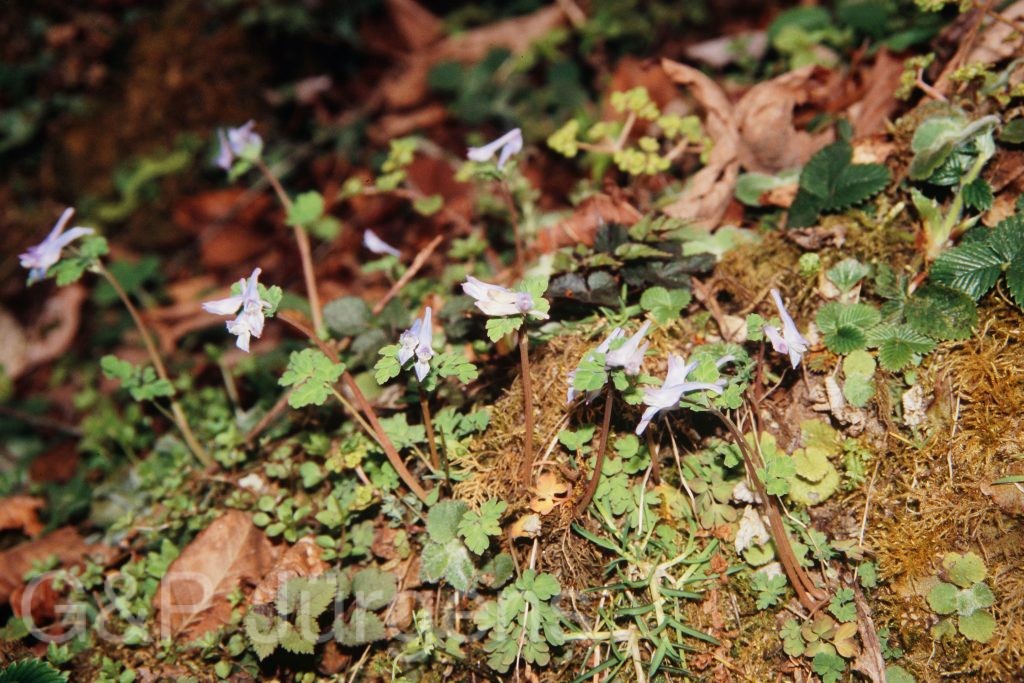
(Fedde.) Hand.-Mazz.

Bhutan2012 678
Bhuitan Tserang 1300m, June

Description

Dactylicapnos lichiangensis (Fedde) Hand.-Mazz. is a scandent herbaceous climber of the Fumarioideae, distributed across the eastern Himalaya and the Sino-Himalayan transition zone. GBIF records (136 occurrences) confirm its presence in southwest China (notably Yunnan, where the epithet references the Lijiang district) and Bhutan, where it ascends into the subtropical and warm-temperate belts. The species was photographed at Tserang in Bhutan at 1,300 m in June, a typical setting along moist forest margins, shaded ravines, and shrubby thickets where it scrambles over neighbouring vegetation. It favours humid, sheltered microhabitats on well-drained slopes between roughly 1,200 and 2,800 m.

The plant is a delicate, glabrous annual or short-lived perennial with slender, brittle, much-branched stems that climb by means of tendril-like terminations of the much-divided leaves. The foliage is biternately to triternately compound, the ultimate segments ovate to lanceolate, glaucous beneath. The pendent, few-flowered racemes bear distinctive yellow, heart-shaped flowers; the outer pair of petals is saccate at the base, forming a dorsal pouch characteristic of the genus, enclosing the inner petals. The fruit is a slender capsule containing several glossy black seeds, each typically bearing an elaiosome that promotes myrmecochorous dispersal.

Dactylicapnos was segregated from Dicentra on the basis of its climbing habit and tendrillar leaves, and lichiangensis sits within a cluster of yellow-flowered Sino-Himalayan species often confused in herbaria. Like many Fumarioideae it contains isoquinoline alkaloids of pharmacological interest. Although not formally assessed as threatened, its restricted distribution and dependence on intact forest-edge habitat make local populations sensitive to deforestation.

Author: (Fedde.) Hand.-Mazz. · Sources: POWO (Kew), Flora of China Vol. 7, Flora of Bhutan Vol. 1, GBIF, Lidén & Fukuhara: Taxonomy of Fumariaceae (1997)