
Royle
Description
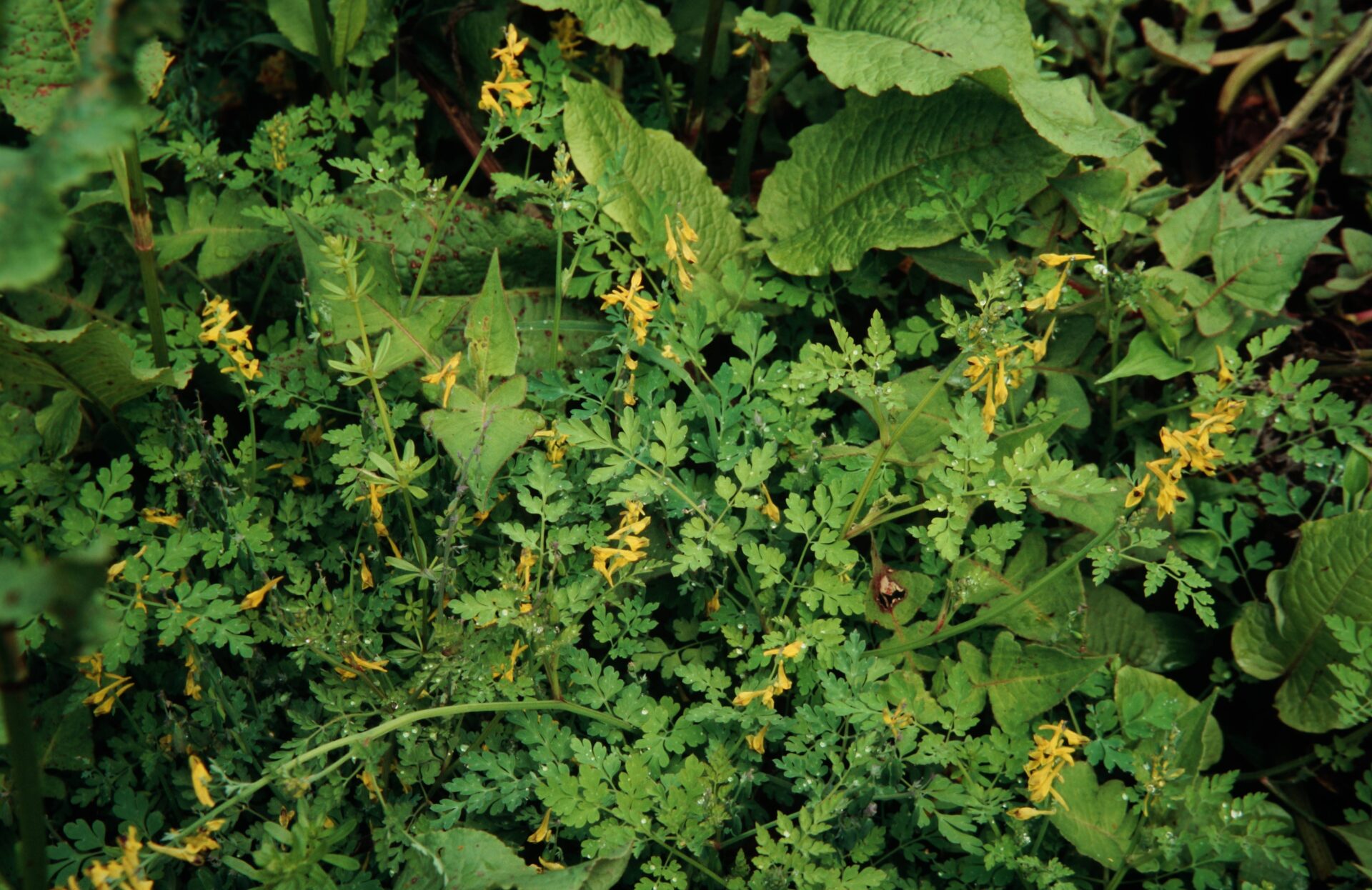
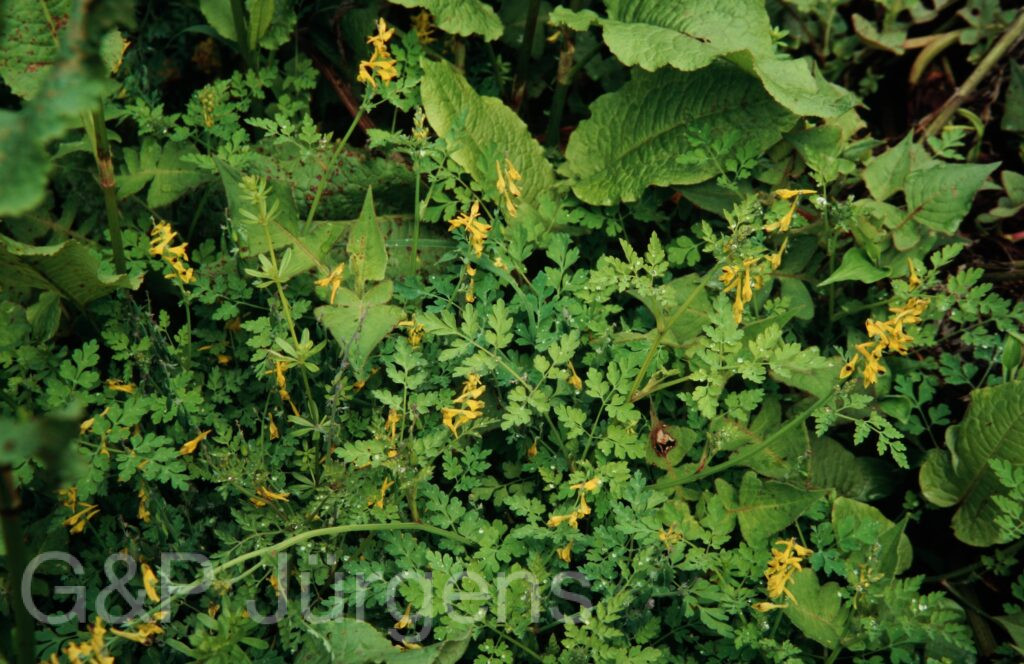
Corydalis cornuta is a Himalayan fumitory whose reliable distribution lies along the temperate ranges of Nepal, India, Pakistan, Afghanistan and adjacent China; GBIF returns 273 occurrences, though several listed countries reflect database artefacts rather than genuine native populations. It grows in moist shaded sites, on damp banks, forest floors, ledges and cultivated terrace margins in the temperate belt, broadly between about 1800 and 3000 m. The illustrated plant was recorded in Nepal, in Helambu near Bolgoau, at around 2000 m in May, a typical mid-montane spring station where the slender annual completes its cycle before the monsoon.
The plant is a delicate, glabrous annual herb with brittle, often branched stems arising from a slender root. Leaves are alternate and two- to three-pinnately dissected into small obovate to cuneate ultimate segments, the foliage glaucous and somewhat fern-like. The flowers are borne in short, leaf-opposed or terminal racemes; each is strongly zygomorphic and yellow, with four petals in two whorls, the outer upper petal prolonged backwards into a slender nectar spur and the inner pair connate over the stigma. There are two stamens, each split into three (diadelphous), and a superior ovary that ripens into a narrow, linear, dehiscent capsule shedding shining black seeds.
Corydalis is treated here within an expanded Papaveraceae (incorporating the former Fumariaceae), consistent with the input family. POWO and GBIF accept the name. The genus is enormously diverse in the Himalaya and Tibet, and the spurred yellow-flowered annuals such as this form a distinctive ecological group of the moist temperate forest floor.
Author: Royle · Sources: POWO (Kew), GBIF, Flora of Pakistan, Annotated Checklist of the Flowering Plants of Nepal, Flora of China, The Genus Corydalis (Papaveraceae/Fumariaceae monograph)