
Prain
Description
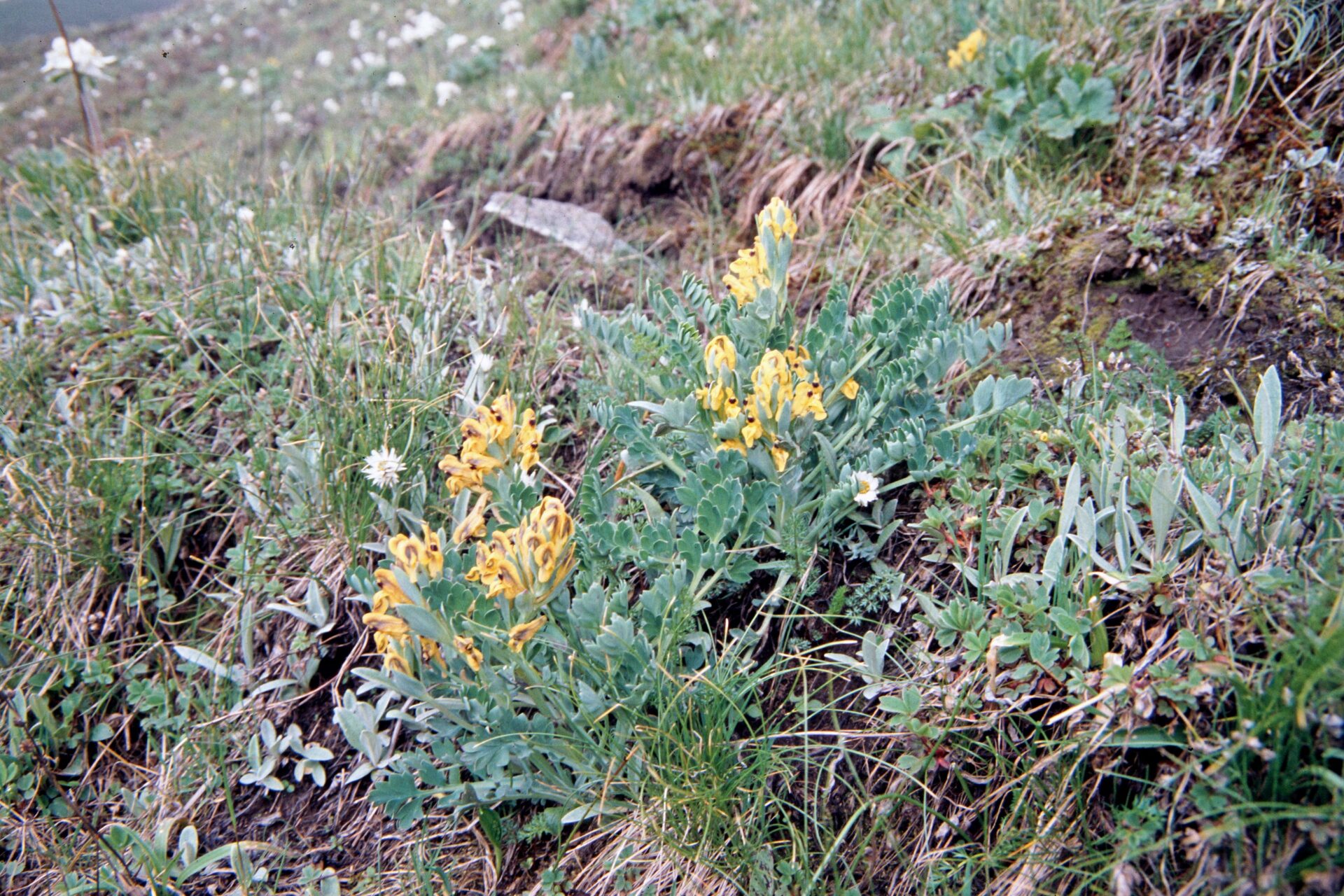
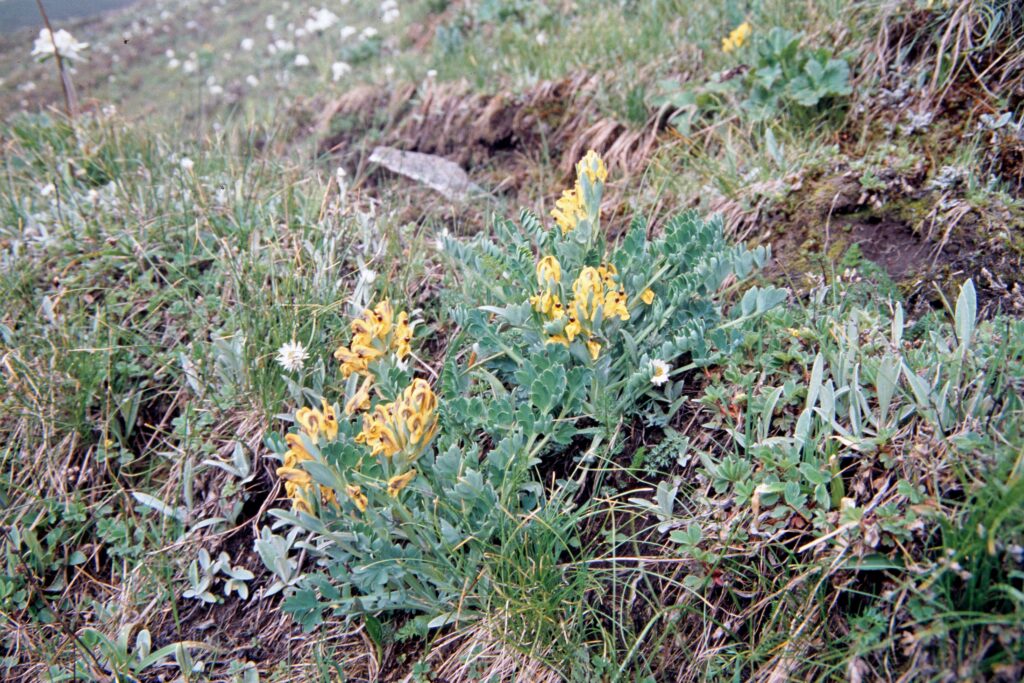
Corydalis hookeri is a high-alpine herb of the central and eastern Himalaya, recorded from Nepal, India, Bhutan and the adjacent Chinese provinces of the Tibetan plateau and Yunnan. GBIF aggregates roughly 111 georeferenced occurrences, a modest figure reflecting both its restricted alpine niche and the difficulty of access to its terrain. It occupies open stony slopes, moist screes, moraine debris and the margins of melting snow-beds, typically between 3500 and 4800 m. The photographed plant from Kalomura in Nepal at about 4050 m in June illustrates its characteristic flowering season, coinciding with the brief window following snowmelt when the short alpine summer permits rapid growth and anthesis on freshly exposed gravels.
The species is a small, glabrous, somewhat glaucous perennial arising from a slender tuberous or fibrous rootstock. The stems are weak, often decumbent to ascending and few-branched. Leaves are mostly basal and long-petiolate, the blades two- to three-ternately or pinnately dissected into narrow oblong to linear ultimate segments, imparting a delicate, finely divided aspect. The inflorescence is a lax few-flowered raceme subtended by entire or lobed bracts. Each zygomorphic flower bears four petals, the upper one prolonged backwards into a slender curved spur; the corolla is blue to purplish-blue, frequently with darker tips, an adaptation favouring bumblebee pollination at altitude. The fruit is a slender dehiscent capsule containing several small black shining seeds, often bearing an elaiosome.
Taxonomically the genus Corydalis is exceptionally species-rich in the Sino-Himalayan region, the principal centre of its global diversity, and C. hookeri belongs to one of the alpine blue-flowered assemblages whose delimitation has long challenged monographers. Its seeds are typically myrmecochorous, dispersed by ants attracted to the oily appendage, while the alkaloid-rich tissues characteristic of the genus deter herbivory. No specific conservation threat is documented and the plant appears locally frequent within suitable habitat, though high-altitude endemics of this kind remain potentially sensitive to glacial retreat and warming-driven upward shifts of the alpine zone.
Author: Prain · Sources: POWO (Kew), GBIF, Flora of China Vol. 7, Flora of Bhutan Vol. 1, Flora of Nepal, Lidén & Zetterlund Corydalis: A Gardener's Guide and a Monograph of the Tuberous Species