Gentianaceae

Harry Sm.

BhutanPG2011 341
Bhutan Jule-Tso, 4000m June

Description

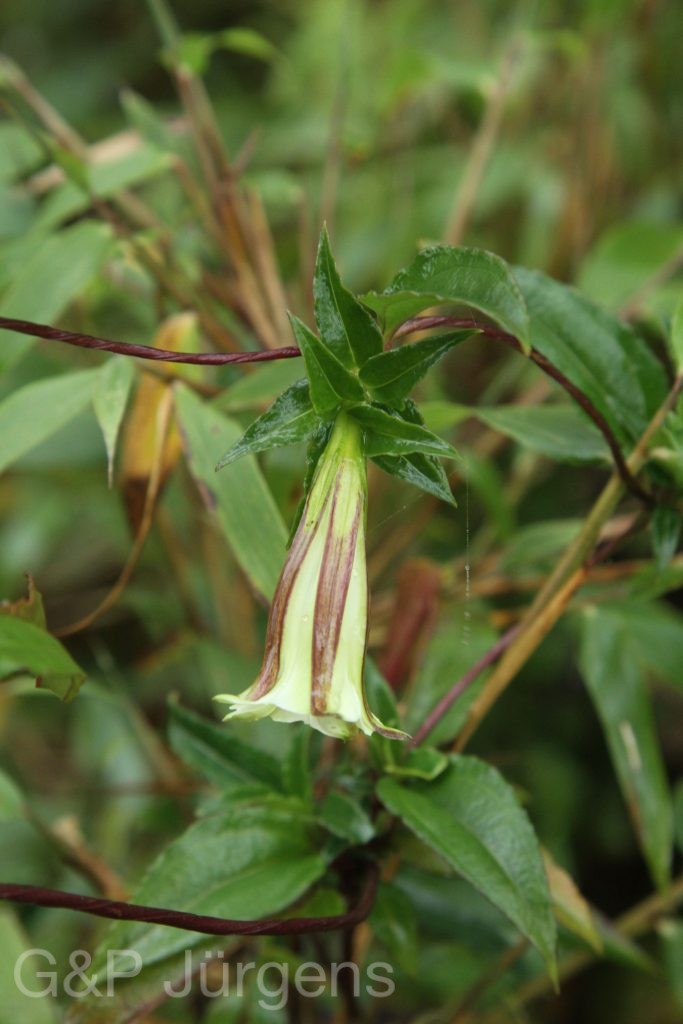
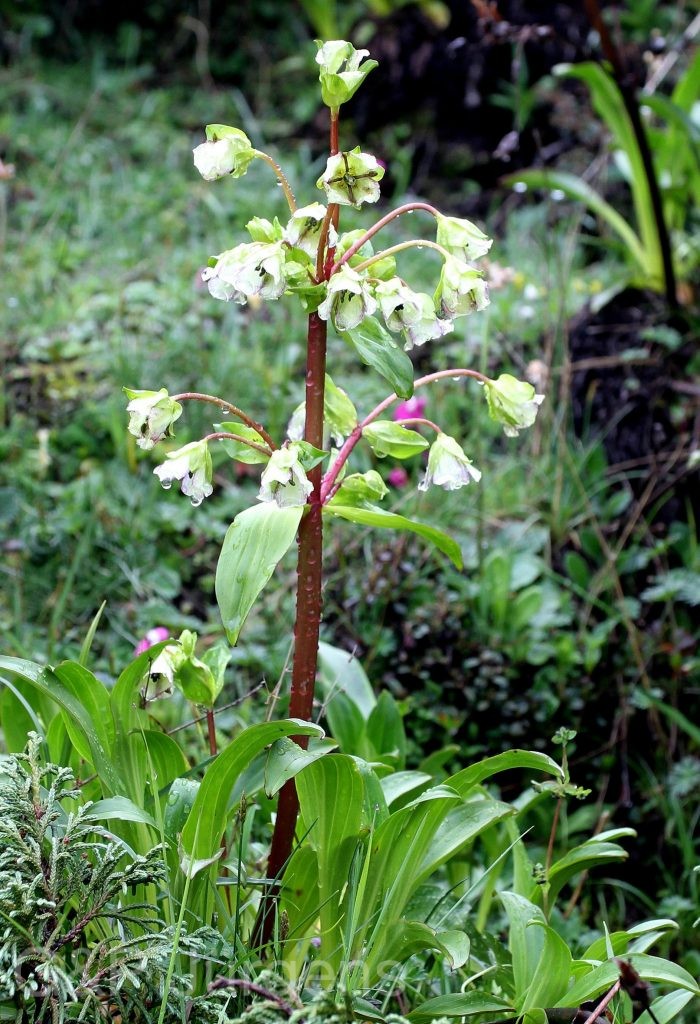
Swertia pseudohookeri is an eastern Himalayan species recorded from Bhutan, Nepal and India, represented in occurrence databases by a modest 17 georeferenced records that reflect both its restricted distribution and its limited collection. It is a plant of high-alpine habitats—moist meadows, open turf, streamsides and the damp margins of glacial lakes—generally near and above 4000 m. The illustrated population at Jule-Tso in Bhutan, photographed at 4000 m in June, typifies its occurrence around tarns and snowmelt flushes where it flowers in the brief alpine summer.

It is an erect annual or short-lived perennial herb with a slender, often quadrangular and sometimes narrowly winged stem arising from a fibrous root. The leaves are opposite, sessile and lanceolate to ovate, with the basal leaves usually larger and the upper ones progressively reduced and bract-like. The inflorescence is a lax, few- to many-flowered cyme; the flowers are typically four- to five-merous with a deeply divided rotate corolla, the lobes pale to bluish or purplish and marked with darker veining, each bearing nectary pits fringed with fimbriae. The fruit is a septicidal, ovoid capsule containing numerous small seeds.

The epithet pseudohookeri, coined by Harry Smith, signals its close morphological resemblance to Swertia hookeri, from which it is distinguished by floral and nectary characters. Swertia is a large, taxonomically intricate genus in the Gentianaceae whose Himalayan members have long been used in traditional medicine for their bitter secoiridoid compounds. Owing to its narrow range and high-elevation niche, S. pseudohookeri is potentially vulnerable to climatic shifts and habitat disturbance, though it has not been formally evaluated.

Author: Harry Sm. · Sources: POWO (Kew), GBIF, Grierson & Long Flora of Bhutan, Annotated Checklist of the Flowering Plants of Nepal, Flora of China (Gentianaceae), Harry Smith's monographic studies on Asiatic Swertia
G.Don

Garw 2005 59 ergebnis ergebnis
India Garhwal Valley of flowers 3400m, September

Description

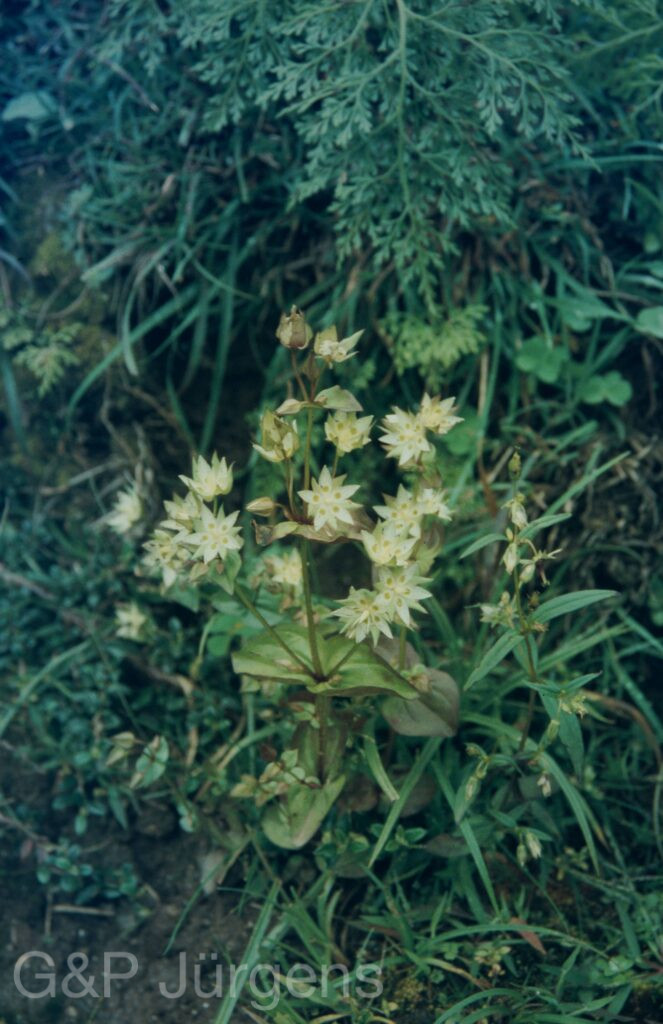
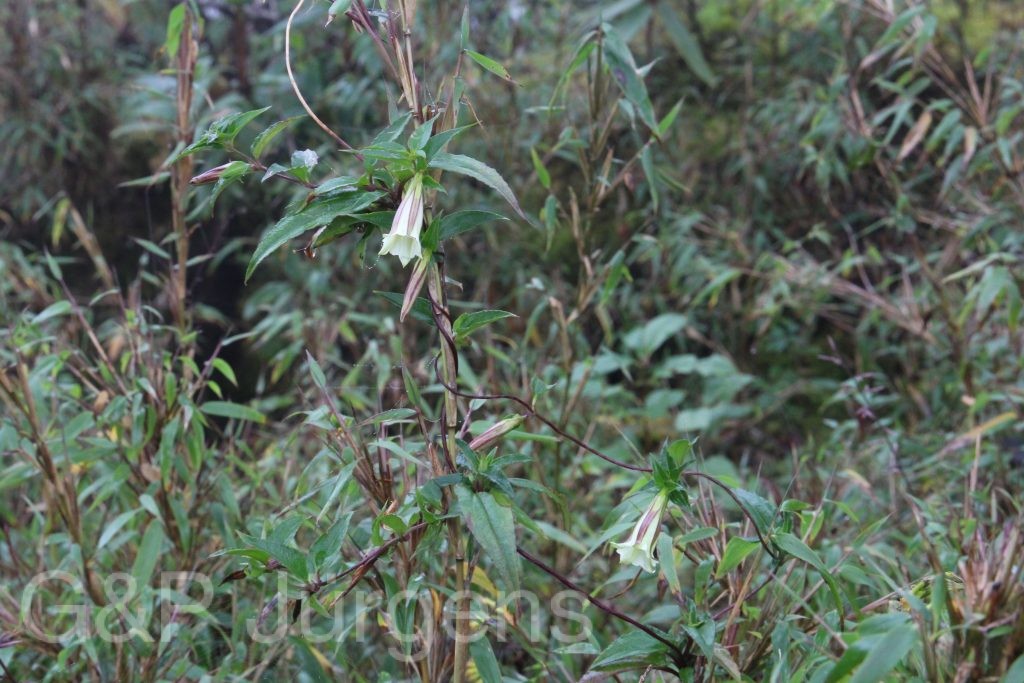
Swertia speciosa is a robust Himalayan gentian distributed through India, Pakistan, Nepal and China, the roughly 132 georeferenced records spanning the moist temperate and subalpine zones of the western and central Himalaya. It favours damp, open situations: tall-herb meadows, forest clearings, streamsides, shrubberies and grassy slopes, generally between about 2700 and 3900 m. The plant was photographed in the Garhwal Valley of Flowers at 3400 m in September, a habitat typical of the species, where it flowers in the late monsoon among lush herbaceous vegetation on cool, humus-rich soils.

It is one of the largest swertias, a stout erect biennial or short-lived perennial herb reaching well over a metre, with a hollow, often purple-tinged, four-angled stem. The leaves are large, ovate to elliptic, prominently several-nerved, the basal ones petiolate and the cauline ones sessile and opposite. The inflorescence is a broad, leafy, much-branched panicle of numerous flowers. Each flower is four- or five-merous with a rotate, greenish-yellow corolla conspicuously veined and dotted with dark purple, the lobes bearing paired fringed nectary pits (foveolae) near the base. The fruit is a many-seeded ovoid capsule splitting septicidally.

Swertia (tribe Gentianeae) is a large Old World genus in which species are separated chiefly by nectary number, position and the form of their marginal fringes, and S. speciosa is distinguished by its great stature and richly veined corolla. Like its relatives it is rich in bitter secoiridoid glycosides and is gathered in Himalayan folk medicine as a tonic and febrifuge, sold under the trade complex of "chiretta." Though widespread and not formally assessed as threatened, such medicinal harvesting warrants monitoring of wild stands.

Author: G.Don · Sources: POWO (Kew), GBIF, Flora of China, Annotated Checklist of the Flowering Plants of Nepal, Flowers of the Himalaya (Polunin & Stainton)

H.Hara

Bhutan2015 23
Bhutan Dochu-La 3000m, October
Bhutan2015 25
Bhutan Dochu-La 3000m, October

Description

Tripterospermum nigrobaccatum is an eastern Himalayan twining gentian recorded from Nepal, Bhutan and India, and is among the least-collected taxa in this set with only about 11 GBIF occurrences. It is a forest plant of the temperate zone, scrambling through shaded broadleaved and mixed forest, shrubby margins and mossy banks, broadly between about 2500 and 3500 m. The photograph from the Dochu-La in Bhutan at 3000 m in October reflects its autumn flowering and fruiting, when this well-known forested pass carries a rich understorey flora in the cooling post-monsoon months.

Unlike the erect alpine gentians, it is a slender, herbaceous perennial climber or trailer with twining stems. The leaves are opposite, ovate to lanceolate, acuminate and three- to five-veined, borne on a vine-like stem. The flowers are solitary or few in the leaf axils, with a campanulate to narrowly funnel-shaped corolla that is blue to purplish, the five lobes alternating with small plicate folds in the sinuses as is typical of the Gentianeae. Most diagnostic is the fruit: rather than a dry capsule, Tripterospermum produces a fleshy berry, here ripening black or blackish (the meaning of "nigrobaccatum"), containing flattened, often winged seeds.

The genus Tripterospermum was segregated from Crawfurdia and Gentiana on the basis of its climbing habit, baccate fruit and three-winged or angled seeds, and is centred on East and Southeast Asia. The fleshy fruits suggest at least partial bird dispersal, contrasting with the wind-dispersed capsules of most gentians. Its narrow range and few records make it a plant of biogeographic note, though no formal conservation assessment is established.

Author: H.Hara · Sources: POWO (Kew), GBIF, Flora of Bhutan, Flora of China, Gentianaceae of the World (Ho & Pringle / Struwe)