Polygonaceae

Greuter & Burdet

Bhutan2015 483
Bhutan Pele-La 3100m, October
Sikkim2003 410 G570
Sikkim Zemu Valley 3400m August

Description

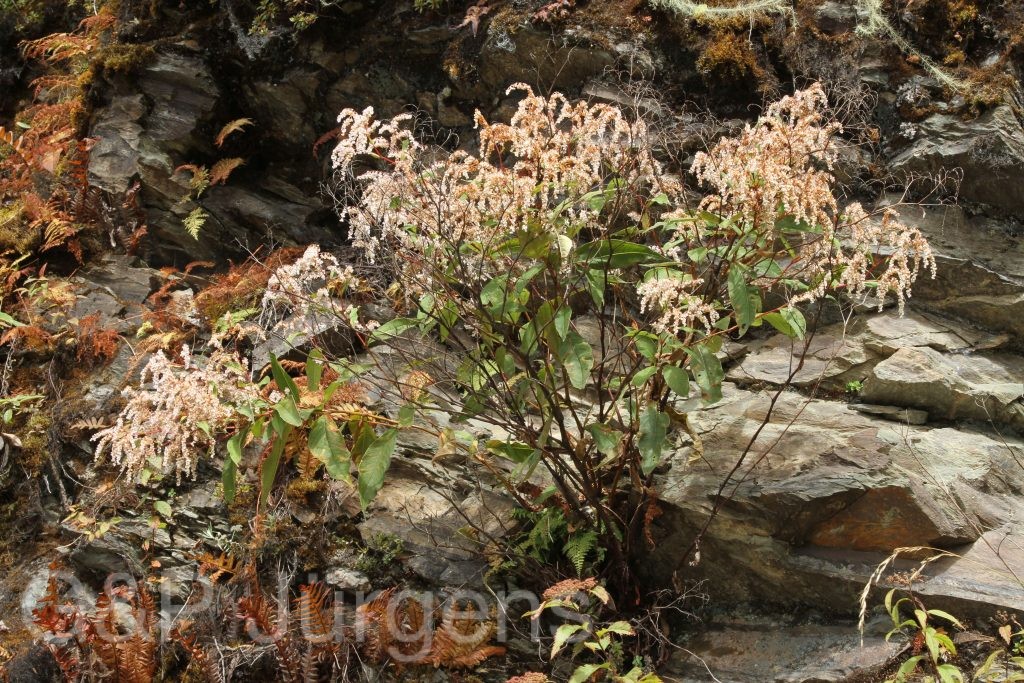
Persicaria wallichii (the accepted name under which this taxon is listed, the binomial here being treated as a synonym in GBIF) is a robust perennial knotweed native to the Himalaya and adjacent mountains of China and Myanmar, where it occupies open hillsides, forest margins, riverbanks and disturbed ground in the temperate and subalpine zones. From its Himalayan homeland it has spread widely as an introduced and frequently invasive plant, the GBIF dataset recording it across much of Europe as well as North and South America and New Zealand, totalling well over a thousand occurrences. The illustrated plants from Pele-La in Bhutan at 3100 m, flowering in October, and from the Zemu Valley in Sikkim at 3400 m in August, exemplify its native montane setting.

The plant forms tall, spreading clumps from a vigorous, far-creeping rhizome, with erect to ascending stems that are reddish-tinged and somewhat woody at the base. The leaves are large, ovate-lanceolate to triangular, acuminate, cordate to truncate at the base, often white-tomentose beneath, and subtended by membranous, brownish ochreae sheathing the swollen nodes. The numerous small flowers are borne in much-branched, lax panicles of slender spike-like racemes; each flower has a white to pinkish perianth of five tepals enclosing eight stamens and a trifid style. The fruit is a small, glossy, three-angled (trigonous) achene enclosed by the persistent perianth.

Formerly placed in Polygonum and Aconogonon (reflected in the synonymy and field labels), the species sits within a much-revised section of Persicaria. Its dense rhizomatous growth allows it to form persistent thickets, and outside its native range it behaves as an aggressive colonist of riverbanks and waste ground, prompting management concern in several countries; within the Himalaya it remains a common and ecologically benign component of moist montane vegetation.

Author: Greuter & Burdet · Sources: POWO (Kew), GBIF, Flora of Bhutan, Flora of China (Polygonaceae), Annotated Checklist of the Flowering Plants of Nepal
D.Don

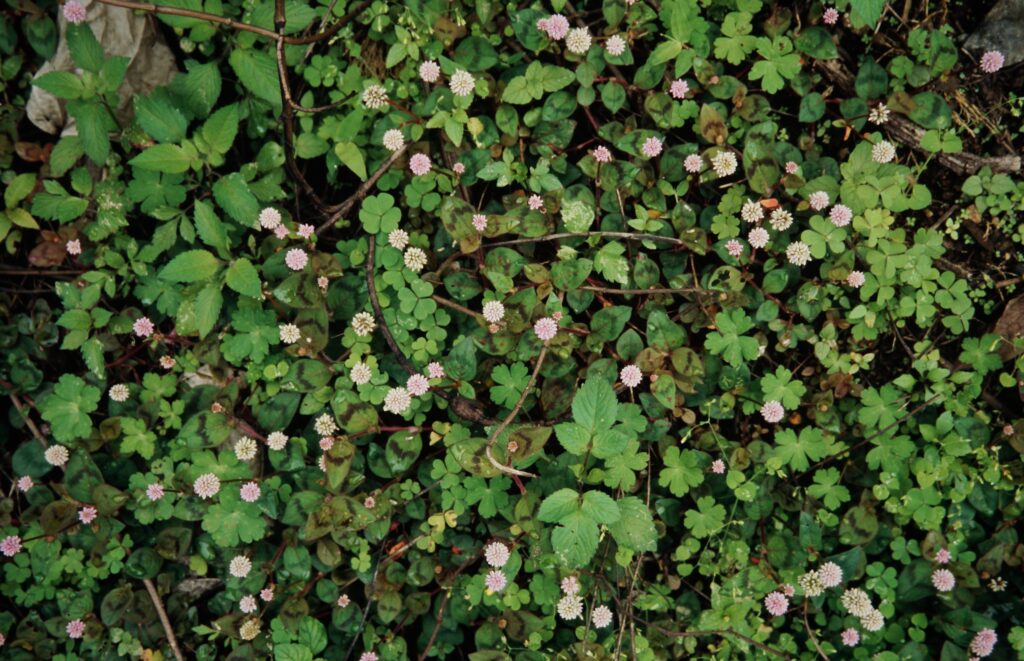
Sikkim 2006 261 ergebnis
India West-Bengal, Lingza 1300m, May

Description

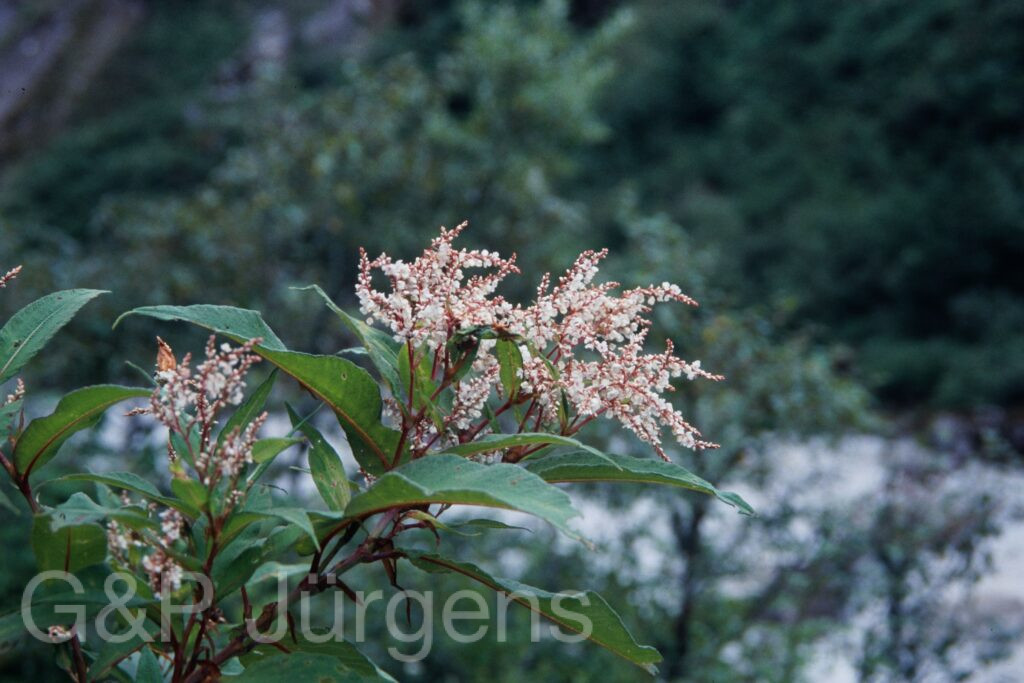
Polygonum microcephalum is a herb of the eastern Himalaya and montane Southeast Asia, widely distributed from Nepal and north-east India through Bhutan and south-western China (Yunnan, Sichuan, Xizang) to northern Myanmar and Vietnam. The very large global occurrence figures returned under the accepted genus Persicaria reflect aggregated records of the broader complex; this taxon is properly treated as Persicaria microcephala (D. Don) H. Gross. It grows in moist, shaded situations — forest understorey, streamsides, ditches and disturbed clearings — chiefly between about 800 and 2,800 m. The plant photographed at Lingza in West Bengal, India, at 1,300 m in May represents its typical low-montane subtropical broadleaf forest habitat.

It is a perennial herb with slender, often reddish, ascending to scrambling stems rooting at the lower nodes, the swollen nodes sheathed by membranous, cylindrical ochreae. The leaves are alternate, ovate to broadly lanceolate, acuminate, frequently marked with a dark chevron and red venation, the surfaces sometimes finely pubescent. The flowers are minute and aggregated into small, dense, head-like or short-spike inflorescences, the perianth of five tepals white to pinkish; stamens commonly eight. The fruit is a trigonous, dark, shining achene enclosed within the persistent perianth.

The segregation of Persicaria from Polygonum sensu lato, supported by molecular phylogenetics, places this species in a large genus characterised by ochreate sheaths and capitate or spiciform inflorescences. The dark-marked, often red-flushed foliage has brought certain forms into cultivation. The species is widespread, ecologically adaptable and of no conservation concern, behaving locally as a colonist of disturbed ground.

Author: D.Don · Sources: POWO (Kew), Flora of China Vol. 5, Flora of Bhutan Vol. 1, GBIF, Hong et al.: Polygonaceae in Flora of China

Hook. f. & Thomson

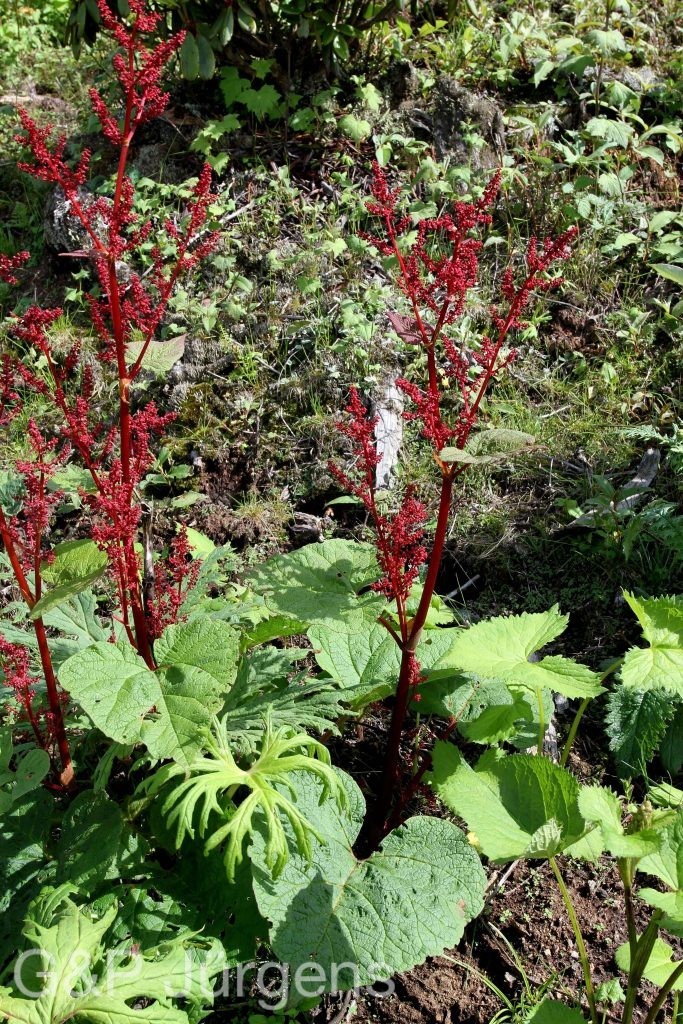
BhutanPG2011 778 01 01
Bhutan Chele-La, 3900m July
Sikkim2003 485 P673
Sikkim Lachung Valley 3500m August

Description

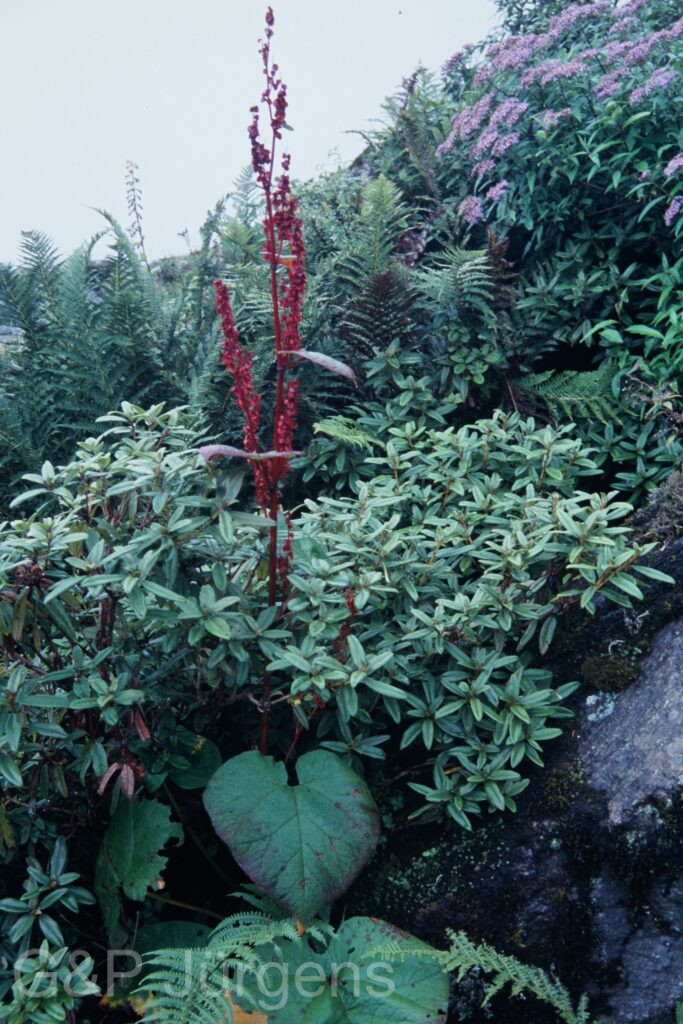
Rheum acuminatum is a stout perennial wild rhubarb of the eastern and central Himalaya, distributed through China, Nepal, India, Bhutan and Myanmar, with some 370 documented records. It is a plant of subalpine and alpine slopes, rocky meadows, open shrubberies and stream margins, generally growing between 3000 and 4300 m. The illustrated plants come from Chele-La in Bhutan at 3900 m in July and the Lachung Valley in Sikkim at 3500 m in August, spanning the high-summer flowering and fruiting period characteristic of the species at these elevations.

The plant arises from a thick woody rhizome and produces erect, often reddish, hollow stems up to a metre or more tall. The basal leaves are large, long-petiolate and broadly ovate-cordate with an acuminate apex giving the epithet, the blade more or less glabrous above and with prominent venation; an ochrea sheaths the stem at each node. The inflorescence is a tall, branched panicle bearing numerous small flowers with a coloured perianth of six segments, white to greenish or reddish. The fruit is a broadly winged triangular achene (a three-angled, three-winged nutlet) adapted to wind and water dispersal.

The genus Rheum reaches its richest diversity in the Himalaya and the Qinghai-Tibetan plateau, where high-altitude rhubarbs show striking adaptations to cold, exposed habitats. R. acuminatum lacks the inflated bracts of the alpine glasshouse rhubarbs but shares the family's ochreate, trigonous-fruited architecture. The rhizomes have a history of local medicinal use, and although the species is widespread and not threatened, related wild rhubarbs are subject to harvesting pressure across the region.

Author: Hook. f. & Thomson · Sources: POWO (Kew), GBIF, Flora of China, Flora of Bhutan, Annotated Checklist of the Flowering Plants of Nepal, Losina-Losinskaja revision of Rheum

Royle

Garw 2005 324 ergebnis
India Garhwal Bagubasa 4100m, September

Description

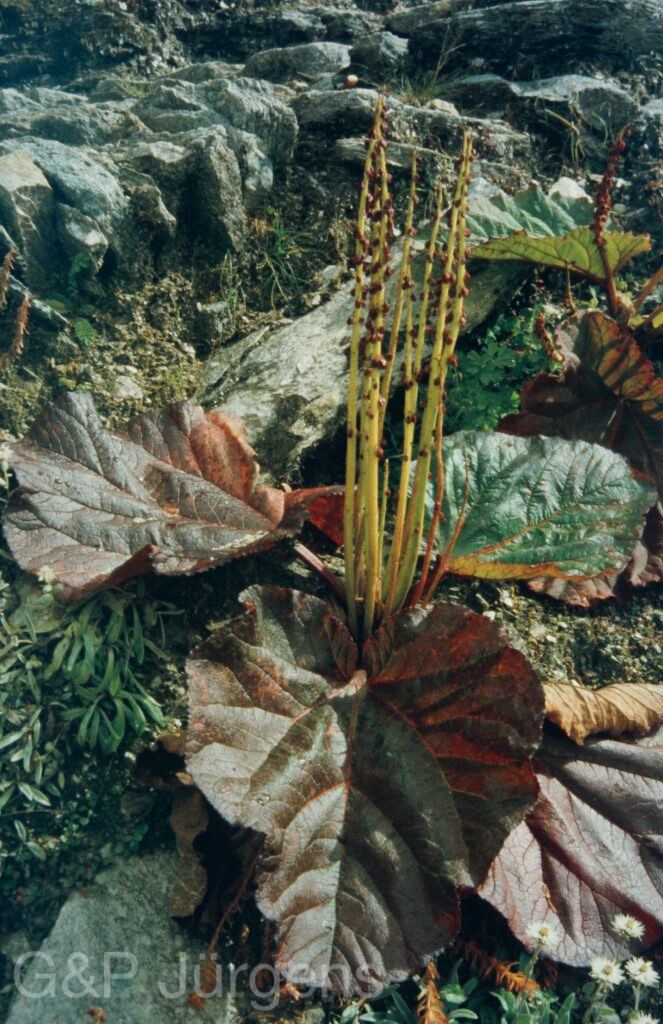
Rheum moorcroftianum is a high-alpine rhubarb of the Western and Central Himalaya, ranging from Pakistan and Kashmir eastward through the Indian Himalaya (including Garhwal) and Nepal to the Tibetan plateau of China; GBIF records 129 occurrences across China, Nepal and India (with stray data points). It is a plant of open alpine slopes, screes, stabilised moraines, glacial flats and grazed meadows generally between 3500 and 5000 m, where it withstands intense insolation, drought and a short growing season. The illustrated specimen from Bagubasa in Garhwal at 4100 m in September shows the plant in its post-flowering, fruiting state at the close of the alpine summer.

It is a low, stout, often almost stemless perennial herb developing from a thick woody rhizome and tap-root. The conspicuous radical leaves form a flattened rosette and are orbicular to ovate-cordate, leathery, the blade prominently reticulate-veined and frequently flushed red or with reddish margins and undersides; petioles are short and stout. The inflorescence is a congested, scapose panicle scarcely exceeding the leaves, bearing numerous small flowers with usually six greenish to reddish perianth segments. The fruit is a broadly winged trigonous achene, the three membranous wings reddish-tinged and conspicuously veined, an adaptation aiding wind and surface dispersal across open terrain.

The species belongs to Rheum (Polygonaceae), a genus centred on the high mountains of Central Asia and the Sino-Himalaya. Its dwarf, ground-hugging rosette habit is a classic adaptation to the cold, windswept alpine environment, contrasting with the giant "glasshouse" rhubarbs such as R. nobile. Like other Himalayan Rheum it is locally harvested for medicinal roots and is subject to grazing pressure, but its wide range and remote habitat mean it is not currently considered threatened.

Author: Royle · Sources: POWO (Kew), GBIF, Flora of China Vol. 5, Flora of Pakistan, Flora of Nepal, A Revision of the Genus Rheum (Losina-Losinskaja)

Rheum nobile

by GP Jürgens

Hook. f. & Thomson

Sikkim2011 328
Sikkim Lada-La 4400m, June
Sikkim2003 309 G438
Sikkim Saniti-Lake 4300m August
Sikkim2003 310 W439
Sikkim Saniti-Lake 4300m August

Description

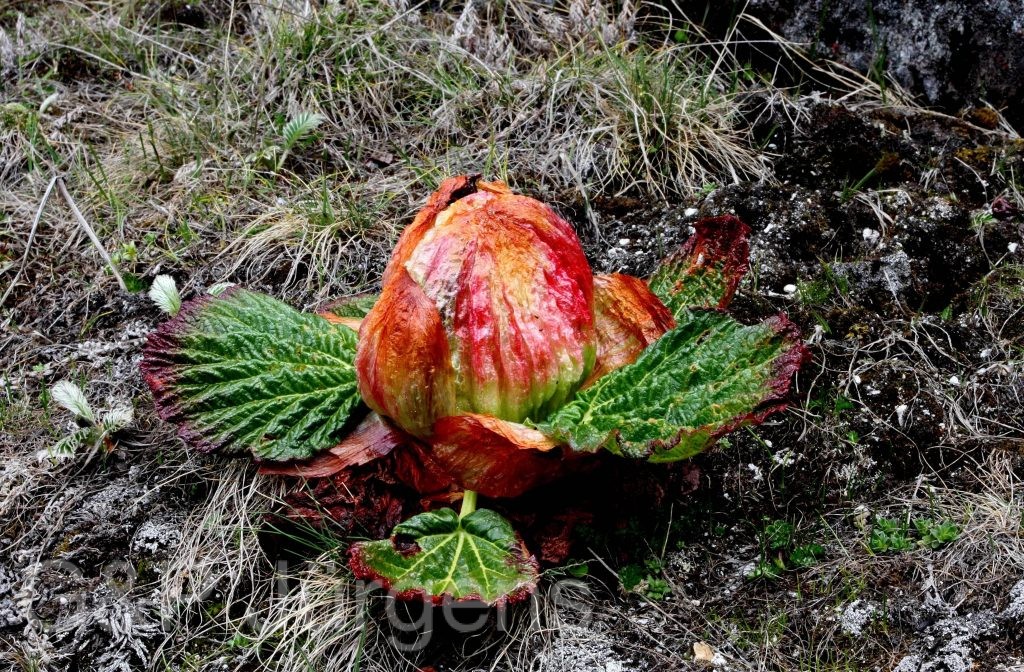
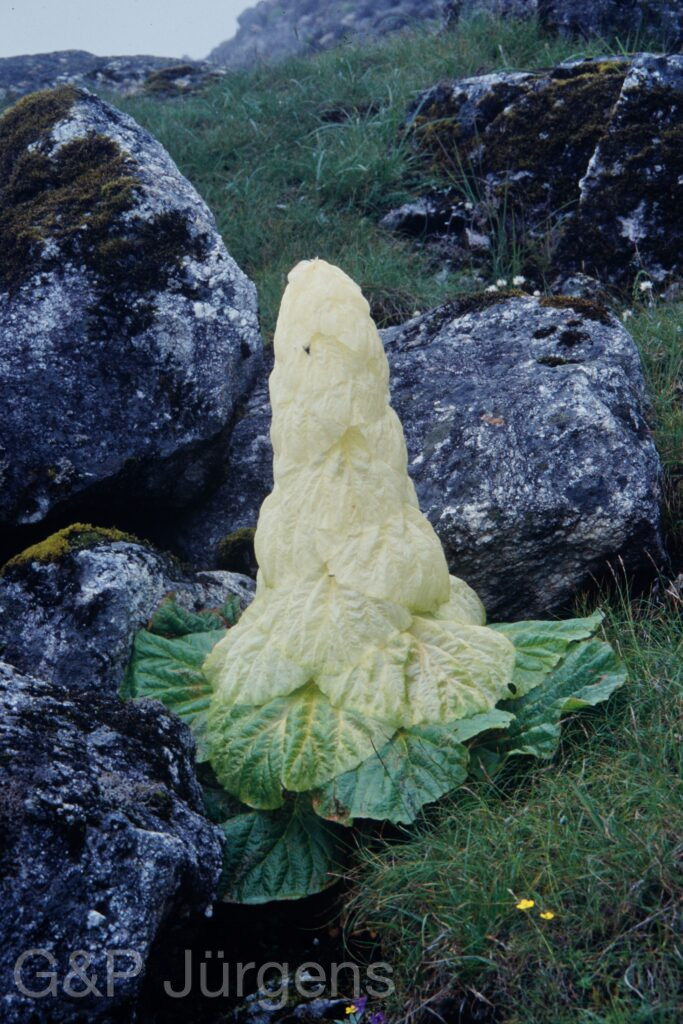
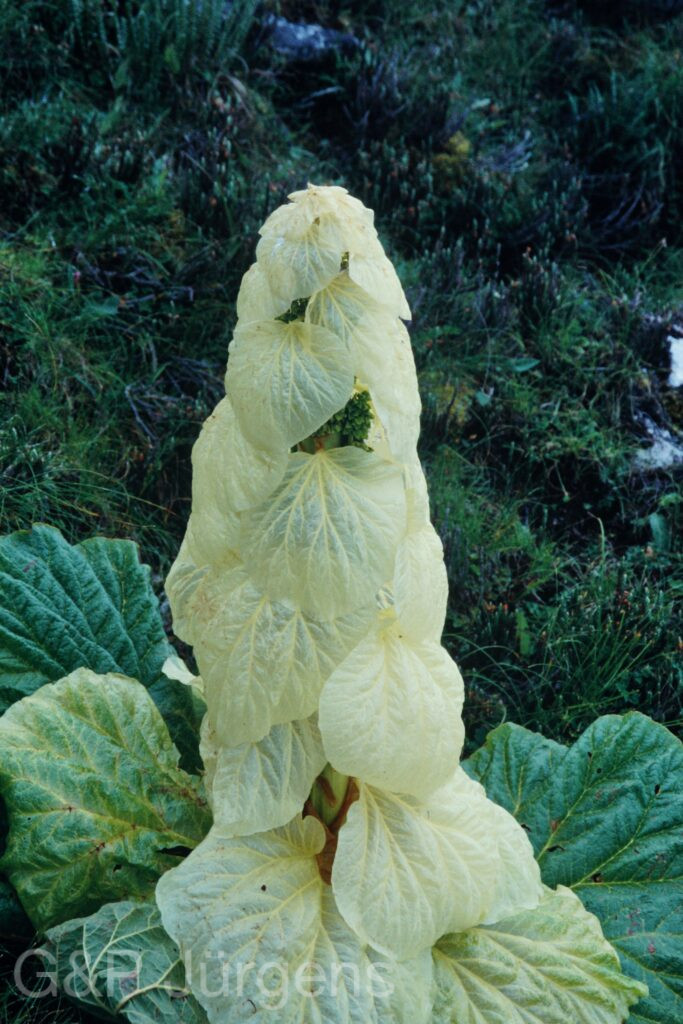
Rheum nobile, the Sikkim or noble rhubarb, is a spectacular high-alpine perennial of the eastern Himalaya, distributed from Nepal through Sikkim and northern India into Bhutan, Myanmar and south-western China, with around 220 occurrence records. It is a strict specialist of open alpine screes, moraines and rocky slopes, typically between about 4000 and 4800 m. The images derive from Sikkim at Lada-La (4400 m, June) and near Saniti Lake (4300 m, August), localities characteristic of the high, exposed scree habitat in which this iconic "glasshouse plant" grows.

The species forms a stout, columnar flowering spike to about 1-2 m, arising from a thick taproot. Its most striking feature is the dense, overlapping series of large, translucent, straw-coloured to pale yellow bracts that sheathe the entire inflorescence, hiding the small flowers within. The basal leaves are large, broadly ovate to orbicular and reddish-margined, forming a rosette. The numerous small flowers are greenish and inconspicuous, concealed beneath the bracts, and develop into small, three-winged nutlets (achenes) typical of the genus.

Rheum nobile (Polygonaceae) is a classic example of a Himalayan "greenhouse" or glasshouse plant: the translucent bracts trap solar heat and create a warm, sheltered microclimate that protects the developing flowers from cold, wind and intense ultraviolet radiation while attracting and harbouring specialist pollinating midges. This remarkable adaptation, much studied in plant ecophysiology, makes the species a celebrated model of high-altitude floral biology. Though localised, it is of least conservation concern, but its restriction to a narrow alpine belt makes it potentially vulnerable to climatic warming.

Author: Hook. f. & Thomson · Sources: POWO (Kew), GBIF, Flora of China, Flora of Bhutan, Annotated Checklist of the Flowering Plants of Nepal, Losina-Losinskaja monograph of Rheum

D.Don

Garh 07 77 ergebnis
India Garhwal Sana at Mandakini 1750m, June

Description

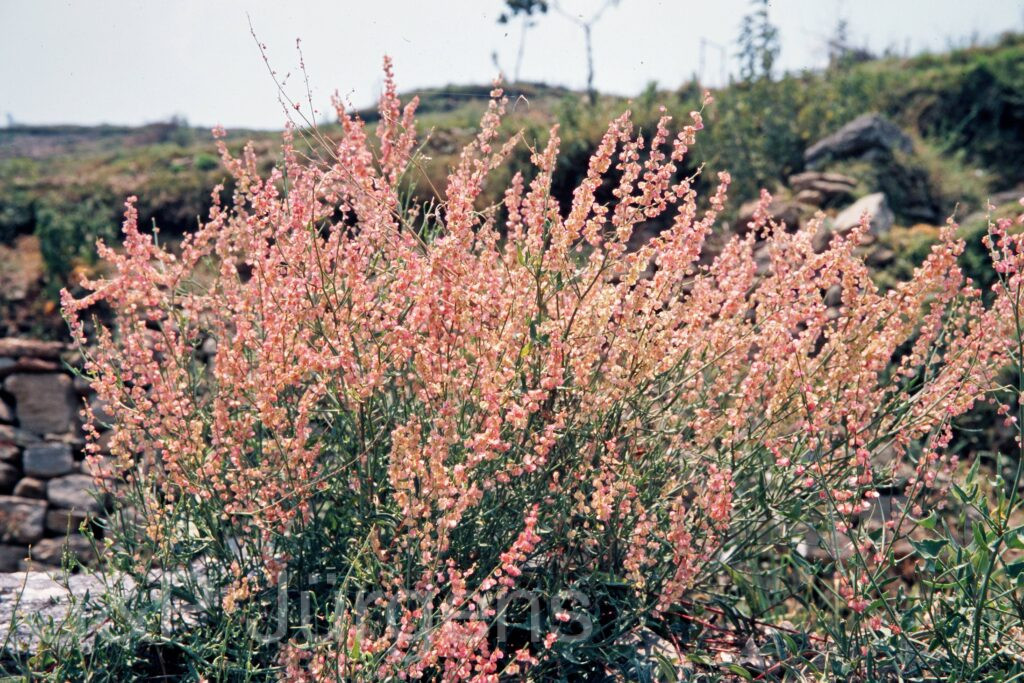
Rumex hastatus is a widespread sub-shrubby dock distributed across the Himalaya and adjacent uplands, with GBIF documenting some 756 occurrences spanning China, India, Pakistan, Nepal, Afghanistan, Bhutan and Myanmar, alongside scattered introduced records in New Zealand and North America that mark it as a casual alien beyond its native range. It is a colonist of dry, sunny, often disturbed ground: rocky banks, terraced field margins, road cuttings, riverine gravels and open hillsides, ranging from around 700 m to over 3000 m. The plant photographed at Sana on the Mandakini in Garhwal, India, at about 1750 m in June, represents a typical warm-temperate montane locality where the species forms conspicuous reddish-tinged stands on stony slopes.

Morphologically it is a much-branched, woody-based perennial or subshrub reaching 30 to 100 cm, the slender intricate branches glabrous and often reddish. The leaves are characteristically hastate, the small narrow blade bearing a pair of spreading basal lobes, hence the epithet; lower leaves may be obovate, and the foliage is somewhat fleshy and grey-green. As in all Rumex the stem is sheathed at the nodes by membranous ochreae. The inflorescence is a large, lax, much-branched terminal panicle of small dioecious or polygamous flowers. The fruiting perianth develops three enlarged, rounded, membranous and often rose-tinted inner valves (wings) without conspicuous tubercles, enclosing a small trigonous brown nutlet and aiding wind dispersal.

The species sits within Rumex subgenus Acetosa, the sorrels, distinguished by their hastate or sagittate leaves, sour oxalate-rich sap and unisexual flowers. R. hastatus is valued locally as a pot-herb and in traditional medicine, the acidic foliage used as a refreshing condiment and astringent. Ecologically it is a hardy pioneer of degraded and eroding substrates, tolerant of drought and grazing, which underlies both its abundance throughout the Himalayan foothills and its capacity to naturalise elsewhere. It is of no conservation concern, being common and adaptable across a broad altitudinal and geographic span.

Author: D.Don · Sources: POWO (Kew), GBIF, Flora of China Vol. 5, Flora of Pakistan, Flora of Nepal, Rechinger Monograph of Rumex

  • 1
  • 2