
Buch.-Ham.
Description
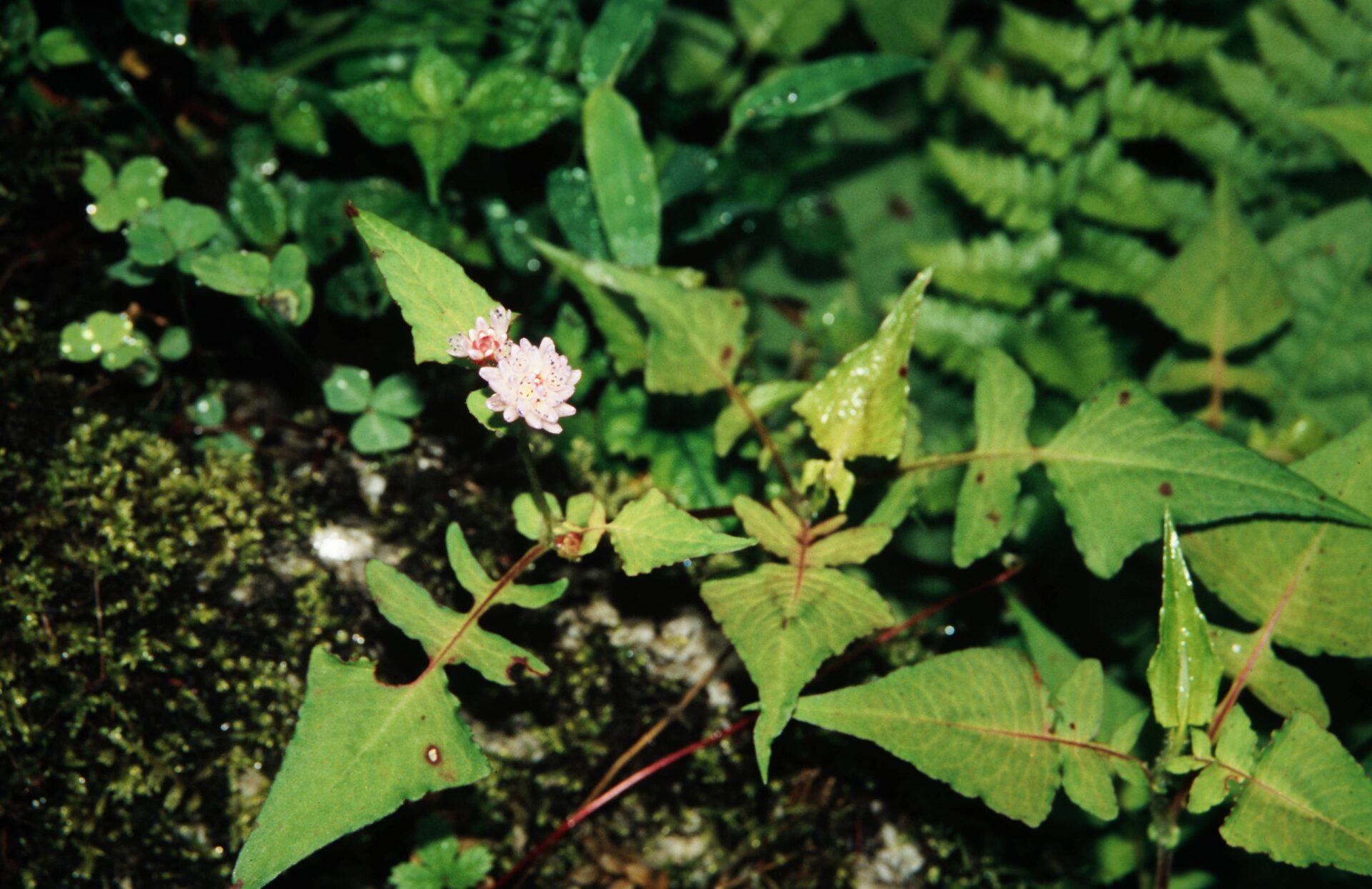
Polygonum runcinatum is a widely distributed knotweed found across the Himalaya and extending through much of eastern and southeastern Asia to Malesia. Its range encompasses Nepal, Bhutan, India, Pakistan, Myanmar, China, Taiwan, Thailand, Vietnam, Malaysia, Indonesia, and Papua New Guinea, with scattered records elsewhere. GBIF documents over 1,660 occurrences, reflecting its abundance and broad ecological amplitude. The species colonises moist, open to semi-shaded habitats including forest margins, stream banks, roadsides, damp meadows, and disturbed ground at elevations from 500 to 3,500 m. The photograph from Ringi-Chu in Sikkim at 2,100 m, taken in May, shows the species at a mid-elevation site in the eastern Himalaya.
The plant is a prostrate to ascending perennial herb, 20–60 cm long, often forming extensive mats. Stems are slender, branched, rooting at lower nodes, reddish-brown, glabrous to sparsely pubescent. Leaves are distinctive: ovate to lanceolate, 3–8 cm long, with a hastate to runcinate base bearing prominent, backward-pointing basal lobes — the feature indicated by the epithet runcinatum. The upper leaf surface frequently bears a dark, V-shaped or chevron-like blotch, a useful field character. Ocreae are tubular, membranous, ciliate. Flowers are borne in dense, globose, terminal capitate heads, 8–12 mm in diameter, on slender peduncles. Individual flowers are small, with a five-lobed perianth, pink to deep rose, occasionally white. Stamens usually eight. The achene is trigonous, dark brown, enclosed within the persistent perianth.
Polygonum runcinatum has been transferred by some authors to Persicaria as P. runcinata (Buch.-Ham.) H.Gross, reflecting the broad restructuring of Polygonum sensu lato based on molecular phylogenetic evidence. The species is ecologically versatile and often weedy, colonising disturbed habitats rapidly. It plays a role in soil stabilisation on moist slopes and provides floral resources for small pollinators. It is not threatened and is considered common to locally abundant throughout its extensive range.
Author: Buch.-Ham. · Sources: POWO (Kew), GBIF, Li et al.: Polygonaceae in Flora of China Vol. 5, Grierson & Long: Flora of Bhutan Vol. 1