
D. Don
Description
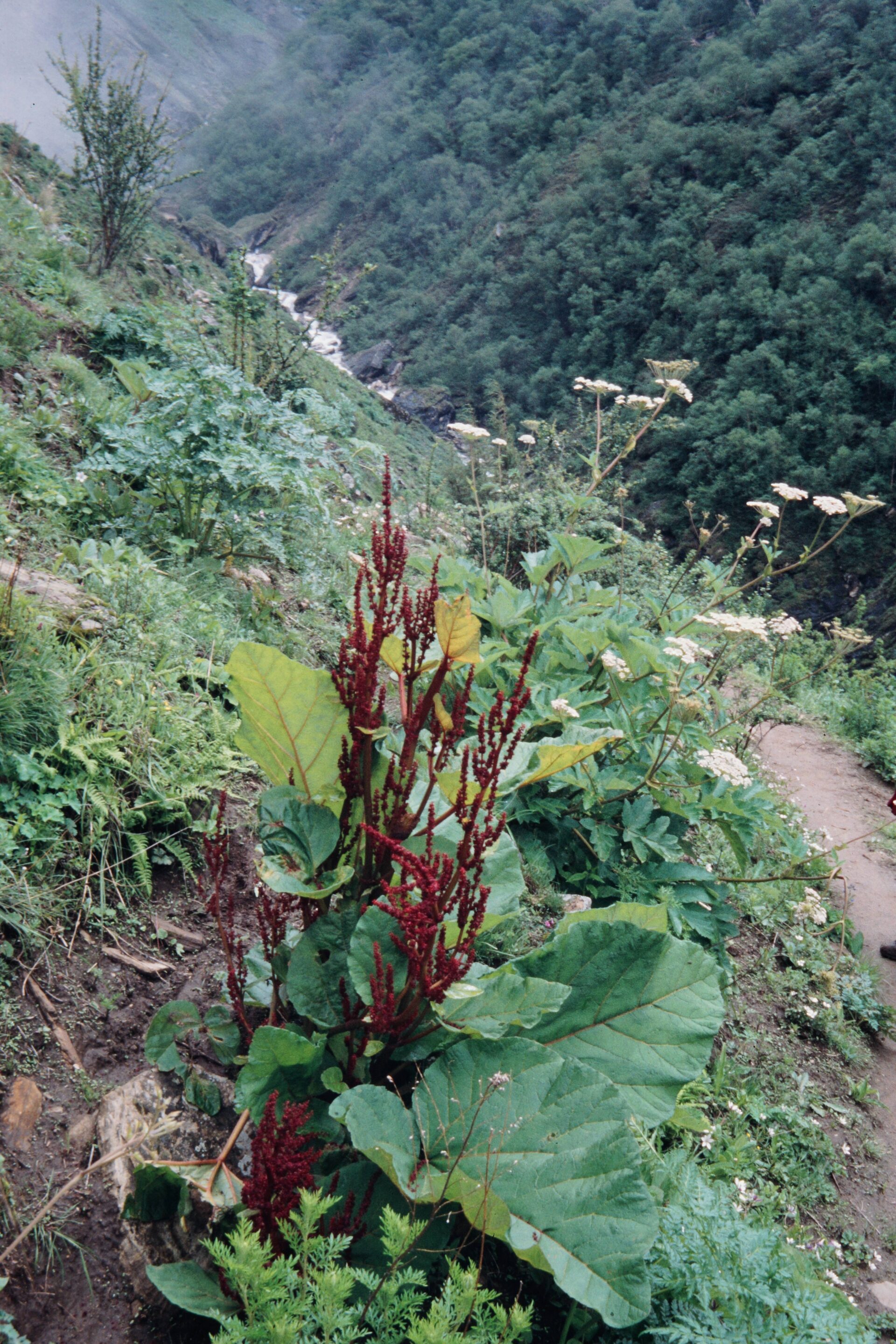
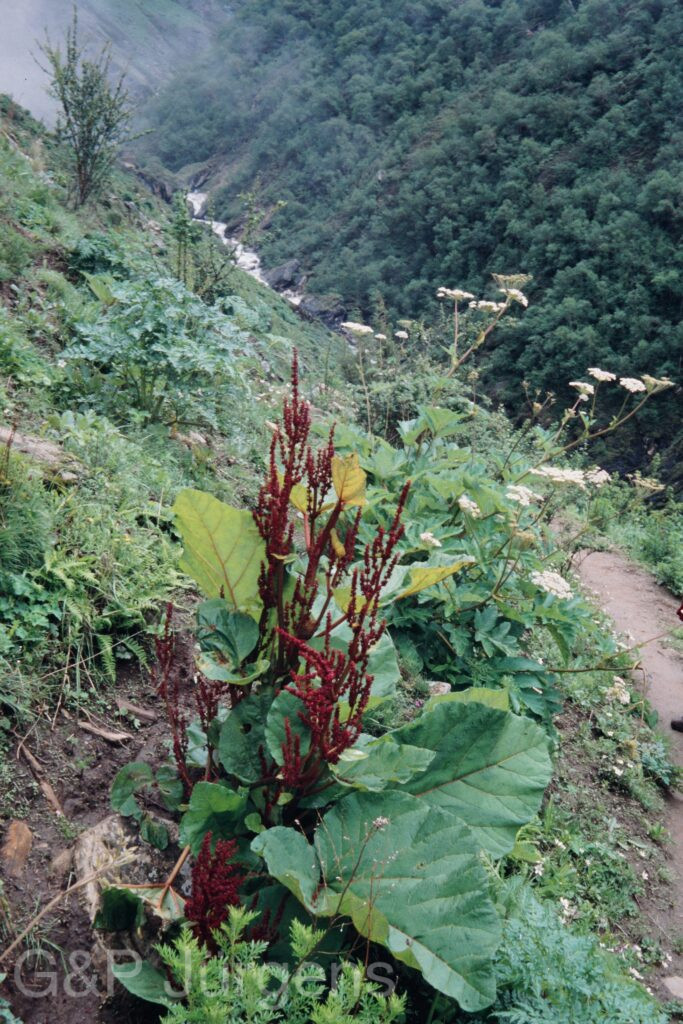
Rheum australe, the Himalayan rhubarb, ranges along the Himalaya from Pakistan through India, Nepal and Bhutan into south-western China (Tibet), with the bulk of its roughly 210 GBIF records falling within this arc; occurrences in Germany, the United States, France, Belgium, Norway, Romania and Sweden derive from cultivation and herbarium accessions. It grows on open alpine and subalpine slopes, in moist rocky meadows, along stream banks and amid boulder fields, generally between 3000 and 4300 m. The photographed plant from the Garpung-Khola valley of West Nepal at 3500 m in July reflects its typical mid-summer growth on damp, high-elevation slopes.
It is a robust, tall perennial herb arising from a thick, woody, reddish rhizome and stout root. The large basal leaves are broadly ovate to orbicular-cordate, with palmate venation, an entire to undulate margin and long, reddish, fleshy petioles. The erect, hollow, often reddish flowering stem reaches one to two metres and bears a large, branched, paniculate inflorescence of small flowers with a dark red to purplish perianth of six segments. The fruit is a broadly winged, ovate-elliptic trigonous achene, the three reddish wings aiding wind dispersal across open terrain.
Rheum australe (long known as R. emodi) is the principal medicinal rhubarb of the Himalaya, its rhizome rich in anthraquinones and valued in traditional systems for digestive and purgative use. Sustained harvesting for the herbal trade, combined with slow regeneration in the alpine zone, has raised conservation concern, and the species is regarded as vulnerable to over-collection across parts of its range, prompting cultivation efforts.
Author: D. Don · Sources: POWO (Kew), GBIF, Flora of China, Flora of Bhutan, Annotated Checklist of the Flowering Plants of Nepal, Rheum (rhubarb) taxonomic monograph