Tag:

Alpine (>3500 m)

(Bruehl) Dorosz.

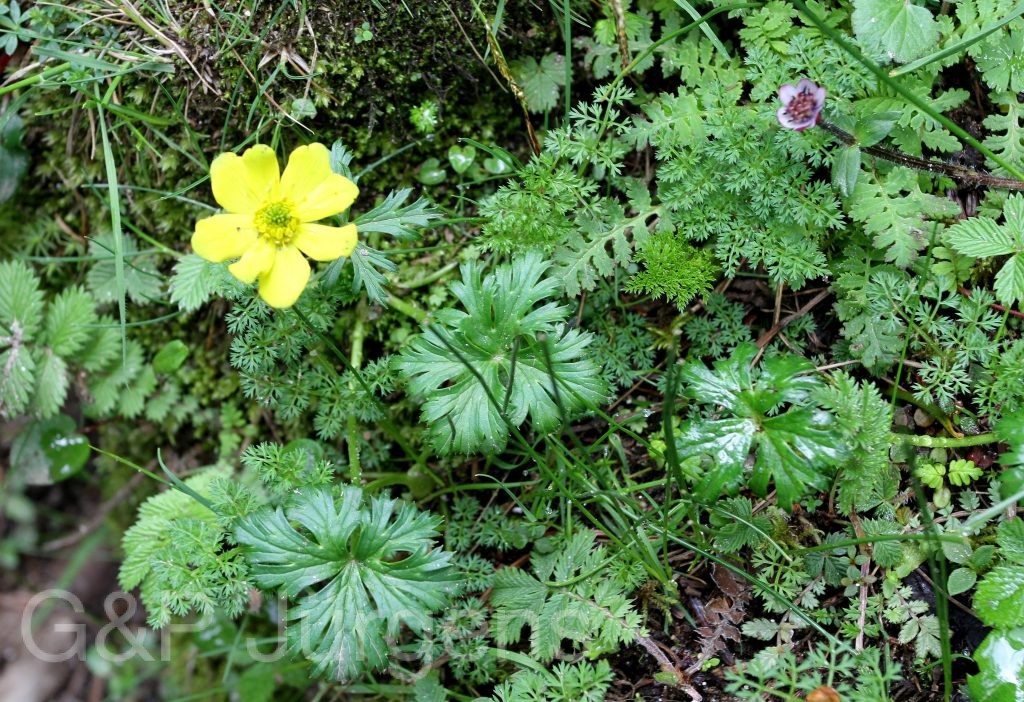
BhutanPG2011 218
Bhutan Jimilangtso, 4000m June;
also included: Anemone rupestris Hook.f. & Thomson
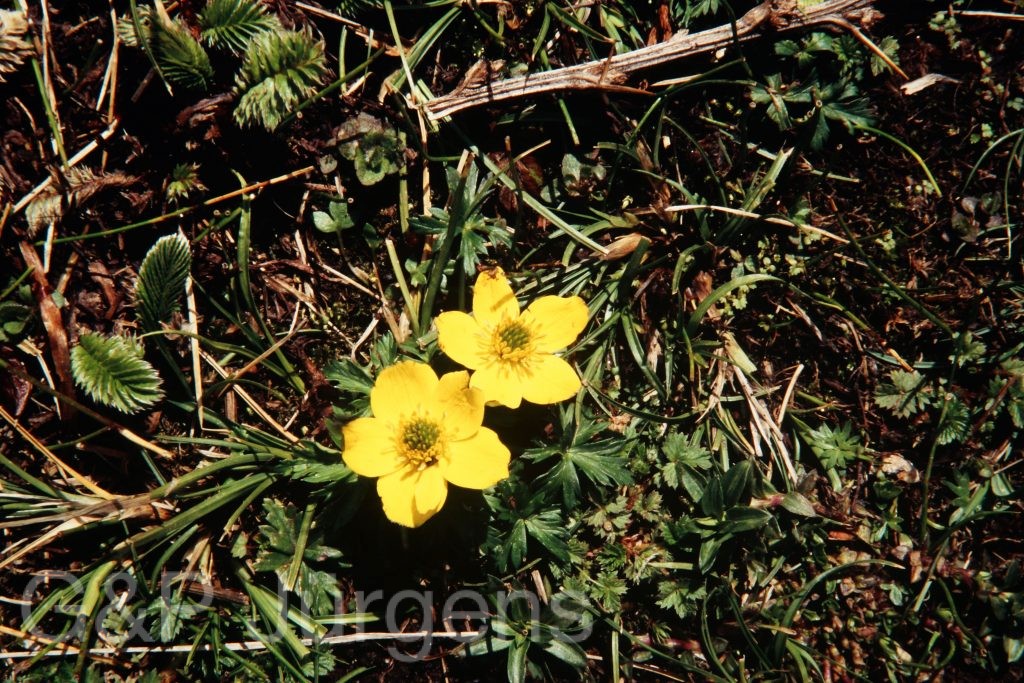
Bh09 137 P239
Bhutan Jimilangtso, 4000m June

Description

Trollius sikkimensis is a high-alpine globeflower restricted to the eastern and central Himalaya, recorded from Nepal, China, Bhutan and India, with only about 31 georeferenced occurrences indicating a comparatively narrow and incompletely documented range. It inhabits moist alpine meadows, marshy turf, streamsides and the margins of glacial tarns between roughly 3500 and 4500 m. The photographed plants from Jimilangtso in Bhutan at 4000 m, flowering in June, exemplify its damp high-meadow habitat near alpine lakes, where it grows alongside other snowmelt herbs such as the Anemone rupestris noted from the same locality.

It is a glabrous perennial herb arising from a short rhizome, with erect, simple or sparingly branched stems. The basal leaves are long-petioled and palmately divided into deeply cut, toothed segments, the cauline leaves smaller and subsessile. The flowers are large and solitary or few, the showy part formed by several broad, spreading, golden-yellow petaloid sepals that open more widely than in the cupped European globeflowers; within are numerous narrow nectariferous petals and many stamens. The fruit is a head of many-seeded, beaked follicles.

Unlike the closed, globular flowers of Trollius europaeus, the open, saucer-shaped perianth of the Asian species facilitates access by a wider range of alpine pollinators. Trollius sikkimensis is closely allied to other Himalayan and Chinese globeflowers and is distinguished on perianth and follicle characters. Its restricted distribution and dependence on intact alpine wetlands make it potentially sensitive to grazing pressure and climatic warming.

Author: (Bruehl) Dorosz. · Sources: POWO (Kew), GBIF, Flora of Bhutan, Flora of China, Doroszewski's revision of Trollius
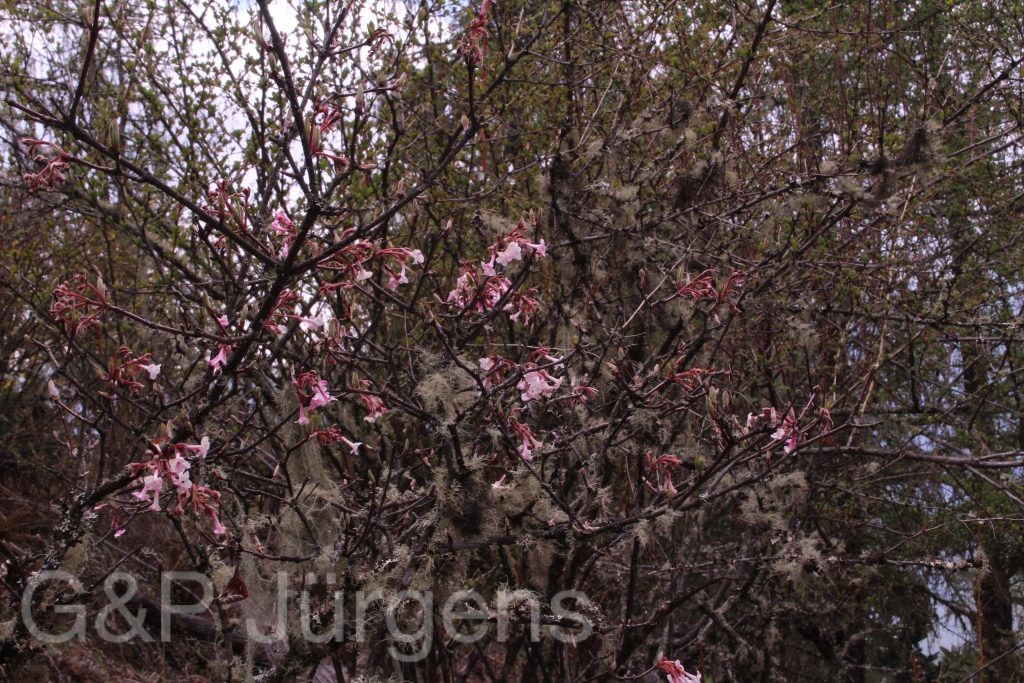
Wall. ex DC.

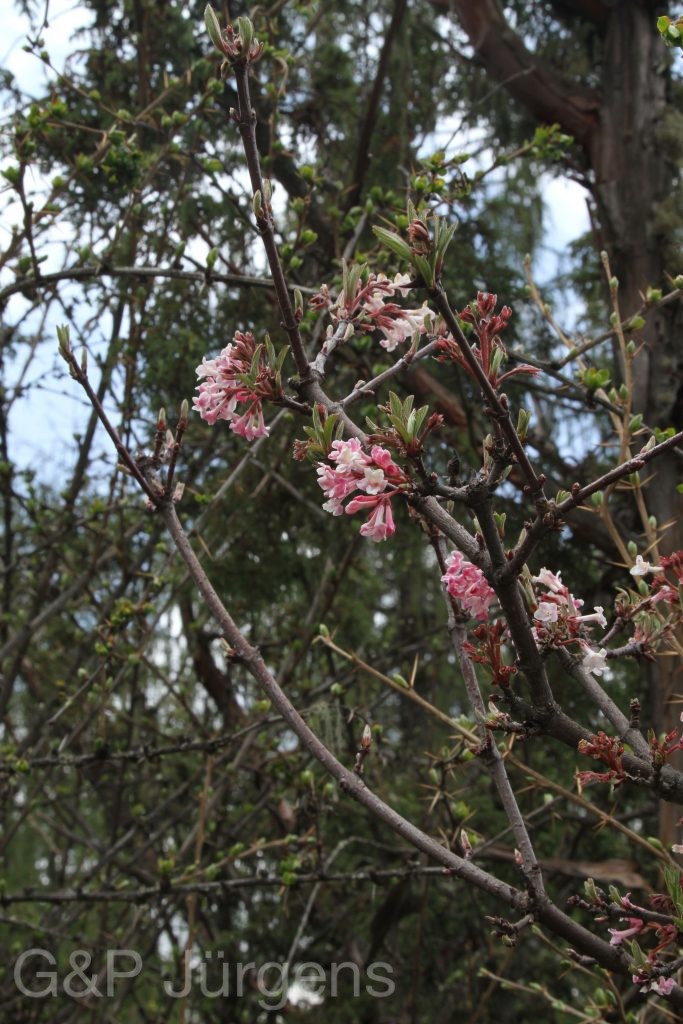
Bhutan2014 977
Bhutan Chele-La 3500m, May
Bhutan2014 978
Bhutan Chele-La 3500m, May

Description

Viburnum grandiflorum is a Himalayan shrub distributed from Pakistan and north-west India through Nepal, Bhutan and adjacent south-western China; records from Britain, Ireland, Belgium, Canada and Korea reflect its cultivation as an ornamental rather than a natural range. It occurs in the upper temperate to subalpine zone, in forest margins, open scrub, Rhododendron thickets and rocky slopes, generally between about 2,400 and 3,900 m. The shrub photographed at the Chele La in western Bhutan at 3,500 m in May illustrates its spring flowering high in the inner ranges, the inflorescences often expanding before the leaves are fully out.

It is a deciduous shrub of moderate stature with stiff, spreading branches. The leaves are opposite, elliptic to oblong-ovate, with a serrate to crenate-serrate margin, acuminate apex, prominent impressed venation above and pubescence along the veins beneath, often colouring richly in autumn. The flowers are borne in dense, rounded, terminal corymbose cymes; the corolla is tubular-funnelform with five spreading lobes, comparatively large for the genus (whence "grandiflorum"), pink to rose in bud and opening paler, fragrant. The fruit is an ovoid drupe ripening from red to blue-black, containing a single compressed stone.

Viburnum, long placed in Caprifoliaceae, is now referred to Adoxaceae on molecular grounds, allied to Sambucus and Adoxa. The species is closely related to V. nervosum and other Himalayan members of section Pseudotinus, with which it can be confused. Hardy and ornamental, it is established in temperate horticulture and has contributed to garden hybrids; in the wild it remains widespread and is not considered threatened.

Author: Wall. ex DC. · Sources: POWO (Kew), Flora of China Vol. 19, Flora of Bhutan Vol. 2, GBIF, Kern: Revision of Viburnum (Asia)

Edgew.

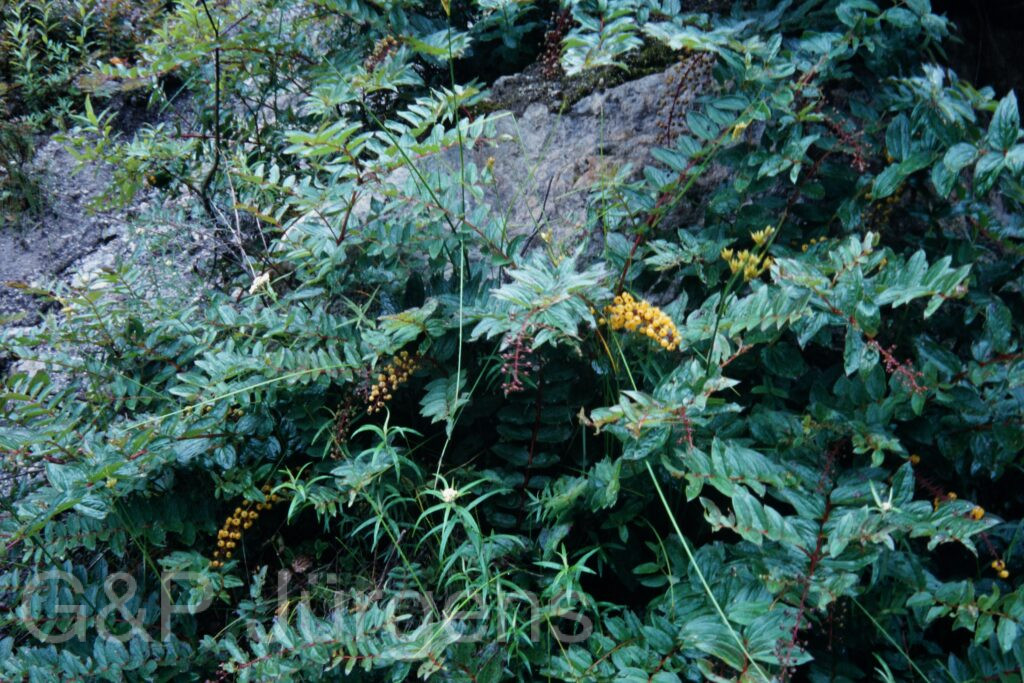
Sikkim2003 369 P518
Sikkim Lachen Tista Tal 3500m August

Description

Zanthoxylum oxyphyllum Edgew. is an aromatic shrub or small tree of the Rutaceae, distributed along the Himalaya from northern India and Nepal through Bhutan to southwestern China and Myanmar (GBIF: c. 372 occurrences). It grows in temperate to subalpine forests, on open slopes, forest margins and in shrubberies, typically between about 1,800 and 3,500 m. The photographed plant from Lachen in the upper Tista Valley of Sikkim, at around 3,500 m and recorded in August, represents the upper elevational range of the species in the eastern Himalaya, where it occurs in cool, moist montane scrub.

The plant is a deciduous, prickly shrub or small tree bearing recurved spines on the stems and often on the rachis and midrib of the leaves, as is typical of the genus. The leaves are alternate, imparipinnate, with several pairs of opposite, lanceolate to ovate-lanceolate leaflets that are crenate and gland-dotted, releasing a pungent citrus aroma when crushed owing to abundant translucent oil cavities. The plant is functionally dioecious, with small greenish or yellowish unisexual flowers borne in axillary or terminal cymose panicles. The fruit is a small reddish follicle that splits to expose a single shiny black seed, and the carpels, like the foliage, are richly pellucid-punctate.

Zanthoxylum oxyphyllum belongs to the pantropical genus Zanthoxylum, whose species are noted for their pungent, numbing fruits (the Sichuan-pepper group) and their alkaloid- and essential-oil chemistry. The fruits and bark are used locally as a spice and in traditional medicine. The species is widespread and not regarded as threatened.

Author: Edgew. · Sources: POWO (Kew), Flora of China Vol. 11, Flora of Bhutan Vol. 2, Flora of Nepal, GBIF, Hartley: A revision of the Malesian species of Zanthoxylum