Tag:

Alpine (>3500 m)

Edgew. & Hook. f.

Nepal 99 555 ergebnis
West-Nepal Churta-Khola 4100m, June
Nepal 99 799 ergebnis
West-Nepal Baga-La-Phedi 4500m, July

Description

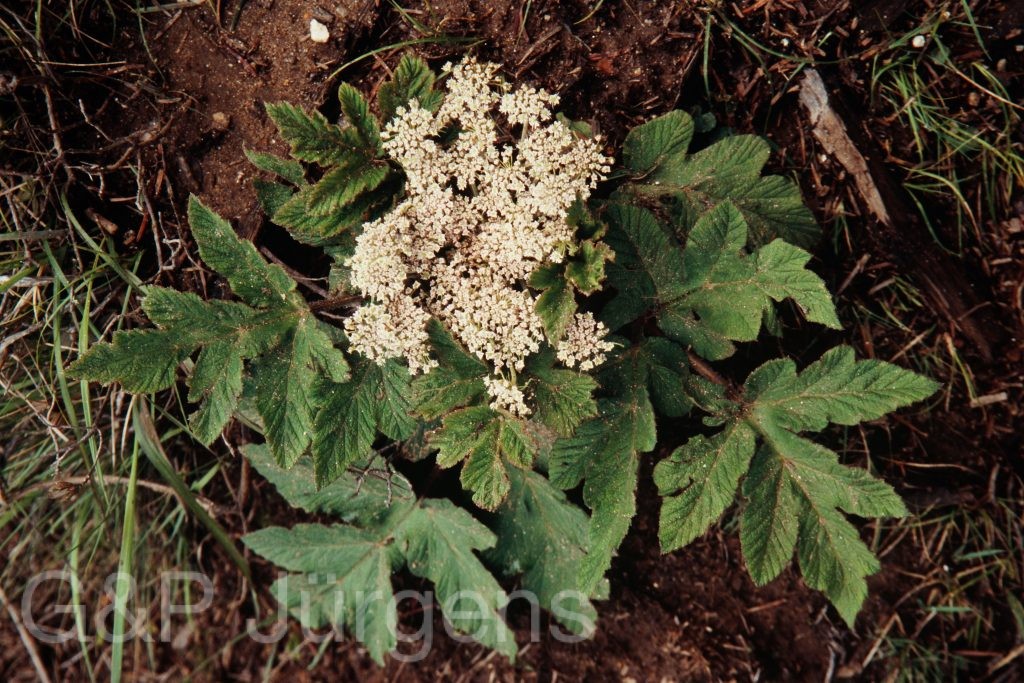
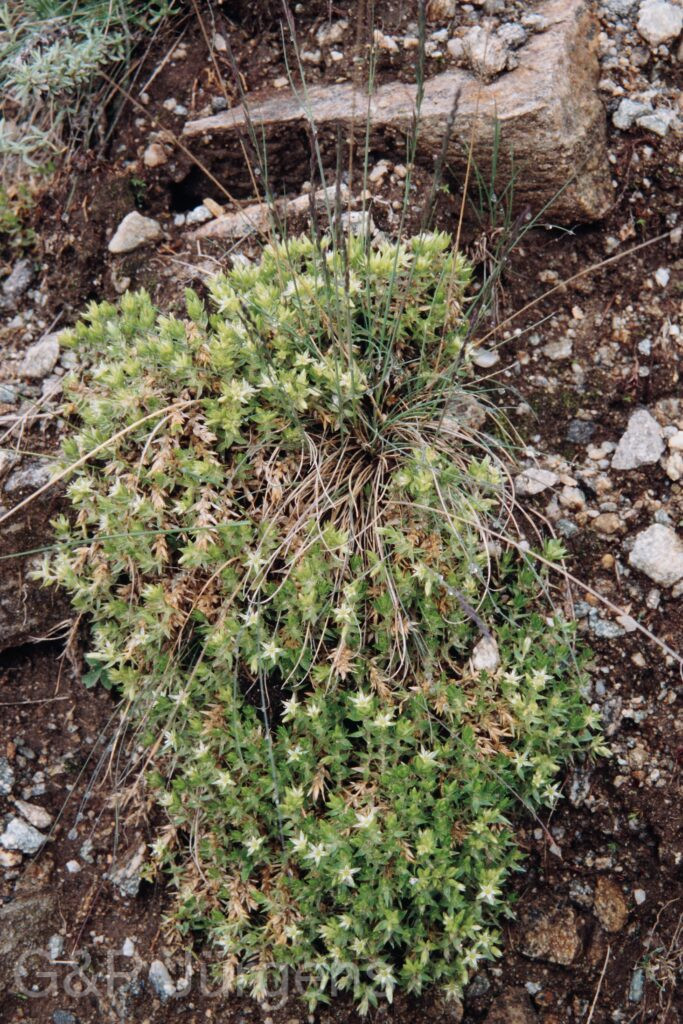
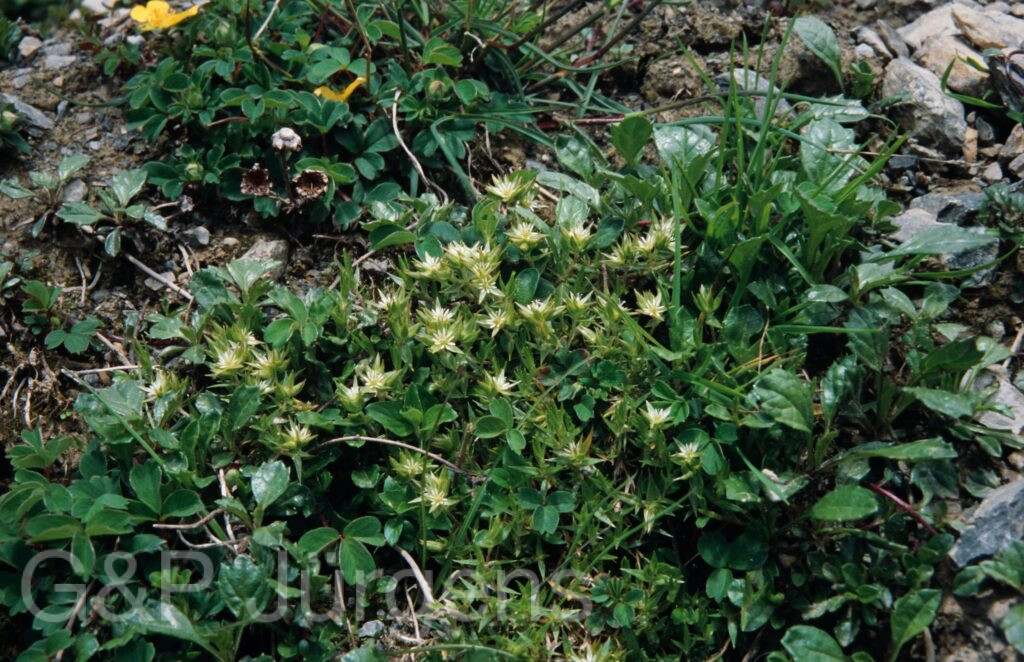
Stellaria decumbens var. pulvinata is a diminutive alpine chickweed of the Himalaya and adjoining Tibetan plateau, recorded by GBIF from China, India, Nepal and Bhutan with around 104 occurrences. The variety occupies cold, exposed alpine and subnival terrain, where it grows in rock crevices, on stabilised scree and among cushion vegetation at very high elevations. It was photographed in West Nepal in the Churta-Khola at 4100 m in June and near the Baga-La-Phedi at 4500 m in July, habitats typical of its preference for open, gravelly ground close to the upper limit of vascular plant life.

As its epithet pulvinata implies, this variety forms dense, hard, compact cushions, more condensed than the laxer typical S. decumbens. The slender, much-branched stems are crowded and decumbent, bearing small, sessile, narrowly lanceolate to ovate leaves arranged in opposite pairs, often somewhat fleshy and ciliate at the margins. The minute flowers are solitary or few, with five free, lanceolate, acuminate sepals and five white petals that are deeply bifid for roughly half their length, the characteristic forked petals of Stellaria; stamens are typically ten and the styles three. The fruit is a small ovoid capsule dehiscing by six valves and releasing several reniform, finely tuberculate seeds.

GBIF accepts the variety. The cushion habit represents convergent adaptation to wind desiccation, frost and a short season shared by many unrelated high-Himalayan plants. Within Caryophyllaceae the species belongs to a complex of dwarf alpine Stellaria whose infraspecific limits remain debated. No conservation concern attaches to this widespread, naturally cryptic high-altitude taxon.

Author: Edgew. & Hook. f. · Sources: POWO (Kew), GBIF, Flora of Nepal, Flora of China, monograph of Himalayan Caryophyllaceae
L.

Nepal 1989 65
Nepal Bhatang 2915m, April
Nepal 99 362 ergebnis
West-Nepal Kalomura 3600m, June

Description

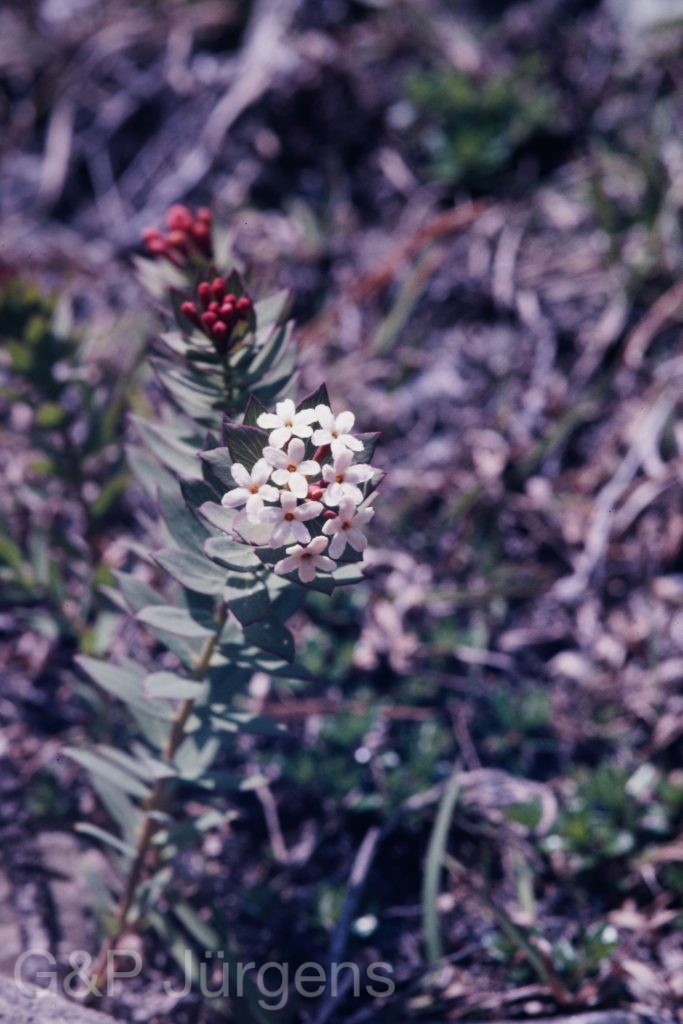
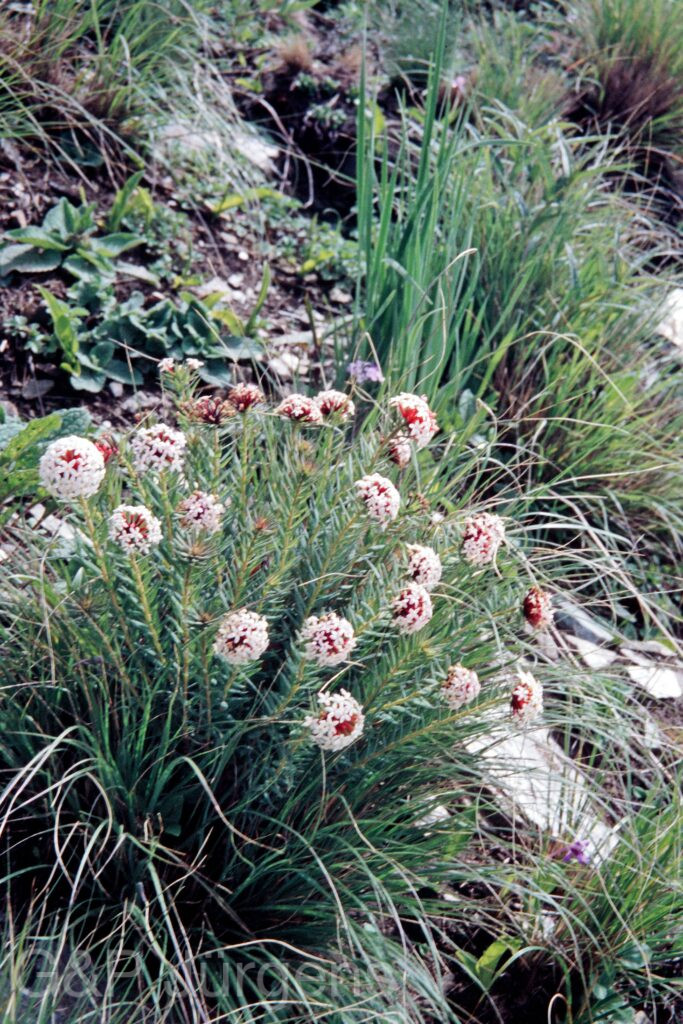
Stellera chamaejasme is a widespread perennial herb of the dry uplands of Central and East Asia, recorded by GBIF from China, Russia, Mongolia, Nepal, India, Bhutan, Kazakhstan, Korea, Iran and Turkey, among others, across some 3,400 georeferenced occurrences. It is characteristic of arid and semi-arid grasslands, alpine and subalpine meadows, sunny rocky slopes and overgrazed pastures on the Tibetan Plateau and throughout the trans-Himalaya, generally between about 2,600 and 4,500 m. The cited Nepalese records, from Bhatang at 2,915 m in April and from Kalomura in West Nepal at 3,600 m in June, span its lower temperate and upper subalpine occurrences and bracket its long spring-to-summer flowering season. It thrives on poor, dry soils where grazing has reduced competing vegetation.

The plant grows from a thick, woody, deep-seated taproot and rootstock, producing numerous erect, slender, unbranched leafy stems in a dense tuft. The leaves are numerous, alternate, crowded, narrowly lanceolate to elliptic, sessile and entire. The flowers are borne in a dense terminal capitate head; each flower lacks petals but has a showy, petaloid, tubular calyx whose five spreading lobes are commonly white above and flushed rose-red to purplish in bud on the outside, producing a striking bicoloured head. There are typically ten stamens in two whorls within the calyx tube, and the fruit is a small dry achene-like nutlet enclosed in the persistent base of the perianth.

Stellera chamaejasme is the best-known species of its genus within Thymelaeaceae and is notorious as a toxic, unpalatable indicator of rangeland degradation; its expansion is regarded across Tibet and Mongolia as a sign of overgrazing, since livestock avoid the poisonous foliage and roots. The plant is rich in bioactive diterpenoids and lignans and has a long history in Tibetan and Chinese traditional medicine, while its tough bast fibres have been used in papermaking. Though abundant and in no way threatened, it is ecologically significant as both a grassland weed and a chemically defended species of considerable pharmacological interest.

Author: L. · Sources: POWO (Kew), GBIF, Flora of China Vol. 13, Flora of Bhutan Vol. 2, Flora of Nepal, Flora of Pakistan, Tan & Wang: revision of Asian Thymelaeaceae and the Stellera complex

Nees

BhutanPG2011 806 01 01
Bhutan Chele-La, 3800m July

Description

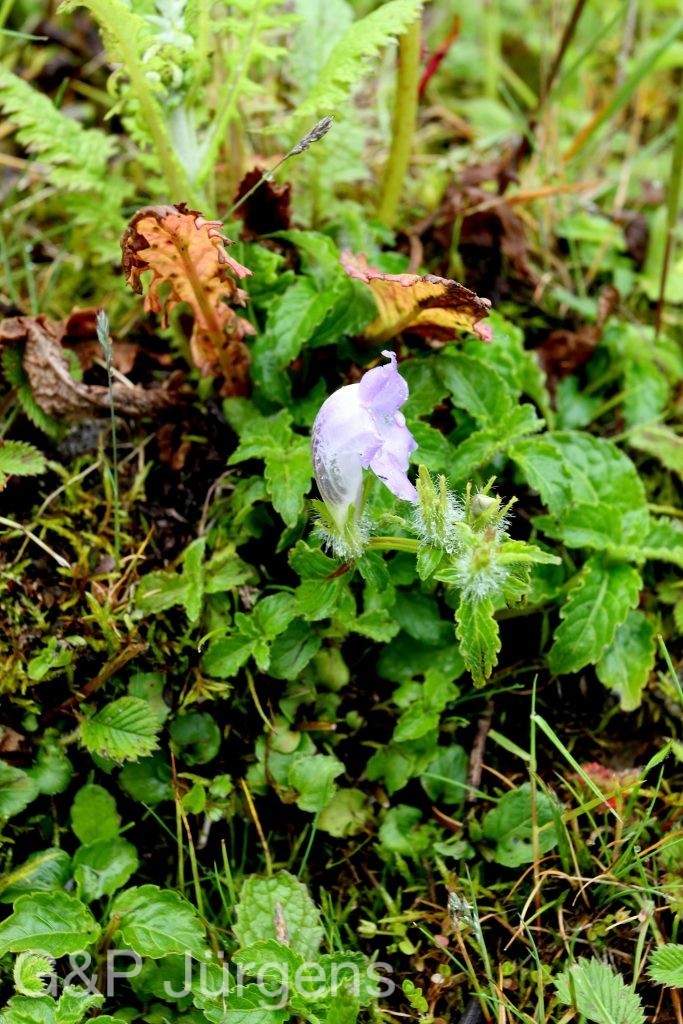
Strobilanthes echinata Nees is a shrubby herb of the acanthus family widely distributed through tropical and subtropical Asia, with GBIF documenting 319 occurrences from India (IN), Bhutan (BT), China (CN), Myanmar (MM), Thailand (TH), Vietnam (VN), Indonesia (ID), Malaysia (MY), Laos, Cambodia and Bangladesh. It is a plant of moist forest understorey, shaded slopes, ravines and clearings ranging from the warm lowlands to high temperate elevations. It was photographed in Bhutan on the Chele-La at 3800 m in July, near the upper limit of its range, where it grows in the cool, humid forest belt. The source URL references Strobilanthes wallichii, indicating a synonymous or closely allied treatment.

The plant is a perennial herb or soft shrub with quadrangular, often anisophyllous-leaved stems. The leaves are opposite and decussate, ovate to elliptic, acuminate and toothed, with cystoliths visible as fine streaks, the paired leaves of a node frequently unequal in size as is characteristic of the genus. The flowers are borne in dense, often spiciform or capitate inflorescences subtended by conspicuous, sometimes spiny-tipped or bristly bracts, the epithet echinata alluding to this prickly aspect. The corolla is tubular and curved, five-lobed and blue to violet or pale lilac. The fruit is an elongate, two-valved, explosively dehiscent capsule bearing a few flattened seeds.

Strobilanthes is a large and taxonomically difficult Asian genus famous for its mass-flowering, plietesial life cycle in which whole populations bloom synchronously after several years and then die. Its centre of diversity lies in the Indo-Burmese and Sino-Himalayan region, making it an important element of Asian forest floras. The bird- and insect-pollinated flowers and explosively dispersed seeds aid colonisation of forest gaps. While many species are narrow endemics of conservation concern, S. echinata is comparatively widespread.

Author: Nees · Sources: POWO (Kew), GBIF, Flora of Bhutan, Flora of China, Strobilanthes monograph (Y. F. Deng & J. R. I. Wood revision)

D. Don

Bhutan2012 299
Bhutan Shale-La, 4300m September

Description

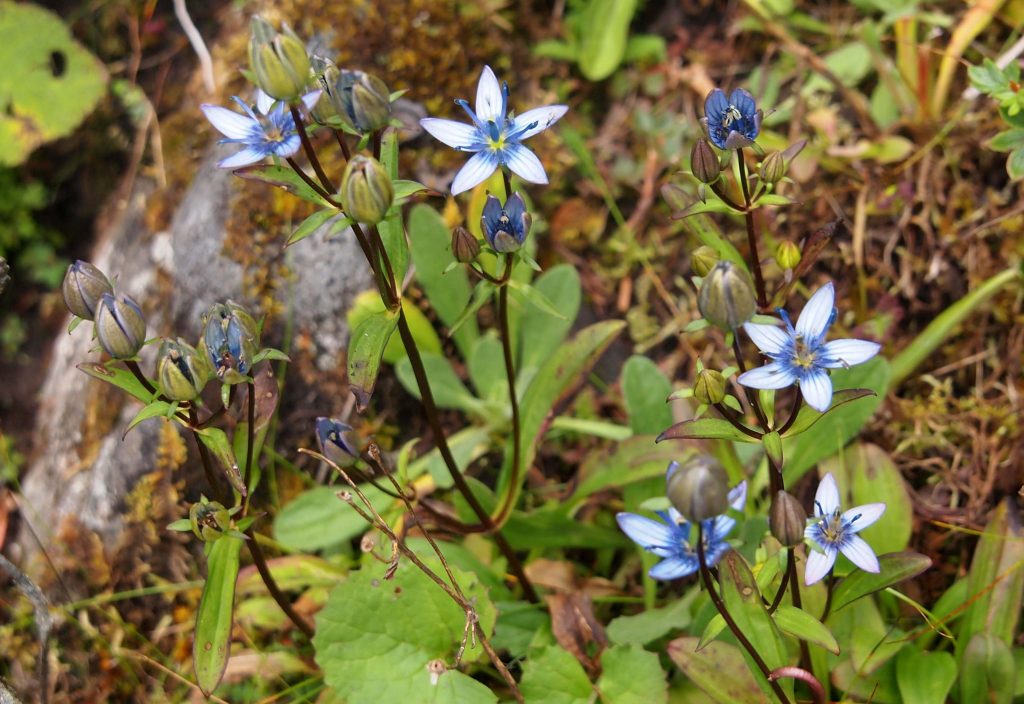
Swertia cuneata is a Himalayan gentian relative distributed from Pakistan through India, Nepal, China and Bhutan, with around 157 GBIF records. It is a plant of the alpine and upper subalpine zone, growing in open meadows, turfy slopes, rocky pastures and streamsides, broadly between about 3500 and 4500 m. The gathering from the Shale-La in Bhutan at 4300 m in September documents its late-summer flowering, when these high passes carry a colourful display of gentians, swertias and other alpine herbs at the close of the monsoon.

It is an erect annual or short-lived perennial herb with a simple or branched, often four-angled stem. The leaves are opposite, sessile, oblong to lanceolate and cuneate (wedge-shaped) at the base, the feature recalled by the epithet "cuneata". The flowers are borne in terminal and axillary cymes forming a loose panicle; each is rotate and four- or five-merous, with spreading lobes that are pale blue to purplish or yellowish and conspicuously veined or spotted, and bearing the nectary glands (nectaries fringed with fimbriae) on the corolla lobes that are diagnostic of Swertia. The fruit is a septicidal capsule containing numerous small seeds.

Swertia belongs to tribe Gentianeae and is well diversified in the Sino-Himalayan alpine flora, distinguished from Gentiana by its deeply divided, wheel-shaped corollas with open nectar glands rather than a tubular flower. Several species are important in Himalayan traditional medicine (the "chiretta" group), and although S. cuneata itself is widespread and not of conservation concern, harvesting pressure affects related taxa. Pollination is by generalist insects attracted to the exposed nectaries.

Author: D. Don · Sources: POWO (Kew), GBIF, Flora of China, Flora of Bhutan, Swertia revision (Clarke / Ho & Liu)

C.B. Clarke

Sikkim2003 447 P620
Sikkim Chopta Valley 3800m August
Sikkim2003 448 K620.2
Sikkim Chopta Valley 3800m August

Description

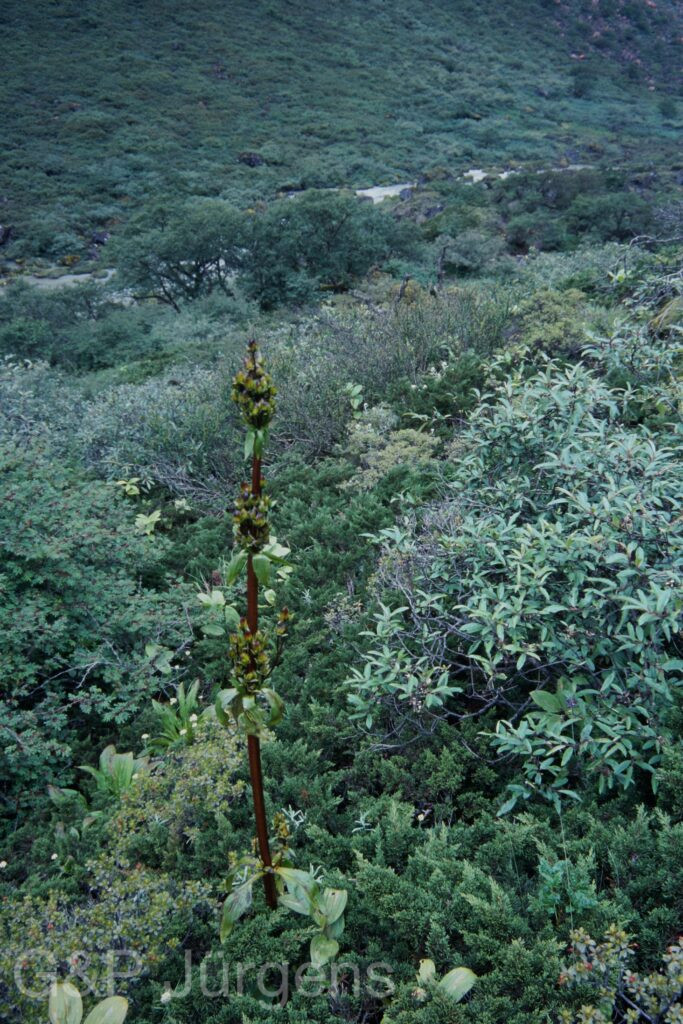
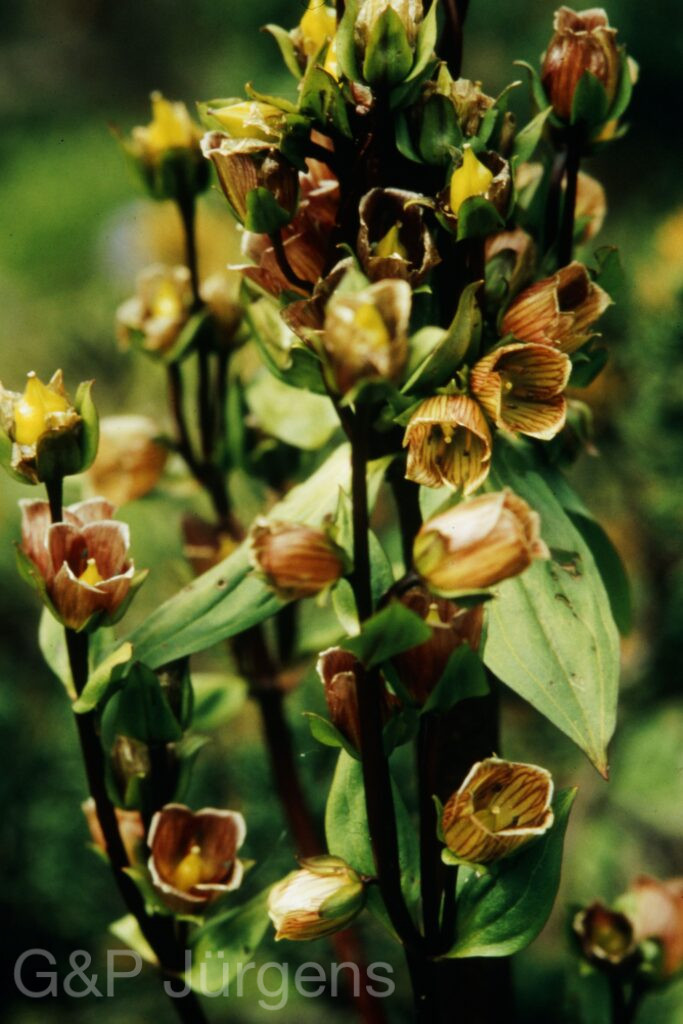
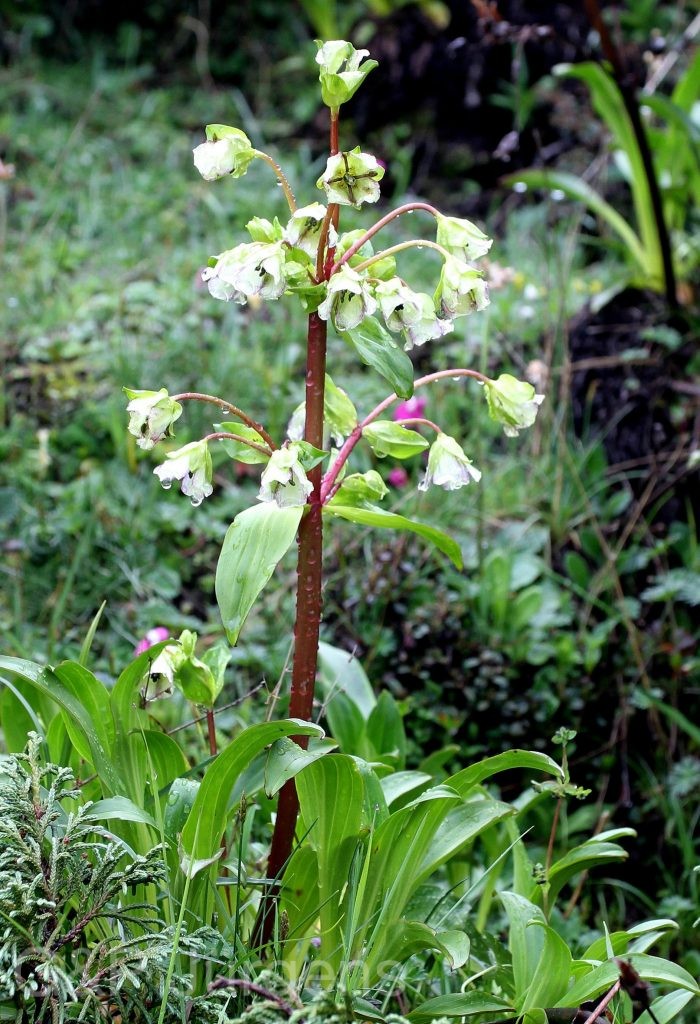
Swertia hookeri is an eastern Himalayan gentian of comparatively restricted range, recorded from India (chiefly Sikkim and Darjeeling), Nepal, Bhutan and the bordering provinces of southern China, GBIF holding around 63 occurrences consistent with a regional endemic. It inhabits moist alpine and upper subalpine zones, growing on open grassy slopes, among shrubberies, on rock ledges and along stream margins where snowmelt maintains high soil moisture. The plant photographed in August in the Chopta Valley of Sikkim at about 3800 m is typical of its elevation band, flowering at the height of the monsoon when the alpine turf is lush and humid.

It is a robust perennial or biennial herb with a stout, erect, often purple-tinged stem arising from a thick rootstock. The leaves are largely basal, broadly elliptic to ovate, conspicuously several-nerved and narrowed to a sheathing base, the cauline leaves becoming smaller and sessile upward. The inflorescence is a leafy branched panicle of large, broadly campanulate flowers; the corolla is usually 4- or 5-merous, pale greenish-yellow to whitish and densely veined with purplish-blue reticulation, each lobe bearing a pair of fimbriate nectary pits at the base. Stamens alternate with the lobes, and the superior ovary develops into a septicidal capsule with numerous small seeds.

Described by C. B. Clarke, Swertia hookeri belongs to a large, taxonomically intricate genus centred on the Sino-Himalayan region, forming part of a species swarm noted for diagnostic nectary morphology. Like many congeners it is rich in bitter secoiridoid and xanthone compounds and is gathered locally for medicinal and febrifugal use. Its dependence on intact high-altitude grassland renders it potentially sensitive to grazing pressure and climate-driven treeline shifts, though it has not been formally evaluated.

Author: C.B. Clarke · Sources: POWO (Kew), GBIF, Flora of Bhutan, Flora of China, Hara Flora of Eastern Himalaya, Clarke revision of Swertia

D. Don

Sikkim2003 301 G422
Sikkim Saniti-Lake 4250m August

Description

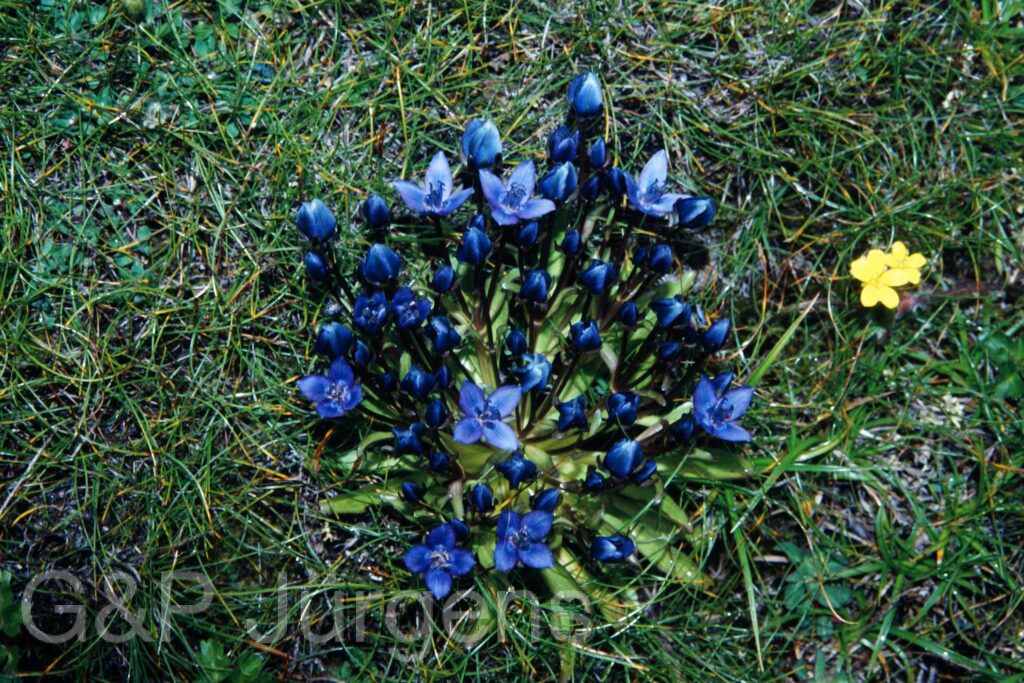
Swertia multicaulis is a high-alpine Himalayan gentian distributed through Nepal, China, India, Bhutan and recorded marginally from Kazakhstan, with GBIF holding around 144 occurrences along the main Himalayan chain. It is a plant of the upper alpine zone, growing on damp, peaty or gravelly meadows, moist rock ledges, seepage slopes and the margins of glacial lakes and snowbeds. The specimen from Saniti Lake in Sikkim at about 4250 m in August typifies its preference for cold, moisture-saturated high-altitude turf, where it flowers late in the short growing season as the monsoon wanes and snowmelt keeps the substrate constantly wet.

As its epithet indicates, it is a low perennial herb producing several stems from a stout, often branched rootstock crowned by a rosette of leaves. The basal leaves are obovate to spathulate, entire and narrowed to a petiolar base, forming a compact tuft, while the few stem leaves are small and sessile. The flowers are borne singly or in few-flowered clusters and are typically 4- or 5-merous; the corolla is rotate and deep blue-purple to violet, the lobes ovate-lanceolate and each furnished at the base with one or two fringed nectary scales characteristic of the genus. The stamens alternate with the corolla lobes, and the superior ovary ripens into a many-seeded capsule.

Described by D. Don, Swertia multicaulis is part of the speciose, taxonomically complex Sino-Himalayan radiation of the genus, where species are separated largely by nectary structure, corolla colour and habit. Its cushion-forming, multi-stemmed growth is an adaptation to wind-swept, frost-prone high-alpine conditions. The plant accumulates bitter secoiridoids and xanthones and, like other swertias, has a reputation in local folk medicine. Restricted to intact high-elevation wetland and meadow habitats, it may be vulnerable to grazing and to upward habitat compression under a warming climate.

Author: D. Don · Sources: POWO (Kew), GBIF, Flora of China, Flora of Bhutan, Hara Enumeration of Flowering Plants of Nepal, Clarke revision of Swertia

Harry Sm.

BhutanPG2011 341
Bhutan Jule-Tso, 4000m June

Description

Swertia pseudohookeri is an eastern Himalayan species recorded from Bhutan, Nepal and India, represented in occurrence databases by a modest 17 georeferenced records that reflect both its restricted distribution and its limited collection. It is a plant of high-alpine habitats—moist meadows, open turf, streamsides and the damp margins of glacial lakes—generally near and above 4000 m. The illustrated population at Jule-Tso in Bhutan, photographed at 4000 m in June, typifies its occurrence around tarns and snowmelt flushes where it flowers in the brief alpine summer.

It is an erect annual or short-lived perennial herb with a slender, often quadrangular and sometimes narrowly winged stem arising from a fibrous root. The leaves are opposite, sessile and lanceolate to ovate, with the basal leaves usually larger and the upper ones progressively reduced and bract-like. The inflorescence is a lax, few- to many-flowered cyme; the flowers are typically four- to five-merous with a deeply divided rotate corolla, the lobes pale to bluish or purplish and marked with darker veining, each bearing nectary pits fringed with fimbriae. The fruit is a septicidal, ovoid capsule containing numerous small seeds.

The epithet pseudohookeri, coined by Harry Smith, signals its close morphological resemblance to Swertia hookeri, from which it is distinguished by floral and nectary characters. Swertia is a large, taxonomically intricate genus in the Gentianaceae whose Himalayan members have long been used in traditional medicine for their bitter secoiridoid compounds. Owing to its narrow range and high-elevation niche, S. pseudohookeri is potentially vulnerable to climatic shifts and habitat disturbance, though it has not been formally evaluated.

Author: Harry Sm. · Sources: POWO (Kew), GBIF, Grierson & Long Flora of Bhutan, Annotated Checklist of the Flowering Plants of Nepal, Flora of China (Gentianaceae), Harry Smith's monographic studies on Asiatic Swertia

(C.B.Clarke) Kitam.

Sikkim2003 135 P183
India Sikkim Dzongri 4000m, August

Description

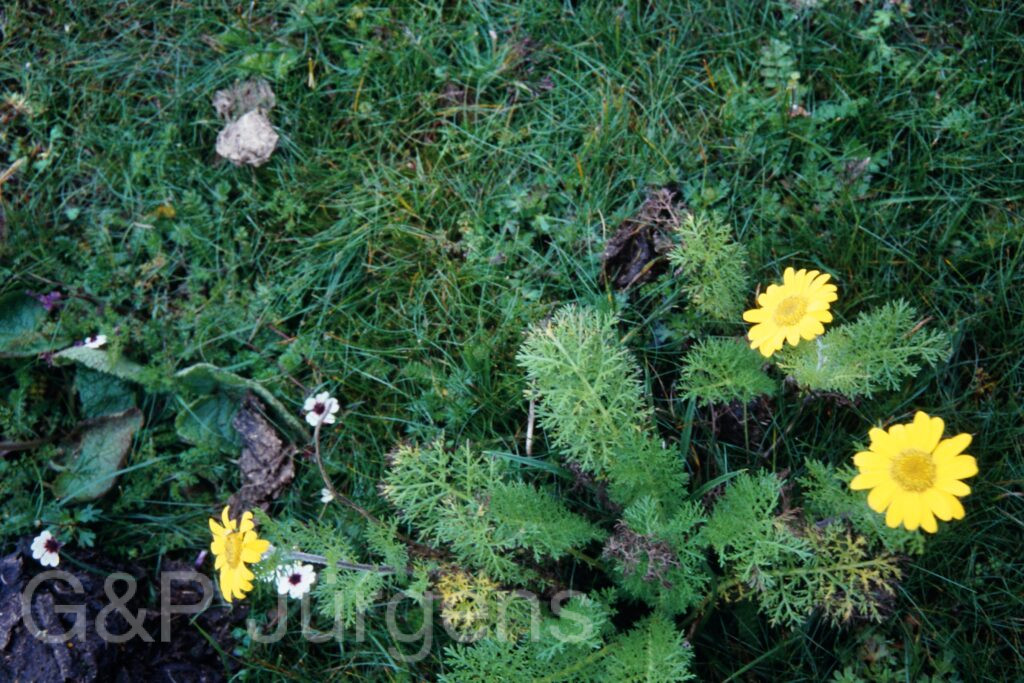
Tanacetum atkinsonii is an aromatic alpine composite of the Himalaya, recorded from Nepal, India, Bhutan and southern China, with GBIF holding around 102 occurrences across this range. It grows on open, stony alpine slopes, rocky pastures, screes and dry grassy banks in the high alpine zone, generally between about 3500 and 4500 m, where it tolerates strong insolation, cold and free-draining substrates. The illustrated plant from Dzongri in Sikkim at 4000 m, flowering in August, is characteristic of these exposed high-altitude habitats and of its late-summer flowering after the monsoon.

It is a perennial, aromatic herb with a woody rootstock producing erect to ascending stems and finely divided, pinnately dissected or bipinnatisect leaves that are grey-green and often hairy, releasing a tansy-like scent when crushed. The capitula (flower heads) are borne in a terminal corymb; each head has an involucre of imbricate, scarious-margined bracts and the typical Tanacetum structure of yellow disc florets, with the marginal florets reduced or shortly rayed rather than conspicuously ligulate. The fruit is a small, ribbed, glandular cypsela, usually with a short membranous corona rather than a true pappus.

Transferred to Tanacetum by Kitamura from an original placement under Chrysanthemum/Pyrethrum by C.B. Clarke, the species sits within the taxonomically fluid tansy group of the tribe Anthemideae, distinguished by its dissected aromatic foliage and reduced ray florets. A widespread high-Himalayan element, it is of no particular conservation concern.

Author: (C.B.Clarke) Kitam. · Sources: POWO (Kew), GBIF, Flora of Bhutan, Flora of China, Compositae of the Himalaya (specialist treatments)

Hand.-Mazz.

Sikkim2003 512 G712 2 ergebnis
Sikkim Yumedzandong 4500m, August

Description

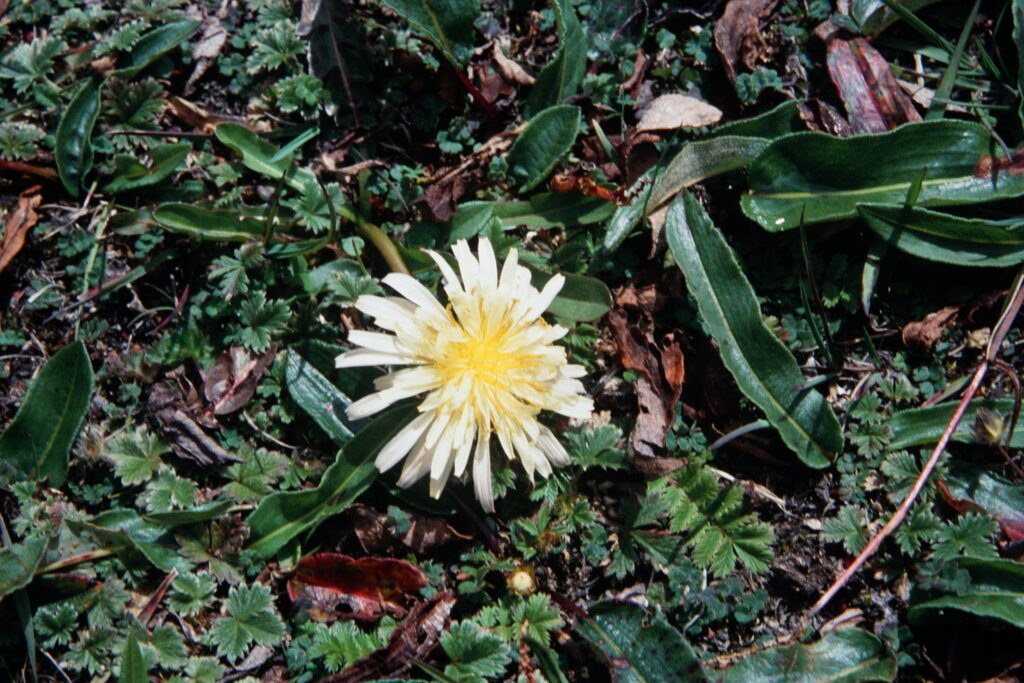
Taraxacum sikkimense is a high-alpine dandelion of the Himalaya and Tibetan Plateau margins, recorded from China, India, Nepal, Bhutan and Pakistan, with a modest set of records (c. 128 in GBIF) reflecting its restricted high-elevation range. It occupies alpine meadows, turfy slopes, moist gravelly ground and the surrounds of snowmelt flushes, typically between about 4000 and 4800 m. The photographed plant from Yumedzandong in Sikkim, at 4500 m and flowering in August, exemplifies the species in its short alpine growing season, when warmth and meltwater briefly permit growth and flowering near the upper limit of vascular plant life.

The plant is a small, acaulescent, rosette-forming perennial herb with a thick, often blackened taproot and a milky white latex characteristic of the tribe Cichorieae. The leaves are all basal, runcinate to pinnatifid or shallowly toothed, sometimes nearly entire in dwarfed alpine forms. The flowering scapes are short, each bearing a single capitulum subtended by an involucre of imbricate phyllaries, the outer often appressed or recurved with a coloured margin. The capitulum is homogamous, composed entirely of yellow ligulate (ray) florets; the fruit is a ribbed, spinulose-muricate cypsela narrowed above into a slender beak that bears a pappus of simple white bristles, dispersed by wind.

Taraxacum is a taxonomically formidable genus owing to widespread apomixis (agamospermy) and polyploidy, which generate innumerable stable microspecies; the Himalayan high-elevation taxa form a distinctive assemblage that remains incompletely revised. Taraxacum sikkimense belongs to this alpine radiation. As a specialised high-altitude plant with a naturally fragmented distribution, it is potentially sensitive to alpine habitat change, though it has not been formally assessed.

Author: Hand.-Mazz. · Sources: POWO (Kew), GBIF, Flora of China (Asteraceae), Flora of Bhutan, Taraxacum: A monograph (Richards)

(D.Don) Manden.

Bh09 71 P123
Bhutan Jili-La 3600m, June

Description

Tetrataenium nepalense is a tall Himalayan umbellifer distributed from Nepal and northern India through Bhutan into south-western China and Myanmar. Its 266 GBIF records lie within this native arc, indicating a widespread montane species of the Eastern and Central Himalaya. It occupies subalpine and alpine meadows, open slopes, forest margins and clearings, generally between about 3000 and 4000 m, where it is a characteristic robust herb of moist high-altitude grassland. The plant photographed at Jili-La in Bhutan at about 3600 m in June illustrates the species at its early-summer flowering on these damp, herb-rich montane slopes.

It is a stout, erect biennial or perennial herb arising from a thick taproot, with hollow, ridged, often pubescent stems. The large leaves are pinnate to ternately compound, the broad leaflets ovate, lobed and toothed, the lower leaves long-petiolate with conspicuous sheathing bases. The inflorescence is a large terminal compound umbel with numerous rays; the small white flowers are often radiant, the marginal petals of the outer flowers enlarged. The fruit is a flattened, broadly ovate to obovate, dorsally compressed schizocarp with conspicuous oil ducts (vittae) and narrowly winged lateral ribs.

Long known as Heracleum nepalense (a name preserved in its WordPress URL), the species was transferred to the segregate genus Tetrataenium, distinguished from Heracleum by features of the vittae and fruit. Its hogweed-like habit and large radiant umbels are typical of the group. Widespread and locally common across its range, T. nepalense is not considered threatened and is a prominent component of high Himalayan meadow vegetation.

Author: (D.Don) Manden. · Sources: POWO (Kew), GBIF, Flora of Bhutan, Flora of China, Pimenov & Kljuykov Umbelliferae revision