Tag:

Alpine (>3500 m)

Fröd.

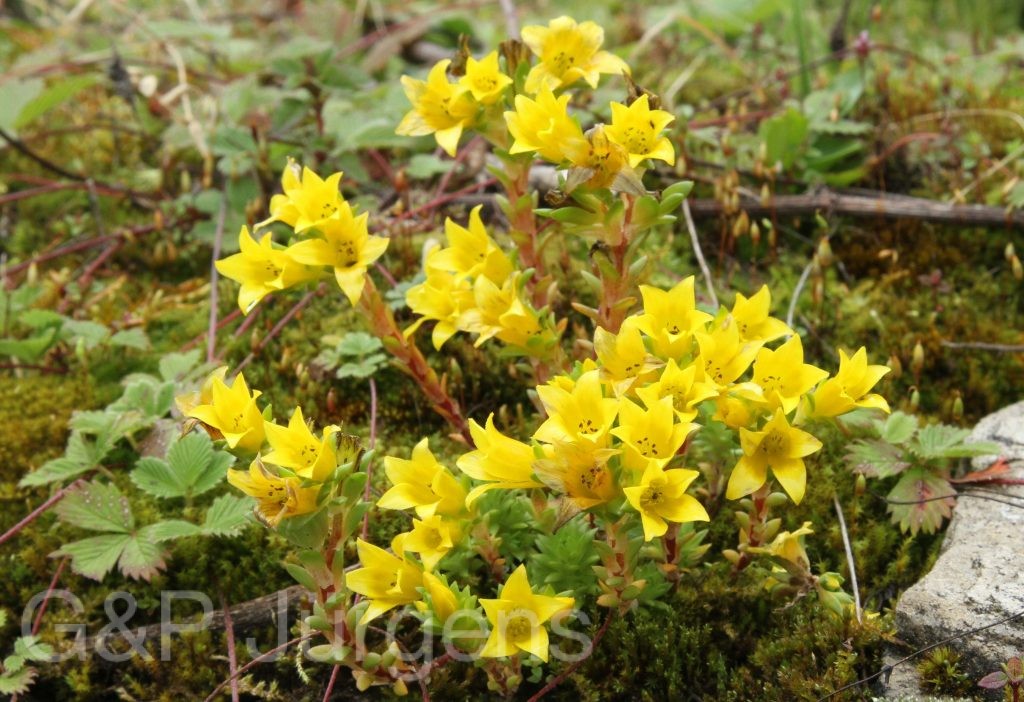
Bhutan2012 148
Bhutan Haarvalley 3500m, October

Description

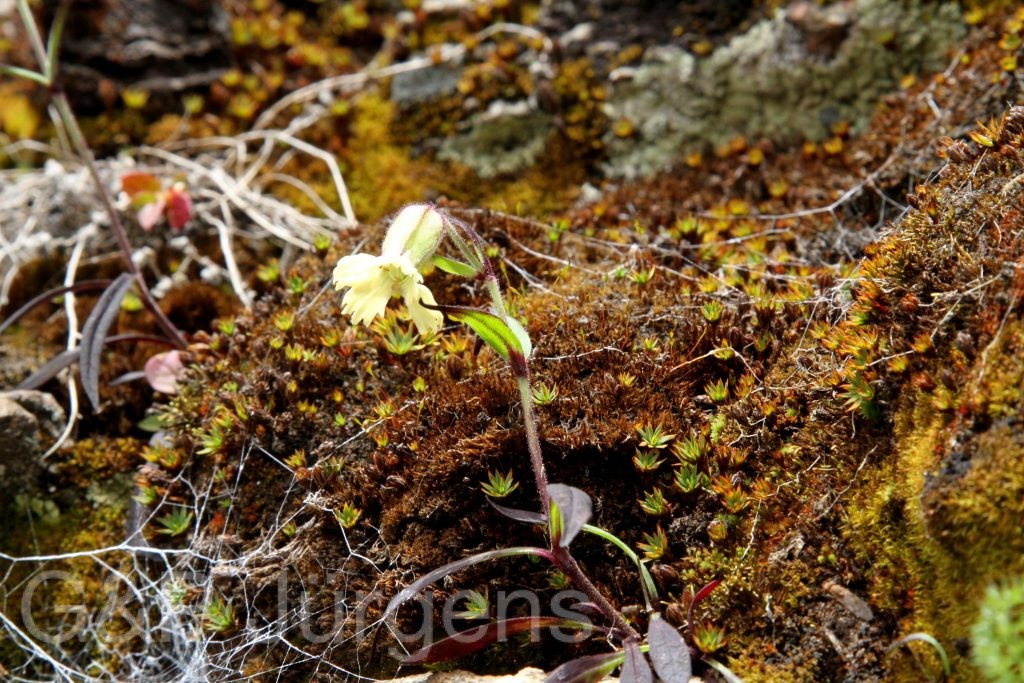
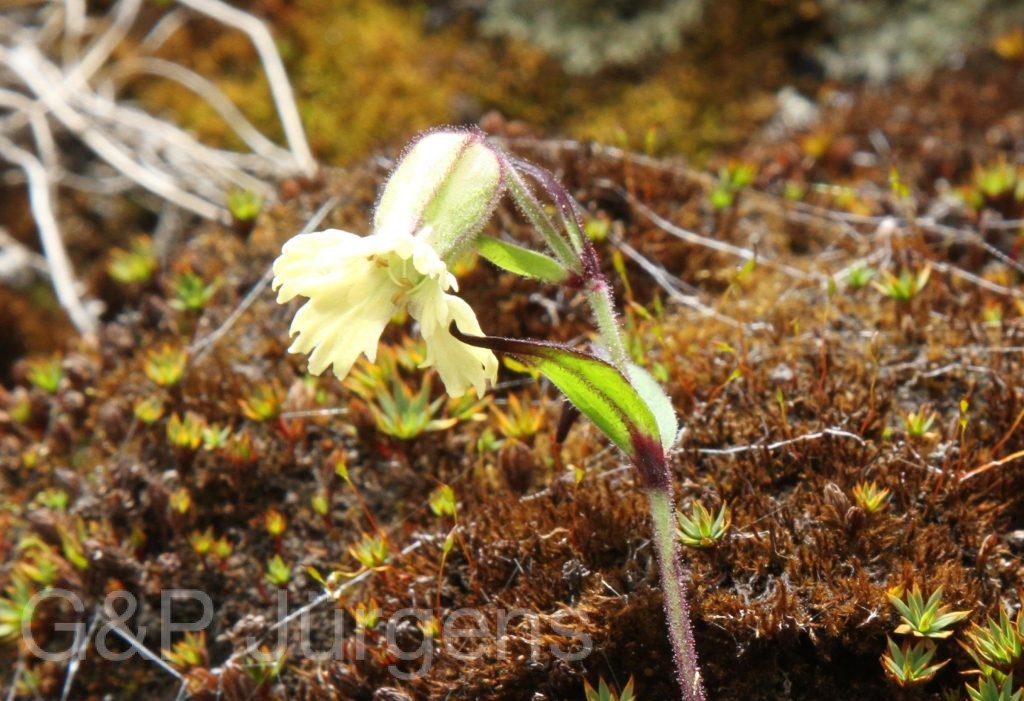
Sedum correptum is a rare stonecrop with a restricted distribution in the eastern Himalaya, known from Bhutan and adjacent areas of southwestern China (southern Tibet). GBIF records only nine occurrences, indicating the species is infrequently collected and poorly documented. It inhabits rocky ledges, cliff faces, stony ground, and mossy boulders in the upper temperate to subalpine zone, at elevations of approximately 3,000–4,000 m. The photograph from the Haar Valley in Bhutan at 3,500 m, taken in October, captures the species in fruit or late flowering in its characteristic rocky subalpine habitat.
The plant is a perennial succulent herb, 5–15 cm tall, with ascending to decumbent stems arising from a slender rootstock. Leaves are alternate, sessile, fleshy, oblong-elliptic to obovate, 8–15 mm long, entire, glabrous, often tinged reddish-purple especially under high light conditions. The inflorescence is a compact, terminal, corymbose cyme with few to several flowers. Flowers are pentamerous with lanceolate, fleshy sepals and yellow to pale yellow petals, 4–6 mm long, lanceolate to elliptic, acute. Stamens 10, in two whorls. Carpels five, erect, ripening into divergent follicles containing minute, oblong seeds.
Sedum correptum was described by the Swedish botanist Harald Fröderström, who monographed the genus extensively in the early twentieth century. The species belongs to the large and taxonomically difficult genus Sedum, which has undergone significant reclassification in recent decades as molecular phylogenetics have revealed polyphyly in its traditional circumscription. The placement of S. correptum within current infrageneric classifications requires further study. Its limited collection record and restricted range suggest it may be uncommon, though it likely remains undercollected due to the remoteness and inaccessibility of its subalpine habitats in Bhutan and Tibet.

Author: Fröd. · Sources: POWO (Kew), GBIF, Grierson & Long: Flora of Bhutan Vol. 1, Fu & Ohba: Crassulaceae in Flora of China Vol. 8
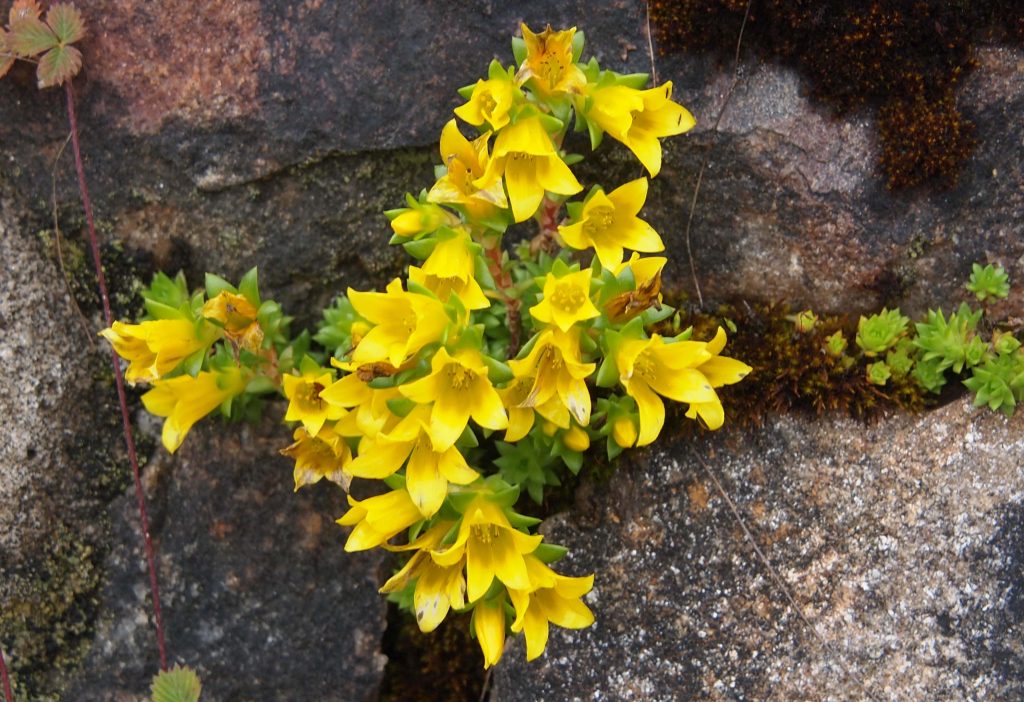
Hemsl. ex F.B. Forbes & Hemsl.

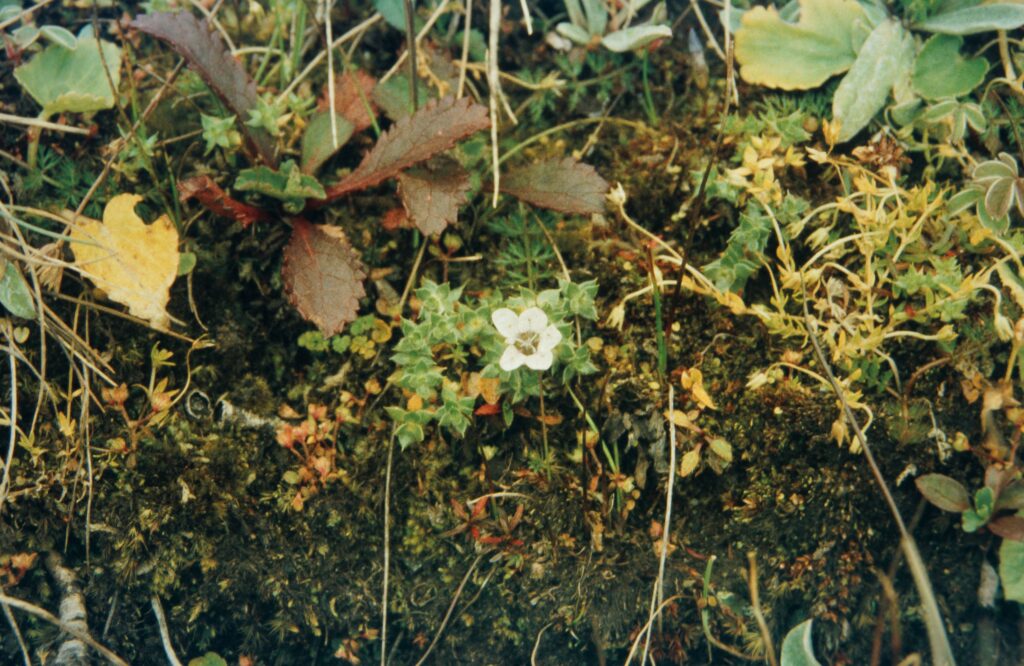
Bhutan2012 150
Bhutan Haarvalley 3500m, October

Description

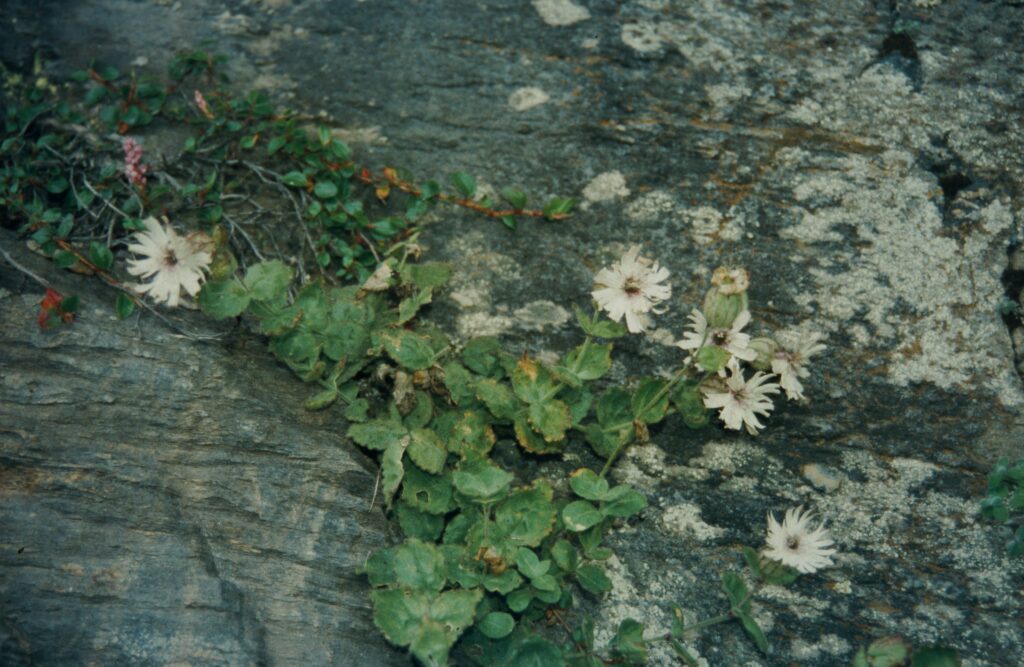
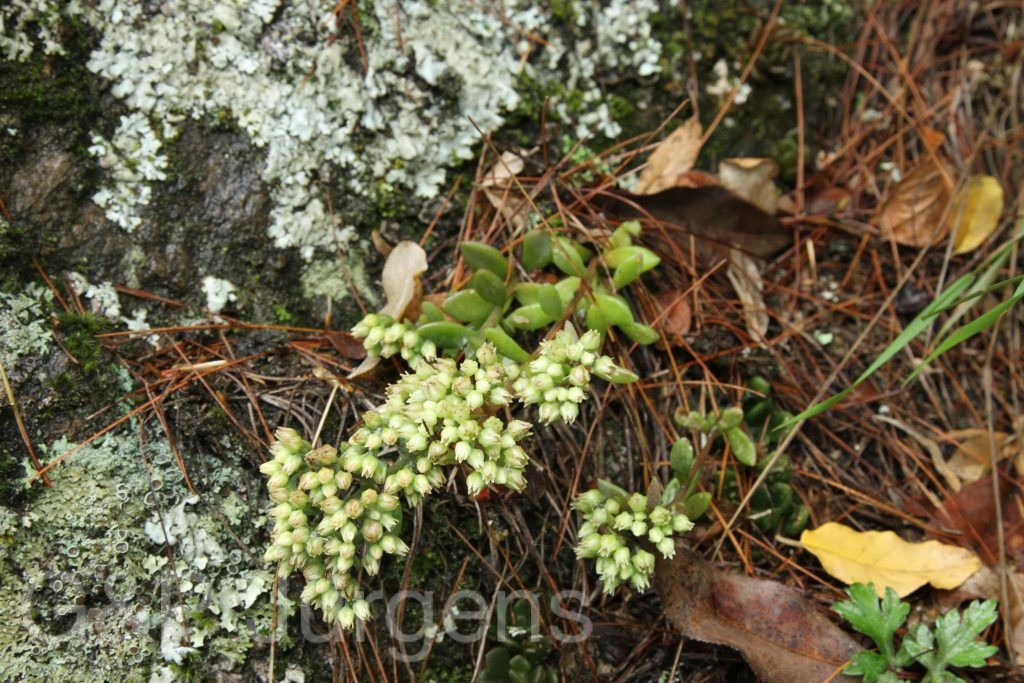
Sedum filipes Hemsl. ex F.B.Forbes & Hemsl. is a slender, succulent herb of the Sino-Himalayan mountains, recorded by GBIF from China, Nepal, India, Bhutan and Myanmar. It is a plant of moist, shaded rock ledges, mossy boulders, stream banks and forest margins in the subalpine and lower alpine belts, occurring from around 2,500 to 4,000 m. The October collection from the Haa valley in western Bhutan at 3,500 m reflects its preference for cool, humid microhabitats, where it often grows in thin soil pockets over rock alongside ferns, bryophytes and other small montane herbs at the close of the monsoon season.

The species is a delicate, glabrous annual or short-lived perennial with thread-like, often reddish, ascending or decumbent stems, as the epithet filipes (slender-stalked) implies. The fleshy leaves are alternate, flat to slightly terete, spathulate to obovate, narrowed to the base and entire. The inflorescence is a lax, few-flowered cyme bearing small, yellow, star-shaped flowers; each flower is typically five-merous, with lanceolate sepals, narrowly lanceolate petals, ten stamens and free or basally united carpels that ripen into erect, beaked follicles releasing minute seeds.

Within Crassulaceae the genus Sedum in its broad traditional sense is highly polymorphic, and slender Himalayan taxa such as S. filipes have at times been segregated into genera such as Sinocrassula or treated within narrowly defined sections. Its succulent CAM-related physiology allows survival on exposed, drought-prone rock surfaces, making it a characteristic colonist of rocky subalpine habitats and a useful indicator of undisturbed montane rock communities.

Author: Hemsl. ex F.B. Forbes & Hemsl. · Sources: POWO (Kew), GBIF, Flora of China Vol. 8, Flora of Bhutan Vol. 1, 't Hart & Eggli: Evolution and Systematics of the Crassulaceae

Sedum oreades

by GP Jürgens

(Decne.) Raym.-Hamet

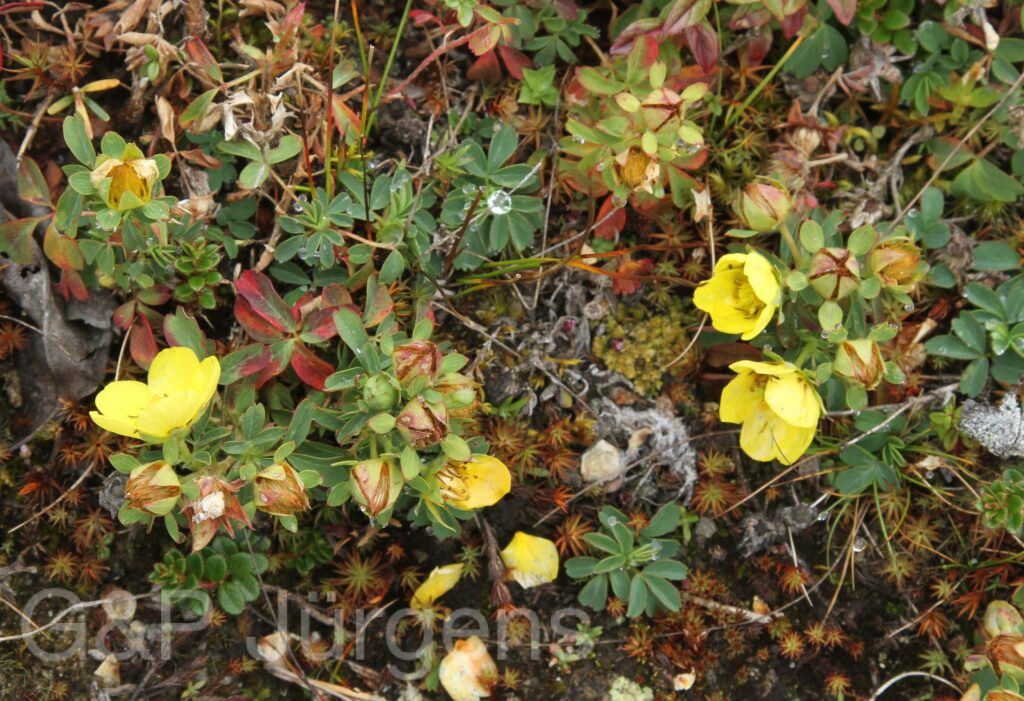
Bhutan2012 46
Bhutan Shele-La, 3900m September
Bhutan2012 48
Bhutan Shele-La, 3900m September

Description

Sedum oreades is a small succulent perennial of the Himalaya and Tibetan Plateau, recorded by GBIF in some 368 occurrences from China, India, Nepal, Bhutan and Pakistan. It is a plant of high alpine habitats, colonising rock crevices, stony slopes, screes, moraine and gravelly turf, broadly between 3500 and 5000 m. The illustrated plant was photographed in Bhutan at the Shele-La at 3900 m in September, persisting and fruiting late in the season, its drought- and cold-tolerant succulence well suited to the thin, freely draining, sun-exposed substrates of the upper alpine zone.

The plant forms low tufts or cushions from a branched, often woody rootstock bearing crowded leafy shoots. The leaves are small, fleshy and succulent, linear-oblong to terete and densely imbricate along the stems, frequently flushed red in exposed sites. The flowers are borne in a compact terminal cyme; they are typically five-merous with lanceolate, free or basally connate petals that are yellow, sometimes tinged red, surrounding the stamens and the cluster of carpels. The fruit consists of erect to slightly spreading follicles that split along the inner suture to release numerous minute seeds.

Sedum (Crassulaceae) is a large, taxonomically complex genus, and many Himalayan-Tibetan species formerly placed here have been transferred to segregate genera such as Rhodiola and Phedimus on the basis of habit and floral structure; S. oreades is a member of the high-altitude alpine assemblage. GBIF treats the name as accepted. Employing crassulacean acid metabolism and a cushion habit, it is a hardy pioneer of harsh, exposed ground and is locally common, with no recognised conservation concern.

Author: (Decne.) Raym.-Hamet · Sources: POWO (Kew), GBIF, Flora of China, Flora of Pakistan, Ohba studies of Himalayan Crassulaceae

(Edgew.) Pusalkar & D.K.Singh

Garw 2005 333 ergebnis
India Garhwal Bagubas 4000m, October

Description

Shivparvatia glanduligera is an alpine herb of the Caryophyllaceae distributed across the Himalaya from northern India (Kashmir, Himachal Pradesh, Uttarakhand) through Nepal and Bhutan to southwestern China (Tibet). GBIF records 256 occurrences, making it one of the more frequently collected high-altitude caryophylls in the region. The species inhabits alpine meadows, moist scree, rocky slopes, and gravel flats at elevations of 3,500–5,200 m. The photograph from Bagubas in the Garhwal Himalaya at 4,000 m, taken in October, shows the species in the western part of its range during its late-season flowering.
The plant is a low, tufted perennial herb, 3–12 cm tall, with ascending stems that are characteristically glandular-pubescent throughout — the feature referenced in the epithet glanduligera. Leaves are opposite, linear-lanceolate to narrowly elliptic, 5–15 mm long, acute, with glandular hairs on both surfaces and margins. Flowers are solitary or in few-flowered terminal cymes. Sepals five, ovate-lanceolate, glandular-hairy, 3–5 mm long. Petals five, white, obovate, slightly exceeding the sepals, entire or shallowly emarginate at the apex. Stamens 10. Styles three. The capsule is ovoid, dehiscing by six teeth, containing numerous small, reniform, tuberculate seeds.
This species was long placed in Arenaria as A. glanduligera Edgew. before molecular phylogenetic analyses revealed that the traditional genus Arenaria was massively polyphyletic. Pusalkar and D.K. Singh transferred it to the newly erected genus Shivparvatia, named after the Hindu deities Shiva and Parvati in reference to the Himalayan home of these plants. The reclassification reflects a broader reorganisation within Caryophyllaceae tribe Arenarieae based on molecular evidence. The species is ecologically significant as a component of high-alpine plant communities and is not currently assessed as threatened.

Author: (Edgew.) Pusalkar & D.K.Singh · Sources: POWO (Kew), GBIF, Pusalkar & Singh (2015) in Phytotaxa, Flora of China Vol. 6, Naithani: Flora of Chamoli Vol. 1

(Bertol.) Paule & Soják

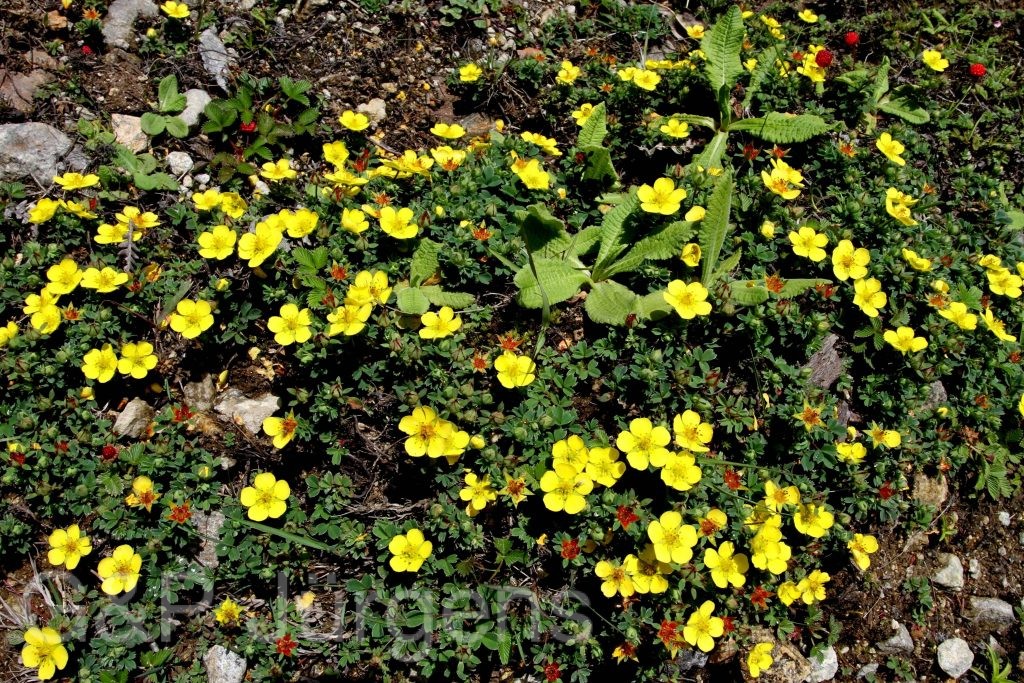
Bhutan2012 910
Bhutan Tumching-La 4000m, October
Sikkim2011 27
Bhutan Lachen 2800m, June

Description

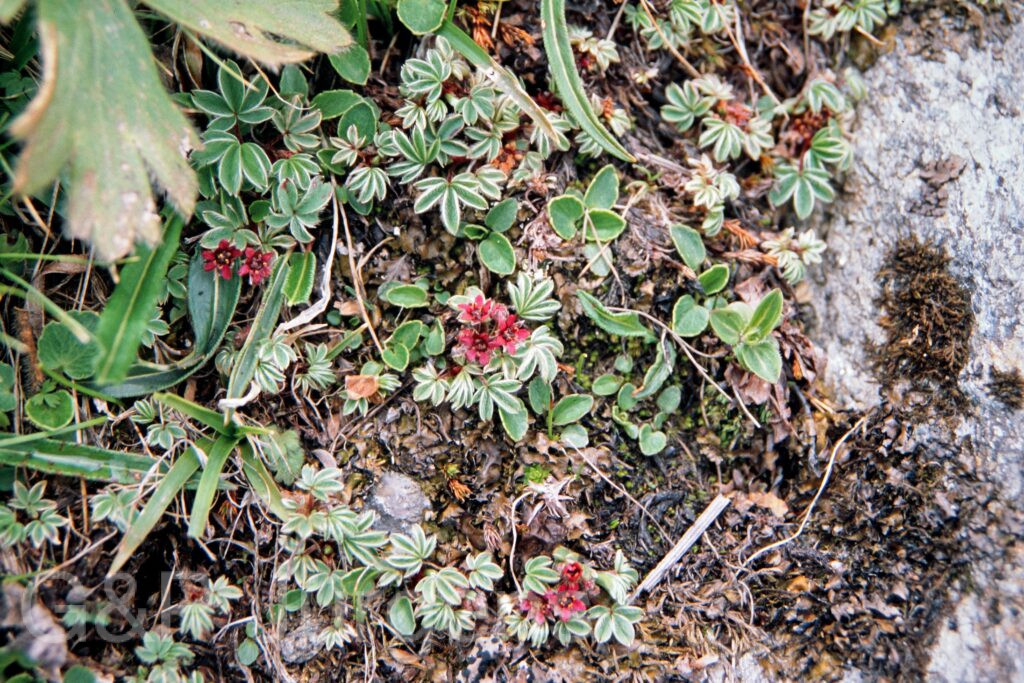
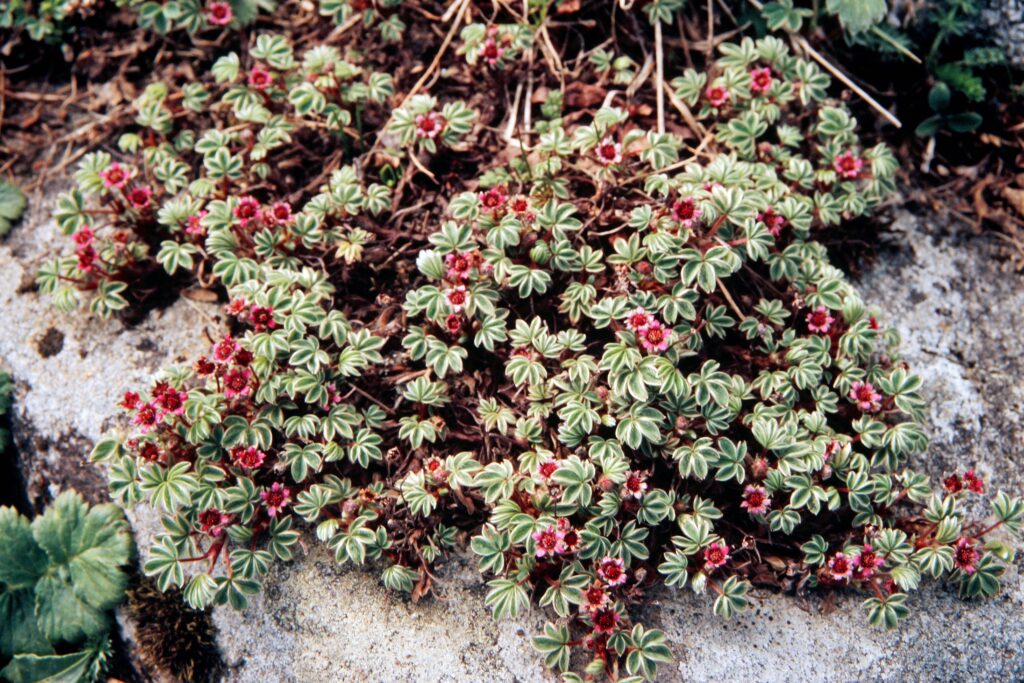
Sibbaldia cuneifolia (Bertol.) Paule & Soják is a cushion-forming perennial of the high Himalaya and adjoining Central Asian mountains, distributed across India, Nepal, Bhutan, Pakistan and SW China, with additional records from temperate Europe (Austria, Switzerland, Britain, Sweden, Finland) reflecting both a wide alpine range and naturalised or rock-garden occurrences; the roughly 184 georeferenced collections concentrate in the Sino-Himalayan alpine belt. It inhabits open stony slopes, screes, glacial moraine, alpine turf and the margins of late-melting snowbeds. The species ascends to considerable altitude, as the photographed material from the Tumching-La pass in Bhutan at about 4,000 m in October and from Lachen at 2,800 m in June illustrates, spanning the subalpine to high-alpine zones.

It is a low, mat-forming herb arising from a woody, branched rootstock and slender creeping rhizome. The leaves are trifoliolate and basal in dense rosettes, the obovate-cuneate leaflets wedge-shaped at the base and conspicuously few-toothed at the truncate apex, often somewhat fleshy and sparsely strigose. Short cymes bear small flowers with five green sepals alternating with smaller epicalyx segments, and five minute yellow petals shorter than the calyx; stamens are typically five, and the carpels few, ripening into small dry achenes seated on a dry receptacle.

The genus Sibbaldia is closely allied to Potentilla, into which it is sometimes merged, and the basionym links this taxon to the Potentilla ambigua complex referenced on the source page. Adapted to short growing seasons, intense insolation and frost, these prostrate cushions exemplify alpine stress tolerance. The species is widespread and not considered threatened, though high-altitude populations are sensitive to grazing pressure and climate-driven upslope shifts.

Author: (Bertol.) Paule & Soják · Sources: POWO (Kew), Flora of China Vol. 9, Flora of Bhutan Vol. 1, GBIF, Soják: Notes on Potentilla and allied genera (2008)

Royle

Nepal 99 315 ergebnis
West-Nepal Kalmura 4200m, June
Garh 07 454 ergebnis
India Garhwal Khiar Kutti 3900m, June

Description

Sibbaldia purpurea is a low, cushion-forming alpine perennial of the high Himalaya and adjacent Tibetan ranges, recorded from China, India, Nepal, Bhutan and Pakistan (gbif_countries: CN, IN, NP, BT, ZZ, PK), with some 252 GBIF occurrences. It inhabits open alpine turf, gravelly slopes, screes and stony pastures, typically above the treeline in cold, well-drained, exposed sites. The illustrated gatherings come from Kalmura in West Nepal at about 4200 m and Khiar Kutti in Garhwal, India, near 3900 m, both flowering in June as the brief high-alpine growing season opens. In GBIF the name is treated under gbif_status SYNONYM, with Sibbaldia purpurea itself given as the accepted name.

The plant forms dense mats or low tufts from a branched woody caudex, with prostrate to ascending stems and crowded leaves. The leaves are trifoliolate, the leaflets small, wedge-shaped and toothed at the apex, frequently silky-hairy. The flowers are small and borne singly or in few-flowered cymes; they are distinctive within the genus for their reddish-purple to purple petals, contrasting with the yellow flowers of most Sibbaldia, set against a persistent calyx with an epicalyx. The fruit is a cluster of small, dry achenes.

Sibbaldia is a small genus of the rose family closely allied to Potentilla, from which it is segregated chiefly by its reduced stamen and carpel number, and recent molecular studies have repeatedly examined the boundary between the two; some treatments subsume part of Sibbaldia into Potentilla, accounting for the synonymy noted above. S. purpurea is a hardy cushion plant well adapted to alpine extremes. Widespread across the high Himalaya, it is of no conservation concern.

Author: Royle · Sources: POWO (Kew), GBIF, Flora of Nepal, Flora of China, Annotated Checklist of the Flowering Plants of Nepal, Eriksson et al. phylogenetic studies of Potentilleae

(Rupr.) Bocquet

Nepal 99 320 ergebnis
West-Nepal Kalmura 4200m, June

Description

Silene gonosperma is a high-mountain perennial campion with a wide Central Asian, Himalayan and boreal distribution, recorded from Afghanistan, Tajikistan, Kyrgyzstan, Kazakhstan, Pakistan, the Himalaya (India, Nepal, Bhutan), Mongolia, Russia, China and even reaching Sweden in the broad sense. GBIF aggregates around 657 occurrences spanning this trans-Asiatic range. It is a plant of the alpine zone, growing in stony and grassy meadows, screes, moraines and exposed slopes, commonly above 3500 m and reaching well over 4000 m. The West-Nepal population photographed at Kalmura (4200 m, June) typifies its occurrence in cold, open high-alpine turf near the upper limit of flowering plants.

The species forms small tufts or cushions from a branched woody caudex, producing short, ascending, often glandular-hairy flowering stems. The leaves are opposite, linear to narrowly oblanceolate, the basal ones crowded and the cauline pairs few and reduced. The flowers are usually solitary or few, often nodding, with a tubular to inflated, many-nerved calyx frequently flushed dark purple, and five clawed petals, pink-purple to dull violet or greenish, with shallowly emarginate to bifid laminae. Ten stamens and three styles are present. The fruit is an ovoid capsule opening by six teeth and bearing the distinctive angular, often winged seeds that give the epithet.

Silene gonosperma, transferred by Bocquet from earlier placements in Melandrium and Wahlbergella, exemplifies the taxonomic flux around the boreal-alpine campions, and several subspecies and varieties have been described across its enormous range. Its cushion habit, dark calyx and angular seeds aid identification among co-occurring high-alpine Silene. As a widespread, locally frequent species of remote high-mountain habitats it faces no significant threats, though its uppermost populations may be sensitive to warming.

Author: (Rupr.) Bocquet · Sources: POWO (Kew), GBIF, Flora of China, Flora of Pakistan, Flora of USSR, Annotated Checklist of the Flowering Plants of Nepal, Caryophyllaceae monograph of Silene (Bocquet)

(Rohrb.) Majumdar

Nepal 99 517 ergebnis
West-Nepal Churta-Khola 3800m, June

Description

Silene himalayensis is a perennial campion widely distributed across the high mountains of Central and South Asia, ranging from Afghanistan and Tajikistan through Pakistan and the Himalaya (India, Nepal, Bhutan) into south-western China. GBIF records around 817 occurrences, concentrated in the Himalayan arc and the Chinese borderlands. It grows in alpine and subalpine habitats, favouring open meadows, grassy and stony slopes, screes and streambanks, generally between about 3000 and 4500 m. The West-Nepal population photographed at Churta-Khola (3800 m, June) is characteristic of its occurrence in moist alpine turf at the height of the short montane summer.

The species forms tufts from a branched woody rootstock, producing several ascending to erect, slender, often glandular-pubescent stems. The leaves are opposite, linear-lanceolate to oblanceolate, the basal ones tapering to the base and the cauline pairs sessile. The inflorescence is few-flowered, the flowers solitary or in lax dichasia and frequently nodding in bud. Each flower has a tubular to clavate, ten-nerved, glandular calyx, often suffused with purple, and five clawed petals, pink to purplish or whitish, the laminae bifid and bearing small coronal scales. Ten stamens and three styles are present; the fruit is an ovoid capsule opening by six apical teeth on a short carpophore, releasing reniform, tuberculate seeds.

The genus Silene is taxonomically complex in the Himalaya, and this species was transferred by Majumdar from Melandrium, reflecting uncertainty about generic limits between Silene and its segregates. Its glandular indumentum, nodding flowers and high-elevation ecology aid recognition among the many regional campions. As a broadly distributed, locally frequent alpine perennial it is not considered threatened, although high-altitude grazing and warming may locally affect marginal populations.

Author: (Rohrb.) Majumdar · Sources: POWO (Kew), GBIF, Flora of China, Flora of Pakistan, Flora of Bhutan, Annotated Checklist of the Flowering Plants of Nepal, Caryophyllaceae monograph of Silene (Bocquet)

(W.W. Sm.) Bocquet

Bhutan2012 276
Bhutan Shele-La, 4000m September
Bhutan2012 277
Bhutan Shele-La, 4000m September

Description

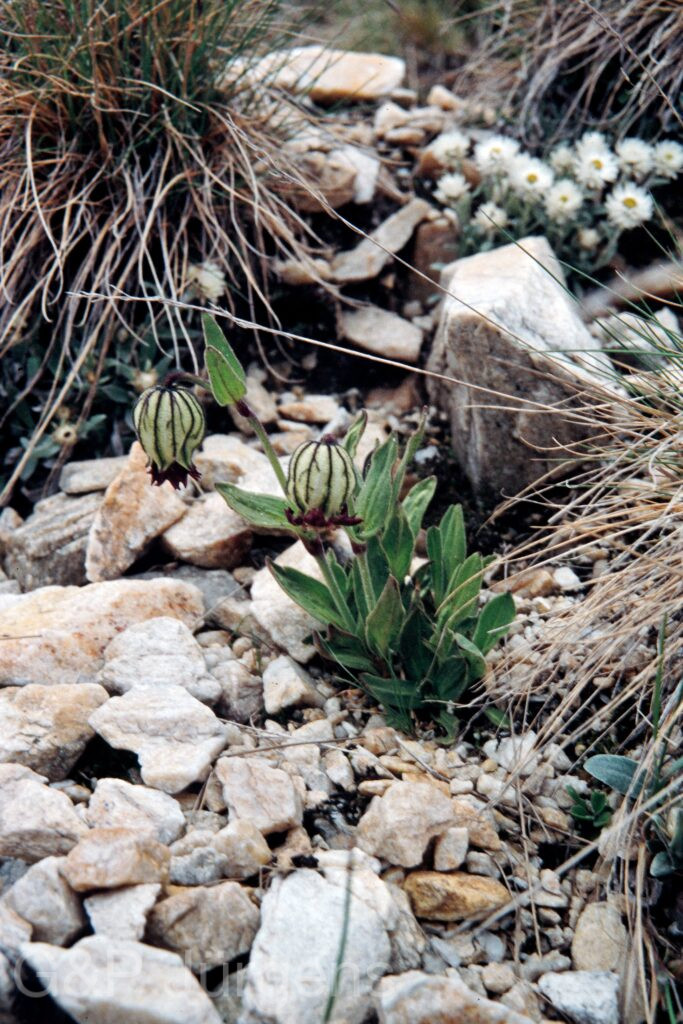
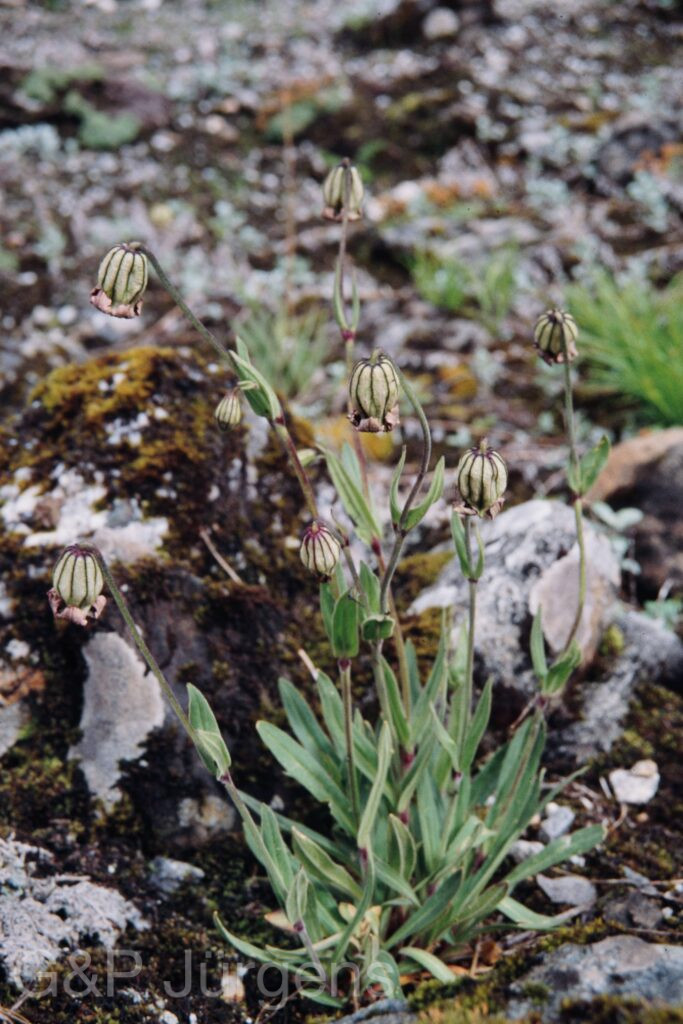
Silene indica var. bhutanica is a campion of the high Himalaya, recorded from Nepal, Bhutan, India and adjacent China. It occupies alpine and upper subalpine habitats, growing on open grassy slopes, stony pastures, screes and rocky ground in the high mountains, generally between about 3500 and 4500 m. The photographed plant comes from the Shele-La in Bhutan at around 4000 m, flowering in September towards the close of the monsoon season. With only eighteen georeferenced records this variety is sparsely documented, in keeping with its restricted eastern Himalayan range and the difficulty of access to its high-altitude habitats.

It is an erect to ascending perennial herb arising from a stout rootstock, the stems usually several, simple or sparingly branched and often glandular-pubescent above. The leaves are opposite, linear-lanceolate to oblong, sessile or shortly stalked, with entire ciliate margins. The flowers are borne in a lax cymose inflorescence; each has a tubular, inflated and prominently 10-veined calyx, often glandular and tinged purple, enclosing the claws of the petals. The five petals are pink to purplish, the limb bifid or notched and bearing a small scaly corona at the throat. There are ten stamens and three styles, characteristic of the genus, and the fruit is a capsule dehiscing by apical teeth and shedding numerous reniform seeds.

Silene is the largest genus of Caryophyllaceae, and var. bhutanica is distinguished within the variable S. indica complex by features of indumentum, calyx and petal form, its delimitation depending on revisionary treatment of Himalayan Silene. Given its narrow range and few records, its conservation status is poorly known; restricted high-alpine taxa of this kind are potentially vulnerable to grazing and climatic shifts.

Author: (W.W. Sm.) Bocquet · Sources: POWO (Kew), GBIF, Flora of Bhutan, Flora of China, Bocquet's revisions of Asian Silene

(Bocquet) Y.J.Nasir

Garw 2005 312 ergebnis
India Garhwal Bagubas 3800m, October

Description

Silene indica var. edgeworthii is a western Himalayan campion recorded from Pakistan, India and Nepal, known from a small set of around 18 georeferenced occurrences that together delimit a fairly narrow distribution along the inner ranges. It is a plant of open, high-elevation habitats, favouring alpine and subalpine meadows, stony slopes, grassy hollows and the margins of moraines where snowmelt provides seasonal moisture. The individual illustrated near Bagubas in Garhwal (India) at about 3800 m in October exemplifies this affinity for the upper alpine zone, where it flowers and fruits late in the growing season as the surrounding turf begins to senesce. According to GBIF, the name carries a SYNONYM status, with Silene indica edgeworthii treated as the accepted name.

It is a perennial herb arising from a stout rootstock, producing erect to ascending stems that are often glandular-pubescent in the upper parts. The leaves are opposite and entire, the basal ones spathulate to oblanceolate and the cauline pairs narrower and sessile. The flowers are borne in a lax, few-flowered cyme; each is subtended by a tubular, prominently ten-nerved calyx that is frequently inflated and contracted at the mouth. The five petals are pink to whitish, clawed, and bear a bifid or shallowly lobed limb with a small coronal scale at the throat. The fruit is a many-seeded capsule dehiscing by apical teeth, the seeds reniform and minutely tuberculate.

Within Silene, this taxon belongs to a Himalayan complex in which infraspecific variation in calyx form, indumentum and petal limb has prompted repeated reassessment, hence its fluctuating rank as a variety versus an accepted entity. Its restricted range and dependence on intact alpine grassland make it a useful indicator of high-pasture condition, while heavy summer grazing and trampling along transhumance routes represent the principal pressures on its populations.

Author: (Bocquet) Y.J.Nasir · Sources: POWO (Kew), GBIF, Flora of Pakistan, Flora of Nepal, Flora of Bhutan Vol. 1, Bocquet Revision der Gattung Silene (Caryophyllaceae)