Tag:

Autumn

(Loes.) S.Y. Hu

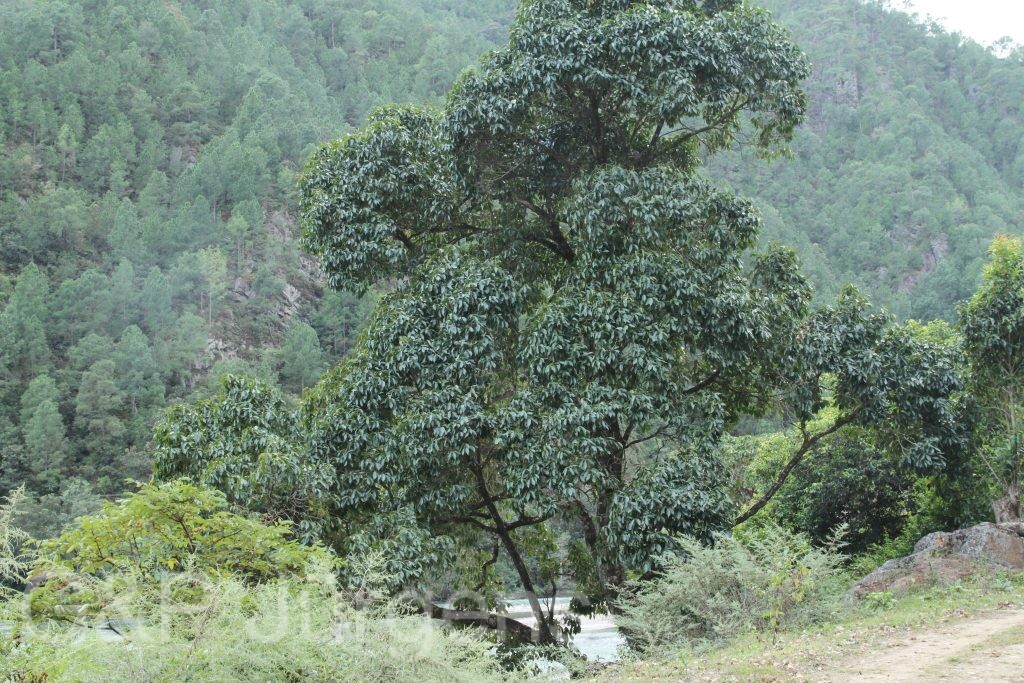
Bhutan2015 536
Bhutan Mo-Chu 1300m, October
Bhutan2015 540
Bhutan Mo-Chu 1300m, October

Description

Ilex excelsa var. hypotricha is a holly of the eastern Himalaya and adjacent China, distributed through Bhutan, Nepal, NE India, Bangladesh and SW China as recorded by GBIF (CN, IN, NP, BD) on the basis of about 39 occurrences. The photographed tree was found in western Bhutan along the Mo-Chu at about 1,300 m in October. It is a component of subtropical and warm-temperate broadleaf forest, growing on humid hill slopes, along streams and forest margins, generally between about 1,000 and 2,200 m, where it occurs as an understorey to mid-canopy evergreen tree in mixed laurophyllous woodland.

It is an evergreen tree or large shrub with smooth grey bark and glabrous to finely puberulent young shoots. The leaves are alternate, leathery, elliptic to oblong-lanceolate, with an entire to remotely crenulate margin and an acuminate apex; this variety is distinguished by a thin pubescence on the lower surface, particularly along the midrib, the feature signalled by the epithet hypotricha. As in all Ilex the plants are dioecious, the small four-merous white to greenish flowers borne in axillary fascicles or short cymes, the staminate and pistillate flowers on separate trees. The fruit is a small globose red drupe containing several hard pyrenes (stones), characteristically ornamented as is diagnostic in the genus.

The genus Ilex is large and taxonomically intricate, with infraspecific variation in leaf indumentum often used to delimit varieties such as this one; the bony pyrene sculpturing remains an important systematic character. As a forest tree of moderately wide range, this taxon is not regarded as threatened, though its dependence on intact mid-elevation broadleaf forest links its fortunes to the conservation of eastern Himalayan woodland.

Author: (Loes.) S.Y. Hu · Sources: POWO (Kew), Flora of China Vol. 11, Flora of Bhutan Vol. 2, GBIF, Loesener: Monographia Aquifoliacearum
Hook.f. & Thomson

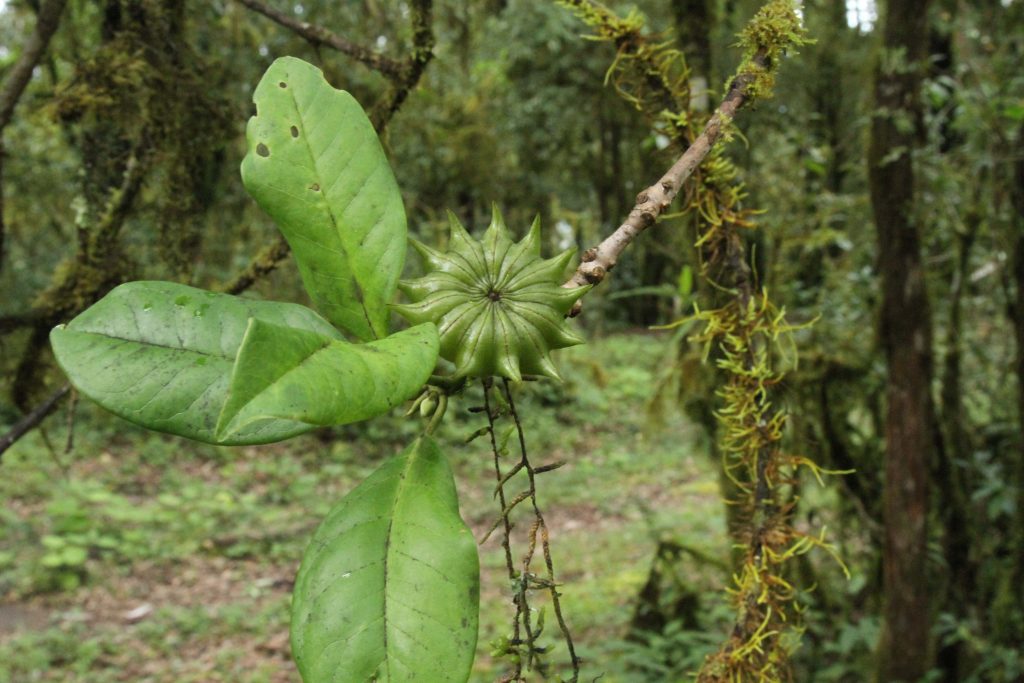
Bhutan2012 346
Bhutan Dochu-La 3000m, September

Description

Illicium griffithii Hook.f. & Thomson is an aromatic evergreen tree or shrub of the eastern Himalaya and montane Southeast Asia. GBIF records it from Bhutan, NE India, China, Myanmar, Bangladesh, Vietnam, Cambodia and Malaysia (about 220 occurrences), a distribution centred on the wet temperate to subtropical forests of the eastern Sino-Himalaya. It grows in cool, humid, mossy broad-leaved and mixed conifer forest, often as an understorey component on damp slopes and ridges, typically between roughly 1,800 and 3,000 m; the illustrated plant is from Bhutan at Dochu-La, 3,000 m, in September, near the upper limit of its range.

The plant is a small to medium-sized tree with smooth bark and aromatic tissues. The leaves are alternate but crowded toward the branch tips in pseudowhorls, simple, entire, elliptic to oblanceolate, leathery, glabrous and gland-dotted, exuding an anise-like scent when crushed. The flowers are solitary and axillary, with numerous spirally arranged perianth segments grading from sepaloid to petaloid, pinkish to dark red, the stamens and free carpels also numerous in the manner of the basal angiosperms. The fruit is the characteristic star-shaped aggregate of (usually) 8–13 woody follicles arranged in a single whorl, each follicle opening to release a single glossy seed.

Illicium (Schisandraceae, formerly Illiciaceae) belongs to the basal angiosperm order Austrobaileyales. Like its relatives the seeds and fruit contain toxic sesquiterpene lactones (anisatin-type), and the star anise of this species is harvested locally for incense, flavouring and medicine, demanding care given its toxicity. The species is widespread within suitable montane forest and is not currently regarded as threatened.

Author: Hook.f. & Thomson · Sources: POWO (Kew), GBIF, Flora of China Vol. 7, Flora of Bhutan Vol. 1, Smith: A Taxonomic Review of Illicium (Sargentia)

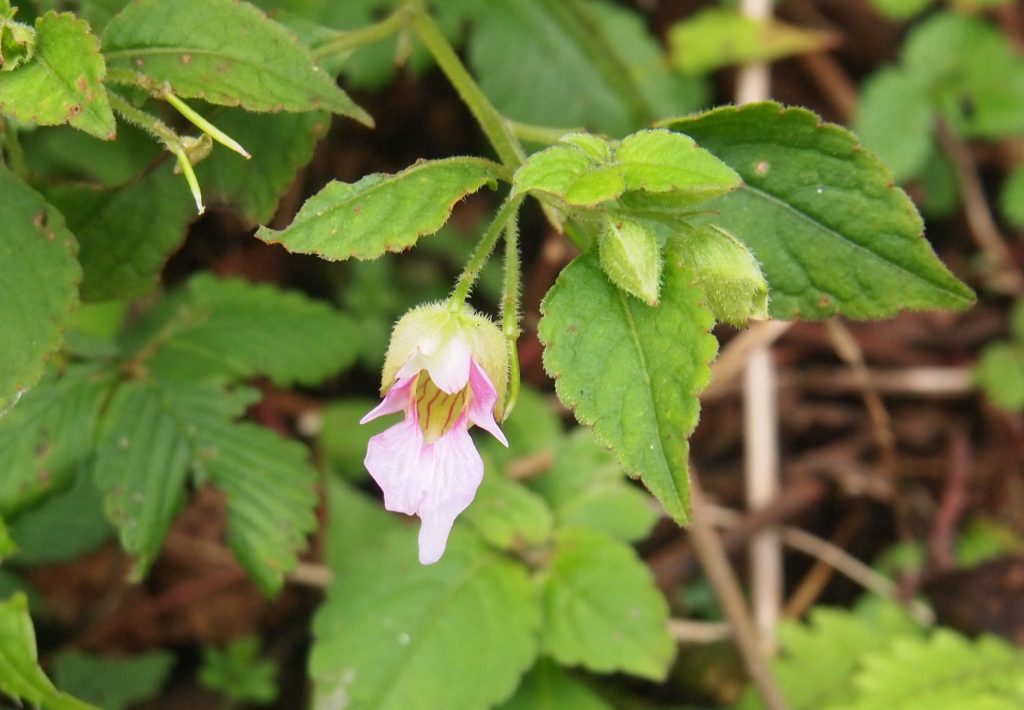
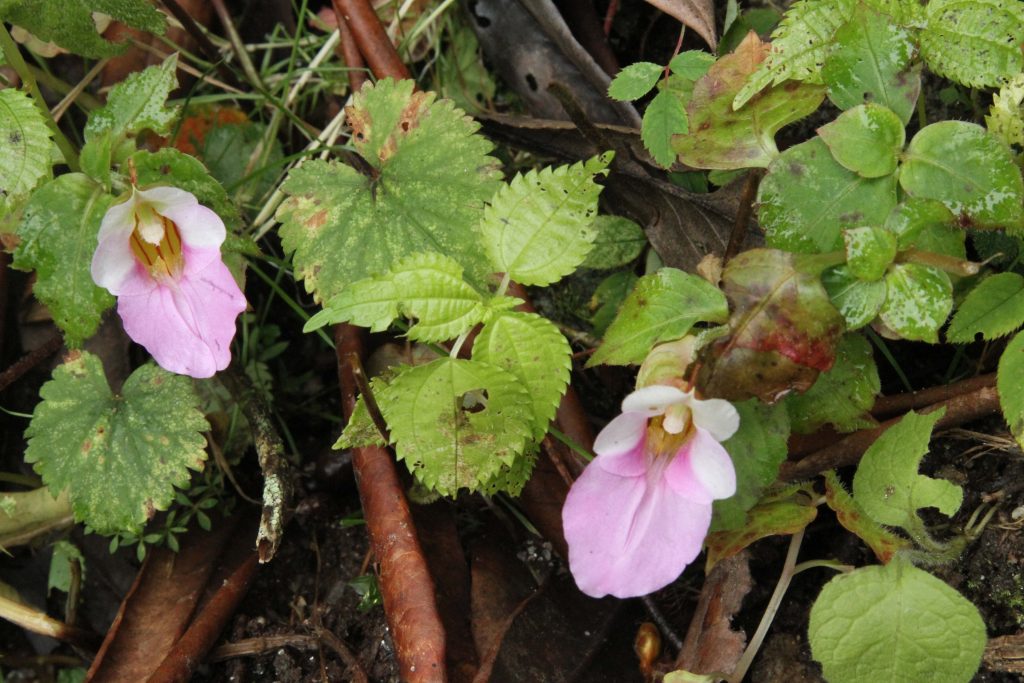
Hook.f. & Thomson

Bhutan2012 329
Bhutan Dochu-La 3200m, September
Bhutan2012 330
Bhutan Dochu-La 3200m, September

Description

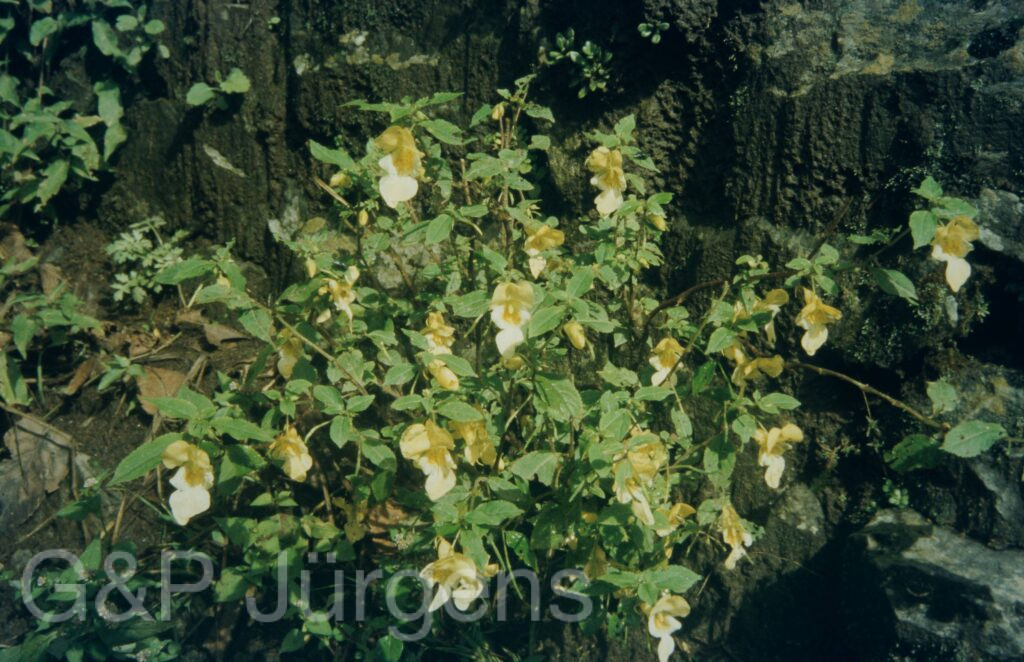
Impatiens arguta is a Sino-Himalayan balsam distributed from the central and eastern Himalaya through Myanmar into south-western China; GBIF records around 934 occurrences across China, India, Myanmar, Bhutan and Nepal. It is a plant of cool, humid temperate forest, growing on shaded moist banks, stream sides, forest margins and clearings, often in the broadleaved and mixed conifer belt. The image from Dochu-La in Bhutan at about 3200 m in September shows it flowering at a misty high pass late in the monsoon season, when temperate balsams reach their flowering peak in the abundant moisture and dappled shade of these slopes.

It is an erect, succulent perennial herb with stout, translucent, glabrous stems swollen at the nodes. The leaves are alternate or subopposite, ovate to lanceolate, with a sharply toothed (arguta, sharp-toothed) margin, an acuminate apex and a petiole sometimes bearing small glands. Flowers are borne singly or few together in the leaf axils on slender pedicels, zygomorphic and showy, typically purple to violet or pinkish; the lower sepal is boat-shaped and prolonged into a slender incurved spur, and the lateral united petals are two-lobed. The fruit is a fleshy, club-shaped capsule that dehisces explosively, scattering the seeds by elastic recoil of the valves.

The genus Impatiens is exceptionally species-rich and rapidly diversifying in the Himalaya, where many narrowly endemic taxa replace one another along altitudinal and longitudinal gradients. The explosive ballistic seed dispersal and nectar-spurred, insect-pollinated flowers of I. arguta are characteristic of the family. The species is widespread and not of conservation concern, but as a moisture-demanding forest herb it depends on the intact humid temperate woodlands of the eastern Himalaya.

Author: Hook.f. & Thomson · Sources: POWO (Kew), GBIF, Flora of Bhutan, Flora of China (Balsaminaceae), Grey-Wilson monograph of Impatiens

Hook.f.

Nepal 95 205 P344 ergebnis
Nepal Cluning-Khola 2900m October

Description

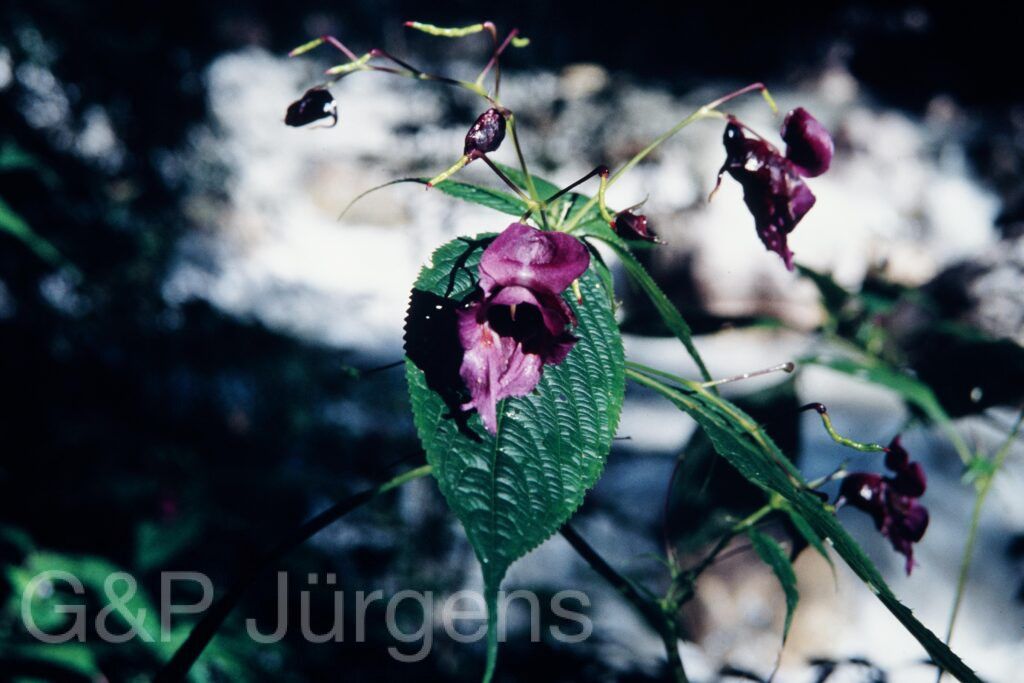
Impatiens cymbifera Hook.f. is a Sino-Himalayan balsam distributed across Nepal, China, India, Bhutan and Myanmar (NP, CN, IN, BT, MM), with GBIF recording about 103 occurrences. It is a plant of cool, humid montane forest, favouring shaded streamsides, seepage slopes, moist rock faces and path margins. The material photographed at the Cluning-Khola in Nepal at 2900 m in October reflects its autumn flowering in the temperate forest belt, where late-monsoon moisture sustains its succulent growth and prolongs anthesis into the post-monsoon season.

It is an erect, succulent annual with translucent, often reddish, watery stems swollen at the nodes and rooting below. The leaves are alternate, ovate to elliptic with a serrate margin bearing small stipitate glands at the base, and an acuminate apex. The flowers are borne singly or few in the leaf axils on slender pedicels, the corolla zygomorphic; the lower sepal is conspicuously enlarged into a boat-shaped (cymbiform, hence the epithet) saccate body abruptly contracted into an incurved spur, while the lateral united petals form two-lobed wings. The capsule is the characteristic clavate, explosively dehiscent fruit of the genus, scattering seeds by elastic recoil of the valves.

Within the large and intricate genus Impatiens, a centre of diversity in the Sino-Himalayan region, I. cymbifera belongs to the forest-dwelling annuals with strongly saccate lower sepals. Its flowers are pollinated by long-tongued insects, and explosive ballistic seed dispersal aids colonisation of moist disturbed ground. As a moisture-demanding annual it is tied to intact montane forest hydrology, and such balsams indicate undisturbed humid forest.

Author: Hook.f. · Sources: POWO (Kew), GBIF, Flora of Nepal, Flora of China Vol. 12, Flora of Bhutan Vol. 2, Grey-Wilson monograph and Sino-Himalayan Impatiens studies

Pusalkar

Garw 2005 73 ergebnis ergebnis
India Garhwal Valley of flowers 3100m, September

Description

Impatiens devendrae is a narrowly distributed balsam of the western Himalaya, described from the Garhwal region of Uttarakhand in India. The photographed plant comes from the celebrated Valley of Flowers at about 3,100 m, recorded in September during the late-monsoon flowering peak. GBIF presently holds no georeferenced occurrences for the species and lists no countries, consistent with its recent description and restricted, poorly collected range. It grows in moist, high-rainfall subalpine habitats characteristic of the genus: shaded streamsides, damp forest margins and seepage slopes within herb-rich alpine meadow.

Like other Himalayan balsams it is a soft, glabrous annual herb with translucent, watery stems and somewhat swollen nodes. The leaves are alternate, ovate to elliptic, with a serrate to crenate-serrate margin and an acuminate apex. The flowers are zygomorphic and resupinate, borne singly or in few-flowered axillary clusters; the lateral sepals are small while the lower sepal is expanded into a boat-shaped saccate body abruptly narrowed into a slender incurved spur, and the standard and paired united lateral petals complete the characteristically asymmetric corolla. The fruit is the typical fleshy, five-valved capsule that dehisces explosively, coiling its valves to fling out the seeds.

The genus Impatiens is exceptionally species-rich and taxonomically challenging in the Himalaya, with many micro-endemics distinguished by subtle differences in flower colour, spur curvature and seed sculpturing; I. devendrae is one such recently recognised entity. Its apparent restriction to a single famous valley underscores both its biogeographic interest and its conservation sensitivity, since narrow-range alpine annuals are highly exposed to trampling, tourism pressure and climatic change.

Author: Pusalkar · Sources: POWO (Kew), Flora of India, GBIF, Grey-Wilson: Impatiens of Africa and the Indian subcontinent

Hook.f.

Bhutan2015 90
Bhutan Wangdi 1400m, October

Description

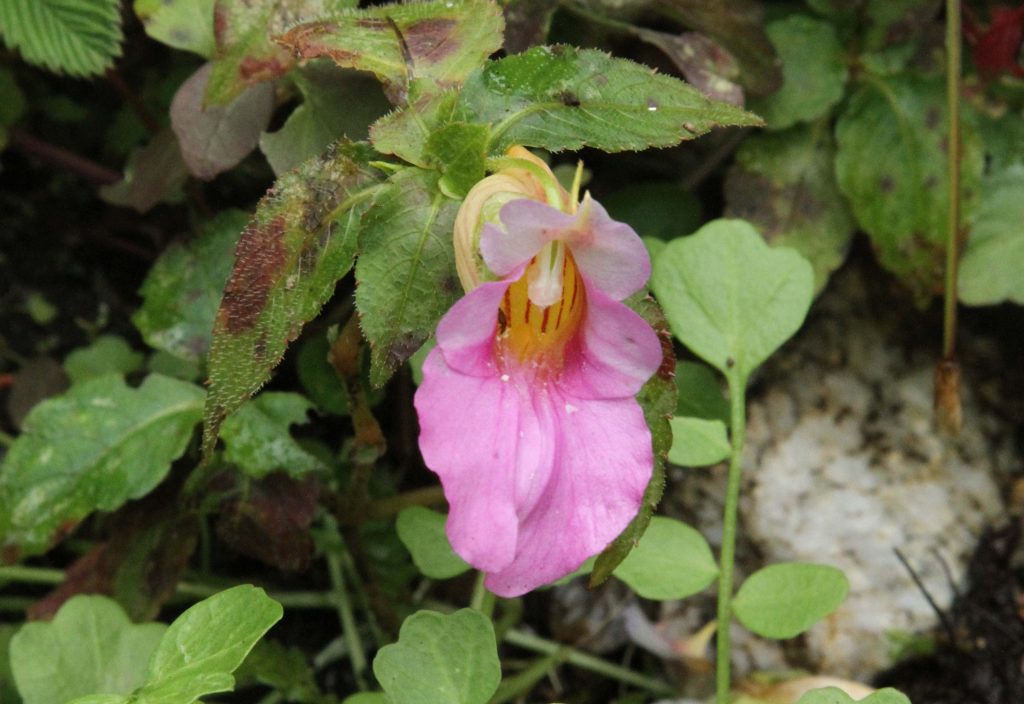
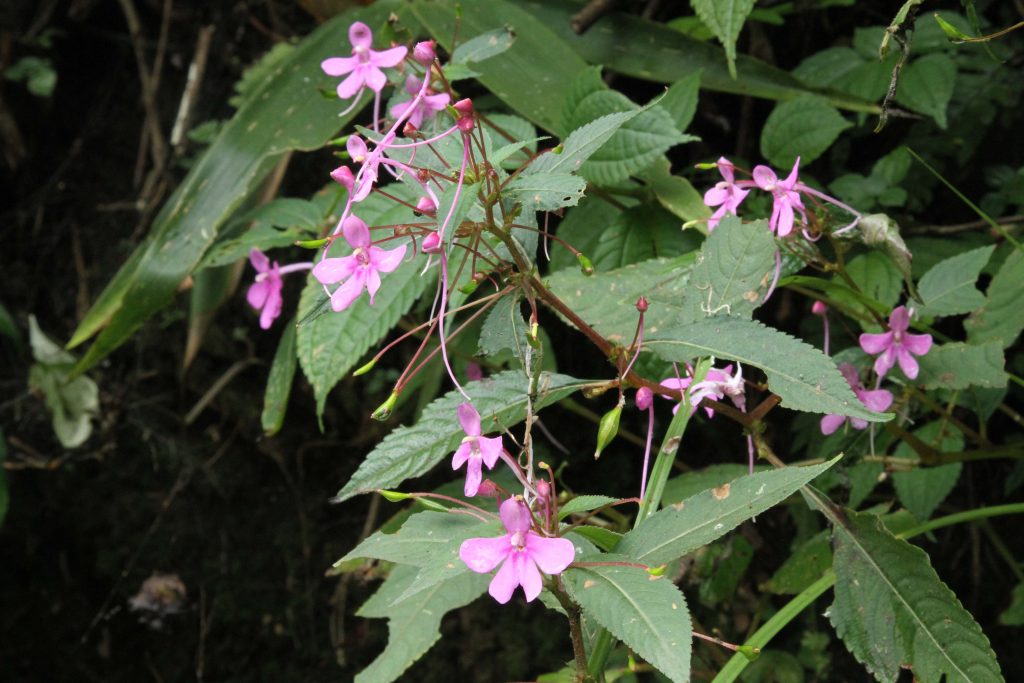
Impatiens drepanophora is a wide-ranging balsam of the eastern Himalaya and Indo-Burmese region, documented from Myanmar, China, India, Nepal, Bangladesh, Bhutan, Laos and Thailand, with around 126 recorded occurrences across this broad arc. It is a plant of warm-temperate to subtropical montane habitats, growing on moist shaded banks, along forest streams, in damp ravines and on disturbed roadside ground where seepage and high humidity prevail. The photographed plant from Wangdi in western Bhutan, at about 1400 m and flowering in October, reflects its mid-elevation preference and its characteristically late, post-monsoon flowering season.

It is a succulent annual with stout, translucent, often reddish-tinged stems that root at the lower nodes and branch freely. The leaves are alternate, ovate to elliptic-lanceolate with a long-acuminate apex and a crenate-serrate margin, the basal teeth or petiole base sometimes bearing stalked glands. The flowers are showy and zygomorphic, borne in axillary clusters, with a slender, conspicuously curved or sickle-shaped spur from which the epithet derives, the lower sepal forming the spurred sac; the lateral united petals and dorsal standard give the characteristic balsam form, the colouring pink to purplish. The fruit is the typical fleshy, explosively dehiscent capsule that scatters seeds when touched at maturity.

The genus Impatiens reaches exceptional richness in the eastern Himalaya, where wet forested slopes and a long monsoon foster numerous species distinguished largely by spur curvature, flower colour and leaf glands. The diagnostic falcate spur of I. drepanophora exemplifies the floral architecture that mediates pollination by long-tongued insects probing for spur-borne nectar. Being relatively widespread and tolerant of disturbed moist habitats, it is not of conservation concern, and like other balsams it can locally form abundant seasonal stands along watercourses and forest margins.

Author: Hook.f. · Sources: POWO (Kew), GBIF, Flora of Bhutan, Flora of China, Flora of British India, Grey-Wilson's Asian Impatiens revisions

Hook.f.

Bhutan2012 696
Bhutan Galephu 850m, September

Description

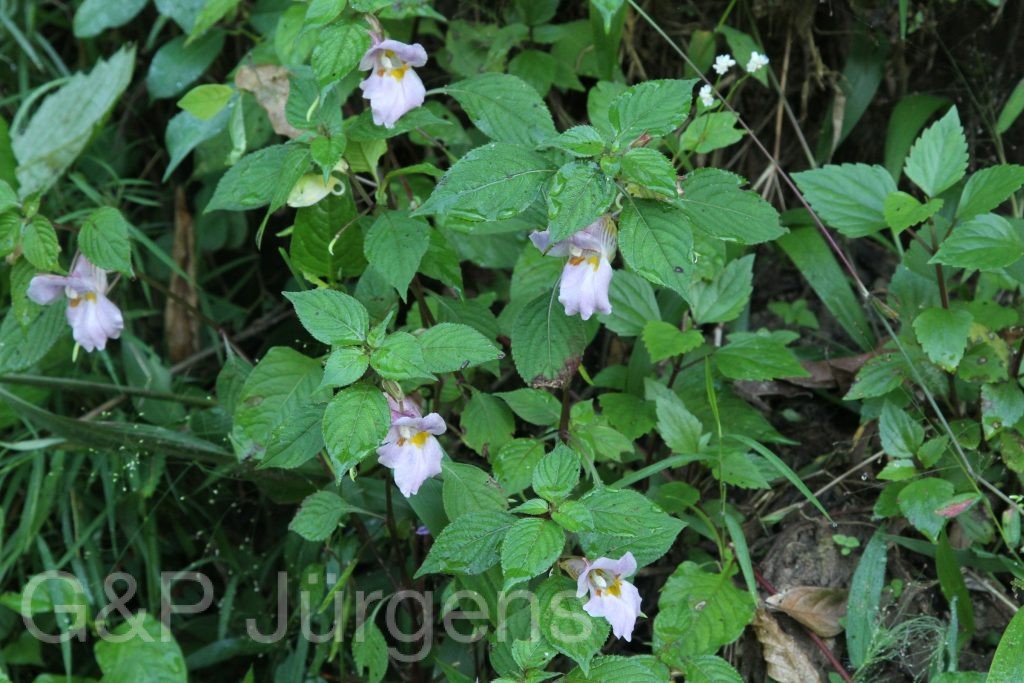
Impatiens exilis is an eastern Himalayan balsam restricted to a relatively narrow range, with confirmed occurrences in India, Nepal and Bhutan and only some 66 documented collections, marking it as a comparatively localised species. It favours warm, humid lower- to mid-montane settings, growing on shaded, moist banks, along forest streams and in disturbed wayside ground where seepage maintains moisture through the late monsoon. The photographed plant from Galephu in southern Bhutan, at around 850 m and flowering in September, reflects its preference for the foothill belt, considerably lower than many alpine congeners, and its tendency to bloom late in the rainy season.

In keeping with its epithet, it is a slender, delicate annual with translucent, watery, branching stems that root at the lower nodes. The leaves are alternate, thin in texture, ovate to elliptic-lanceolate with a serrate to crenate-serrate margin and a tapering apex, borne on slim petioles. The flowers are small and zygomorphic, solitary or few in the leaf axils, with the lateral sepals reduced and the lower sepal modified into a saccate spur typical of the genus; the corolla comprises an upper standard and paired lateral united petals, the colouring pale. The fruit is the explosively dehiscent fleshy capsule characteristic of Impatiens, propelling the seeds when ripe and disturbed.

Balsaminaceae, and especially Impatiens, form one of the great centres of diversity and endemism in the Himalaya, where rapid speciation has produced numerous narrow-range taxa distinguished by fine differences in spur shape, flower size and leaf form. The explosive ballistic seed dispersal aids short-distance colonisation of disturbed moist ground. As a small, restricted-range species, I. exilis warrants attention to habitat continuity along streams and forest edges, since such delicate annuals are vulnerable to drainage alteration and clearance, although no formal conservation assessment is currently in place.

Author: Hook.f. · Sources: POWO (Kew), GBIF, Flora of Bhutan, Flora of British India, Grey-Wilson's monographic Impatiens studies

C.B.Clarke ex Hook.f.

Bhutan2012 772
Bhutan Zemgang 1800m, October
Bhutan2012 774
Bhutan Zemgang 1800m, October

Description

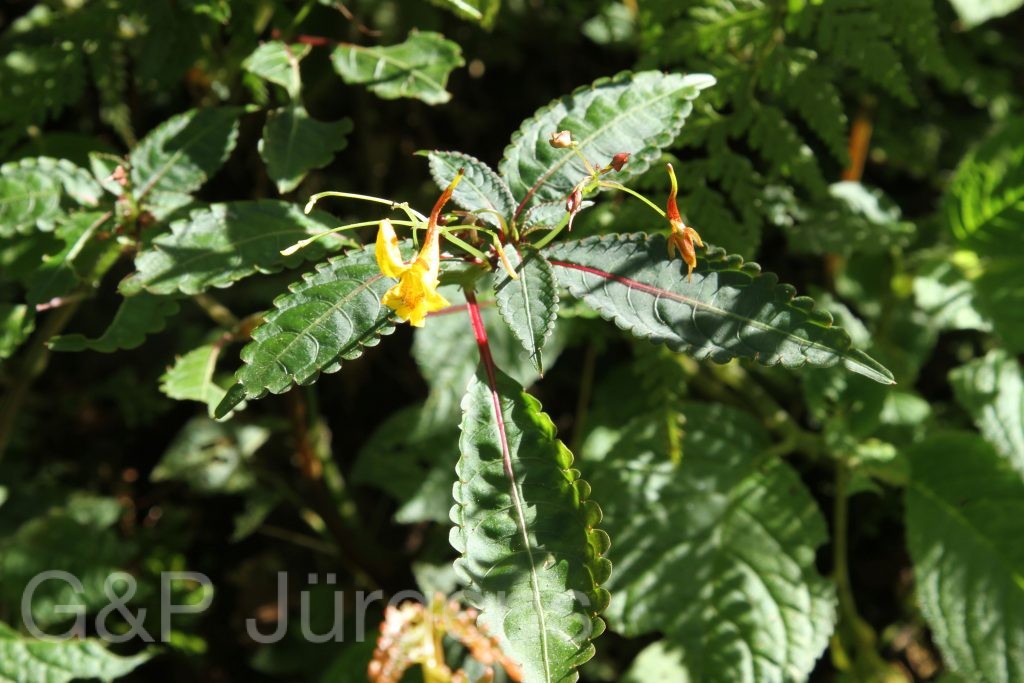
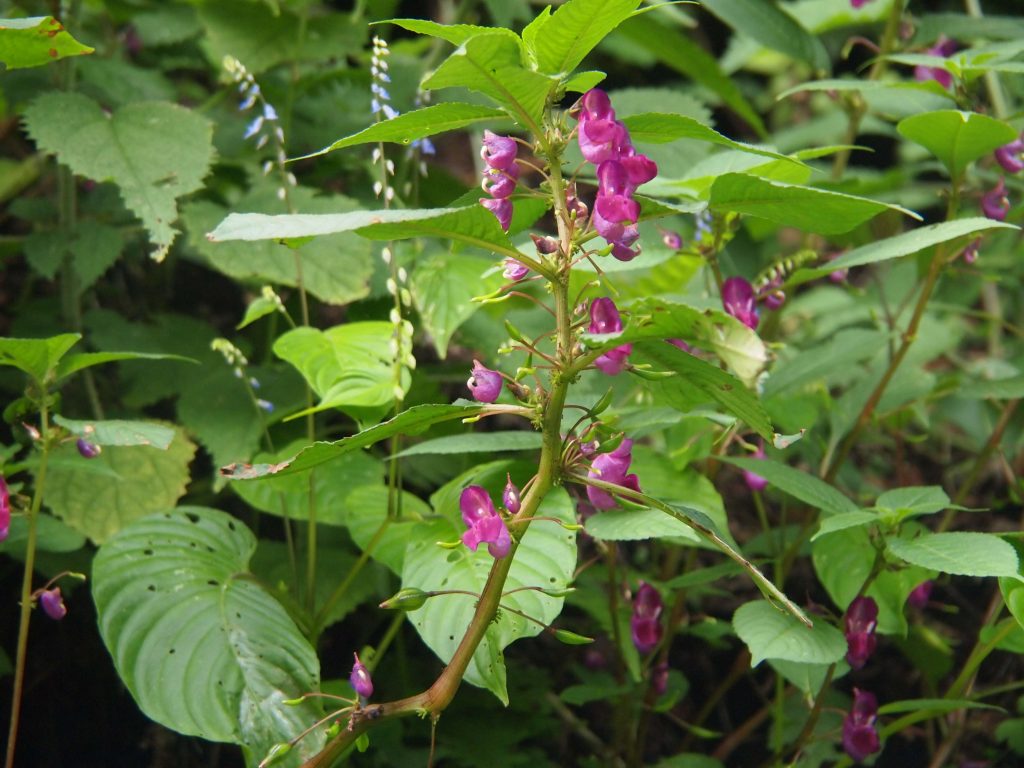
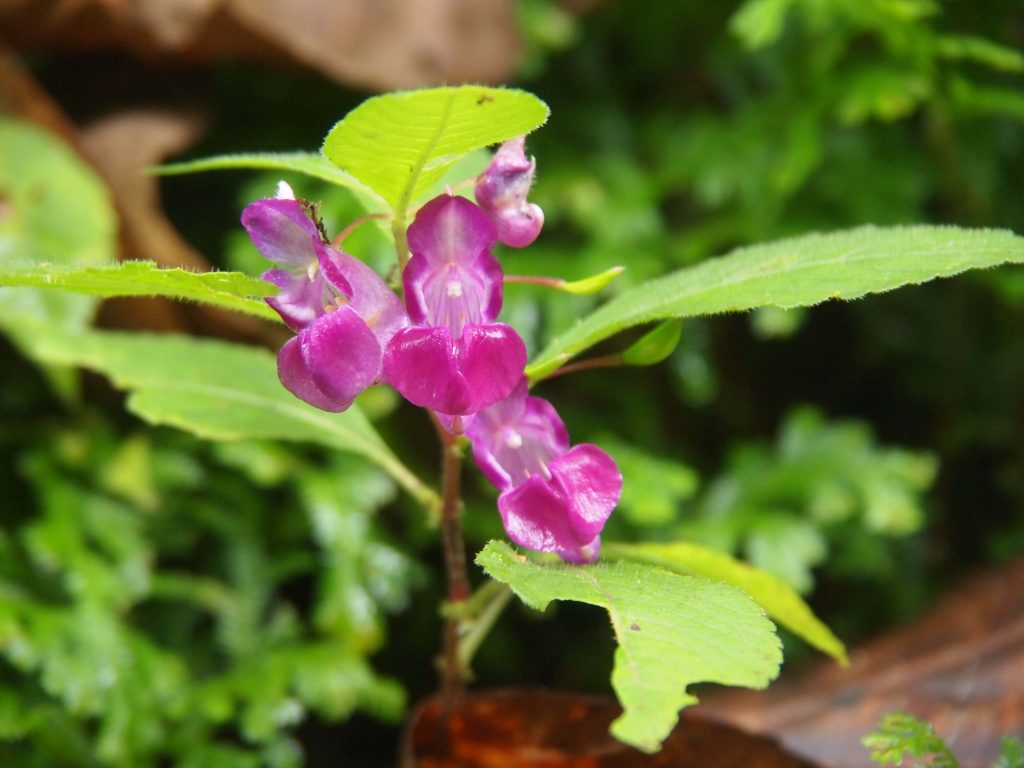
Impatiens florigera is a balsam of the eastern Himalaya, recorded by GBIF (about 29 occurrences) from India, Bhutan and Nepal. It is a herb of moist, shaded habitats in the subtropical and warm-temperate broadleaved forest belt, growing on damp banks, by streams, in forest clearings and along shaded roadsides where soil moisture is high through the monsoon. The illustrated plant was photographed in Bhutan at Zemgang at about 1800 m in October, an autumn-flowering montane forest locality characteristic of the species, which blooms towards the close of the monsoon when many Himalayan Impatiens reach their flowering peak.

The plant is a succulent, glabrous annual with a translucent, watery stem that is often reddish at the swollen nodes and branches freely. The leaves are alternate, ovate to elliptic, with a crenate-serrate margin and shortly acuminate apex, narrowed to a petiole that may bear a few stipitate glands. The flowers are zygomorphic and showy, borne on slender axillary peduncles; each has the balsam structure of three sepals, the lowest enlarged into a spurred boat-shaped lip, and five petals forming a standard and two lateral united pairs, typically pink to purplish. The fruit is a fleshy, club-shaped capsule that dehisces explosively, its valves coiling abruptly to scatter the seeds.

Impatiens is one of the largest genera of flowering plants and especially diverse in the Himalaya, where numerous narrowly distributed species occupy moist forest habitats and are distinguished by fine differences in flower form, spur shape and indumentum. I. florigera belongs to this rich eastern Himalayan radiation. As a monsoon-dependent annual of moist forest it is locally frequent within its range; its explosive seed dispersal and insect pollination are typical of the genus.

Author: C.B.Clarke ex Hook.f. · Sources: POWO (Kew), GBIF, Flora of Bhutan, Flora of China, Annotated Checklist of the Flowering Plants of Nepal, Grey-Wilson's monograph Impatiens of Africa and revisional studies of Asian Impatiens

Buch.-Ham. ex Hook.f. & Thomson

Bhutan2015 299
Bhutan Galephug 500m, October

Description

Impatiens jurpia is a Himalayan balsam ranging through northern India, Nepal, Bhutan and southward into Thailand and Malaysia. It is a hygrophilous herb of moist, shaded habitats, characteristically inhabiting wet forest margins, ravines, dripping banks and the verges of streams within subtropical and warm-temperate woodland. It occurs across a wide altitudinal span; the plant recorded at Gelephu in southern Bhutan at around 500 m in October illustrates its presence in the humid subtropical foothills, where it flowers in the post-monsoon season when soil moisture remains high.

The plant is a succulent annual herb with translucent, swollen, glabrous stems that are often reddish at the nodes, rooting at the lower joints. The leaves are alternate, ovate to elliptic-lanceolate, with a crenate-serrate margin frequently bearing minute setae in the sinuses, and taper into a petiole. The flowers are zygomorphic and borne on slender axillary pedicels; the lateral sepals are small, the lower sepal forms a navicular spur curving downward, and the corolla, pink to purplish or pale, comprises a standard and two bilobed lateral united petals. The fruit is a fusiform capsule that dehisces explosively, ejecting the seeds.

Impatiens is one of the largest genera of flowering plants and a major centre of diversity in the Himalaya and Southeast Asia, where rapid speciation has produced many narrowly distributed taxa. Impatiens jurpia, attributed to Buchanan-Hamilton ex Hooker f. and Thomson, is a comparatively widespread and morphologically variable member of the genus. Its ballistic seed dispersal and dependence on perennially moist microhabitats make it a useful indicator of intact, humid forest streamside ecosystems.

Author: Buch.-Ham. ex Hook.f. & Thomson · Sources: POWO (Kew), Flora of Bhutan Vol. 2, Flora of China Vol. 12, GBIF, Grey-Wilson: Impatiens of Africa and the Himalaya

DC.

Bhutan2012 940
Bhutan Jakar 1950m, October

Description

Impatiens puberula is a Himalayan balsam ranging through Nepal, India, China, Bhutan and Myanmar, with around 186 georeferenced records. It is a plant of cool, humid, shaded habitats, occurring on damp banks, stream-sides, seepage slopes and moist forest margins in the temperate zone. The individual photographed near Jakar in the Bumthang region of central Bhutan at about 1950 m in October illustrates its preference for shaded, moisture-retentive ground, where it flowers late into the monsoon season on rich, organic soils.

The species is a succulent annual with translucent, often reddish-tinged stems that are minutely puberulous, the indumentum giving rise to its epithet. The leaves are alternate, ovate to elliptic-lanceolate with a crenate-serrate margin, the teeth often gland-tipped, and taper to a petiole. The zygomorphic flowers are borne singly or in few-flowered axillary clusters; the showy lower sepal is prolonged into a slender, curved nectar spur, and the lateral united petals form broad wings, as is characteristic of the genus. The fruit is an explosively dehiscent fleshy capsule that, when ripe, coils its valves to fling out the seeds.

Impatiens is one of the largest angiosperm genera and is notably species-rich and taxonomically difficult across the Sino-Himalayan region, where rapid radiation has produced numerous narrowly defined and frequently endemic taxa separated by floral colour, spur curvature and seed sculpturing. Its explosive ballistic seed dispersal and dependence on perennially moist microhabitats make such balsams sensitive to drainage change and forest disturbance, though I. puberula remains widespread.

Author: DC. · Sources: POWO (Kew), GBIF, Flora of Bhutan, Flora of Nepal, Flora of China, Grey-Wilson's monograph of Impatiens