Author

GP Jürgens

(D.Don) Hutch.

Bhutan2012 1316
Bhutan2012 1315
Bhutan2012 678
Bhutan2012 477

Description

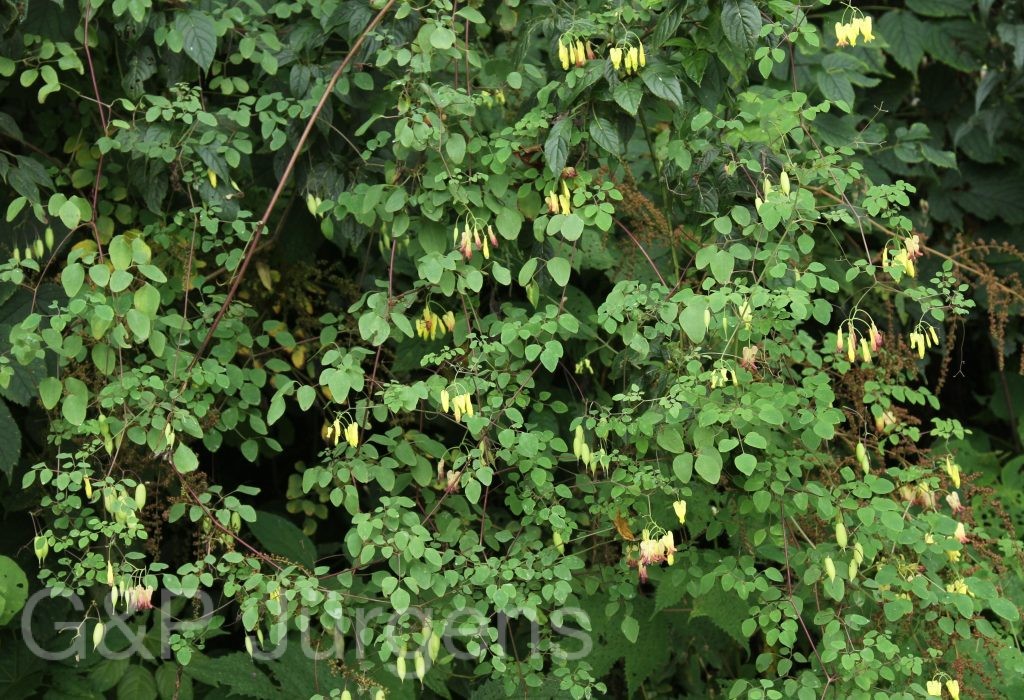
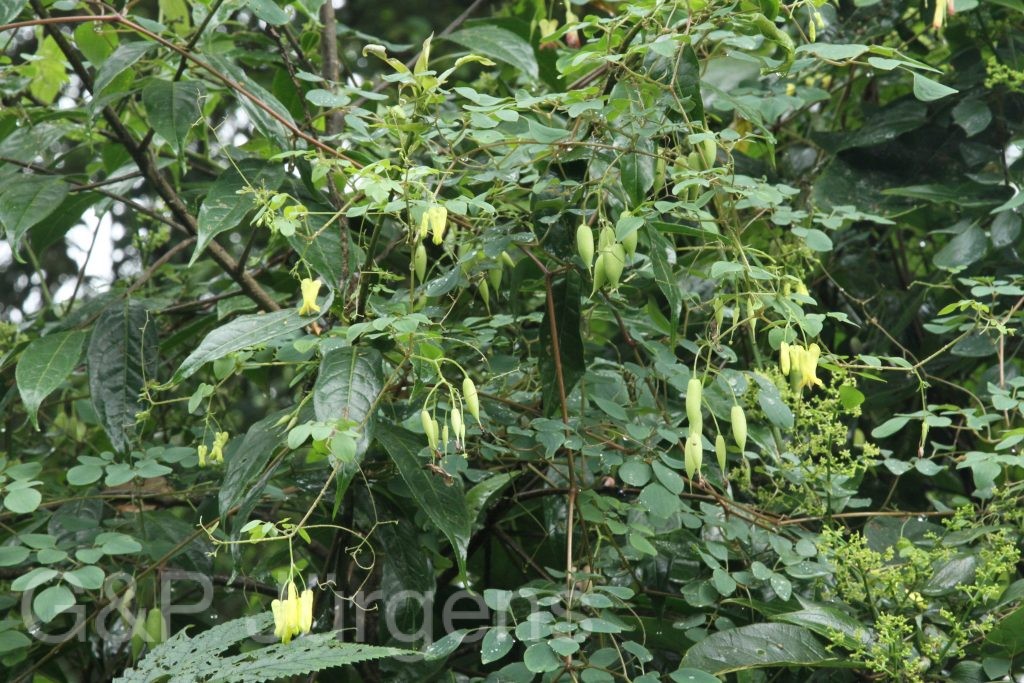
Dactylicapnos scandens (D.Don) Hutch. is a scrambling herbaceous climber of the eastern Himalaya and adjacent montane Asia, ranging across Nepal, India, Bhutan, southern China and Myanmar, with extensions into Thailand and Vietnam; the GBIF dataset records some 301 occurrences, the majority along the Sino-Himalayan arc, while scattered points from Europe, North America and New Zealand reflect cultivated or naturalised material. It favours moist temperate and subtropical forest margins, thickets, ravines and disturbed slopes, typically between about 1500 and 3000 m, threading through supporting vegetation by means of tendrillar leaf appendages.

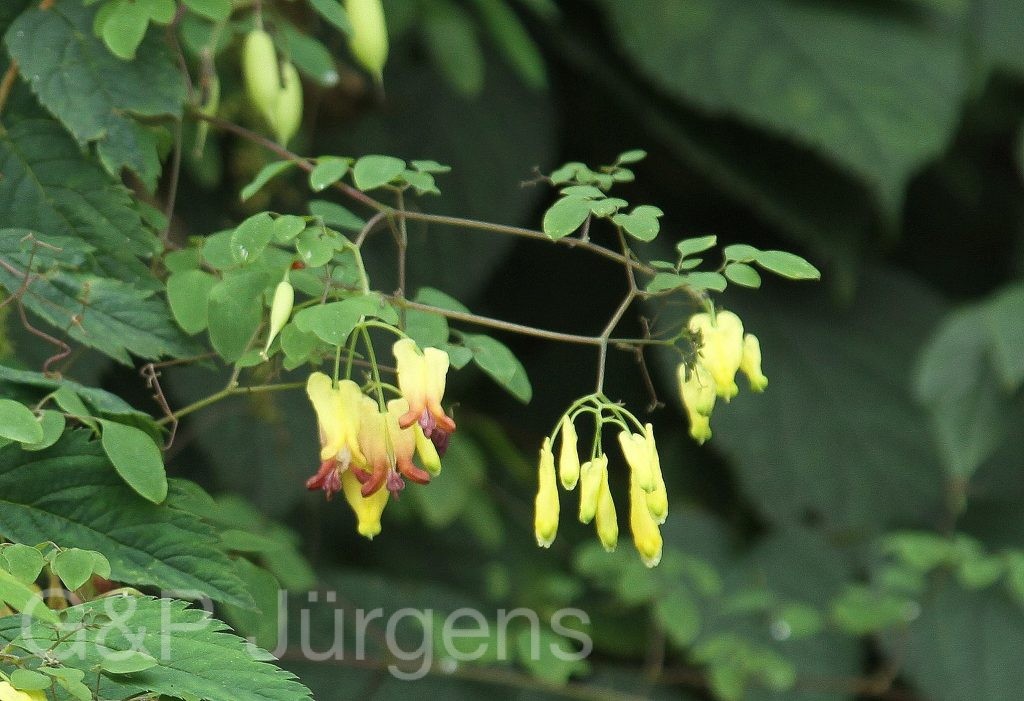
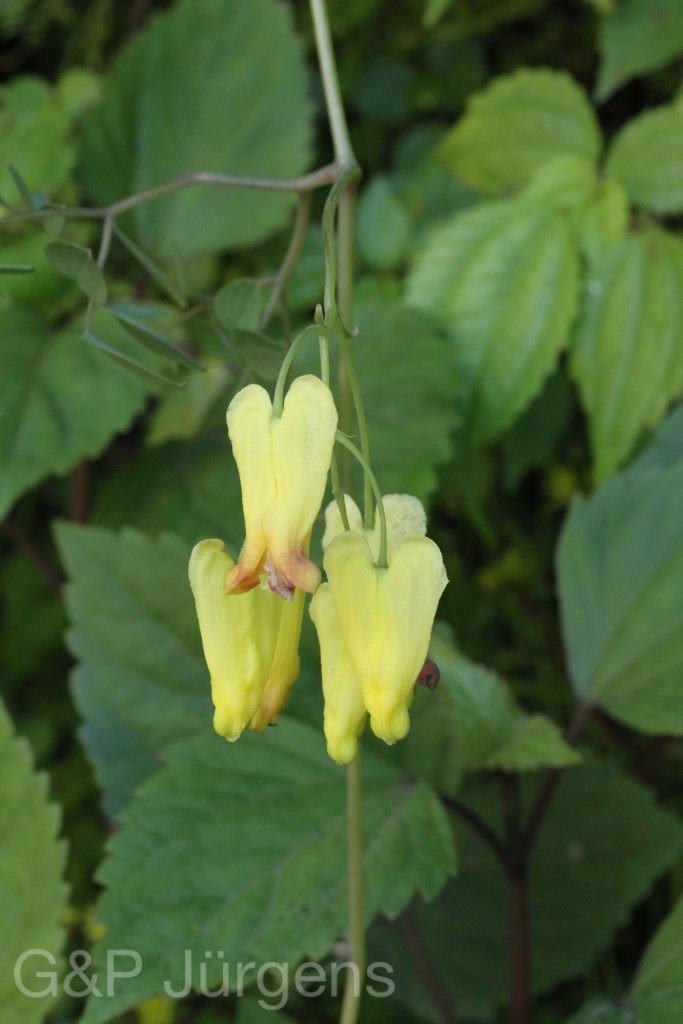
The plant is a glabrous, glaucous perennial with slender, much-branched, climbing stems arising from a slender rootstock. The leaves are alternate, several times pinnately or ternately divided into small ovate to lanceolate leaflets, the terminal segments of the rachis modified into branched tendrils that secure the climbing habit. The pendent inflorescences are racemose, bearing nodding, bright yellow, distinctly heart-shaped flowers; the outer pair of petals is saccate to spurred at the base and connivent at the apex, enclosing the inner petals in the characteristic fumarioid manner. The fruit is a slender, elongate, dehiscent capsule containing several shining black seeds.

Formerly placed in Dicentra and Corydalis, the genus Dactylicapnos is now firmly assigned to the Papaveraceae subfamily Fumarioideae, distinguished by its climbing tendrillate habit and zygomorphic dimerous flowers. The species is widespread and locally common, of no immediate conservation concern, and is valued horticulturally as an ornamental climber for cool temperate gardens.

Author: (D.Don) Hutch. · Sources: POWO (Kew), GBIF, Flora of China, Flora of Bhutan, Flora of Nepal, Lidén & Zetterlund monograph of Dactylicapnos and Fumarioideae
(D.Don) Hutch.

Bhutan2012 477
Bhutan Pele-La 3300m, June

Description

Dactylicapnos scandens is a climbing fumitory of the Himalaya and adjacent China and Indochina, native across China, India, Nepal, Bhutan, Myanmar, Vietnam, Thailand and Sri Lanka; its more than 300 GBIF records include numerous cultivated and naturalised occurrences in Europe, North America and New Zealand, reflecting its popularity as an ornamental climber. It grows in moist temperate forest, thickets and shrubby clearings, scrambling over other vegetation, mostly between about 1500 and 3300 m. The plant shown from Pele-La in Bhutan at 3300 m, flowering in June, sits at the upper edge of this range in cool broadleaved and conifer forest.

It is a herbaceous to suffrutescent perennial climber with slender, much-branched stems clinging by means of branched, tendril-like leaflet tips. The leaves are alternate, two- to three-pinnately compound and glaucous, the ultimate segments small and ovate, the terminal portions modified into coiling tendrils. The flowers hang in pendulous racemes and are zygomorphic with two bilaterally symmetrical, spurred or saccate outer petals enclosing two inner petals, the whole corolla bright golden-yellow. The fruit is an elongate, several-seeded capsule that dehisces to release shining black seeds, each bearing an elaiosome.

Dactylicapnos was separated from Dicentra and Corydalis on the basis of its climbing habit, tendrillate leaves and capsular fruit. D. scandens, based on D. Don's Fumaria scandens and transferred by Hutchinson, is widespread and not threatened, and its toxic isoquinoline alkaloids have attracted pharmacological interest in traditional medicine.

Author: (D.Don) Hutch. · Sources: POWO (Kew), GBIF, Flora of Bhutan, Flora of China, Lidén & Fukuhara revision of Dactylicapnos

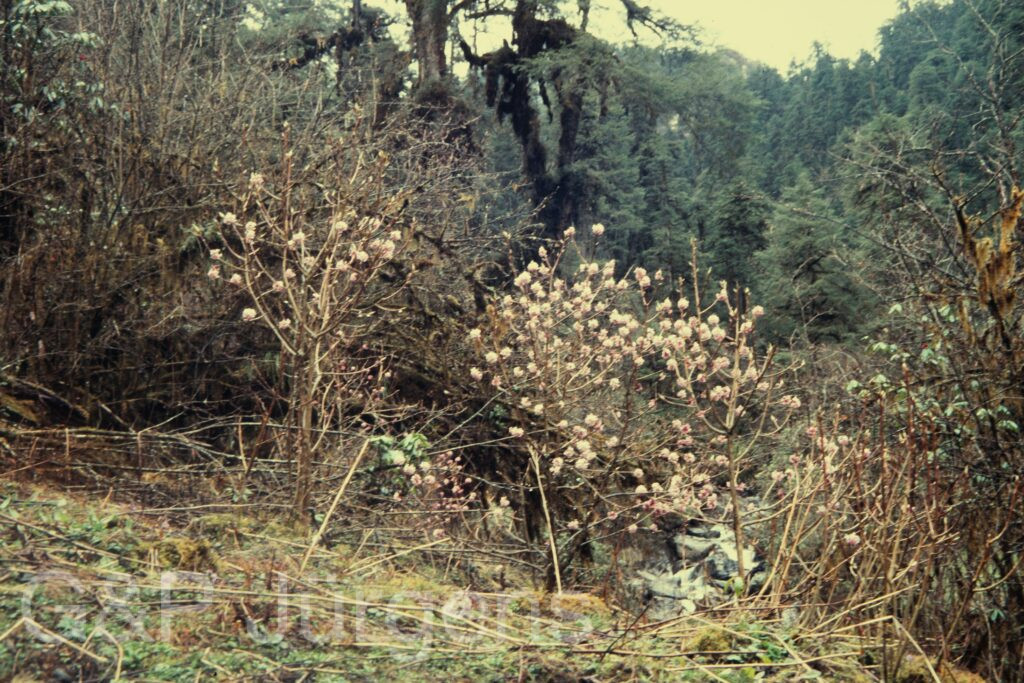
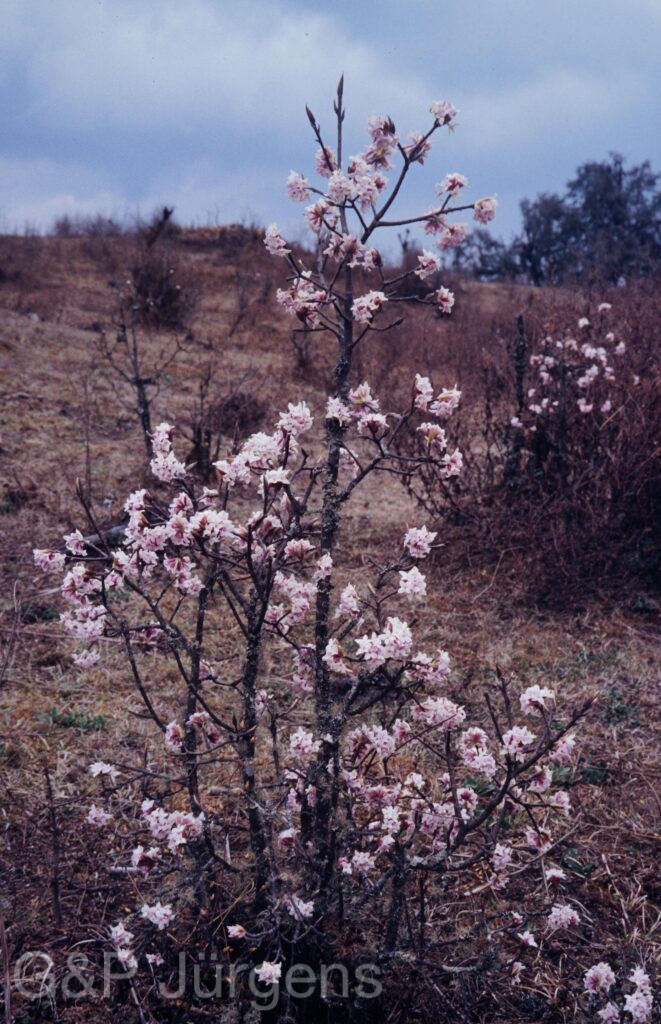
Daphne bholua

by GP Jürgens

Buch.-Ham. ex D.Don

Sikkim2011 45
Sikkim Vista-valley 3750m, June
Sikkim2011 49
Sikkim Vista-valley 3750m, June

Description

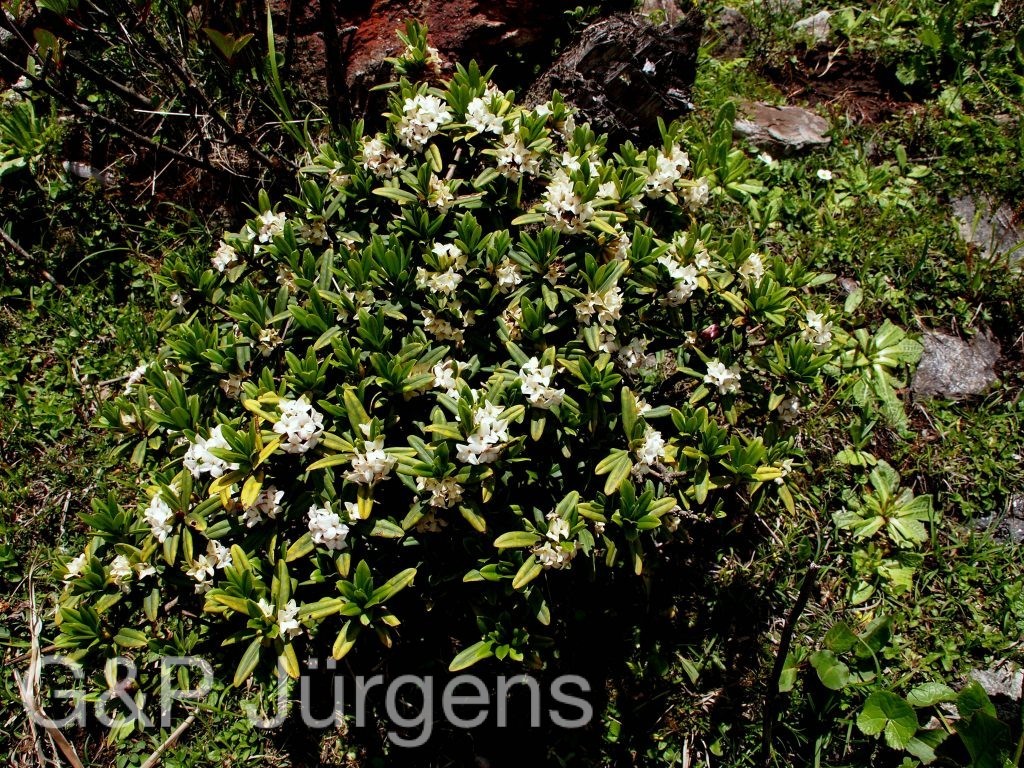
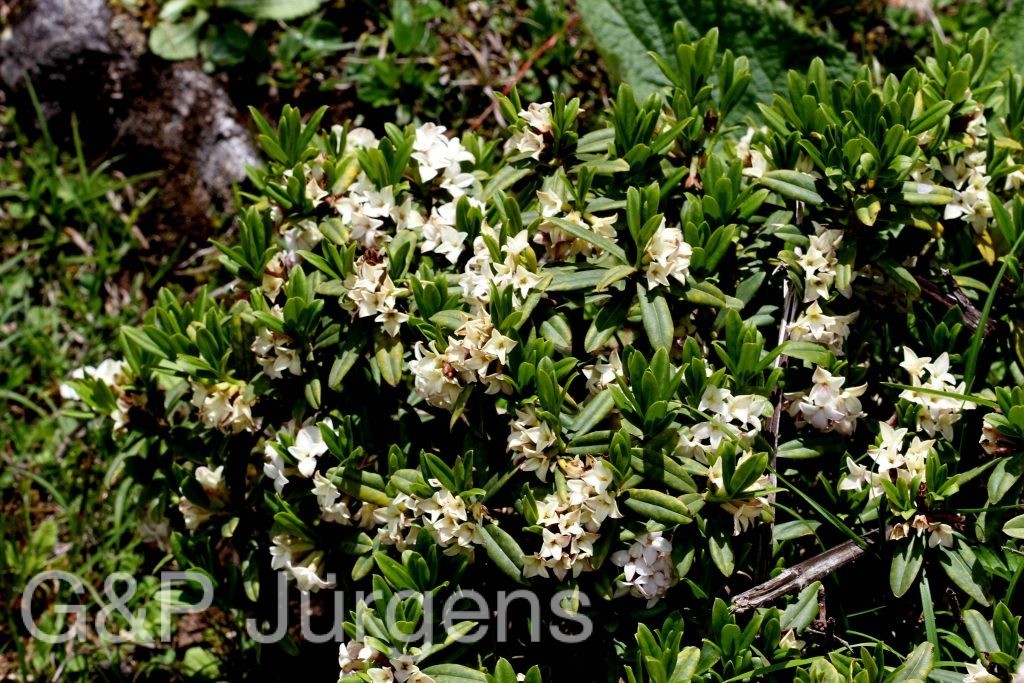
Daphne bholua is an evergreen to semi-deciduous shrub of the central and eastern Himalaya, distributed through Nepal, China, Bhutan and India, with around 758 georeferenced records; its appearance in numerous temperate countries reflects its extensive horticultural cultivation. In the wild it occupies temperate and subalpine forest, scrub and clearings, often in oak, rhododendron and conifer woodland and on open hillsides. The plant photographed in Sikkim's Vista valley at 3750 m, flowering in June, exemplifies its upper-elevation range, where it forms thickets on moist, well-drained slopes.

It grows as an erect shrub to about 2.5 m with tough, fibrous bark and densely leafy branches. The leaves are alternate, clustered toward the branch tips, oblong-lanceolate, leathery, glossy dark green above and entire-margined. The fragrant flowers are borne in dense terminal and subterminal clusters; each has no petals but a petaloid, salverform perianth tube, white within and flushed rose-purple outside, the four spreading lobes strongly scented. The fruit is a fleshy ovoid berry-like drupe, blackening when ripe.

Daphne bholua, described by Buchanan-Hamilton ex D. Don, is celebrated in horticulture for its intensely fragrant winter-to-spring flowers and has given rise to many cultivars. In its homeland the strong bast fibres of the bark are a principal source of traditional Nepali handmade paper (lokta). Like other Thymelaeaceae it contains acrid, toxic compounds. Although widespread and not formally threatened, intensive bark harvesting for paper-making places localised pressure on wild populations.

Author: Buch.-Ham. ex D.Don · Sources: POWO (Kew), GBIF, Flora of Bhutan, Annotated Checklist of the Flowering Plants of Nepal, Halda The Genus Daphne

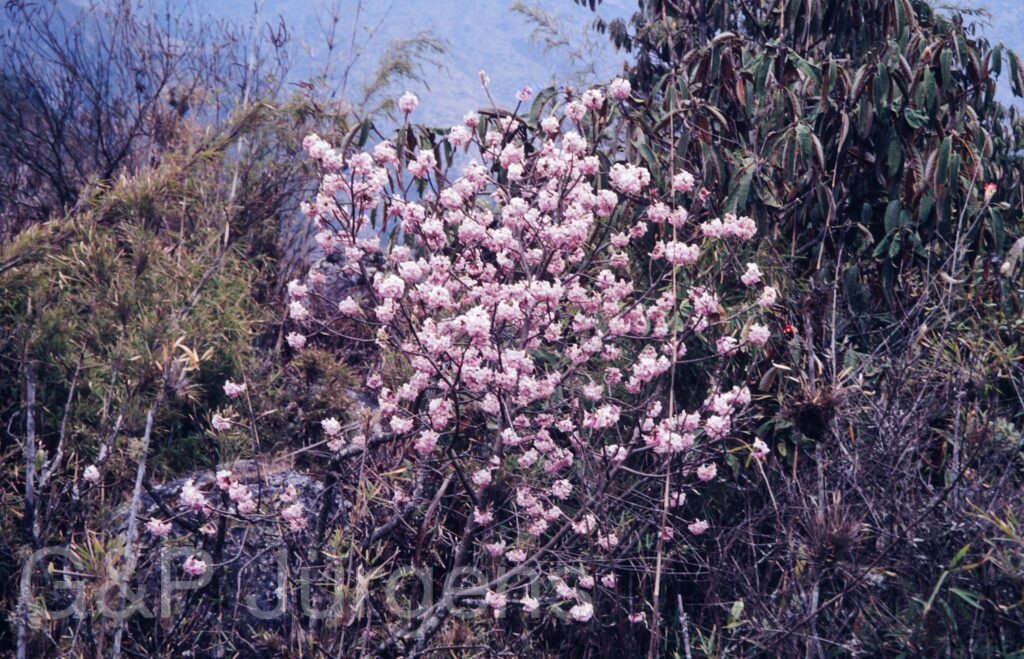
(W.W.Sm. & Cave) B.L.Burtt

Nepal 97 130 P229
Nepal Mewa-Khola 2600m April
Nepal1992 238 W349 ergebnis
Nepal Kyapra 2800m March 
Nepal1992 108 W148 ergebnis
Nepal Kyapra 2800m March 

Description

Daphne bholua var. glacialis is a Himalayan variant of the paper daphne, distributed across the China-Nepal-India sector of the range, with about 79 GBIF occurrences. It grows in cool temperate forest and forest-edge scrub, in clearings, on shrubby slopes and along ridges, on moist but well-drained humus-rich soils, frequently with rhododendron, oak and conifers. The collections illustrated from the Mewa Khola at 2600 m in April and from Kyapra at 2800 m in March, both in eastern Nepal, are characteristic of its range of roughly 2400-3500 m, where it flowers in late winter and early spring; the epithet glacialis alludes to this hardy, high-cold habitat where the smaller-leaved form prevails.

This variety is a much-branched erect shrub typically 1-2.5 m tall, with tough, fibrous, pliant bark. The leaves are alternate, leathery, elliptic to oblanceolate, entire and glossy above, clustered toward the branch tips and more readily deciduous than in the typical variety. The fragrant flowers are borne in dense terminal and subterminal clusters; lacking petals, the showy perianth consists of a slender hypanthial tube expanding into four spreading lobes that are pinkish-purple outside and paler within, intensely scented. Eight stamens are inserted in two whorls within the tube, and the superior ovary ripens into a small ovoid drupe that turns black.

The taxon is treated by POWO as variety glacialis of Daphne bholua, distinguished from the typical form chiefly by its more deciduous, smaller leaves and tolerance of higher, colder sites. Like other Himalayan daphnes its bark yields strong fibre used in handmade lokta paper, and the whole plant contains acrid, irritant compounds. It is prized in horticulture for its winter fragrance; wild populations can be affected by bark harvesting and habitat clearance.

Author: (W.W.Sm. & Cave) B.L.Burtt · Sources: POWO (Kew), GBIF, Flora of China, Flora of Nepal, Halda The Genus Daphne, Brickell & Mathew Daphne monograph

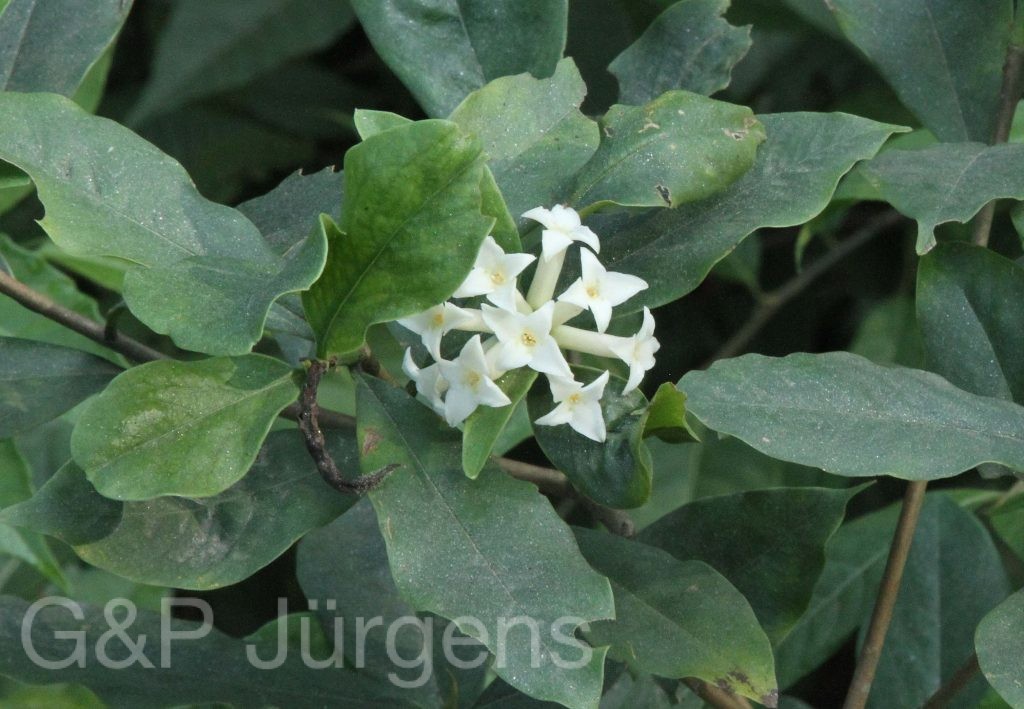
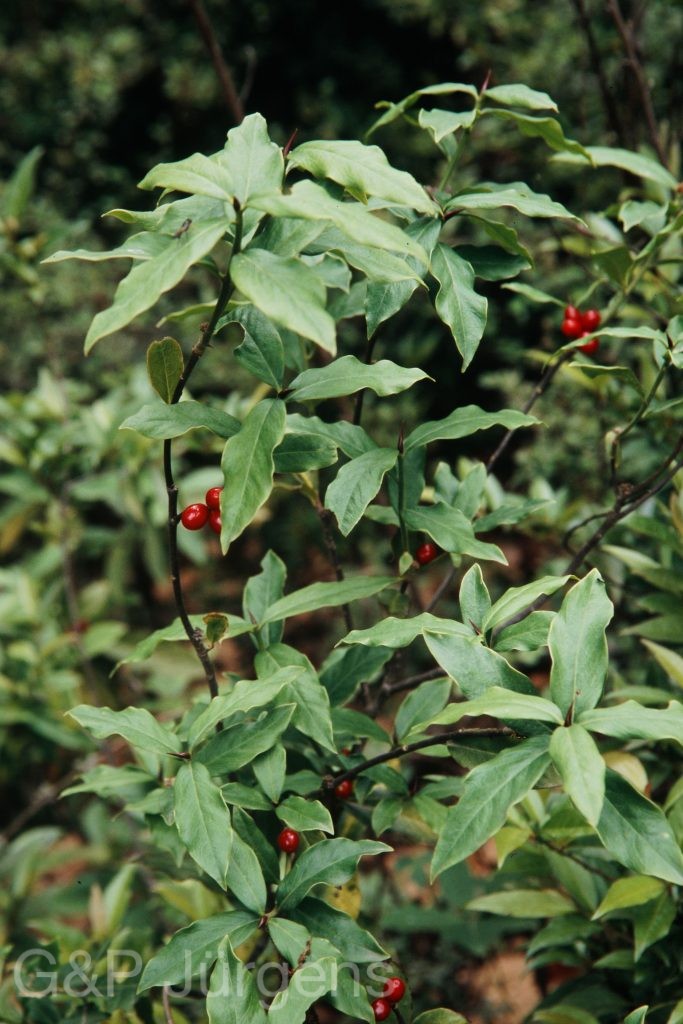
Daphne sureil

by GP Jürgens

W.W.Sm. & Cave

Bhutan2012 638
Bhutan Tserang, 1600m September
Bhutan2015 218
Bhutan Zhemgang 1000m, October
Bh2008 515 P790
Bhutan Chongsakha, 1800m April

Description

Daphne sureil is a shrub of the eastern Himalaya and adjacent Southeast Asia, recorded from India, Thailand, Nepal, Bhutan, Myanmar, Bangladesh and Vietnam, with about 124 documented occurrences. It is a plant of warm-temperate and subtropical broad-leaved forest, growing in the understorey and along forest margins, ravines and stream banks on moist, well-drained slopes. In Bhutan it occupies the lower to middle montane belt across a broad elevational span, as shown by collections from Tserang at about 1600 m in September, Zhemgang at 1000 m in October and Chongsakha at 1800 m in April, the spring date corresponding to its flowering period.

The species is an evergreen shrub with slender, glabrous branches bearing alternate, shortly petiolate leaves that are elliptic to oblanceolate, entire, acuminate or acute at the apex and tapering at the base, leathery and glossy above with a paler lower surface. The flowers are borne in small terminal clusters and lack petals, the floral display formed instead by a tubular, fragrant white to creamy perianth of four spreading lobes, the tube silky-pubescent without and enclosing eight stamens in two whorls. The fruit is a fleshy ovoid drupe, ripening red, containing a single seed.

Daphne sureil was described by W. W. Smith and Cave from the eastern Himalaya and belongs to the predominantly evergreen Asian assemblage of the genus. As in other Daphne species, the bark contains tough phloem fibres and the tissues bear the diterpenoid daphnane compounds responsible for their acridity and toxicity. The bird-dispersed drupes and strongly scented, presumably moth-pollinated flowers reflect typical thymelaeaceous biology. The species is locally frequent in suitable forest but, being tied to lower-montane broad-leaved woodland, is potentially vulnerable to habitat clearance at its lower elevational limits.

Author: W.W.Sm. & Cave · Sources: POWO (Kew), GBIF, Flora of Bhutan Vol. 1, Flora of China Vol. 13, Flora of Nepal, Halda monograph The Genus Daphne

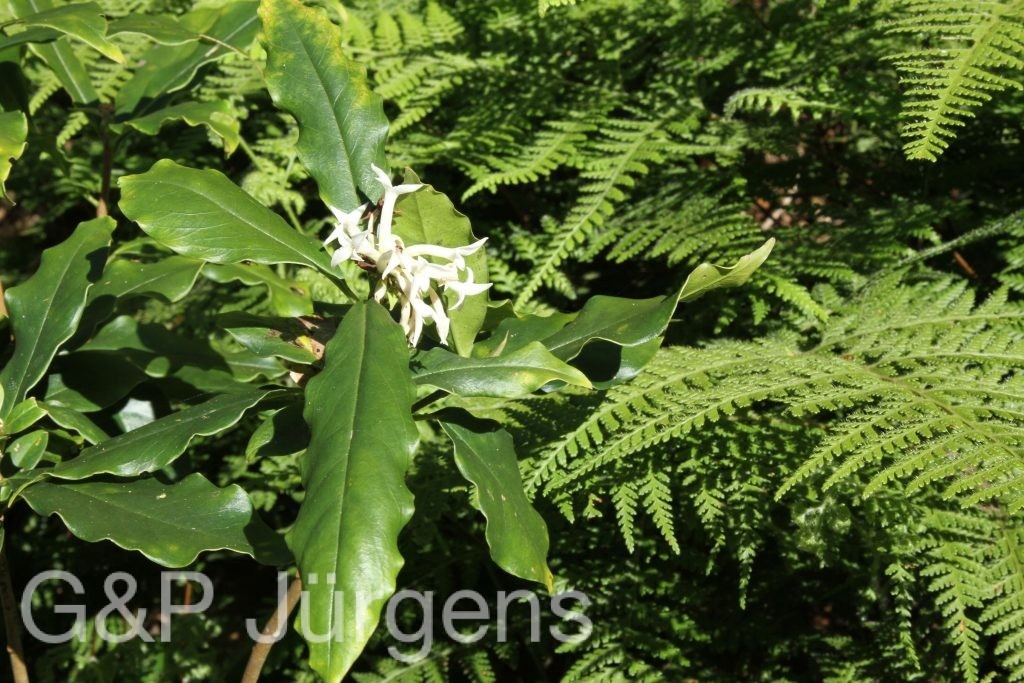
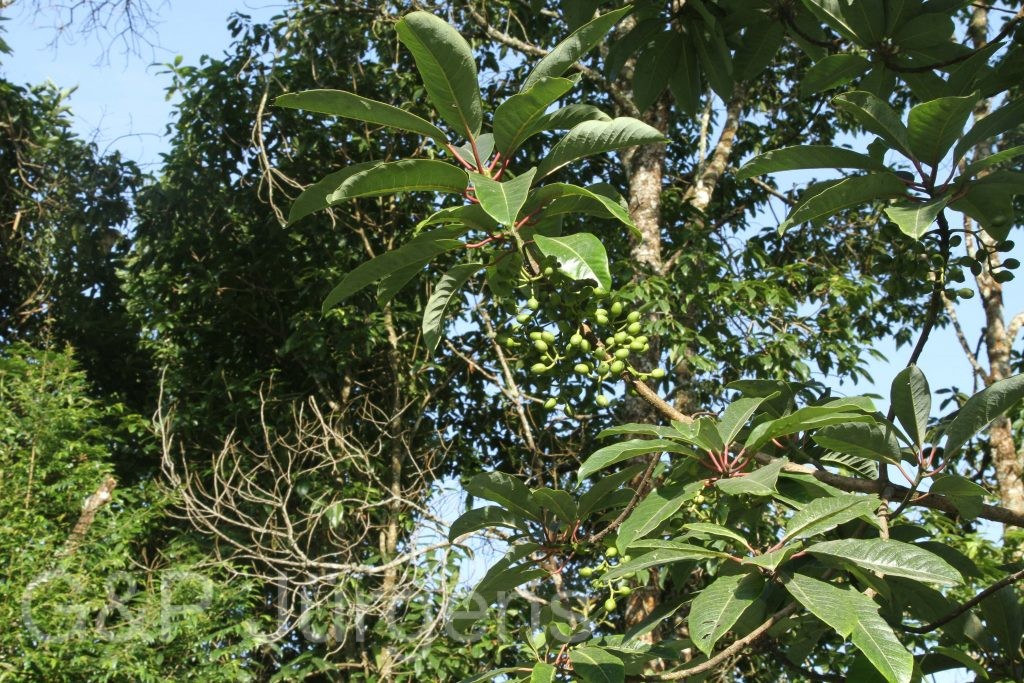
K.Rosenth.

Bhutan2012 636
Bhutan Tserang 1660m, June

Description

Daphniphyllum chartaceum is an evergreen tree or large shrub of the eastern Himalaya and Indo-Burmese uplands, recorded by GBIF, with around 140 occurrences, from China, Nepal, India, Bhutan, Vietnam and Myanmar. It is a component of moist, broad-leaved evergreen and warm-temperate forest, growing on humid slopes, in ravines and along forest margins, typically between about 1500 and 2500 m. The photographed plant from Tserang in Bhutan, at roughly 1660 m and recorded in June, is representative of its mid-elevation, subtropical-to-warm-temperate forest habitat, where it occupies the understorey to mid-canopy of dense, evergreen Himalayan woodland under a humid, monsoon-influenced climate.

The species is a dioecious tree with smooth bark and stout twigs bearing leaves crowded toward the branch tips. The leaves are simple, alternate but often appearing pseudo-whorled, elliptic to oblong-lanceolate, leathery to chartaceous (papery, as the epithet indicates), entire-margined, with the lower surface usually glaucous and conspicuously papillose, and frequently reddish petioles. Being dioecious, male and female flowers are borne on separate trees in axillary racemes; the flowers are small and apetalous, the males with numerous stamens and the females with a unilocular to bilocular ovary, lacking showy perianth. The fruit is a small, ellipsoid, one-seeded drupe, bluish-black and often glaucous at maturity, borne in short axillary clusters.

Daphniphyllum is the sole genus of Daphniphyllaceae, an isolated family of eastern and southern Asia of considerable phylogenetic interest, placed near Saxifragales and noted for its distinctive Daphniphyllum alkaloids. D. chartaceum is distinguished within the genus by its papery, glaucous-papillose leaves and has been associated with the variable D. himalense complex, with which it shares its montane Himalayan range. The fleshy drupes are dispersed by birds, and the dioecious breeding system enforces outcrossing. The species is reasonably widespread across the eastern Himalaya and Indo-Burma and is not regarded as threatened, though, like many evergreen forest trees of the region, local populations are sensitive to deforestation and land-use change.

Author: K.Rosenth. · Sources: POWO (Kew), GBIF, Flora of China Vol. 11, Flora of Bhutan Vol. 1, Flora of Nepal, Flora of Pakistan, Huang's monograph of Daphniphyllum

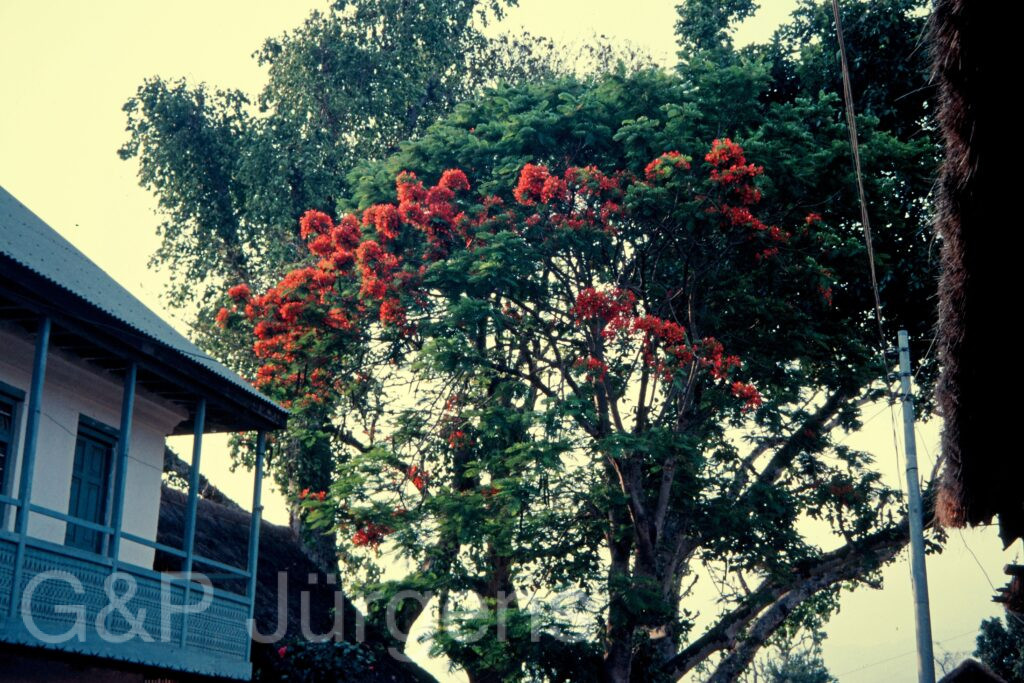
Delonix regia

by GP Jürgens

(Bojer ex. Hook.) Raf.

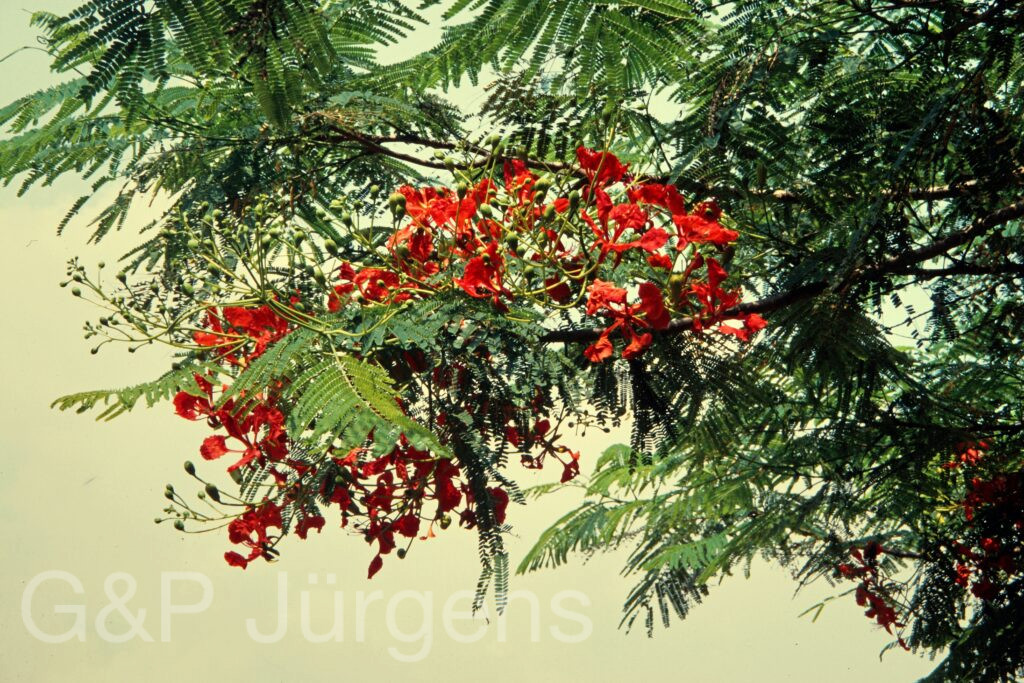
Nepal 97 595 P1150
Nepal Sabha-Khola 1200m,May
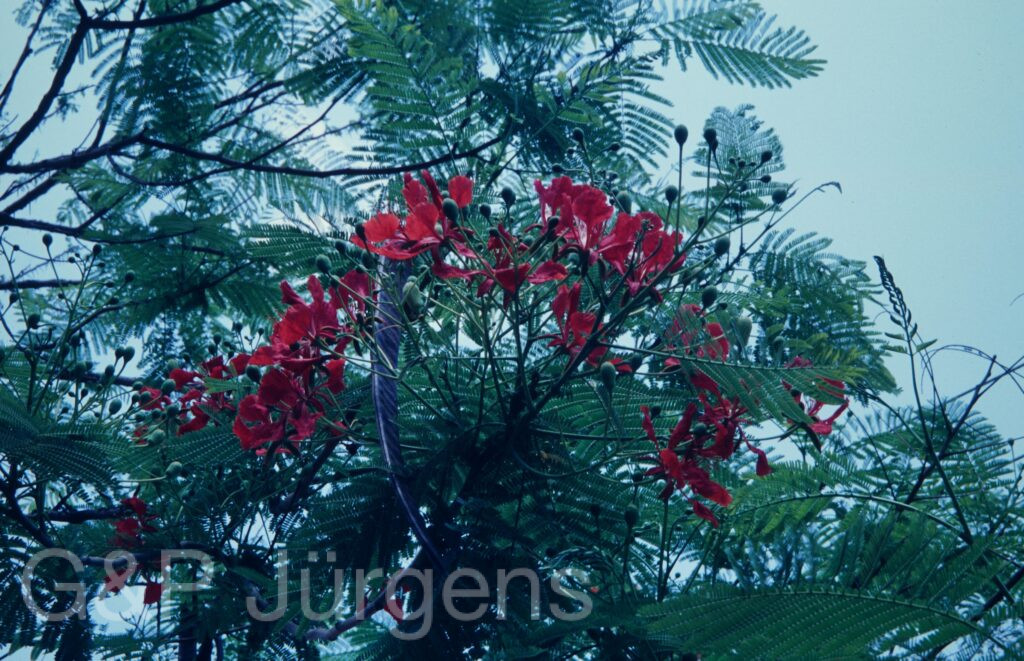
Nepal 97 596 G1151
Nepal Sabha-Khola 1200m,May
Nepal 1994 335 2 ergebnis
Ost-Nepal Chainpur 400m May 

Description

Delonix regia is one of the most widely cultivated ornamental trees of the tropics, native to the deciduous and dry forests of western Madagascar but now naturalised and planted across the warm regions of every continent. GBIF records reflect this pantropical spread, with occurrences across India, Australia, Brazil, Mexico, the United States, Tanzania, Madagascar, Thailand, China, Kenya, South Africa and the Dominican Republic, drawn from more than 27,000 documented collections. In the eastern Himalaya it occurs only as an introduced shade and avenue tree of the warm lowlands and foothills; the photographed material from the Sabha-Khola valley at 1200 m and from Chainpur in East Nepal at around 400 m, flowering in May, lies near the upper altitudinal limit at which the species thrives, requiring frost-free, seasonally dry, sun-exposed sites.

It forms a spreading, umbrella-crowned deciduous tree to 10–15 m, the trunk often buttressed and the bark smooth and grey. The leaves are large, bipinnate and fern-like, with 10–25 pairs of pinnae each bearing numerous small oblong leaflets. The flowers, borne in showy corymbose racemes, are large and zygomorphic with five clawed, spreading petals, four scarlet to orange-red and one larger, whitish or yellow petal streaked with red; the ten stamens are long and exserted with red filaments. The fruit is a large, woody, flattened legume to 60 cm long, persistent and dark brown when ripe, containing numerous hard, mottled seeds.

A member of the Caesalpinioid clade of the Fabaceae, Delonix is a small genus centred on Madagascar and East Africa. Though abundant in cultivation, the species is assessed as of conservation concern in its native range owing to deforestation and a highly restricted wild distribution. Its conspicuous flowering, drought tolerance and nitrogen-fixing capacity have made it a favoured street and amenity tree throughout the tropics, where it is valued equally for shade and ornament.

Author: (Bojer ex. Hook.) Raf. · Sources: POWO (Kew), GBIF, Flora of Nepal, Flora of Madagascar (Flore de Madagascar et des Comores), Legumes of the World (Lewis et al.)

Jacquem. ex Cambess.

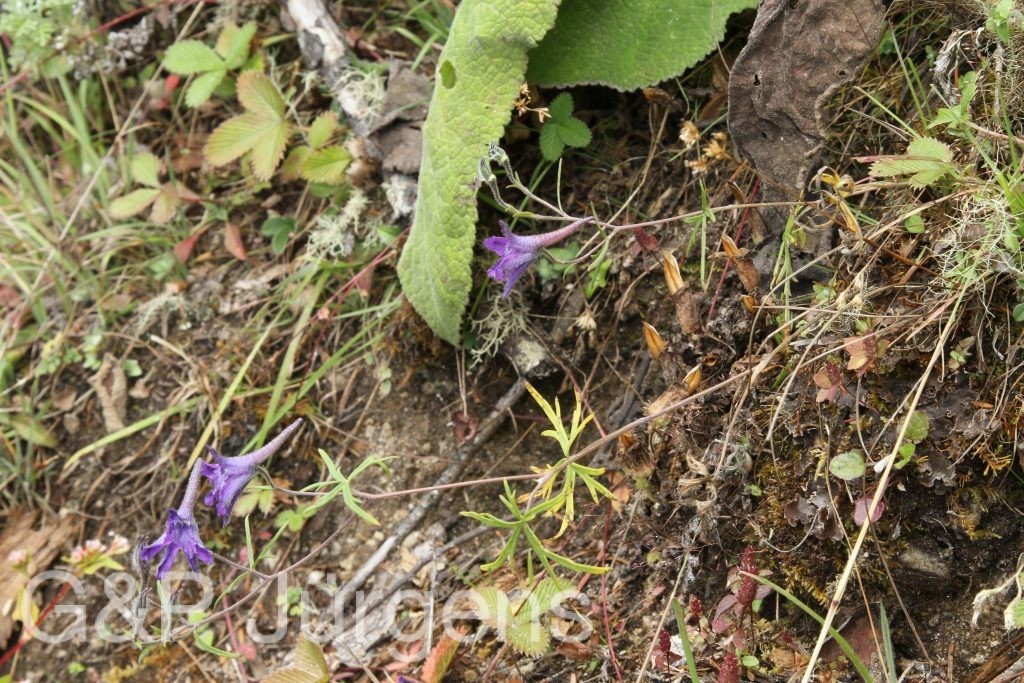
Bhutan2015 676
Bhutan Chele-La 3960m, October

Description

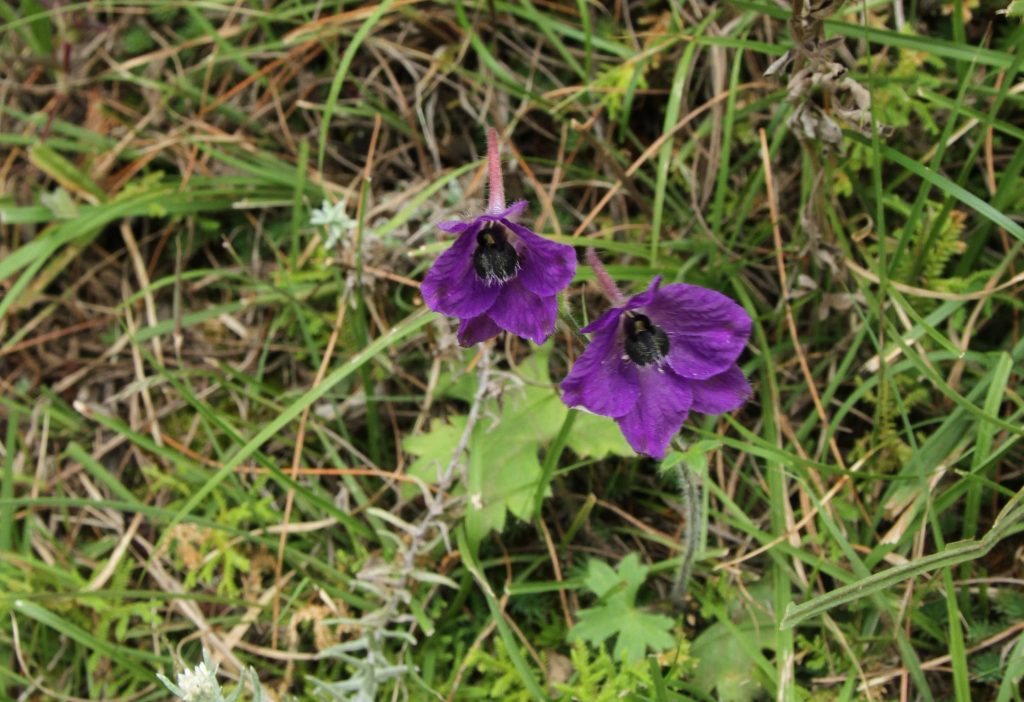
Delphinium caeruleum is an alpine larkspur of the high Himalaya and the Qinghai-Tibetan plateau, distributed across south-western China, northern India, Nepal and Bhutan, well represented in GBIF with 646 occurrences. It inhabits dry alpine meadows, open grassy slopes, sandy and gravelly turf and rocky pastures, typically between 3000 and 5000 m, often on relatively arid, well-drained ground. The photographed plant was found at Chele-La in Bhutan at 3960 m in October, a notably late flowering for this short, cushion-like high-elevation species at the close of the growing season on an exposed pass.

It is a low perennial herb, often only 5-30 cm tall, arising from a slender taproot, with erect or ascending stems and finely dissected leaves divided into narrow linear segments, the lower leaves long-petiolate. The flowers are few in a lax raceme or sometimes solitary, and are an intense deep blue to violet-blue. Each flower has five showy petaloid sepals, the upper one prolonged backward into a slender spur, enclosing the smaller true petals, of which the upper pair forms the nectariferous spur and the lower pair is often bearded. The fruit is a cluster of three erect, glabrous to pubescent follicles releasing winged or scaly seeds.

The spurred flower with its concealed nectar reservoir is adapted to pollination by long-tongued bumblebees, abundant in Himalayan alpine grassland. Within Delphinium it belongs to a group of dwarf, blue-flowered, plateau and high-alpine larkspurs. Like other members of the genus it contains diterpenoid alkaloids and is toxic to livestock, which contributes to its persistence in grazed pasture. Wide-ranging and locally common across the Tibetan and Himalayan highlands, it is of least concern, and several Sino-Himalayan Delphinium species, this among them, feature in traditional Tibetan medicine.

Author: Jacquem. ex Cambess. · Sources: POWO (Kew), GBIF, Flora of China, Flora of Bhutan, Munz: A Revision of Delphinium

Munz

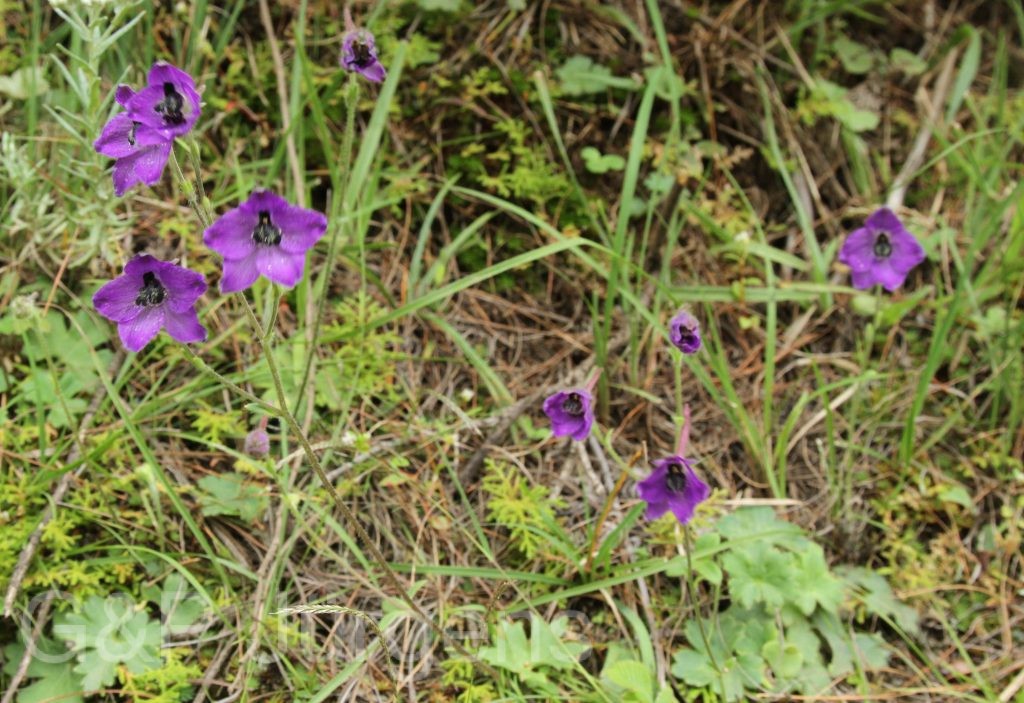
Bhutan2012 184
Bhutan Haar-Valley, 3200m September
Bhutan2012 185
Bhutan Haar-Valley, 3200m September

Description

Delphinium cooperi is a Himalayan larkspur of restricted range, recorded principally from Bhutan and Nepal, with only about 42 GBIF occurrences reflecting its narrow distribution. It grows on open alpine and subalpine slopes, meadow margins and among scrub in cool, moist montane settings. The photographed plant in the Haa (Haar) valley of western Bhutan at 3200 m, flowering in September, captures its late-season anthesis in the high inner valleys, where it occupies humus-rich, well-drained ground in a cool, monsoon-influenced climate. Its limited recorded range marks it as a regional endemic of the eastern Himalaya.

The species is an erect perennial herb arising from a fibrous or somewhat thickened rootstock. The leaves are palmately divided into several cuneate, toothed or further-lobed segments, larger and longer-petiolate toward the base and reduced upward. The inflorescence is a terminal raceme of zygomorphic flowers in shades of blue to violet; as in all Delphinium the upper sepal is prolonged backward into a conspicuous spur that encloses the nectariferous petal spurs. Stamens are numerous and the gynoecium of free carpels matures into a cluster of erect, many-seeded follicles that split along the inner suture to shed angular seeds.

Delphinium belongs to the buttercup family Ranunculaceae, within the tribe Delphinieae characterised by spurred, bilaterally symmetrical flowers. The long-spurred corolla of D. cooperi is adapted to pollination by long-tongued bumblebees that probe the nectar spurs. As with many members of the genus, the plant contains toxic diterpenoid alkaloids that deter grazing. Given its apparently narrow eastern-Himalayan range and modest population records, the species warrants attention as a potentially vulnerable regional endemic dependent on intact subalpine habitat.

Author: Munz · Sources: POWO (Kew), GBIF, Flora of Bhutan, Annotated Checklist of the Flowering Plants of Nepal, Munz Delphinium monograph

Hook.f. & Thomson

Nepal 95 415 G723 ergebnis
Nepal Jaisuli Kund 4200m October

Description

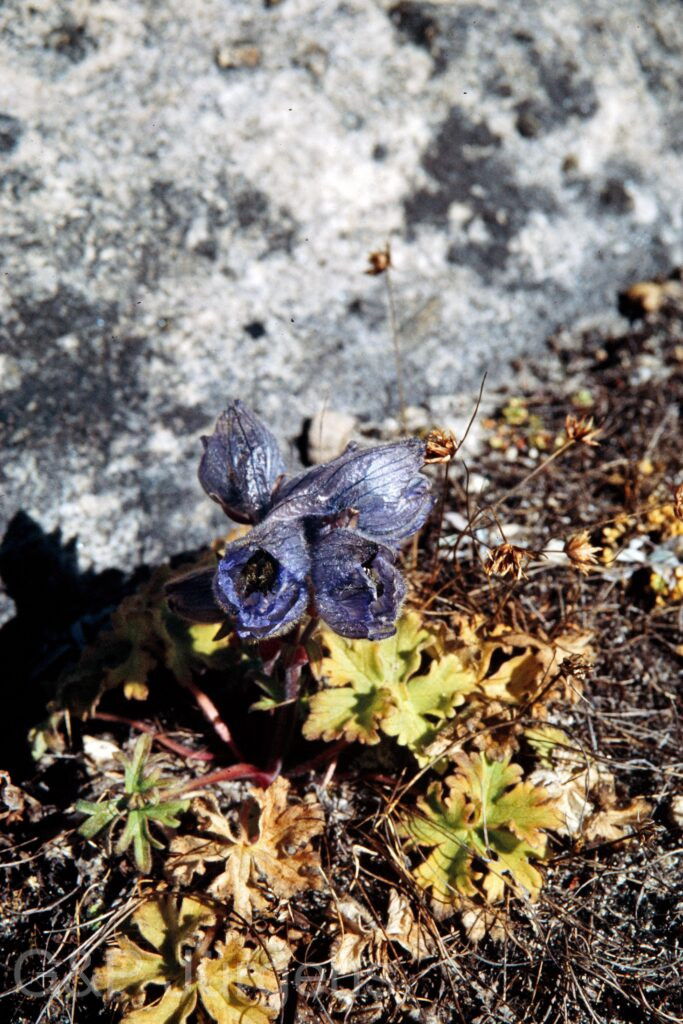
Delphinium glaciale is a high-alpine larkspur distributed across the central and eastern Himalaya, with documented occurrences in Nepal, India, Bhutan and southern Tibet (China); GBIF records some 85 collections from this range. It is a plant of the upper alpine and subnival zones, typically encountered between roughly 4000 and 5000 m on open screes, moraines, glacial forelands and stony alpine turf, as reflected by the population photographed near Jaisuli Kund in Nepal at about 4200 m in October. It tolerates a short growing season, intense insolation and prolonged snow cover.

The species is a dwarf, cushion-forming or compactly tufted perennial herb arising from a stout woody rootstock. Stems are short, ascending and densely covered, like the foliage, in spreading whitish to yellowish hairs that lend the plant a shaggy appearance. The leaves are palmately divided into narrow segments, mostly basal or crowded toward the stem base. The inflorescence is few-flowered and condensed; the zygomorphic flowers are deep blue to violet-blue, the posterior sepal prolonged into a stout spur enclosing two nectariferous petals, the whole densely pubescent externally. The fruit is a cluster of erect, hairy follicles releasing small angular seeds.

Within Delphinium the species belongs to the assemblage of dwarf, glandular- or villous-haired Sino-Himalayan high-alpine larkspurs adapted to glacial habitats, a feature echoed in the epithet glaciale. Its compact habit and dense indumentum are classic adaptations to wind exposure and cold. Like most members of the genus it contains diterpenoid alkaloids and is toxic to livestock. No specific conservation assessment has been published; its restriction to remote subnival terrain confers natural protection, though high-altitude warming and habitat shifts may threaten such narrowly zoned alpine specialists.

Author: Hook.f. & Thomson · Sources: POWO (Kew), GBIF, Flora of Nepal, Flora of Bhutan, Flora of China, Annotated Checklist of the Flowering Plants of Nepal, Munz Monograph of Delphinium