
(Bojer ex. Hook.) Raf.
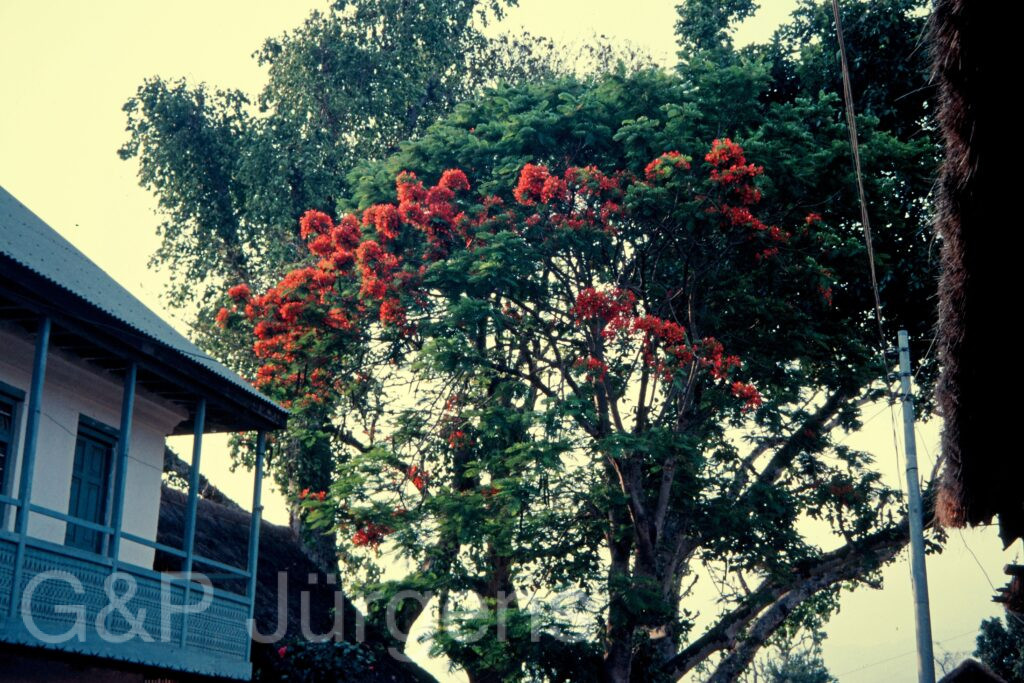
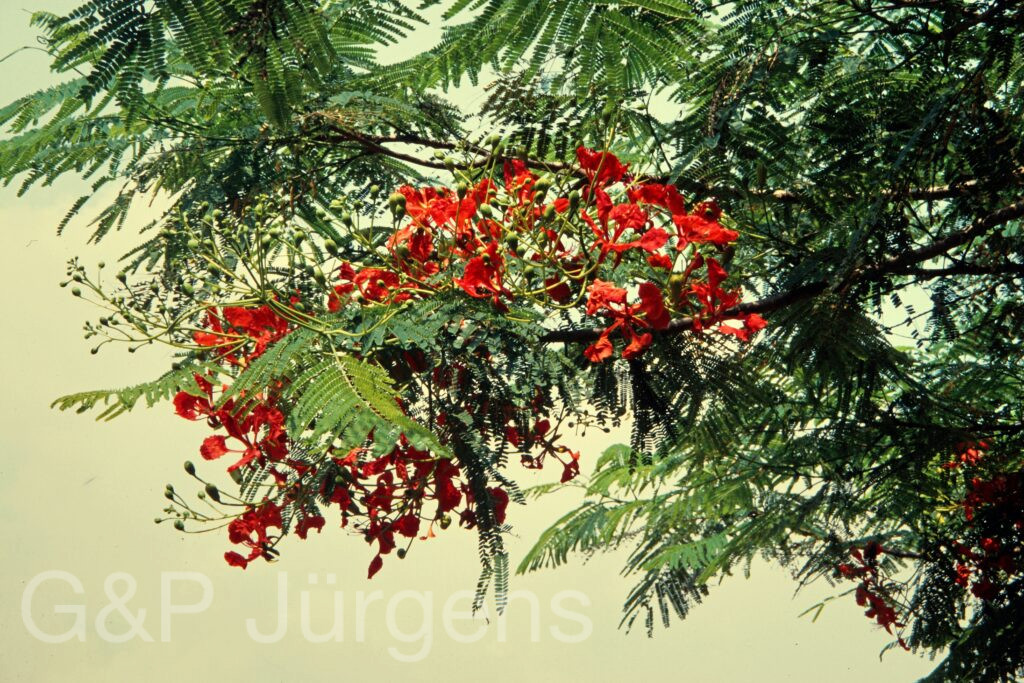
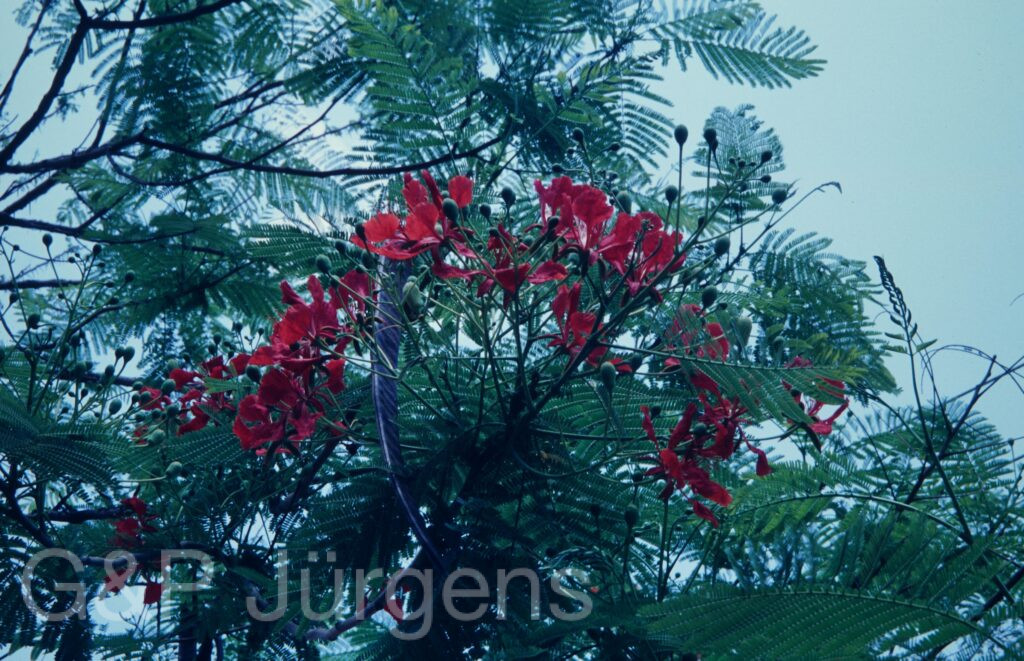
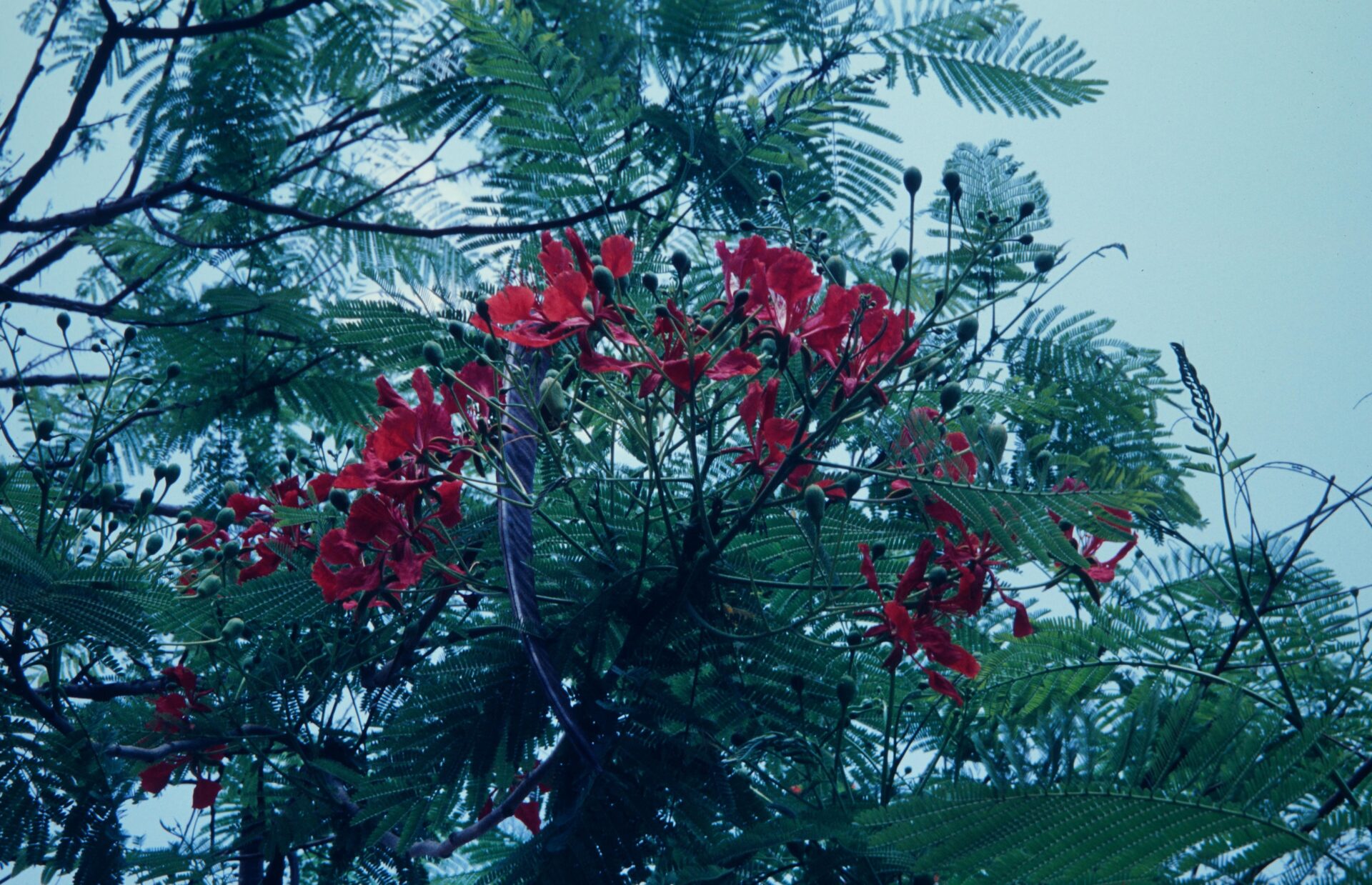
Description
Delonix regia is one of the most widely cultivated ornamental trees of the tropics, native to the deciduous and dry forests of western Madagascar but now naturalised and planted across the warm regions of every continent. GBIF records reflect this pantropical spread, with occurrences across India, Australia, Brazil, Mexico, the United States, Tanzania, Madagascar, Thailand, China, Kenya, South Africa and the Dominican Republic, drawn from more than 27,000 documented collections. In the eastern Himalaya it occurs only as an introduced shade and avenue tree of the warm lowlands and foothills; the photographed material from the Sabha-Khola valley at 1200 m and from Chainpur in East Nepal at around 400 m, flowering in May, lies near the upper altitudinal limit at which the species thrives, requiring frost-free, seasonally dry, sun-exposed sites.
It forms a spreading, umbrella-crowned deciduous tree to 10–15 m, the trunk often buttressed and the bark smooth and grey. The leaves are large, bipinnate and fern-like, with 10–25 pairs of pinnae each bearing numerous small oblong leaflets. The flowers, borne in showy corymbose racemes, are large and zygomorphic with five clawed, spreading petals, four scarlet to orange-red and one larger, whitish or yellow petal streaked with red; the ten stamens are long and exserted with red filaments. The fruit is a large, woody, flattened legume to 60 cm long, persistent and dark brown when ripe, containing numerous hard, mottled seeds.
A member of the Caesalpinioid clade of the Fabaceae, Delonix is a small genus centred on Madagascar and East Africa. Though abundant in cultivation, the species is assessed as of conservation concern in its native range owing to deforestation and a highly restricted wild distribution. Its conspicuous flowering, drought tolerance and nitrogen-fixing capacity have made it a favoured street and amenity tree throughout the tropics, where it is valued equally for shade and ornament.
Author: (Bojer ex. Hook.) Raf. · Sources: POWO (Kew), GBIF, Flora of Nepal, Flora of Madagascar (Flore de Madagascar et des Comores), Legumes of the World (Lewis et al.)